
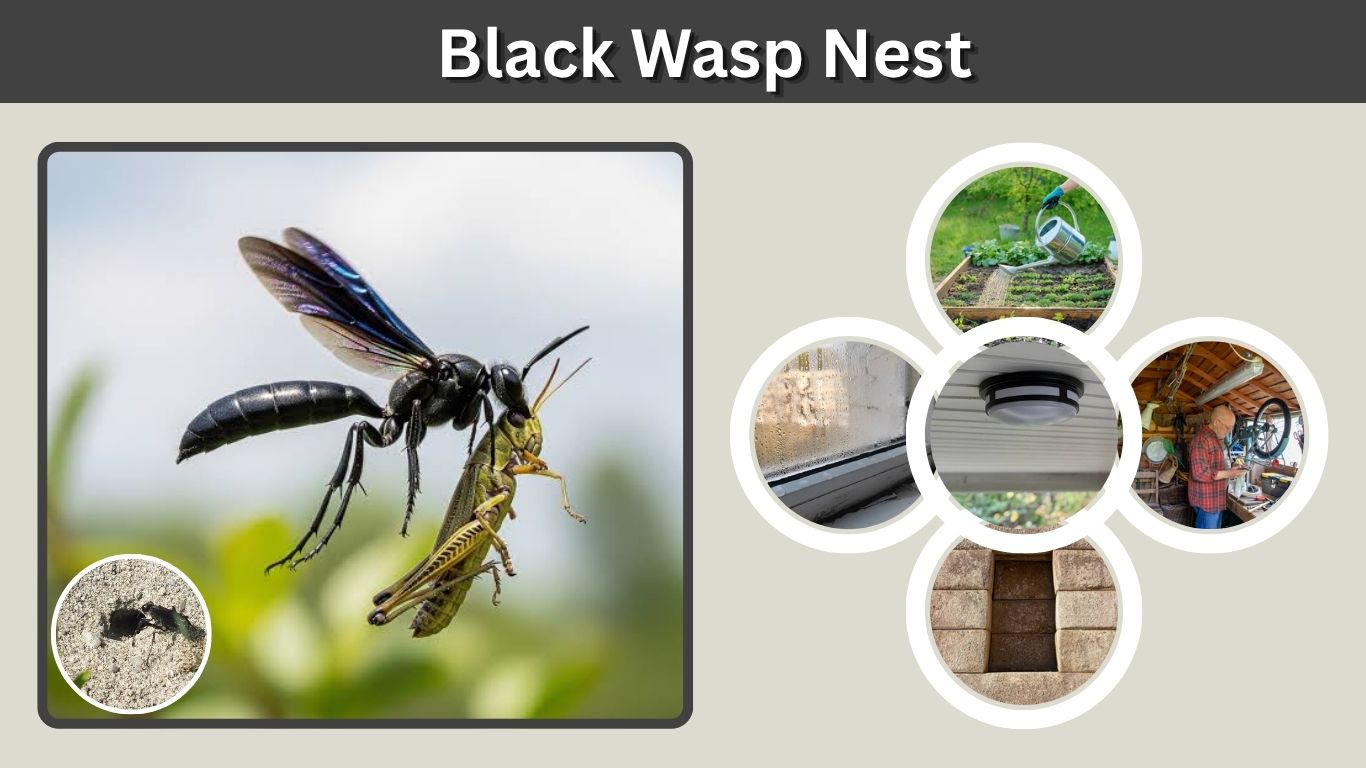
A black wasp nest can look very different depending on the species that built it. A great black wasp usually creates an underground burrow, while black mud daubers use sheltered mud nests and some dark-colored paper wasps build exposed paper combs. Correct identification is important because solitary black wasps are generally far less defensive than social wasps. This guide explains what black wasp nests look like, where to find them, common nest types, potential sting risks, and when removal may be necessary.
What Does a Black Wasp Nest Look Like?
There is no single nest that can officially be called a black wasp nest because many unrelated wasps have mostly black bodies. The nest’s material, location, entrance, and number of wasps are often more useful for identification than color. Great black wasps, mud daubers, mason wasps, and dark paper wasps all use different nesting strategies.
Common Identification Features
Look closely from a safe distance for these clues:
- Hole in soil: Often indicates a digger wasp or another ground-nesting species.
- Mud tubes or cells: Usually associated with mud daubers.
- Small mud chamber: May indicate a potter or mason wasp.
- Open paper comb: Often belongs to a paper wasp.
- Enclosed paper nest: More likely a social hornet or yellowjacket-type wasp.
- Repeated activity from siding: May indicate a nest inside a structural cavity.
The University of Minnesota notes that most solitary wasps nest underground, although some construct mud nests or use cavities in plants and wood.
Number of Wasps Matters
One of the easiest ways to distinguish nest types is to watch traffic around the entrance. Solitary species usually have one female responsible for an individual nest, although many females may build separate nests close together.
By contrast, a steady stream of many wasps entering one opening can indicate a social colony.
Black Wasp Nest Pictures: What to Look For
In pictures of a great black wasp nest, the visible portion is often surprisingly simple. You usually see a round opening surrounded by loose or recently excavated soil. Most of the actual nest remains hidden underground.
That is very different from a mud dauber nest, which appears as hardened mud attached to a protected surface.
Great Black Wasp Nest in the Ground
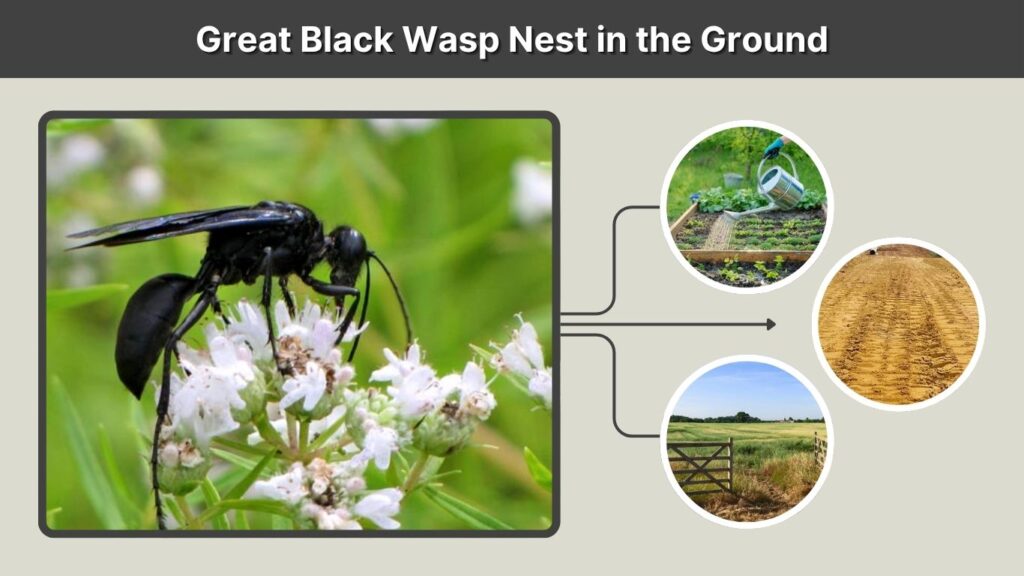
The great black wasp (Sphex pensylvanicus) is one of the insects most commonly associated with searches for black wasp nests. It is a large solitary hunting wasp with an entirely dark body and dark blue-black wings. Despite its intimidating appearance, its nesting behavior differs greatly from that of social yellowjackets or hornets.
Where Great Black Wasps Nest
Great black wasps build their nests in soft soil, especially in fields and gardens. Adults can reach nearly 1½ inches long, making them particularly noticeable when they fly close to the ground.
Suitable nesting locations can include:
- Garden beds
- Open fields
- Loose or sandy soil
- Bare areas around landscaping
- Sunny patches of ground
- Areas with relatively easy-to-excavate soil
What Does a Great Black Wasp Nest Look Like?
Above ground, the nest generally appears as a hole leading into a subterranean burrow. The female excavates the soil and creates protected chambers below the surface.
The entire structure cannot normally be seen without disturbing the ground, so identifying it usually depends on seeing the female entering or leaving the opening.
What Is Inside the Nest?
Great black wasps are hunters. Females capture and paralyze katydids and carry them into their underground nests as food for developing larvae.
The female places prey within a nest chamber and lays an egg. The larva later feeds on the stored prey while developing safely underground.
Other Types of Black Wasp Nests
Not every large or small black wasp emerging around a house is a great black wasp. Several groups contain dark species, and their nesting habits can immediately point toward a different identification. Examining whether a nest consists of soil, mud, paper, or an existing cavity can therefore narrow the possibilities considerably.
Black Mud Dauber Nest
Mud daubers construct or reuse nests made from mud. These nests are usually attached to dry, protected surfaces rather than buried underground.
Common locations include:
- Beneath roof eaves
- Inside sheds
- Under porches
- Garages
- Barns
- Protected wall corners
Black-and-yellow mud daubers construct cylindrical mud cells under sheltered surfaces, while the metallic blue-black blue mud dauber can renovate existing mud-dauber nests.
Black Paper Wasp Nest
Paper wasps build nests from chewed wood fibers mixed with saliva. Their nests typically contain exposed hexagonal cells and may hang from a narrow stalk.
Paper nests can occur beneath eaves, branches, porch ceilings, sheds, and other protected surfaces. Social wasps can defend their colonies more aggressively than solitary digger or mud-dauber wasps, so nests should not be approached unnecessarily.
Black Mason or Potter Wasp Nest
Many mason and potter wasps are solitary. Depending on the species, females may use existing holes or construct small mud or clay cells.
The nest may occur in:
- Hollow plant stems
- Existing holes in wood
- Old insect burrows
- Abandoned mud nests
- Small protected cavities
These nests can easily be mistaken for mud-dauber nests because both groups incorporate mud or similar material.
Where to Find a Black Wasp Nest
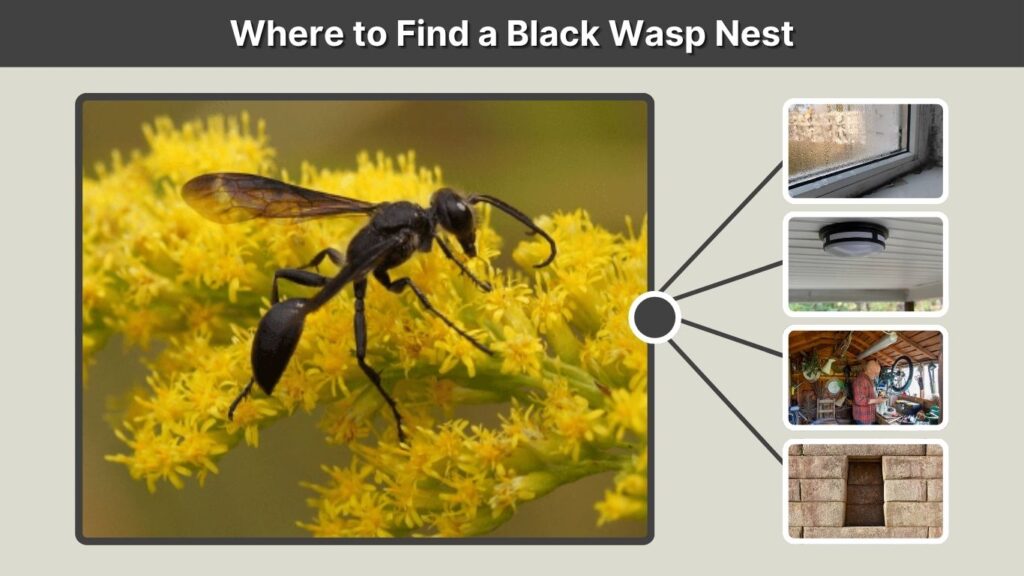
Finding the nesting location is usually easier when you watch the wasp’s behavior rather than trying to follow it continuously. Observe from several feet away and note whether the insect repeatedly disappears into soil, beneath siding, behind trim, or into a mud structure.
Black Wasp Nest on a House
Around buildings, check common sheltered locations such as:
- Eaves and roof overhangs
- Window frames
- Porch ceilings
- Garages and sheds
- Gaps beneath trim
- Exterior wall cavities
- Attics or vents
- Abandoned mud nests
Mud daubers frequently use protected building sites, and blue mud daubers may also nest within cavities in buildings.
Black Wasp Nest in Siding
Repeated activity at the same siding gap deserves closer attention. Several types of wasps can exploit existing openings.
Do not assume that every wasp disappearing behind siding has constructed a visible nest directly at the entrance. The actual nesting chamber may be deeper within the void.
If numerous wasps are continuously using one opening, professional identification is sensible before sealing or disturbing the area.
Black Wasp Nest in a Tree
A wasp entering a tree cavity may simply be using an existing hollow. Social wasps can establish paper nests in protected tree cavities, whereas some solitary species use naturally occurring holes.
A visible hanging paper nest is more characteristic of certain social wasps than of a great black wasp.
Are Black Wasp Nests Dangerous?
Risk depends much more on species and social behavior than on whether the insect is black. Great black wasps are solitary, and each female manages her own nest. Solitary hunting wasps are generally unlikely to defend nesting areas as intensely as colony-forming social wasps.
Will a Great Black Wasp Sting?
Female great black wasps have functional stingers because they use venom to immobilize prey. However, their main purpose is hunting rather than defending hundreds of nestmates.
Stinging becomes more likely if a female is grabbed, stepped on, trapped against clothing, or otherwise directly threatened.
When a Nest Requires More Caution
Use additional caution when you notice large numbers of wasps repeatedly entering one entrance. This can suggest a social species whose workers may defend their colony.
Also avoid disturbing any unidentified nest when someone nearby has a known severe insect-sting allergy.
How to Get Rid of a Black Wasp Nest Safely
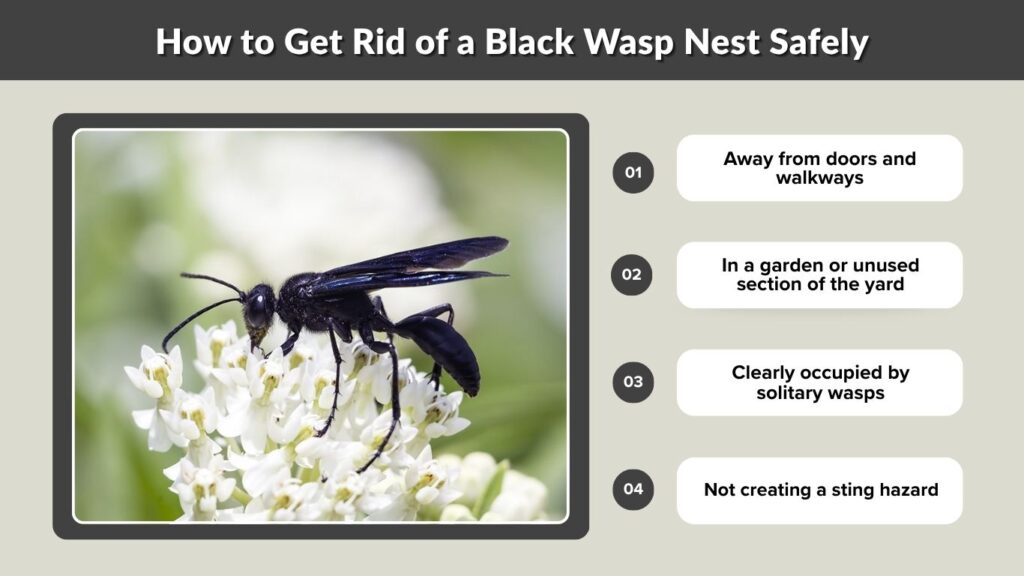
Not every black wasp nest needs to be destroyed. Solitary wasps are important predators of insects and other arthropods, and many remain active around their nests only temporarily. University of Maryland Extension recommends recognizing whether wasps are solitary or social before deciding whether control is necessary.
When You Can Leave the Nest Alone
A nest can often remain undisturbed when it is:
- Away from doors and walkways
- In a garden or unused section of the yard
- Clearly occupied by solitary wasps
- Not creating a sting hazard
- Only seasonally active
When Removal Makes Sense
Removal may be appropriate when a nest occurs next to an entrance, children’s play space, frequently used patio, or another location where people cannot reasonably avoid it.
An active colony inside siding, walls, or other inaccessible areas is also better evaluated before attempting removal.
Preventing Future Nesting
After the nest is inactive, reduce future problems by repairing openings in siding, window frames, screens, soffits, and other exterior gaps.
For ground-nesting solitary wasps, improving vegetation coverage can make bare soil less attractive. Some ground-nesting species favor sunny, exposed, well-drained soil.
Black Wasp Nest vs. Social Wasp Nest
A great black wasp ground nest usually belongs to one female even when several separate burrows occur close together. Social species operate differently. Many workers may share one colony and repeatedly use the same entrance.
Solitary Black Wasp
Great black wasps, mud daubers, and many mason wasps generally work independently. Their nests contain individual brood chambers supplied with prey.
Social Wasp
Paper wasps, yellowjackets, and hornets live in colonies. Their paper-based nests contain many developing larvae and can grow substantially during the warmer months. Social wasp colonies may contain hundreds of individuals later in the season.
Correct identification is therefore far more useful than simply describing the insects as “black wasps.”
FAQs
What does a black wasp nest look like?
It depends on the species. Great black wasps create underground burrows, mud daubers construct hardened mud cells, and dark paper wasps make exposed paper combs. Watching where the wasp enters is often the easiest way to identify the nest type.
Where does a great black wasp build its nest?
Great black wasps typically nest in soft soil in gardens, fields, and similar open areas. The nest consists of an underground burrow containing chambers for developing young.
Are great black wasp nests dangerous?
They are generally less concerning than social wasp colonies because great black wasps are solitary. Females can sting, however, so nests and individual wasps should still be left undisturbed.
Why are black wasps going into my siding?
They may be using an existing structural gap or cavity for nesting. Because both solitary and social species can enter buildings, observe the number of wasps and have an active nest identified before sealing the opening.
Should I remove a black wasp nest?
Not necessarily. A solitary nest located away from people can often be left alone. Removal becomes more reasonable when the nest creates unavoidable contact, occurs inside a building, or belongs to a defensive social species.
