
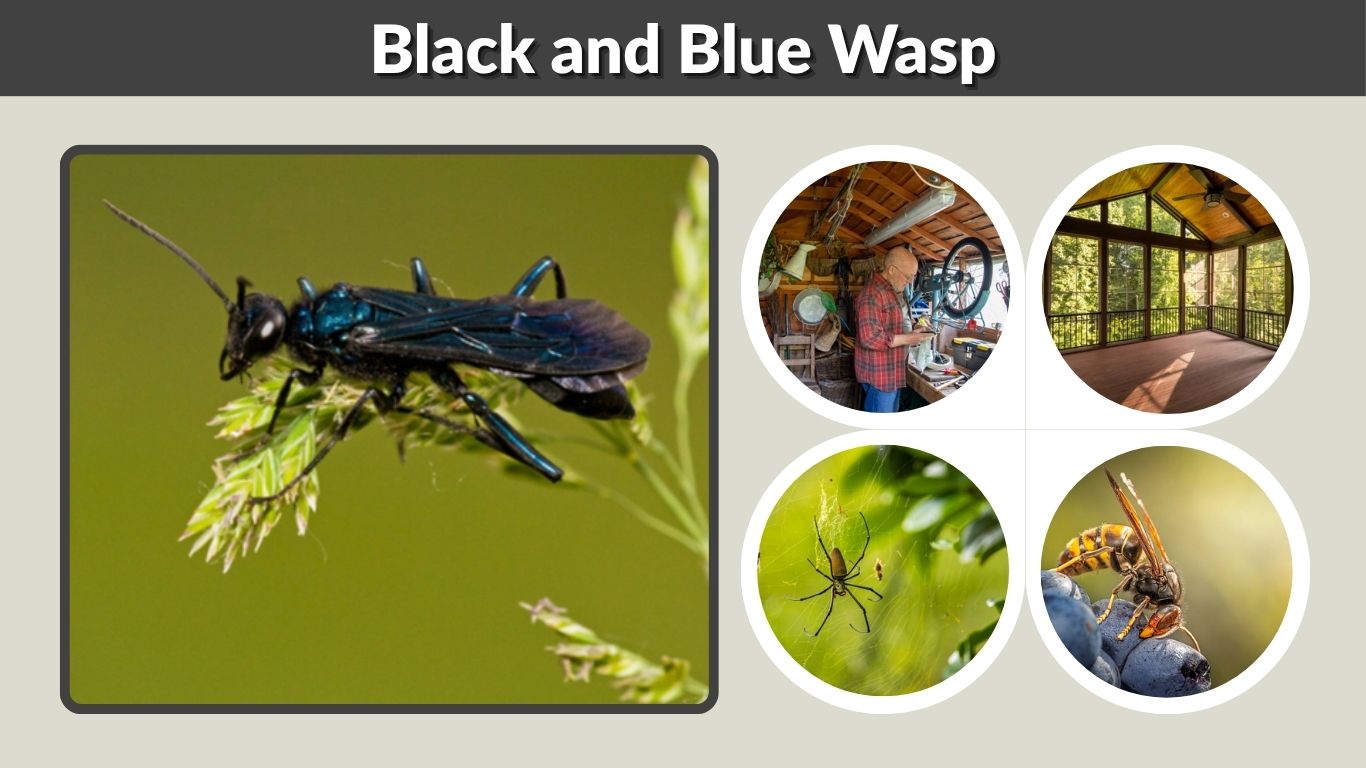
A black and blue wasp is usually a dark-bodied wasp with metallic blue, violet, or iridescent coloring. In North America, one of the most likely matches is the blue mud dauber, Chalybion californicum. However, great black wasps and steel-blue cricket-hunter wasps can also look similar. Most of these striking wasps are solitary hunters rather than aggressive social wasps. This guide explains how to identify a blue and black wasp, where it nests, whether it stings, and how to distinguish common look-alikes.
What Is a Black and Blue Wasp?
“Black and blue wasp” is a descriptive term rather than the official common name of one particular species. People commonly use it for wasps whose bodies appear black in shade but shine metallic blue or violet in sunlight. In much of North America, the description frequently fits blue mud daubers, although several other solitary wasps have similar coloration.
Blue Mud Dauber
The blue mud dauber (Chalybion californicum) is one of the strongest matches for a shiny black and blue wasp. Adults have a slender body, narrow waist, long legs, and metallic blue-black coloration. Their wings may also show blue or violet iridescence.
Individuals are generally about 10–23 mm long, although apparent size varies depending on sex and viewing angle. University of Minnesota Extension describes these wasps as roughly three-quarters of an inch to an inch long.
Why Does the Wasp Look Blue and Black?
The blue appearance is largely caused by the way light interacts with the surface of the wasp’s body. Depending on lighting and viewing angle, the same individual may look:
- Metallic blue or steel blue
- Blue-black or nearly black
- Violet or purple-blue
- Shiny dark blue
- Greenish-blue in bright sunlight
This explains why people may describe the same insect as a black and blue wasp, blue and black wasp, or black and iridescent blue wasp.
Identifying Features
Look for a combination of:
- Metallic blue-black body
- Narrow, thread-like waist
- Long dark legs
- Dark or iridescent wings
- Slender abdomen
- Relatively smooth, shiny appearance
- Approximately 3/4 to 1 inch body length
Color alone should not be used for identification because several unrelated wasps can appear blue-black.
Black and Blue Wasp Look-Alikes
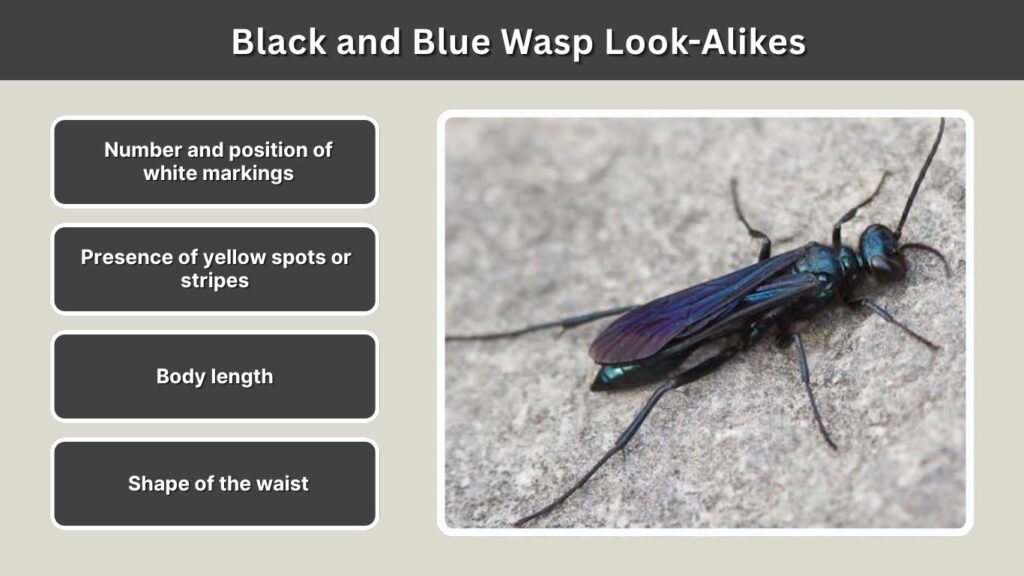
Several insects can easily be confused with the blue mud dauber. Body size, shape, wings, nesting behavior, and prey can help narrow down the identification. This is particularly important when identifying a large black and blue wasp, because larger species may belong to a completely different genus.
Great Black Wasp
The great black wasp (Sphex pensylvanicus) is considerably larger. It has a mostly black body and wings that may appear dark blue or iridescent.
University of Minnesota Extension notes that great black wasps can reach nearly 1½ inches long. Unlike blue mud daubers, they build nests in soil and provision them primarily with katydids.
Steel-Blue Cricket-Hunter Wasp
The steel-blue cricket-hunter, Chlorion aerarium, is another metallic species that can resemble a blue mud dauber. It typically has a metallic blue-green body and hunts crickets.
Distinguishing these insects from Chalybion can be difficult from color alone. Blue mud daubers generally appear hairier around the head and thorax and have somewhat different body proportions.
Black and White Wasp With Blue Wings
A black and white wasp with blue wings may not be a blue mud dauber at all. White, cream, or yellow abdominal markings suggest another species.
Important identification clues include:
- Number and position of white markings
- Presence of yellow spots or stripes
- Body length
- Shape of the waist
- Whether it nests underground or in mud
- Whether the body itself is metallic blue
Close-up photographs are much more reliable than wing color alone.
Where Do Black and Blue Wasps Live?
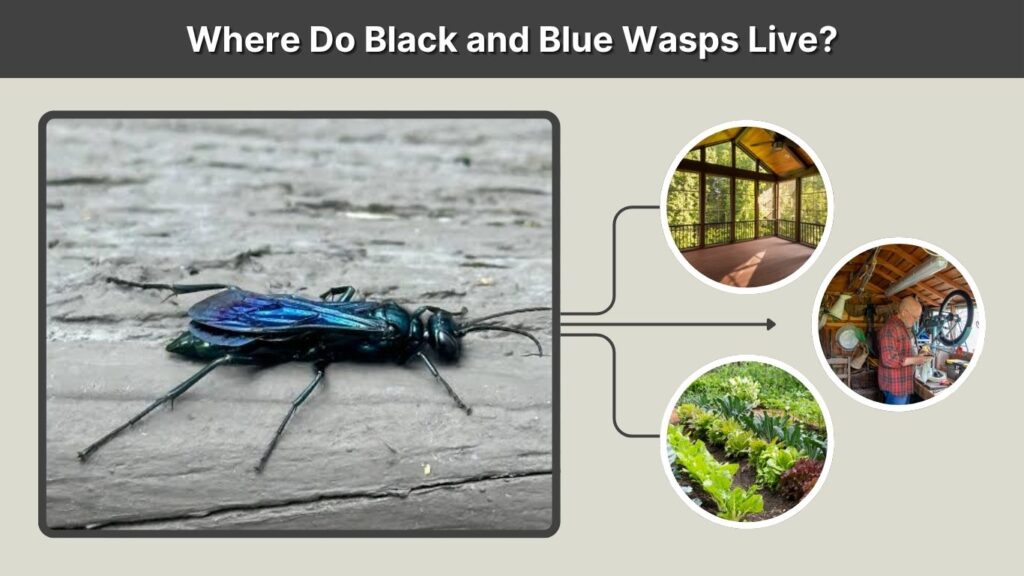
Blue mud daubers occur widely in North America and are commonly encountered around gardens, flowering plants, buildings, and places where suitable nesting cavities occur. Searches for black and blue wasps in Texas, Illinois, Michigan, Minnesota, Ohio, Pennsylvania, New York, Wisconsin, and other states can therefore involve the same or closely related species.
Around Homes
A blue and black wasp may appear around houses because structures provide sheltered places for nests.
Common locations include:
- Porches and covered areas
- Garages and sheds
- Barns and outbuildings
- Wall cavities and protected openings
- Around old mud-dauber nests
- Near gardens and flowering plants
Finding one around a structure does not automatically indicate a large colony.
In Gardens
Adults visit flowers for nectar, so they may be noticed moving rapidly among flowering plants. Gardens also provide spiders, which female blue mud daubers collect for their larvae.
Seasonal Activity
In colder parts of North America, adults are mainly noticed during warmer months. University of Minnesota Extension lists blue mud daubers as active primarily from late spring through summer in Minnesota. Timing can differ considerably in warmer climates.
Black and Blue Wasp Nesting Habits
The nest is one of the best clues for separating blue mud daubers from similar insects. Despite their name, blue mud daubers often do not start an elaborate mud structure from scratch. Females frequently renovate or reuse suitable existing mud nests and cavities.
What Does a Black and Blue Wasp Nest Look Like?
Blue mud daubers commonly reuse nests built by other mud-dauber species. A female can carry water to dried mud, soften it, and remodel the structure.
They may use:
- Existing mud-dauber nests
- Protected building cavities
- Hollow spaces
- Sheltered cracks
- Hollow plant stems
University of Minnesota Extension notes that the species may renovate old black-and-yellow mud-dauber nests rather than construct an entirely new structure.
Are They Ground Wasps?
Blue mud daubers are not normally considered typical ground-nesting wasps. If you see a large black and blue wasp repeatedly entering a hole in soil, consider other possibilities, including great black wasps or other solitary ground-nesting species.
Do They Form Colonies?
Blue mud daubers are solitary wasps. Each female manages her own nesting activities rather than participating in the organized colonies associated with yellowjackets or hornets.
Several adults can sometimes occur in the same favorable area, but their presence does not necessarily mean there is a social colony.
What Do Black and Blue Wasps Eat?
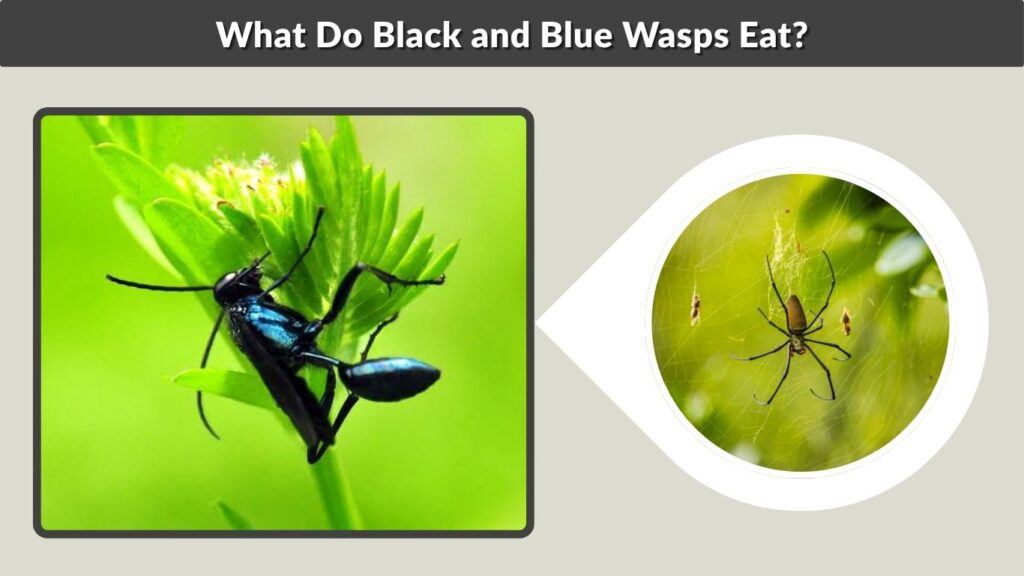
Adult blue mud daubers primarily obtain energy from flower nectar. Females are also skilled predators because they must collect food for developing larvae. Their hunting behavior is one reason these wasps can be useful members of garden ecosystems.
Adults and Larvae
Adult and immature wasps have different diets.
- Adults: mainly consume nectar.
- Females: hunt spiders for their nests.
- Larvae: consume spiders supplied by the female.
- Prey: can include orb-weavers and cobweb spiders.
Do Blue Mud Daubers Kill Spiders?
Yes. A female locates a spider and uses her sting to immobilize it. She then transports the prey to a nest cell where it becomes food for her developing offspring.
Interestingly, blue mud daubers are known to prey on several spiders, including black widow spiders.
Are They Beneficial?
They can be beneficial around gardens because they naturally hunt spiders while adults also visit flowers. Their solitary lifestyle generally produces fewer conflicts with people than highly defensive social wasps.
Does a Black and Blue Wasp Sting?
A black and blue wasp sting is possible, but blue mud daubers are generally considered nonaggressive toward people. Their sting is primarily a hunting tool used by females to immobilize spiders rather than a defense mechanism for a large communal colony.
Will a Blue and Black Wasp Attack You?
Normally, no. A blue mud dauber flying around flowers or a building usually has little interest in people.
A sting is more likely when the insect is:
- Grabbed with bare hands
- Trapped against clothing
- Stepped on accidentally
- Handled around its nest
- Repeatedly disturbed
Extension information describes blue mud daubers as nonaggressive and notes that human stings are uncommon.
What Should You Do After a Sting?
For an uncomplicated wasp sting, wash the area and use a cold compress to help reduce discomfort and swelling. Avoid scratching the site.
Seek urgent medical assistance if symptoms such as difficulty breathing, swelling of the throat or tongue, widespread hives, faintness, or other signs of a severe allergic reaction develop.
Are They Dangerous?
For most people, simply seeing one does not indicate a serious danger. Problems are more likely when someone attempts to capture, crush, or handle the insect.
Giving the wasp space is generally the easiest way to avoid being stung.
Black and Blue Wasp vs. Hornet
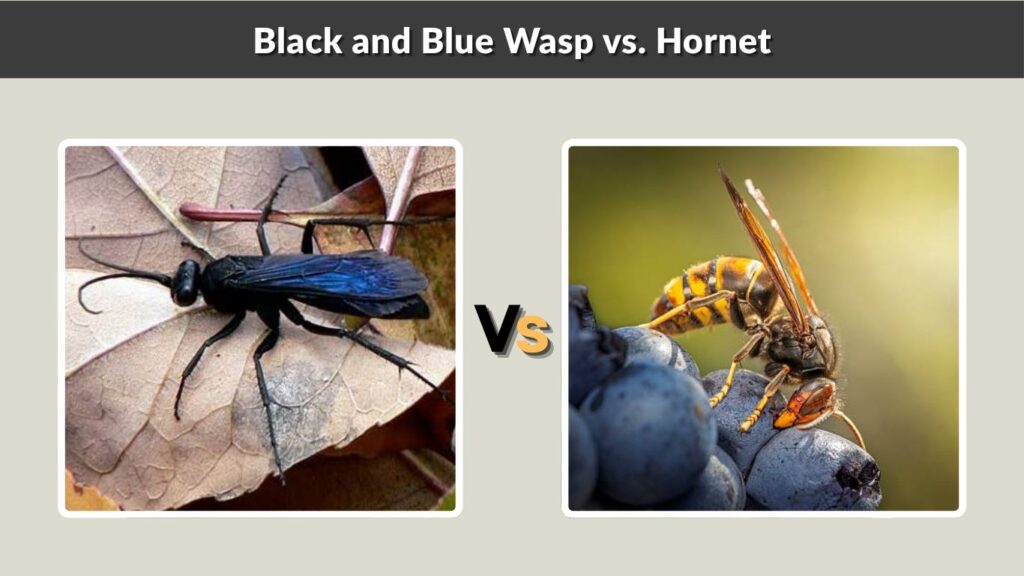
A shiny wasp’s large size can sometimes cause people to describe it as a black and blue hornet. However, metallic blue coloration does not automatically indicate a hornet. True hornets are social wasps in the genus Vespa, whereas blue mud daubers and great black wasps have very different nesting and hunting behaviors.
Body Shape
Blue mud daubers typically have a particularly narrow connection between the thorax and abdomen. Their long legs and slim body create a more delicate appearance than that of a robust hornet.
Nest Structure
Social hornets build colonies containing many workers. Blue mud daubers are solitary and use individual nest cells for their offspring.
This difference in social behavior helps explain why blue mud daubers usually show much less defensive behavior around their nests.
Identification at a Glance
If the insect is shiny blue-black, has a very narrow waist, is around an inch long, and appears around old mud nests, a blue mud dauber is a strong possibility. A much larger black insect coming from a hole in soil may instead be a great black wasp.
Should You Get Rid of Black and Blue Wasps?
In many situations, removal is unnecessary. A solitary blue mud dauber outdoors poses relatively little risk when left undisturbed and can contribute to natural control of spider populations.
When You Can Leave Them Alone
Consider leaving the wasp undisturbed when:
- The nest is away from frequently used areas.
- Nobody nearby has a serious sting allergy.
- Wasps are simply visiting flowers.
- The insect is not entering indoor living spaces.
When Removal May Be Necessary
Management becomes more reasonable when a nest is located directly beside a doorway, children’s play area, frequently used patio, or another location where accidental contact is unavoidable.
Before treating a nest, confirm the species whenever possible. Social yellowjackets, hornets, solitary mud daubers, and ground-nesting wasps require different approaches.
Preventing Future Nesting
Seal unnecessary openings around buildings after confirming they are no longer occupied. Repair screens and gaps, and remove abandoned mud nests when appropriate. Keeping sheltered structural areas in good condition can reduce opportunities for repeated nesting.
FAQs
What is a black and blue wasp?
The term usually describes a wasp with metallic blue-black coloration rather than one specific species. In North America, the blue mud dauber (Chalybion californicum) is a common match.
Are black and blue wasps poisonous?
They are venomous rather than poisonous because females can inject venom through a sting. Blue mud daubers primarily use their venom to paralyze spiders and rarely sting people unless disturbed.
What is a big black and blue wasp?
A particularly large specimen may be a great black wasp rather than a blue mud dauber. Great black wasps can approach 1½ inches long and have dark wings with a bluish appearance.
Where does a black and blue wasp build its nest?
Blue mud daubers often use protected cavities or renovate old mud-dauber nests around buildings. A black-and-blue wasp nesting in soil may represent another solitary species.
Is a black and blue wasp beneficial?
Yes. Blue mud daubers are generally considered beneficial predators. Females hunt spiders to provision their offspring, while adults visit flowers for nectar.
