
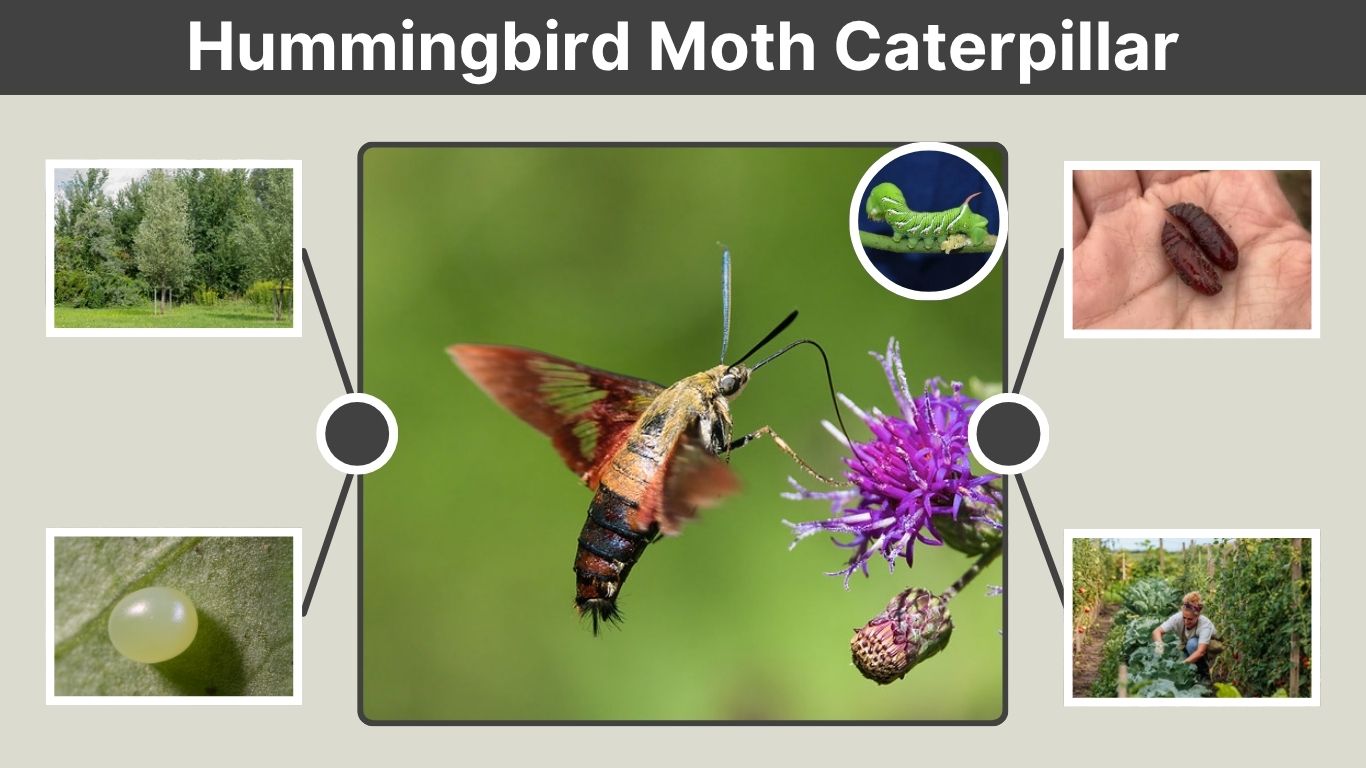
A hummingbird moth caterpillar can be surprisingly difficult to identify because several sphinx and hawk moth larvae share the same green body and distinctive rear horn. Depending on the species and location, “hummingbird moth” may refer to hummingbird clearwings, snowberry clearwings, hummingbird hawk-moths, or other hovering sphinx moths. Learning their markings, host plants, size, and life cycle makes identification much easier. This guide explains what hummingbird moth caterpillars look like, what they eat, whether they are dangerous, and how they differ from tomato hornworms.
What Is a Hummingbird Moth Caterpillar?
A hummingbird moth caterpillar is the larval stage of certain moths in the sphinx moth family, Sphingidae. The name covers more than one species rather than a single universal caterpillar. In North America, the hummingbird clearwing (Hemaris thysbe) is a familiar example, while the hummingbird hawk-moth (Macroglossum stellatarum) is especially well known in Europe.
What Caterpillar Turns Into a Hummingbird Moth?
Hummingbird clearwing caterpillars eventually become fast-flying moths with partly transparent wings that hover around flowers while drinking nectar. Adults resemble tiny hummingbirds or large bees when seen from a distance.
However, the term “hummingbird moth” is also used informally for other sphinx moths that hover while feeding. This explains why online pictures of hummingbird moth caterpillars can look quite different from one another.
The hummingbird clearwing is Hemaris thysbe, while the snowberry clearwing is Hemaris diffinis. The European hummingbird hawk-moth is Macroglossum stellatarum. Correct identification therefore requires considering both the caterpillar’s appearance and its host plant.
What Does a Hummingbird Moth Caterpillar Look Like?
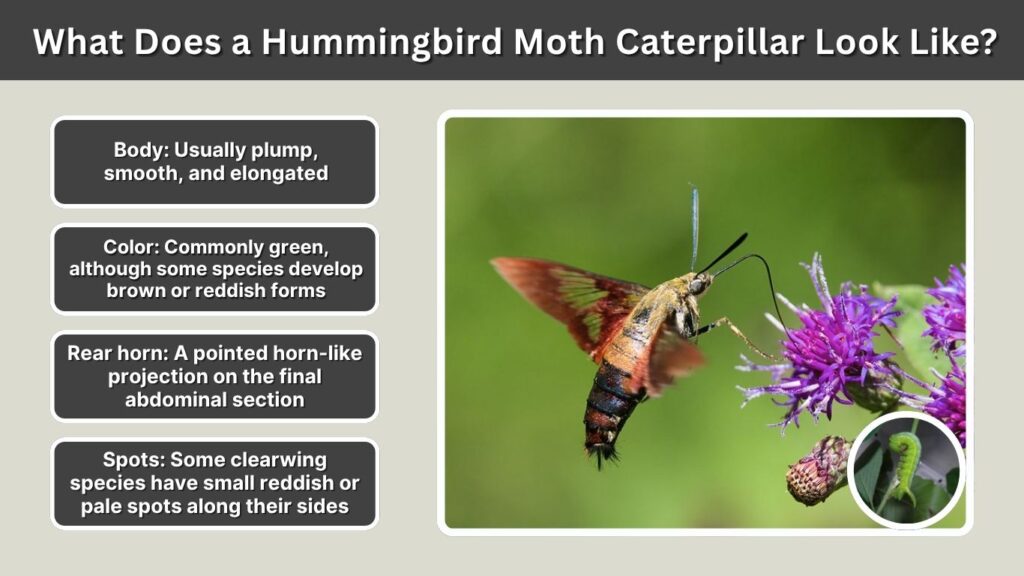
Most hummingbird moth caterpillars have the classic appearance of sphinx moth larvae: a thick, elongated body, several pairs of abdominal prolegs, and a noticeable horn or projection near the rear. Color can change as the caterpillar grows, so photographs of the same species may show individuals ranging from bright green to yellowish, reddish, or brownish forms.
Key Identification Features
Look for several characteristics rather than relying on color alone:
- Body: Usually plump, smooth, and elongated
- Color: Commonly green, although some species develop brown or reddish forms
- Rear horn: A pointed horn-like projection on the final abdominal section
- Spots: Some clearwing species have small reddish or pale spots along their sides
- Texture: Many appear finely dotted or granular when viewed closely
- Legs: Small true legs near the head with fleshy prolegs farther down the body
- Behavior: Usually remains on or near its larval host plant
- Camouflage: Green coloration allows it to blend closely with leaves
The rear horn can appear intimidating, but it is not a stinger. Butterflies and Moths of North America notes that this characteristic horn of sphinx moth larvae is harmless.
Hummingbird Moth Caterpillar Host Plants and Food
Hummingbird moth caterpillars eat leaves rather than flower nectar. Their exact diet depends heavily on species. Knowing which plant a caterpillar is feeding on is therefore one of the most useful identification clues. Adult hummingbird moths may visit dozens of flowers, but caterpillars tend to have a much narrower range of suitable host plants.
Common Host Plants
For the North American hummingbird clearwing, recorded caterpillar host plants include:
- Honeysuckle (Lonicera)
- Snowberry (Symphoricarpos)
- Hawthorn (Crataegus)
- Cherry and plum (Prunus)
- European cranberry bush (Viburnum opulus)
The hummingbird hawk-moth has a different diet. Its larvae primarily use bedstraws such as Galium species, including hedge bedstraw and lady’s bedstraw, as well as related plants such as wild madder.
This difference illustrates why a caterpillar’s food plant can often narrow identification more effectively than body color alone.
Hummingbird Moth Caterpillar Life Cycle
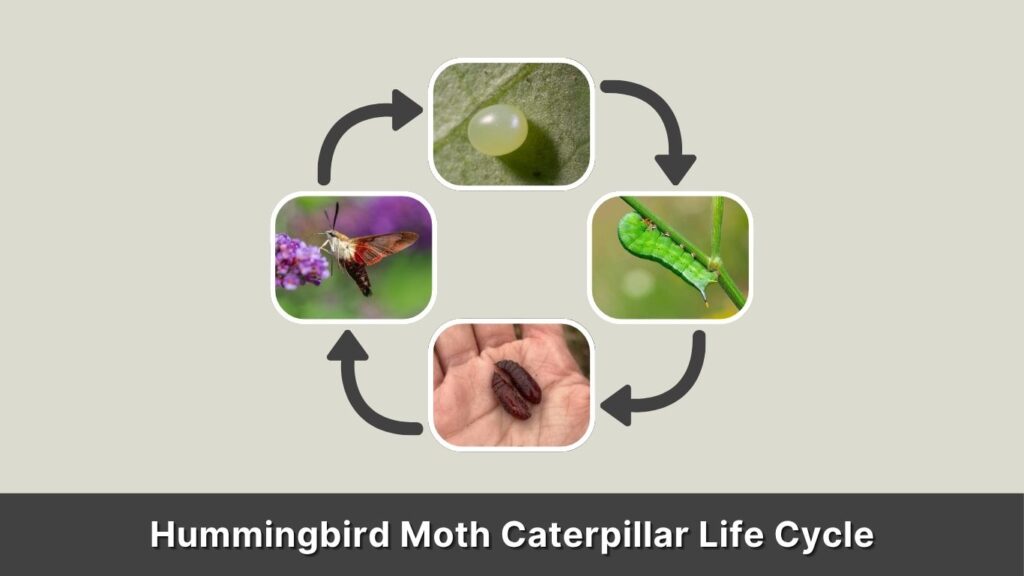
Like other moths, hummingbird moths undergo complete metamorphosis through egg, larva, pupa, and adult stages. The amount of time spent in each stage varies with species, temperature, season, and geographic location. Caterpillars focus primarily on feeding and growing before leaving their host plant or moving into protected material where they can pupate.
From Caterpillar to Hummingbird Moth
After hatching, the tiny caterpillar begins feeding on its host plant and passes through several growth stages called instars. Each time its outer skin becomes too small, the larva molts and continues growing.
Once mature, hummingbird clearwing caterpillars form cocoons at the soil surface. The European hummingbird hawk-moth typically pupates just below the soil or among material near ground level.
Inside the pupal stage, the insect undergoes its dramatic transformation. The emerging adult no longer resembles the caterpillar. It develops wings, a long nectar-feeding proboscis, and the rapid hovering flight responsible for the “hummingbird” name.
Hummingbird Moth Caterpillar vs Tomato Hornworm
Confusion between hummingbird moth caterpillars and tomato hornworms is understandable because both belong to the sphinx moth family and may have prominent rear horns. A tomato hornworm, however, refers specifically to Manduca quinquemaculata, whose adult is the five-spotted hawkmoth. It is not the same species as a hummingbird clearwing caterpillar.
How to Tell Them Apart
Several features can help separate them:
- Tomato hornworm: Can reach about four inches long
- Tomato hornworm markings: Usually has eight pale V-shaped markings along each side
- Tomato hornworm host plants: Commonly tomato, potato, pepper, eggplant, and related nightshades
- Hummingbird clearwing: Generally associated with plants such as honeysuckle, snowberry, hawthorn, cherry, plum, and viburnum
- Adult tomato hornworm: Becomes the large five-spotted hawkmoth
- Adult hummingbird clearwing: Becomes a clear-winged, day-flying moth that strongly resembles a hummingbird or bumblebee
Tomato hornworms can remove substantial amounts of foliage from garden plants, whereas finding a clearwing caterpillar on one of its natural host shrubs is usually a normal part of the local ecosystem.
Are Hummingbird Moth Caterpillars Dangerous?
Their size and tail horn can make these caterpillars look threatening, particularly when viewed up close. Despite that appearance, the characteristic horn is defensive-looking rather than a venom-delivery structure. These larvae are primarily plant feeders and generally rely on camouflage, remaining still among foliage rather than attacking animals or people.
Do Hummingbird Moth Caterpillars Bite or Sting?
Hummingbird moth caterpillars are not equipped with a stinging tail. The “horn” is simply part of their body and cannot inject venom. Butterflies and Moths of North America specifically describes the horn found on sphinx moth caterpillars as harmless.
They should still be handled gently, if handling is necessary at all. Caterpillars are delicate, and unnecessary handling can injure them. Leaving an unidentified caterpillar on its host plant is often the simplest approach unless it is causing significant crop damage.
Where Are Hummingbird Moth Caterpillars Found?
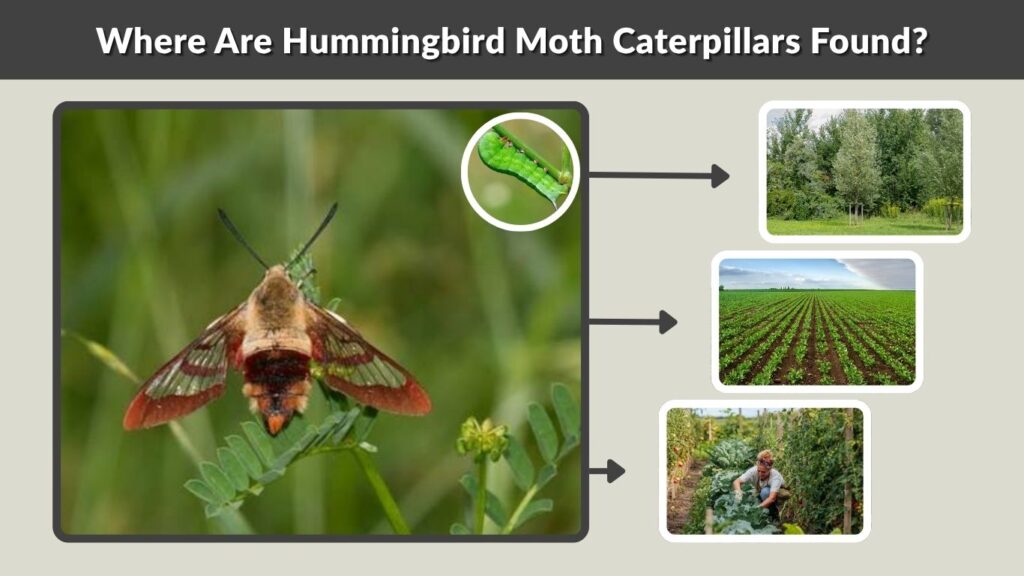
Location also helps determine which species you have found. Hummingbird clearwings occur across a broad portion of North America, while the hummingbird hawk-moth is familiar across Europe and other parts of its wider range. Caterpillars are most likely to be noticed wherever their required host plants grow, including gardens, woodland edges, fields, and suburban habitats.
North America, the UK, and Gardens
The hummingbird clearing ranges widely through Canada and the United States, including areas extending south to Florida and Texas. It occurs in gardens, suburbs, and open or second-growth habitats.
In the UK, searches for “hummingbird moth caterpillar” frequently refer to the hummingbird hawk-moth. Its larvae feed especially on bedstraw, and adult records are concentrated heavily through the warmer months.
Therefore, a green horned caterpillar in Texas, Ontario, California, Pennsylvania, or the UK should not automatically be assumed to be the same species.
What Should You Do If You Find One?
Finding a hummingbird moth caterpillar usually provides an opportunity to observe part of a fascinating moth life cycle. Before moving it, identify the plant on which it was feeding and photograph the caterpillar from several angles. Host plant, geographic location, side markings, horn shape, and body coloration can collectively provide a much more reliable identification.
Caring for a Caterpillar in the Garden
If the caterpillar is on a non-crop host plant and is not causing serious damage, leaving it where it was found generally allows it to continue its natural development.
Avoid relocating it randomly to a different plant. Many caterpillars cannot simply eat any available leaf. If movement is necessary, placing it on the same species of host plant nearby gives it a better chance of continuing to feed.
Also avoid unnecessary pesticide use around known host plants if your goal is to encourage hummingbird moths and other beneficial pollinating insects.
FAQs
Hummingbird moth caterpillars generate many questions because their horned appearance resembles other large garden caterpillars. The most important points are that several moth species may be called hummingbird moths, their host plants differ, and the caterpillar’s rear horn is not a dangerous stinger. These quick answers cover the most common identification and life-cycle questions.
1. What Does a Hummingbird Moth Caterpillar Eat?
Its diet depends on species. Hummingbird clearwing caterpillars eat plants including honeysuckle, snowberry, hawthorn, cherry, plum, and viburnum. Hummingbird hawk-moth caterpillars primarily feed on bedstraws and related plants.
2. Is a Hummingbird Moth Caterpillar Poisonous?
The characteristic horn on a sphinx moth caterpillar is harmless and does not function as a venomous stinger. These caterpillars are plant feeders rather than aggressive insects.
3. Is a Tomato Hornworm a Hummingbird Moth Caterpillar?
Not specifically. A true tomato hornworm is the caterpillar of the five-spotted hawkmoth, Manduca quinquemaculata. Some sphinx moth adults may be loosely called hummingbird moths because of their hovering flight, which creates confusion between the names.
4. Does a Hummingbird Moth Caterpillar Make a Cocoon?
Hummingbird clearwing caterpillars pupate in cocoons at the soil surface. Other hummingbird-associated hawk moths may pupate beneath or close to the soil, so the exact pupation behavior varies by species.
5. How Can I Identify a Hummingbird Moth Caterpillar?
Check its body color, side markings, rear horn, size, geographic location, and especially the plant on which it is feeding. Because several sphinx moth caterpillars look similar, using all these clues is more reliable than trying to identify one from color alone.
