
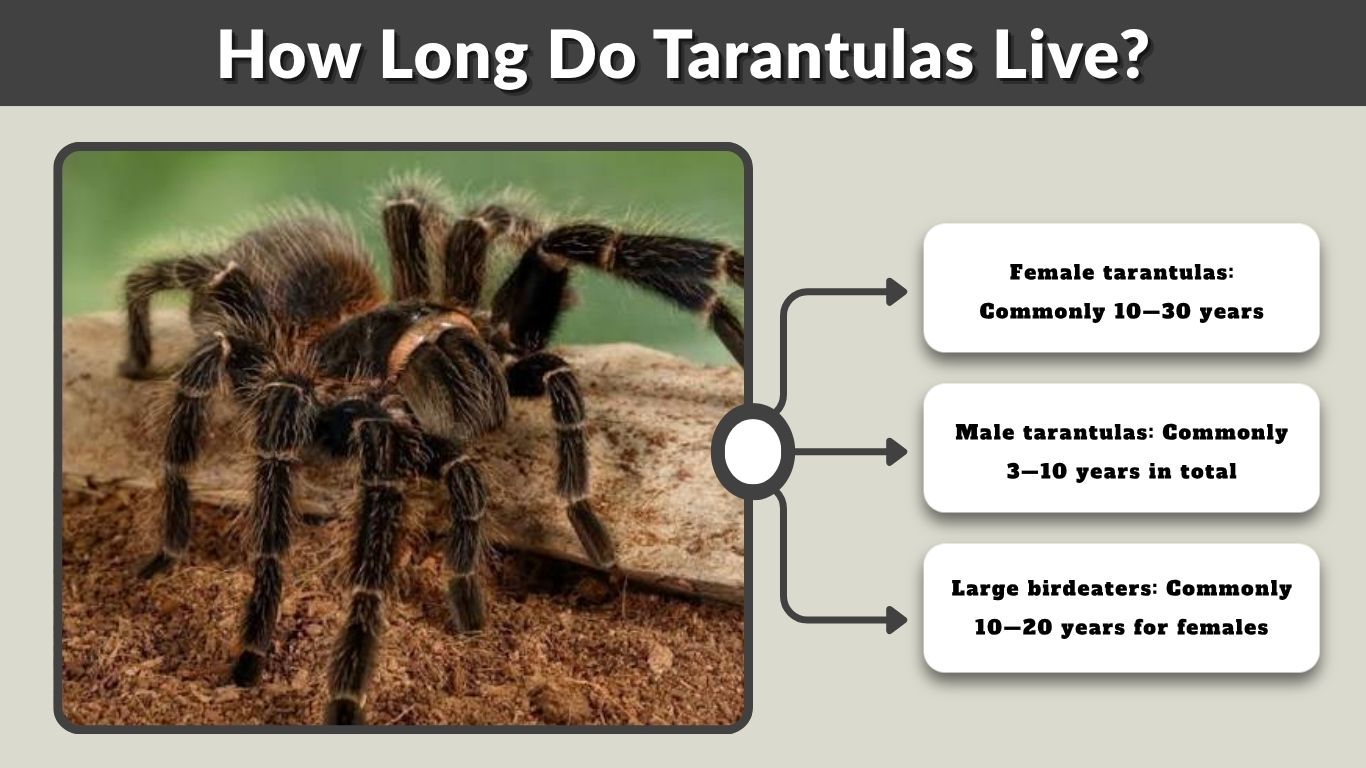
Tarantulas can live from several years to more than three decades, depending primarily on their species and sex. Female tarantulas usually live much longer than males, particularly among slow-growing terrestrial species. A female kept under suitable conditions may remain with its owner for 15–30 years, while many males live approximately 3–10 years in total. Temperature, feeding, growth rate, enclosure safety, genetics, and molting success can also influence longevity. Understanding these differences is essential before choosing a tarantula as a long-term pet.
Average Tarantula Lifespan
There is no single lifespan that applies to every tarantula. The family includes hundreds of species from deserts, grasslands, forests, and tropical environments. Small, fast-growing species usually have shorter lives, while slow-growing terrestrial tarantulas often survive considerably longer. Captive females generally reach the highest ages recorded among commonly kept species.
General Lifespan Estimates
- Female tarantulas: Commonly 10–30 years
- Male tarantulas: Commonly 3–10 years in total
- Mature males: Often several months to two years after maturity
- Small dwarf species: Approximately 5–12 years for females
- Slow-growing terrestrial females: Often 20–30 years
- Large birdeaters: Commonly 10–20 years for females
These figures are broad estimates rather than guarantees. The University of Illinois College of Veterinary Medicine reports that some males may reach ten years, while females of certain species can live beyond 30 years.
Why Do Female Tarantulas Live Longer?
Female tarantulas continue molting after reaching sexual maturity. These later molts allow them to repair some damaged tissues and maintain their exoskeleton throughout adulthood.
A male undergoes a final maturation molt that produces reproductive features, including emboli on his pedipalps. Depending on the species, he may also develop tibial hooks. Mature males usually stop molting and devote their remaining lives to searching for females, which limits their longevity.
Male and Female Tarantula Lifespans
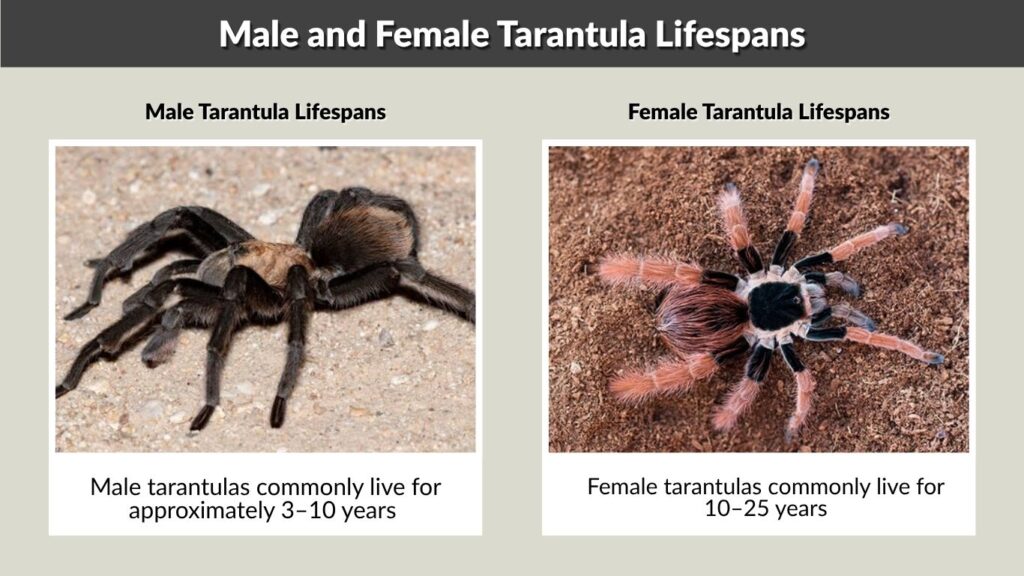
Sex is one of the strongest predictors of a tarantula’s lifespan. This difference can be significant even when a male and female come from the same egg sac. Consequently, confirmed females generally cost more than males because owners can expect to keep them for many additional years.
How Long Do Female Tarantulas Live?
Female tarantulas commonly live for 10–25 years, while some slow-growing species may reach or exceed 30 years. Mexican red knees, Arizona blondes, Brazilian blacks, and other slow-growing terrestrial species are particularly long-lived.
Female longevity is linked to their slower metabolism, continued molting, and relatively sedentary adult lifestyle. A mature female may spend most of her life near the same burrow or retreat.
How Long Do Male Tarantulas Live?
Male tarantulas commonly live for approximately 3–10 years in total. Fast-growing species may produce mature males within two or three years, whereas slow-growing desert species can take much longer to mature.
After the ultimate molt, a male often becomes restless, eats less, and repeatedly walks around his enclosure. Depending on the species and individual, a mature male may survive for several months to approximately two years.
Lifespan of Popular Pet Tarantulas
Available lifespan figures often differ among care guides because relatively few tarantulas have been followed from hatching until death under controlled conditions. Diet, temperature, identification errors, and husbandry also produce different results. The following ranges represent reasonable expectations rather than exact expiration ages for individual spiders.
Tarantula Lifespan Comparison
| Tarantula species | Female lifespan | Male lifespan |
| Mexican red knee | 20–30 years | 5–10 years |
| Arizona blonde | 20–30 years | 8–12 years |
| Brazilian black | 15–25 years | 5–8 years |
| Chilean rose hair | 15–20+ years | 4–8 years |
| Curly hair | 15–20 years | 5–8 years |
| Pink toe | 10–12 years | 3–5 years |
| Goliath birdeater | 15–20 years | 3–6 years |
| Green bottle blue | 12–15 years | 3–5 years |
| Cobalt blue | 10–15 years | 3–5 years |
| Pumpkin patch | 8–12 years | 3–4 years |
| Brazilian jewel | 8–12 years | 3–5 years |
| Orange baboon | 10–15 years | 3–5 years |
The Smithsonian’s National Zoo reports female lifespans of up to 20 years for both the Chilean rose and Goliath birdeater, while female pink toes generally live around 10–12 years.
Why Species Have Different Lifespans
Tarantulas that grow and mature slowly generally live longer. Many Aphonopelma, Brachypelma, and Grammostola species may need several years to reach adulthood, especially in cooler or seasonally dry environments.
Fast-growing arboreal, dwarf, and tropical species often mature earlier and have shorter overall lifespans. However, growth speed is not the only factor; genetics, sex, environmental conditions, and reproductive history also matter.
Captivity Versus the Wild
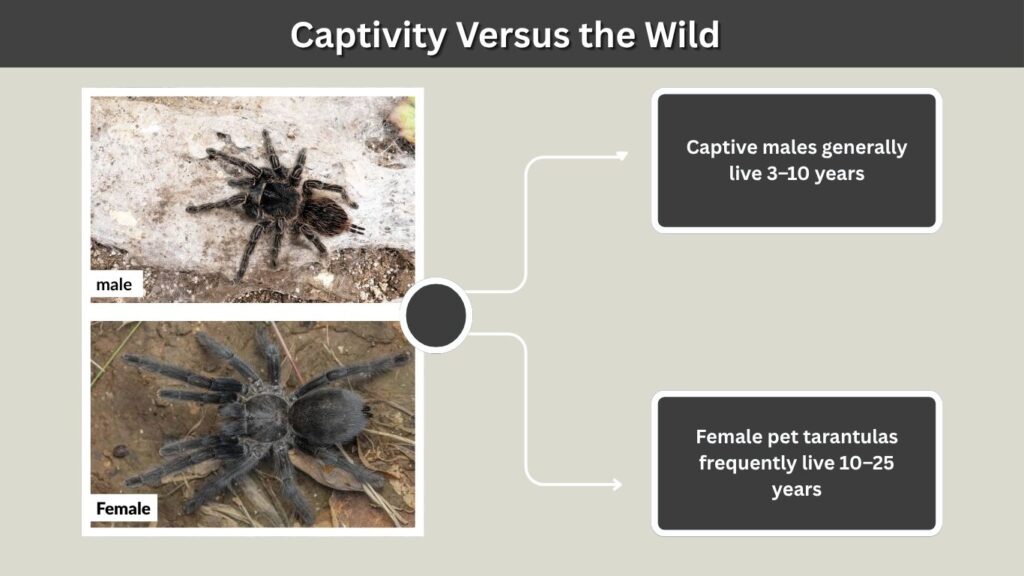
Captive tarantulas may reach the upper end of their expected lifespan when their environmental needs are met. They receive regular food and water while being protected from predators, parasites, fires, floods, and extreme weather. Nevertheless, unsuitable captive housing can create dangers that a wild tarantula might avoid.
How Long Do Tarantulas Live in Captivity?
Female pet tarantulas frequently live 10–25 years, with some slow-growing species surviving for 30 years or longer. Captive males generally live 3–10 years, although much of that time is spent growing toward maturity.
A tarantula purchased as an adult female may have an unknown age. Unless the breeder raised it from a spiderling, accurately determining its remaining lifespan is usually impossible.
How Long Do Tarantulas Live in the Wild?
Wild lifespan is difficult to measure because individual spiders cannot easily be observed throughout their entire lives. Females that maintain protected burrows may survive for many years, while roaming mature males face predators, dehydration, vehicles, and severe weather.
Wild spiderlings experience especially high mortality. Many are eaten or die from environmental stresses long before reaching adulthood.
Factors That Affect Tarantula Longevity
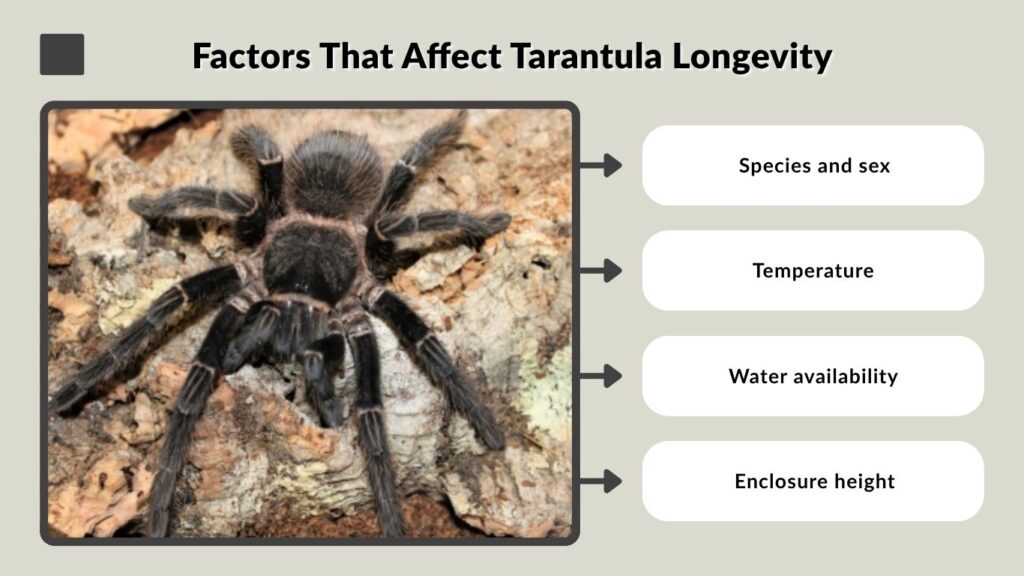
Appropriate care cannot guarantee a particular age, but it can prevent many avoidable deaths. The greatest captive risks include falls, dehydration, excessive moisture, unsuitable temperatures, contaminated feeders, failed molts, and injuries caused by careless handling or enclosure decorations.
Important Longevity Factors
- Species and sex: These establish the tarantula’s basic lifespan potential.
- Temperature: Excessive heat may increase metabolism and growth while causing dehydration.
- Water availability: Every juvenile and adult needs continuous access to fresh water.
- Feeding: Appropriate portions support growth without producing an dangerously oversized abdomen.
- Enclosure height: Heavy terrestrial tarantulas can die from relatively short falls.
- Ventilation: Poor airflow combined with excessive moisture encourages unhealthy conditions.
- Molting safety: Live prey should never remain with a vulnerable molting spider.
- Handling: Avoiding handling reduces fall injuries and unnecessary stress.
Does Slower Growth Mean a Longer Life?
A lower growth rate is commonly associated with greater longevity at the species level. However, owners should not deliberately keep a tarantula cold or underfed to extend its life. Maintain a suitable temperature, provide water continuously, and adjust feeding according to age and body condition.
How Long Can Tarantulas Live Without Food?
Tarantulas have slow metabolisms and can survive longer without food than most conventional pets. Healthy adults may refuse meals for several weeks or months, especially before molting. Certain well-established individuals can fast for much longer, but the maximum differs greatly among species and circumstances.
Fasting Versus Starvation
Food refusal is often normal when a tarantula has a plump abdomen, is preparing to molt, or has recently undergone an enclosure change. Remove uneaten prey and continue offering fresh water.
A shrinking abdomen, weakness, unusual posture, or prolonged fasting accompanied by poor condition may indicate dehydration, unsuitable husbandry, injury, or illness. Never intentionally test how long a tarantula can survive without food.
FAQs
Tarantula longevity depends on more than simply identifying the species. Sex, maturity, growth rate, and captive conditions can substantially alter the expected range. These answers address common questions from owners attempting to estimate their spider’s age or understand its changing behavior.
Can a Tarantula Live for 30 Years?
Yes. Females of certain slow-growing species, including Mexican red knees and Arizona blondes, may live for 25–30 years or longer under suitable conditions.
How Long Do Mature Male Tarantulas Live?
Many mature males live for several months to approximately two years after their final molt. Their remaining lifespan depends on species, age at maturity, condition, and environmental care.
Can You Tell a Tarantula’s Age by Its Size?
Not accurately. Size is affected by species, sex, feeding, temperature, and individual growth. A molt history and known hatching date provide much better estimates.
Do Tarantulas Live Longer Than Other Spiders?
Many female tarantulas live considerably longer than typical house and garden spiders. Their slow metabolism, protected burrows, and continued adult molting contribute to their exceptional longevity.
Does Molting Extend a Tarantula’s Life?
Molting allows a female to replace her exoskeleton and repair certain physical damage, supporting long-term survival. Mature males usually stop molting after developing their adult reproductive structures.
