
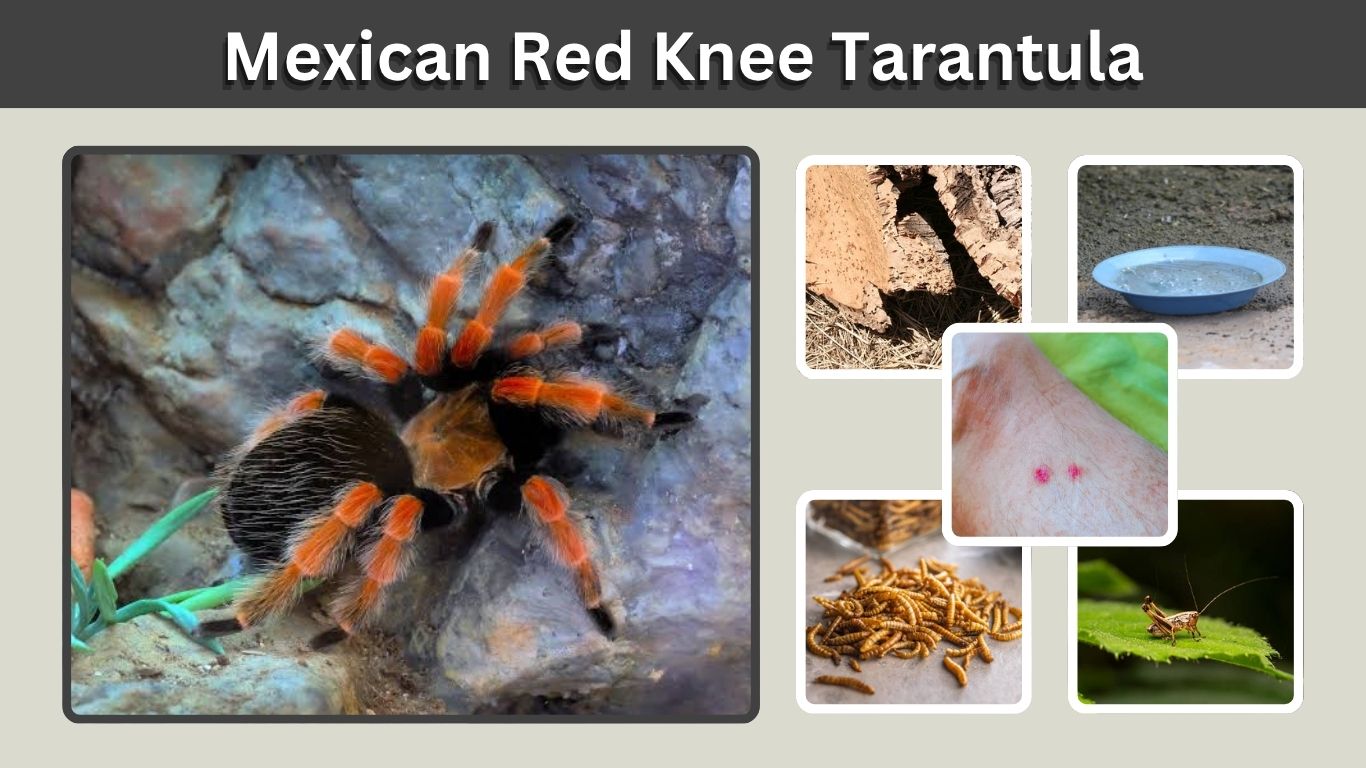
The Mexican red knee tarantula is one of the best-known pet tarantulas, famous for its black body and bright orange-red markings on the legs. Native to Mexico, this slow-growing terrestrial spider is valued for its generally calm temperament, striking appearance, and relatively straightforward care. A proper enclosure, deep substrate, moderate temperatures, fresh water, and suitable feeder insects can keep it healthy for many years. Females are especially long-lived and can remain in captivity for decades when cared for correctly.
What Is a Mexican Red Knee Tarantula?
Mexican red knee tarantulas belong to the genus Brachypelma. The name is commonly associated with Brachypelma hamorii, although Brachypelma smithi is another closely related Mexican species with similar red-orange leg markings. These tarantulas are terrestrial and spend much of their time on the ground or inside burrows rather than climbing.
Identification
A Mexican red knee tarantula can be recognized by several characteristic features:
- Mostly black or dark brown body
- Bright orange-red bands around the leg joints
- Dense hairs covering the body and legs
- Stocky, heavy terrestrial build
- Adult leg span commonly around 5–6 inches
- Eight small eyes grouped on the carapace
- Large downward-pointing fangs
- Urticating hairs on the abdomen
Their contrasting black and red-orange coloration makes them particularly distinctive.
Scientific Name
The name “Mexican red knee tarantula” can cause some confusion because closely related species have historically been sold under similar common names.
Brachypelma hamorii is widely known as the Mexican red knee, while Brachypelma smithi is also called the Mexican giant red knee or Mexican red knee in some sources.
Natural Habitat and Range
Mexican red knees naturally inhabit dry to seasonally moist areas of western Mexico. They are terrestrial spiders that shelter in burrows, beneath roots, or in protected ground cavities.
Their burrows help protect them from predators and extreme temperature changes. In captivity, providing a secure hide and deep substrate allows them to display similar natural behavior.
Mexican Red Knee Tarantula Size and Growth
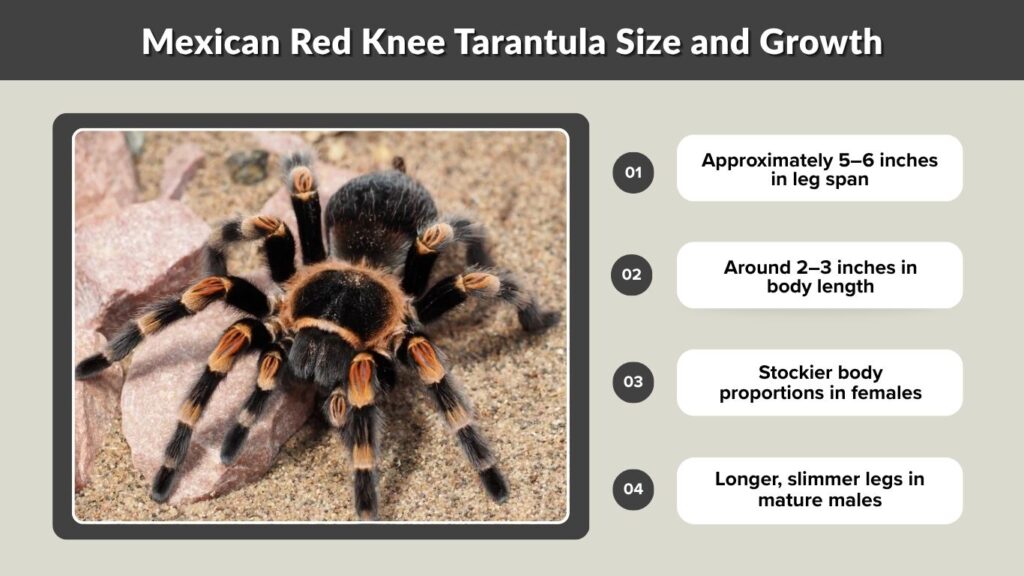
Mexican red knee tarantulas are medium-to-large terrestrial spiders but grow relatively slowly. Spiderlings can take several years to develop into impressive adults. Growth rates vary depending on sex, feeding, temperature, and genetics. Females tend to become heavier and live much longer, while mature males usually develop slimmer bodies and proportionally longer legs.
How Big Does a Mexican Red Knee Tarantula Get?
A full-grown Mexican red knee commonly reaches:
- Approximately 5–6 inches in leg span
- Around 2–3 inches in body length
- Stockier body proportions in females
- Longer, slimmer legs in mature males
- Increasingly vivid red-orange markings as it matures
Some individuals may grow slightly larger or remain smaller depending on genetics and husbandry.
Growth Rate
Mexican red knees are relatively slow-growing tarantulas. Spiderlings molt more frequently than adults because they are developing rapidly.
As the spider matures, the time between molts increases. Females continue molting throughout their lives, while mature males usually have a much shorter remaining lifespan after reaching adulthood.
Baby and Juvenile Tarantulas
Baby Mexican red knee tarantulas, often called slings or spiderlings, need smaller enclosures than adults.
Juvenile care should include:
- Secure ventilated container
- Appropriate moisture without waterlogging
- Small hiding place
- Suitable substrate
- Tiny feeder insects
- Easy access to water as they grow
- Minimal unnecessary disturbance
The enclosure should be upgraded gradually as the tarantula increases in size.
Mexican Red Knee Tarantula Care
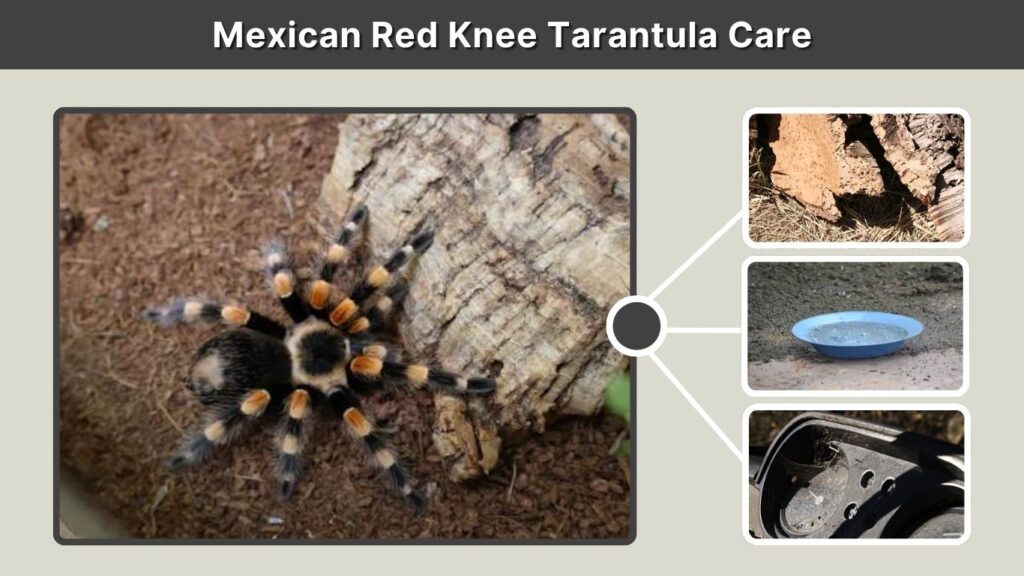
Mexican red knee tarantulas are often considered suitable for newer keepers because their husbandry is relatively uncomplicated. They need a terrestrial enclosure with adequate floor space, deep substrate, ventilation, a hiding place, and drinking water. Excessive humidity and tall climbing areas should be avoided because these heavy-bodied spiders can be injured by falls.
Enclosure and Tank Setup
A suitable enclosure should provide:
- Secure lid
- More floor space than height
- Several inches of substrate
- Cork bark or another dark hide
- Shallow water dish
- Good ventilation
- No sharp decorations
- Limited distance between substrate and lid
A cage roughly two to three times the spider’s leg span in horizontal dimensions is generally sufficient for an adult.
Best Substrate
Mexican red knees appreciate enough substrate to dig or construct shallow burrows.
Suitable substrate options include coconut fiber, pesticide-free topsoil, peat-based mixtures, and prepared tarantula substrates.
The substrate should be slightly compacted so it can support burrowing. Avoid gravel, cedar bedding, chemically treated soil, and substrates containing fertilizers.
Temperature and Humidity
A temperature around 70–80°F (21–27°C) generally works well for Mexican red knee tarantulas.
They do not require a constantly wet enclosure. Moderate humidity, fresh drinking water, and good airflow are more important.
Keeping the substrate permanently saturated can encourage mold and create unhealthy conditions. Adults generally tolerate somewhat drier conditions than very young spiderlings.
Mexican Red Knee Tarantula Diet
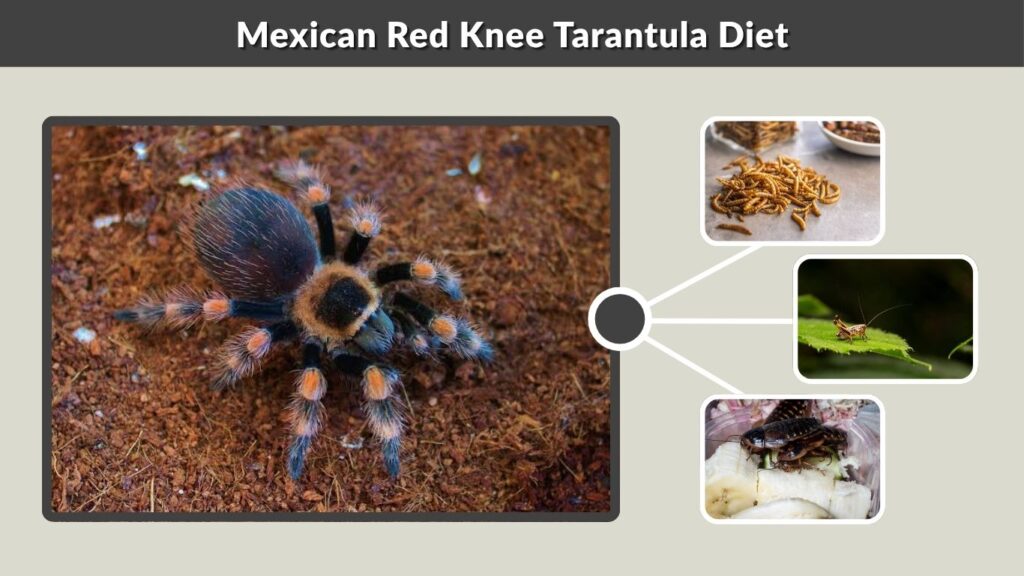
Mexican red knee tarantulas are carnivorous ambush predators. In the wild, they consume insects and other small animals that come within striking distance. Captive tarantulas can thrive on commercially available feeder insects. Meal size and feeding frequency should depend on the spider’s age, abdomen size, activity, and molt cycle rather than an excessively rigid schedule.
What Do Mexican Red Knee Tarantulas Eat?
Appropriate foods include:
- Crickets
- Dubia roaches
- Mealworms
- Superworms
- Other captive-bred insects
- Smaller feeder insects for spiderlings
Large vertebrate prey such as mice is unnecessary and can potentially injure the tarantula.
Feeding Schedule
Growing spiderlings and juveniles can usually be offered food once or twice a week.
Healthy adults may be offered suitable prey approximately every 7–14 days. Tarantulas have slow metabolisms, and adults can sometimes go surprisingly long periods without eating.
When a Tarantula Stops Eating
A Mexican red knee may refuse food because it is approaching a molt.
Other signs of premolt include reduced activity, increased hiding, a swollen abdomen, and darkening of a bald abdominal patch.
Remove uneaten live prey, particularly when you suspect the tarantula is preparing to molt.
Molting and Shedding
Like all tarantulas, Mexican red knees must shed their exoskeleton to grow. Younger tarantulas molt relatively frequently, while large adults may molt much less often. Premolt can last for days or weeks, and appetite often disappears during this period. Providing fresh water and avoiding unnecessary disturbances are particularly important.
Signs of Premolt
Common signs include:
- Refusing food
- Reduced activity
- Darkening abdomen
- Enlarged abdomen
- Increased webbing
- Spending more time in the hide
- Darkening bald spot
- Lying on the back before or during molting
A tarantula lying on its back during a molt should never be turned over.
After the Molt
The newly exposed exoskeleton is extremely soft immediately after molting.
Do not offer food until the spider’s fangs have hardened and darkened. Young tarantulas may recover faster, while adults can require approximately a week or more before they are ready to eat.
Always keep fresh drinking water available during recovery.
Mexican Red Knee Tarantula Lifespan
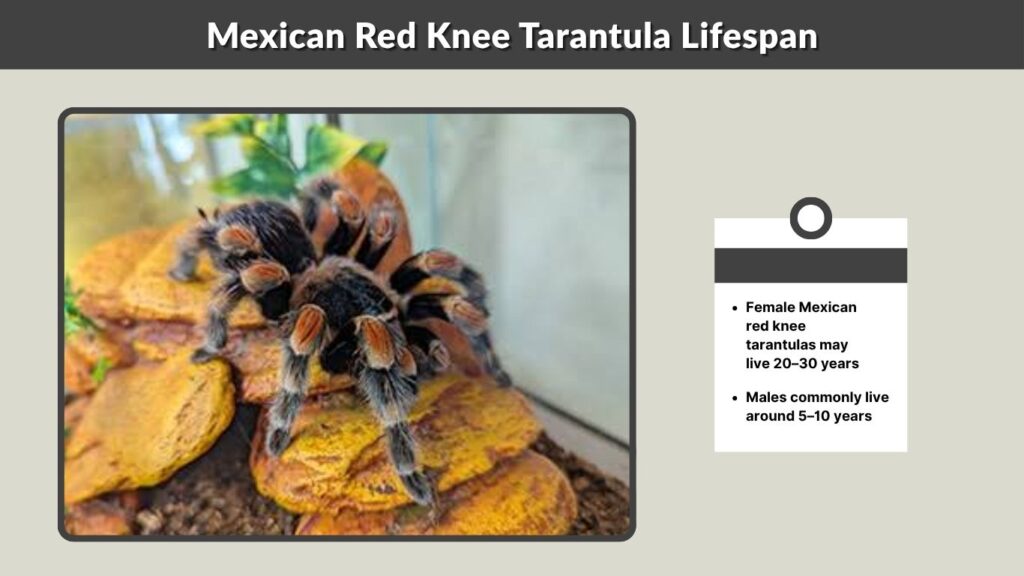
Mexican red knee tarantulas can live exceptionally long lives compared with many common pets. Females have the greatest longevity and can remain alive for decades. Males mature faster and generally have substantially shorter lifespans, especially after reaching reproductive maturity.
Female Lifespan
Female Mexican red knee tarantulas may live 20–30 years, and some individuals can potentially survive even longer with excellent care.
Their longevity means purchasing a young female is a significant long-term commitment.
Male Lifespan
Males commonly live around 5–10 years, depending on their growth rate and age at maturity.
Once mature, males often become more active and may repeatedly walk around their enclosure while instinctively searching for a mate.
Male vs Female Mexican Red Knee
Adult females generally have broader, heavier bodies, while mature males are often thinner and more long-legged.
Reliable sexing can include:
- Examination of a shed molt
- Looking for mature male reproductive structures
- Checking mature males for tibial hooks
- Comparing mature body proportions
Examining a well-preserved molt is generally more dependable than guessing based solely on body shape.
Temperament, Handling, and Bite Risk
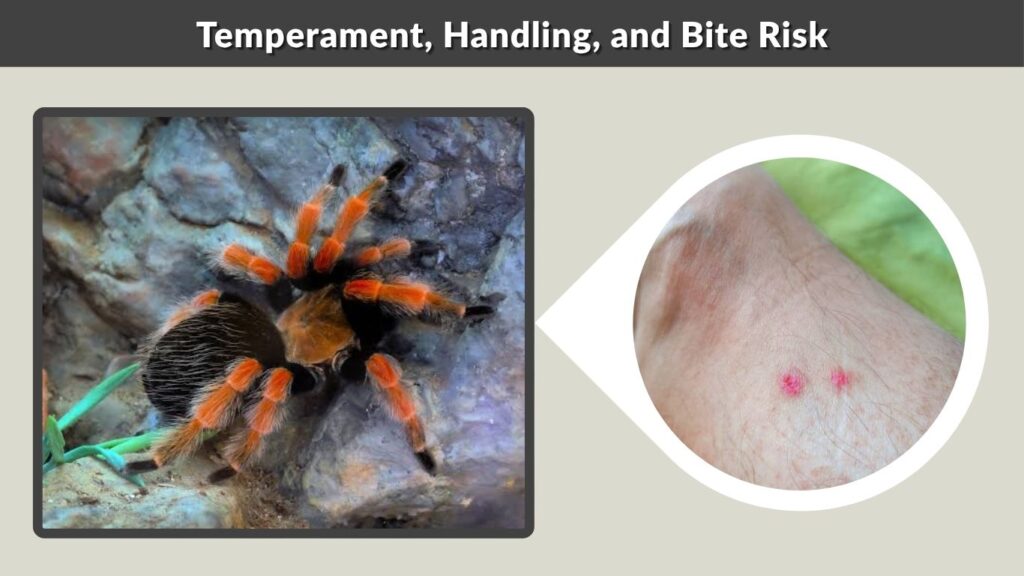
The Mexican red knee has a reputation for being relatively calm and slow-moving, which contributes to its popularity. However, every tarantula has an individual temperament. When frightened, a Mexican red knee may flee, kick irritating hairs, adopt a defensive posture, or bite. Minimal handling is safest for both the keeper and the spider.
Can You Hold a Mexican Red Knee Tarantula?
Although some keepers handle them, routine handling is not recommended.
A tarantula can suddenly run or fall. Because its abdomen is relatively delicate, even a short fall onto a hard surface can cause severe or fatal injuries.
Using a catch cup during transfers is much safer.
Mexican Red Knee Tarantula Bite
Mexican red knees possess venom and large fangs capable of producing a painful bite.
Their venom is generally not considered medically significant to healthy humans, but individual reactions can vary. A bite can also cause mechanical injury from the fangs.
Urticating Hairs
The spider can kick tiny barbed hairs from its abdomen when threatened.
These hairs may cause:
- Skin irritation
- Itching
- Redness
- Eye irritation
- Respiratory discomfort if inhaled
Avoid touching your face during enclosure maintenance and wash your hands afterward.
FAQs
1. How big does a Mexican red knee tarantula get?
A full-grown Mexican red knee commonly reaches around 5–6 inches in leg span. Females generally develop heavier bodies, while mature males are usually slimmer.
2. How long does a Mexican red knee tarantula live?
Females can commonly live around 20–30 years under good captive conditions. Males usually have much shorter lifespans, often approximately 5–10 years.
3. Are Mexican red knee tarantulas poisonous?
They are venomous, not poisonous. They inject venom through their fangs. Their venom is generally considered relatively mild to humans, although bites should always be avoided.
4. Are Mexican red knee tarantulas good pets?
They can make excellent observation pets for responsible keepers because they are attractive, relatively hardy, and usually calm. However, they are better suited to observation than frequent handling.
5. What size tank does a Mexican red knee tarantula need?
An adult needs a secure terrestrial enclosure with roughly two to three times its leg span in horizontal space. Deep substrate and limited vertical climbing height are more important than providing a very tall or oversized tank.
