
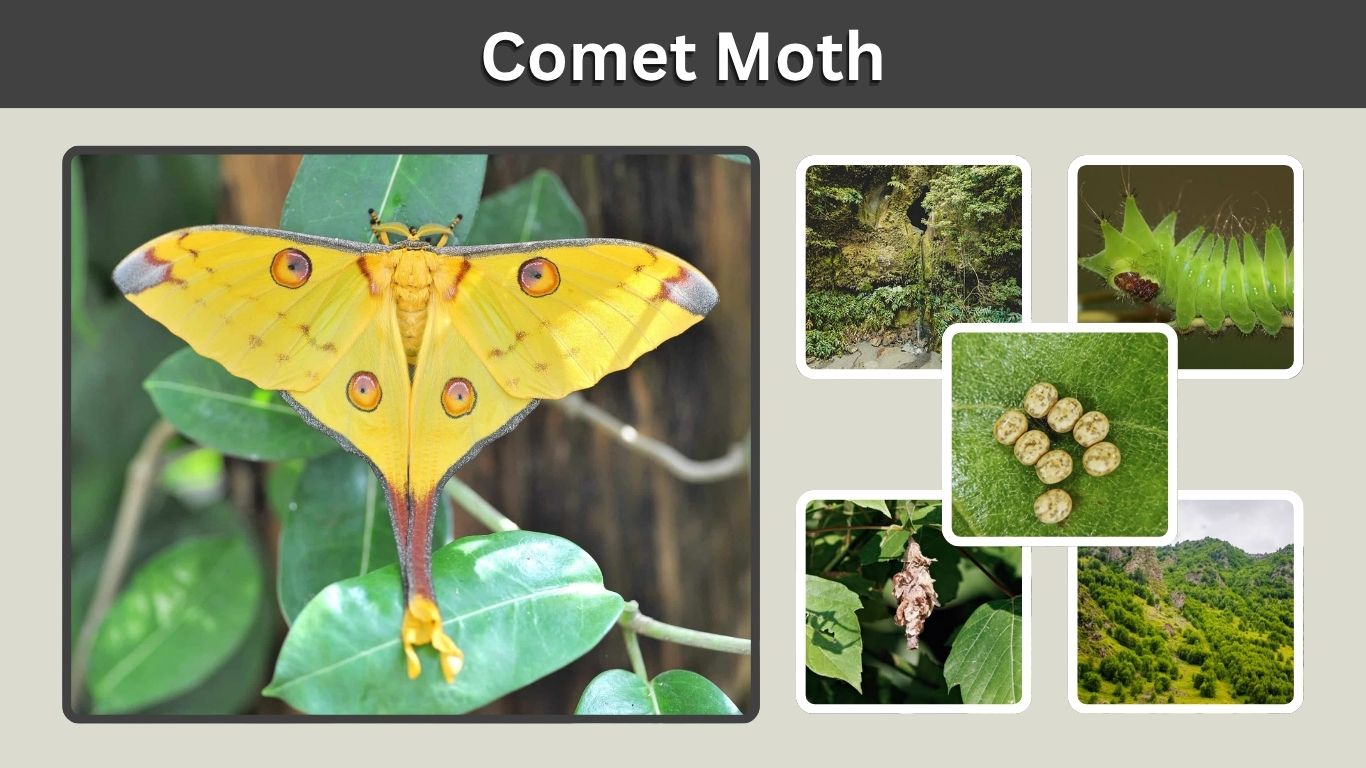
The comet moth (Argema mittrei), also called the Madagascar comet moth or Madagascan moon moth, is one of the most spectacular moths in the world. Native to Madagascar, it is recognized by its bright yellow wings, long flowing tails, eye-like markings, and impressive size. Males and females look noticeably different, while their caterpillars depend on specific host plants before spinning tough silken cocoons. From its unusual feeding habits to its short adult lifespan, the comet moth has many remarkable features worth discovering.
What Does a Comet Moth Look Like?
The comet moth has an unmistakable appearance that makes it easy to distinguish from most other moths. Its vivid yellow coloration, prominent eyespots, and extraordinarily long hindwing tails create a dramatic comet-like shape. Adults belong to the giant silk moth family Saturniidae and are among the most visually striking insects native to Madagascar.
Comet Moth Identification
Typical identification features include:
- Scientific name: Argema mittrei
- Color: Bright yellow to yellow-green
- Wings: Large and broad with reddish-brown markings
- Eyespots: Large circular markings on the wings
- Wing tails: Long extensions from the hindwings
- Body: Thick and furry
- Antennae: Broad and feathery, especially in males
- Activity: Mainly active at night
- Range: Native to Madagascar
The tails are particularly noticeable in males and can make them appear much longer than females.
Why Is It Called the Comet Moth?
The name comes from the moth’s extraordinarily long hindwing tails. When a male flies through the air, these extensions trail behind its body like the glowing tail of a comet.
The species is also called the Madagascan moon moth, partly because it belongs to the same giant silk moth family as other moon moths such as the Luna moth.
Comet Moth Size
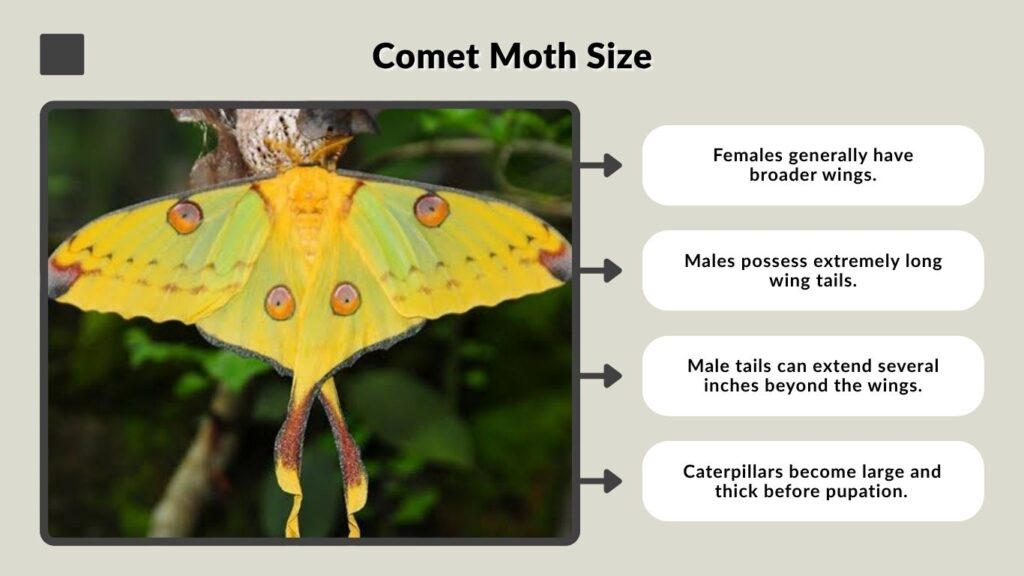
Comet moths are large insects even without considering their spectacular tails. Females generally possess broader wings and heavier bodies, whereas males have much longer hindwing extensions. Because males and females differ considerably in appearance, size measurements may depend on whether the wingspan, body, or full tail length is being considered.
How Big Is a Comet Moth?
Adult comet moths can have a wingspan of roughly 6 to 8 inches, although size varies between individuals.
Notable size features include:
- Females generally have broader wings.
- Males possess extremely long wing tails.
- Male tails can extend several inches beyond the wings.
- Caterpillars become large and thick before pupation.
- Females have heavier abdomens for carrying eggs.
The impressive tails make males appear considerably larger during flight.
Male vs. Female Comet Moth
Male and female comet moths can often be distinguished visually. Females are typically larger-bodied and have shorter tails, while males have narrower bodies and dramatically elongated hindwing tails.
Male antennae are also noticeably feathered. These structures help detect pheromones released by females, allowing males to locate potential mates during their short adult lives.
Where Do Comet Moths Live?
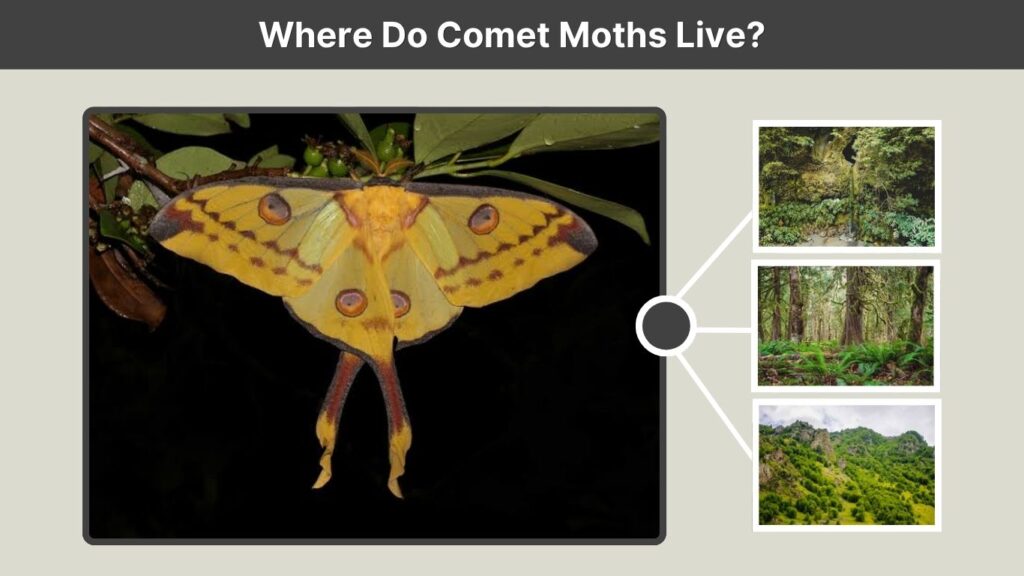
The comet moth is strongly associated with Madagascar and is naturally found nowhere else in the same way. Its life cycle depends on warm environmental conditions and suitable host plants for caterpillars. Forested landscapes provide shelter, food, and appropriate places for larvae to pupate and adults to rest during daylight hours.
Comet Moth Habitat
Comet moths are associated with habitats such as:
- Tropical and subtropical forests
- Humid woodland
- Forest edges
- Vegetated mountain regions
- Areas containing suitable caterpillar host plants
Madagascar’s unique ecosystems support many species found nowhere else on Earth, and the comet moth is one of the island’s most famous insects.
Madagascar Comet Moth
Argema mittrei is endemic to Madagascar, meaning its natural distribution is limited to the island.
Its close relationship with Madagascar is why the names Madagascar comet moth and Madagascan comet moth are widely used.
The species may also be displayed or bred in butterfly houses and insect collections outside Madagascar, but these captive individuals should not be confused with naturally occurring wild populations.
What Do Comet Moths Eat?
The diet of the comet moth changes completely during its development. Caterpillars must eat extensively because they need to accumulate enough energy for metamorphosis and adult reproduction. Once the adult moth emerges, its feeding ability becomes extremely limited, making stored larval energy crucial for survival.
Comet Moth Caterpillar Diet
The larvae feed on leaves from suitable host plants. Their food may include foliage from certain trees and shrubs available within their natural habitat.
Commonly associated host plants include:
- Eugenia species
- Eucalyptus
- Some members of the Myrtaceae family
- Other suitable broadleaf host plants used in captivity
Young caterpillars eat relatively small quantities, but their appetite increases substantially as they grow.
Does the Adult Comet Moth Eat?
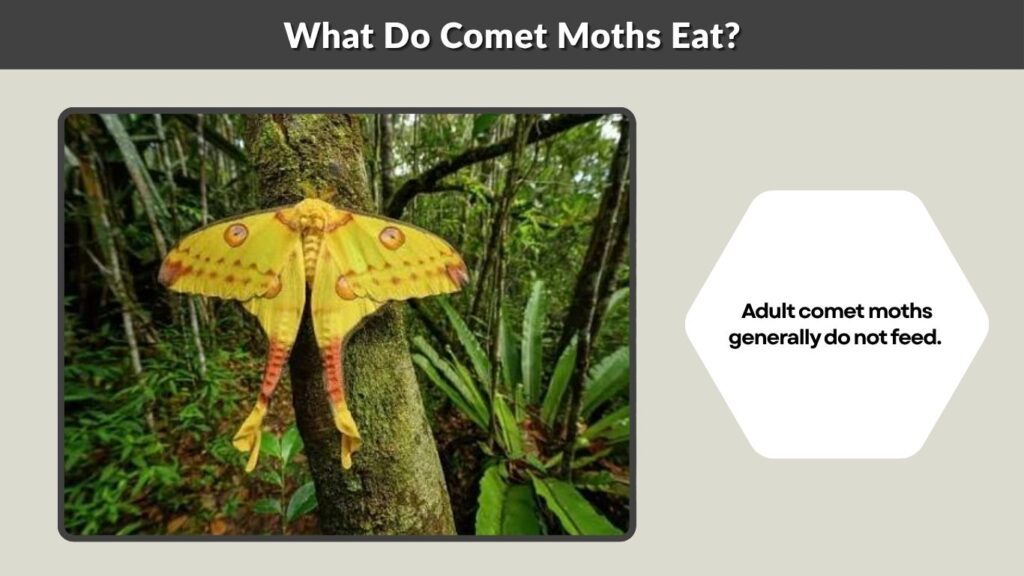
Adult comet moths generally do not feed. Like many giant silk moths, they have reduced mouthparts and depend primarily on nutrients accumulated during the caterpillar stage.
This means adulthood is not devoted to eating or growing.
Instead, adults concentrate almost entirely on reproduction. Males search for females, mating occurs, and females lay eggs before their stored energy is depleted.
Comet Moth Life Cycle
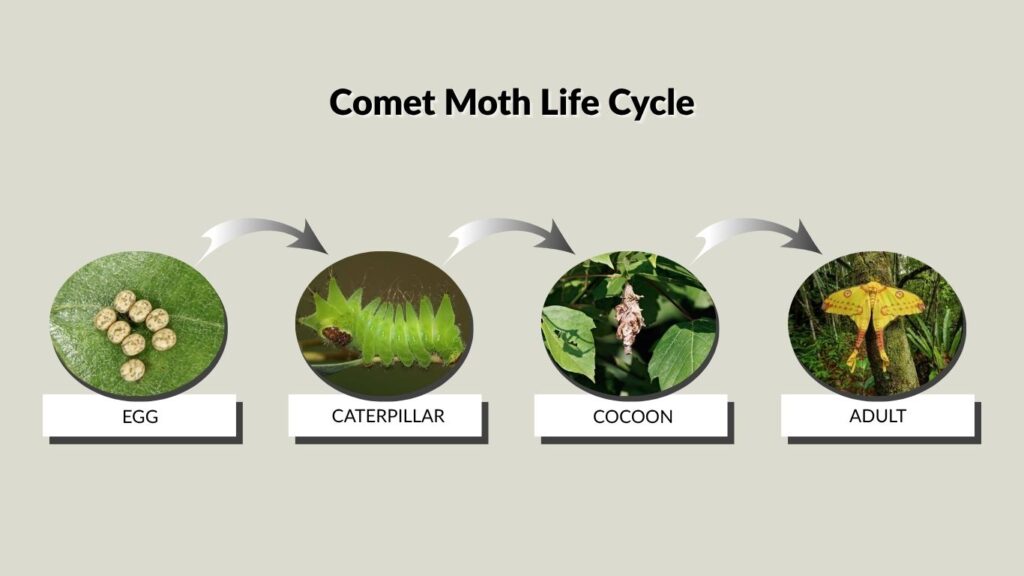
The comet moth undergoes complete metamorphosis, passing through four distinct stages: egg, caterpillar, pupa, and adult. Each stage has a different purpose. Caterpillars focus on feeding and growth, while adults concentrate on reproduction. The transformation between these forms takes place inside a strong silk cocoon.
Egg Stage
After mating, a female deposits eggs in locations where newly hatched caterpillars can access suitable food plants.
The developing larvae remain inside the eggs until they are ready to hatch. Once they emerge, feeding begins quickly.
Comet Moth Caterpillar
Comet moth caterpillars are large, green larvae with noticeable body markings and small projections.
During development, they:
- Feed repeatedly on host-plant leaves.
- Pass through several larval instars.
- Molt as their bodies increase in size.
- Store substantial amounts of energy.
- Eventually stop eating before pupation.
The larval period is vital because the adult moth will have little opportunity to gain additional nutrition.
Comet Moth Cocoon
When mature, the caterpillar begins spinning a strong silk cocoon.
Comet moth cocoons are unusual because they can contain numerous small openings. This structure allows rainwater to drain rather than collecting around the developing pupa.
Inside the cocoon, the caterpillar transforms into a pupa and eventually develops into the winged adult.
Adult Emergence
After completing metamorphosis, the adult moth emerges with soft, folded wings.
It pumps fluid into the wings until they expand to their full size. Once the wings harden, the moth is capable of flying and begins its brief reproductive stage.
Comet Moth Lifespan and Behavior
Adult comet moths have relatively short lives because they cannot continually replace the energy they use. Their behavior is therefore closely connected to reproduction. They conserve energy during periods of inactivity and become more active when conditions are suitable for locating mates.
How Long Does a Comet Moth Live?
The adult stage usually lasts only several days to roughly a week, although exact lifespan can vary according to sex and environmental conditions.
During this period, the moth primarily:
- Rests during daylight hours.
- Becomes active in the evening or at night.
- Searches for or attracts mates.
- Reproduces.
- Lays eggs.
The caterpillar and pupal stages last considerably longer than the brief adult phase.
Comet Moth Flying Behavior
Comet moths are primarily nocturnal.
Male flight is especially remarkable because the enormously long hindwing tails stream behind the body. These tails may also interfere with attacks from echolocating bats by helping divert strikes away from the moth’s body.
During daylight, adults often remain relatively still and depend on their coloration and resting position for protection.
Comet Moth Predators and Adaptations
Living in Madagascar exposes comet moths to predators such as birds, bats, reptiles, and other insect-eating animals. The moth has evolved several features that may increase its chance of surviving long enough to reproduce. Some are visual defenses, while others influence how predators perceive a flying adult.
Important Comet Moth Adaptations
Notable adaptations include:
- Large eyespots that may distract predators
- Long hindwing tails that can redirect attacks
- Nocturnal activity that reduces exposure to some daytime predators
- Strong caterpillar feeding behavior for storing energy
- Durable cocoons that protect developing pupae
- Highly sensitive male antennae for detecting females
The long tails are especially fascinating because they are more than decorative structures.
Comet Moth vs. Luna Moth
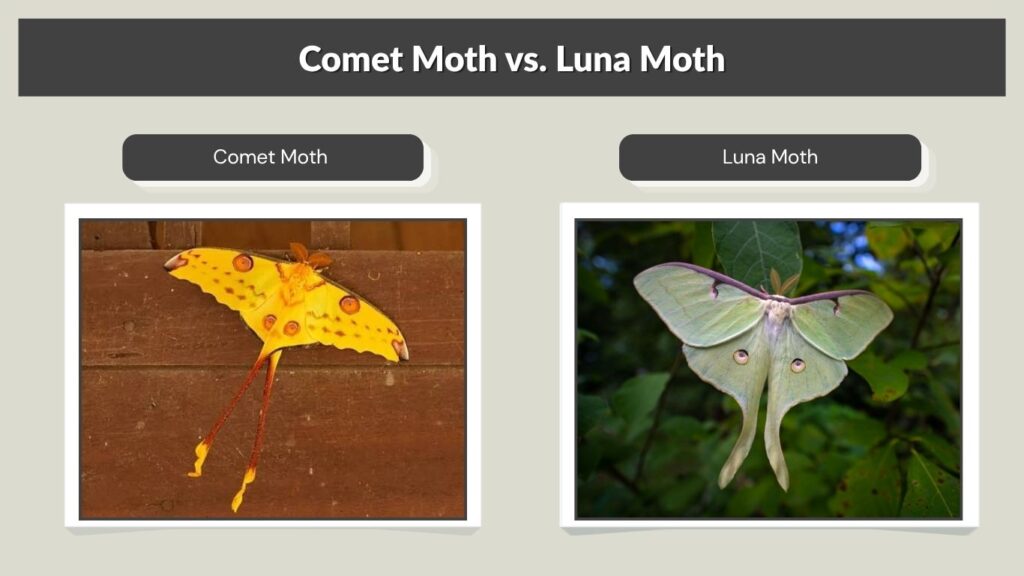
Comet moths and Luna moths are sometimes compared because both belong to the Saturniidae family and possess large wings with extended tails. However, they are different species from different parts of the world and can easily be distinguished by coloration and tail length.
Main Differences
The comet moth is native to Madagascar and is predominantly bright yellow. Male comet moths have extremely long hindwing tails.
The Luna moth (Actias luna) is native to North America and is typically pale green. Its hindwing tails are long but generally much shorter than those of a male comet moth.
Both species have reduced adult mouthparts and rely heavily on energy stored during their caterpillar stages.
Interesting Comet Moth Facts
The combination of brilliant colors, dramatic tails, nocturnal behavior, and unusual adult biology has made the comet moth one of Madagascar’s most famous insects. It is particularly fascinating because the spectacular winged adult represents only a brief final stage of a life largely devoted to growth and transformation.
Quick Comet Moth Facts
- The scientific name is Argema mittrei.
- It belongs to the family Saturniidae.
- It is native to Madagascar.
- Adults are bright yellow.
- Males have extremely long hindwing tails.
- Females generally have larger bodies.
- Caterpillars feed heavily on leaves.
- Adults generally do not eat.
- They are primarily nocturnal.
- Caterpillars spin strong silk cocoons.
- Adults live only briefly.
- The species is also called the Madagascan moon moth.
FAQs
Comet moths raise many questions because their appearance is unlike that of most familiar moths. Their huge wings, long tails, Madagascar origin, and limited adult feeding make them particularly unusual members of the giant silk moth family.
Is the comet moth rare?
The comet moth has a restricted natural distribution because it is endemic to Madagascar. This makes it much less widely distributed than many common moth species. Its abundance can vary between habitats depending on forest conditions, host plants, and local environmental pressures.
Is a comet moth dangerous?
No. Comet moths are not considered dangerous to humans. Adults do not have a venomous sting and are not aggressive. Their large size and dramatic markings can make them look intimidating, but they are delicate insects whose primary adult purpose is reproduction.
Why does the comet moth have such a long tail?
The long hindwing tails may help protect the moth from predators, particularly bats. The moving tails can create misleading sensory targets during flight, potentially directing an attack away from the moth’s body and increasing its chance of escaping.
How long does a comet moth live?
The adult comet moth generally survives only several days to about a week. Because adults have greatly reduced mouthparts and do not normally feed, they rely on energy accumulated as caterpillars and spend their short adult lives mainly reproducing.
Can comet moths be kept as pets?
Comet moths may be raised by experienced insect keepers where legally permitted. Their caterpillars require suitable fresh host plants, appropriate humidity and temperature, good ventilation, and sufficient space. Local regulations should be checked before purchasing, importing, or keeping live moths, eggs, cocoons, or caterpillars.
