
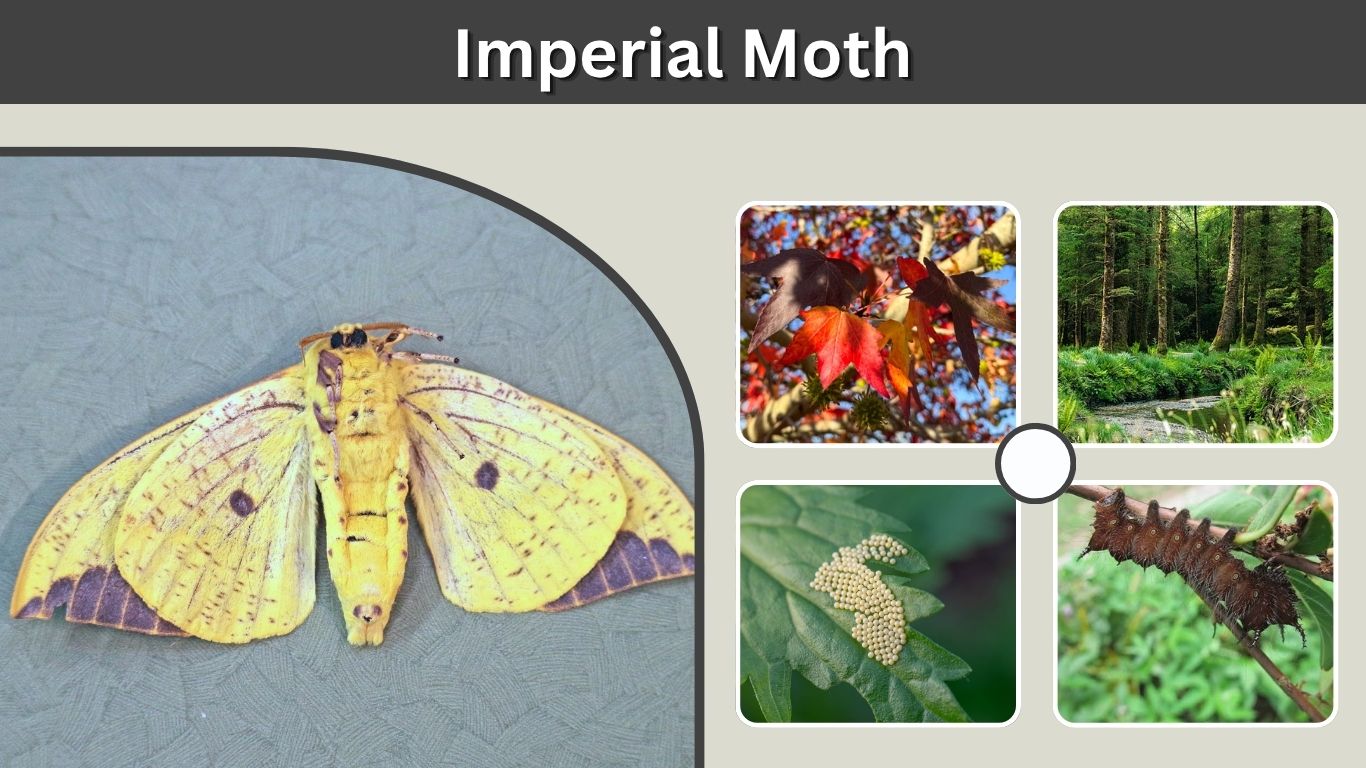
The imperial moth (Eacles imperialis) is a large North American silk moth recognized by its striking yellow wings covered with reddish-brown or purple markings. Adults are impressive in size, while the caterpillars are thick, colorful, and sometimes intimidating in appearance. Imperial moths pass through a complete life cycle that includes egg, caterpillar, pupa, and adult stages. Although their larvae have spines and can look dangerous, they are not considered highly venomous. Here is a closer look at their appearance, diet, habitat, lifespan, and behavior.
What Does an Imperial Moth Look Like?
Imperial moths belong to the giant silk moth family Saturniidae. Their large wings and contrasting colors make them relatively easy to identify. However, coloration can vary considerably between individuals. Males and females also differ in their markings, body size, and antennae, which can help distinguish the sexes when adults are viewed closely.
Imperial Moth Identification
Common identification features include:
- Scientific name: Eacles imperialis
- Wing color: Primarily yellow with purple, reddish-brown, or brown markings
- Wingspan: Commonly about 3 to 7 inches
- Body: Thick and furry
- Antennae: More strongly feathered in males
- Activity: Primarily nocturnal
- Family: Saturniidae
- Range: Much of eastern and central North America
- Resting posture: Wings often spread or held low over the body
Some individuals appear mostly yellow, while others may have extensive darker markings.
Imperial Moth Face and Body
The imperial moth has a furry head and thorax, giving it a soft appearance. Its abdomen is thick and often yellowish with darker markings.
Adults have large compound eyes adapted for nighttime activity. Their feathery antennae are important for detecting chemical signals, particularly in males searching for females.
Imperial Moth Size
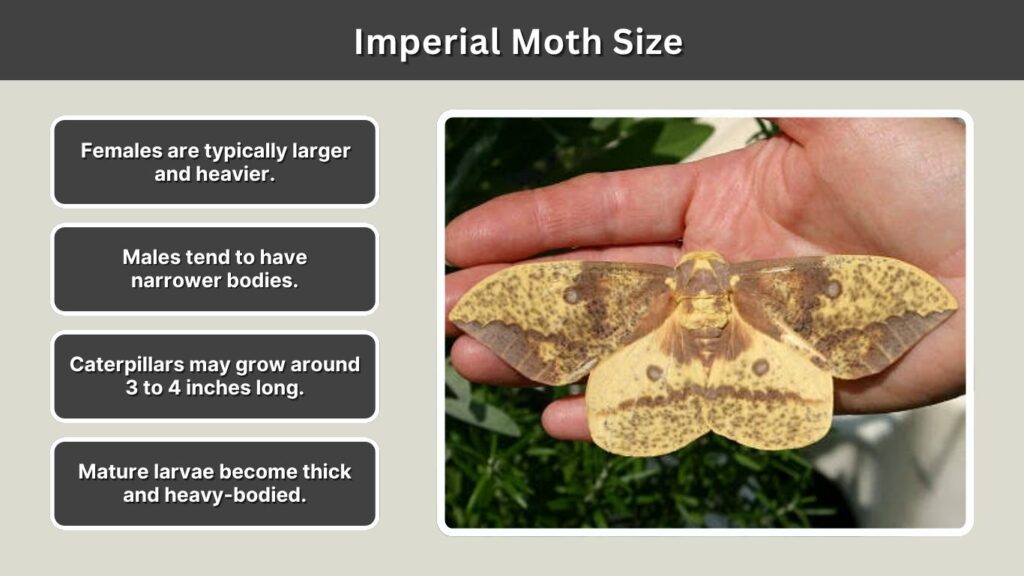
The imperial moth is one of the larger moth species found across much of North America. Females are usually larger-bodied than males because they carry eggs, while males may appear more streamlined. Exact size depends on sex, geographic population, nutrition during the caterpillar stage, and environmental conditions.
How Big Is an Imperial Moth?
Adult imperial moths usually have a wingspan of approximately 3 to 7 inches, with females generally reaching the larger end of the range.
Important size characteristics include:
- Females are typically larger and heavier.
- Males tend to have narrower bodies.
- Caterpillars may grow around 3 to 4 inches long.
- Mature larvae become thick and heavy-bodied.
- Adult wings are broad and rounded.
Their large size makes them particularly noticeable around outdoor lights during summer nights.
Giant Imperial Moth
The term giant imperial moth is sometimes used informally because Eacles imperialis belongs to the giant silk moth family and can reach an impressive size.
It is not necessarily a separate species. Large females can look especially massive because of their broad wings and thick abdomen.
Imperial Moth Caterpillar
The imperial moth caterpillar is dramatically different from the yellow adult. Young caterpillars start relatively small but become large, thick larvae after several molts. Their colors can vary from green and brown to reddish or orange shades. Their spiny appearance often leads people to wonder whether they are dangerous or poisonous.
Imperial Moth Caterpillar Identification
Look for these features:
- Large, thick body
- Green, brown, reddish, or orange coloration
- Long hairs along the body
- Several noticeable spines or horn-like projections
- Dark spots along the sides
- Powerful chewing mouthparts
- Length of roughly 3 to 4 inches when mature
- Color that often becomes darker before pupation
Their appearance changes significantly as they pass through successive larval stages.
Are Imperial Moth Caterpillars Poisonous?
Imperial moth caterpillars are not considered dangerously poisonous or venomous to humans. However, their stiff hairs and spines may cause mild irritation in sensitive individuals.
They do not have the highly specialized venom-delivering structures associated with medically significant stinging caterpillars.
Even so, unnecessary handling is best avoided. If a caterpillar needs to be moved, allowing it to crawl onto a leaf or branch is safer for both the person and the insect.
What Do Imperial Moth Caterpillars Eat?
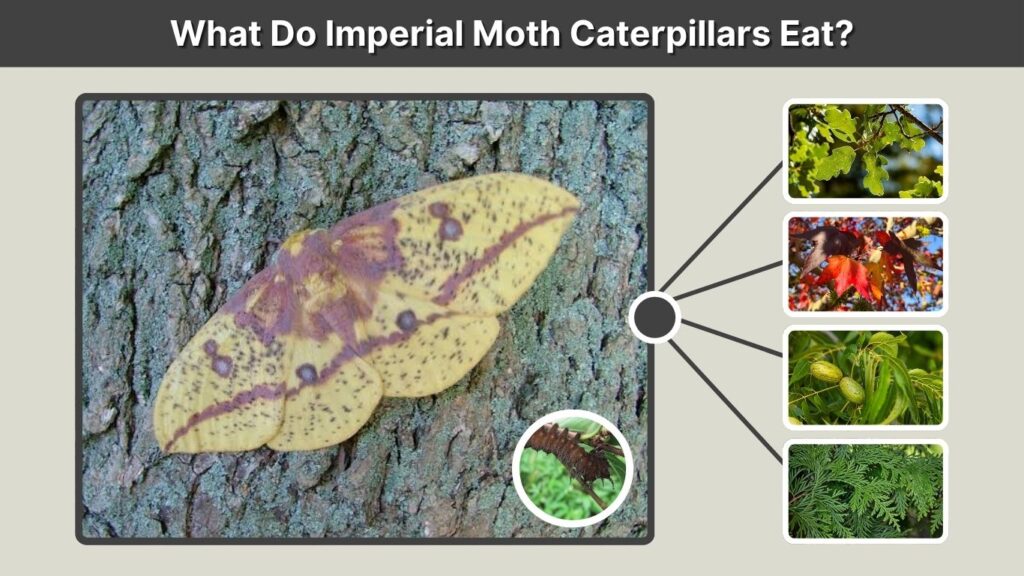
Imperial moth caterpillars feed on leaves from a wide range of trees. Their diet can vary depending on where they live, making them more flexible feeders than some moth species. Caterpillars must consume large amounts of foliage because nearly all physical growth takes place before they enter the pupal stage.
Imperial Moth Caterpillar Food
Common host plants include:
- Oak
- Pine
- Maple
- Sweetgum
- Hickory
- Sassafras
- Sycamore
- Cedar
- Elm
- Birch
Caterpillars generally remain on suitable host trees while actively feeding.
What Do Adult Imperial Moths Eat?
Adult imperial moths do not normally eat. Like many giant silk moths, they have greatly reduced mouthparts and survive mainly on energy stored during the caterpillar stage.
Their adult lives are therefore short and focused almost completely on reproduction.
Imperial Moth Life Cycle
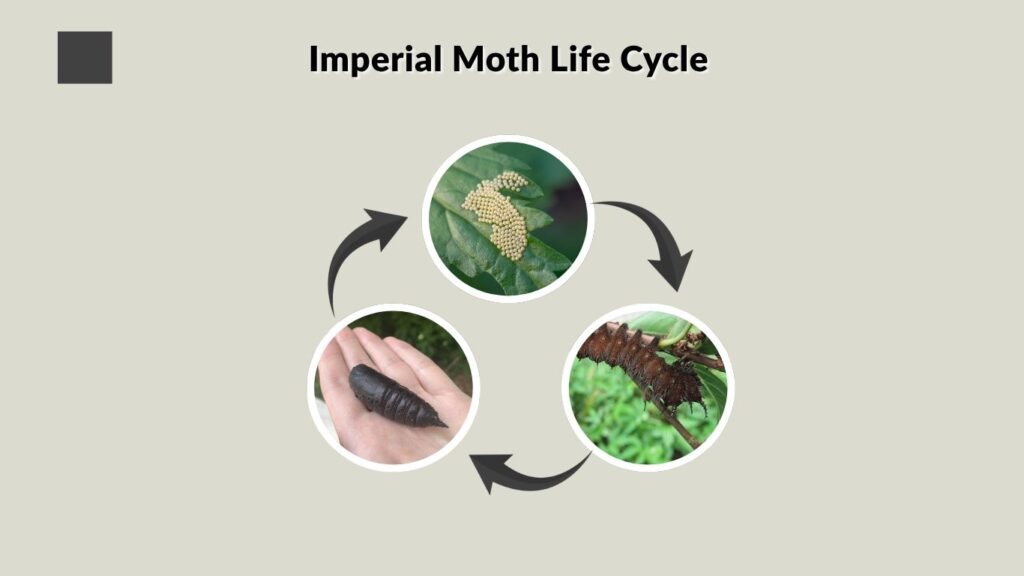
The imperial moth undergoes complete metamorphosis with four major stages: egg, caterpillar, pupa, and adult. Most of the feeding and growth happen during the larval period. Unlike some large moths that suspend a cocoon from vegetation, imperial moth caterpillars usually pupate underground.
Imperial Moth Eggs
After mating, females lay eggs on suitable host plants.
The eggs are usually deposited individually or in small groups. Once they hatch, the tiny larvae begin feeding on nearby leaves.
Caterpillar Stage
Imperial moth larvae pass through several instars as they grow.
During this period, they:
- Eat large quantities of leaves.
- Molt several times.
- Increase dramatically in size.
- Change color as they mature.
- Eventually they leave their host tree before pupation.
When fully grown, the caterpillar often wanders across the ground in search of a suitable place to pupate.
Imperial Moth Pupa
Instead of spinning a typical above-ground silk cocoon, an imperial moth caterpillar generally burrows into loose soil or leaf litter and transforms into a dark brown pupa.
This is why the terms imperial moth cocoon and imperial moth chrysalis can be misleading. Moths form pupae rather than butterfly chrysalises, and this species usually pupates underground without a conspicuous silk cocoon.
The pupal stage may last through winter in cooler regions.
Male vs. Female Imperial Moth
Male and female imperial moths can often be distinguished through a combination of size, markings, and antenna structure. These differences are connected to their reproductive roles. Females need larger bodies for egg production, whereas males need highly sensitive antennae to locate females by detecting pheromones.
Male Imperial Moth
Male imperial moths usually:
- Have more extensive purple or reddish-brown wing markings.
- Possess broader, more feathered antennae.
- Have slimmer bodies.
- Fly actively at night searching for females.
Their sensitive antennae are especially important for detecting female pheromones.
Female Imperial Moth
Females generally have:
- Larger and heavier bodies.
- More yellow visible on the wings.
- Less feathery antennae.
- Large abdomens containing eggs.
After mating, females seek suitable host plants where they can deposit their eggs.
Imperial Moth Habitat and Range
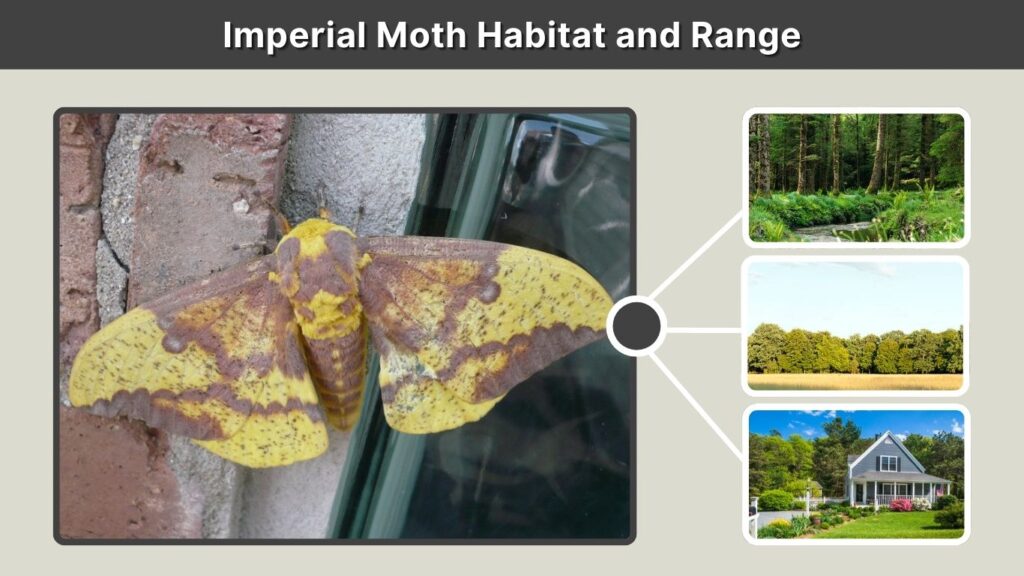
Imperial moths inhabit forests, woodland edges, suburban landscapes, and other areas containing their host trees. Because caterpillars can use many different tree species, the moth occurs across a broad range of habitats. Adults are often noticed around outdoor lighting because they are active at night and may be attracted to artificial light.
Where Do Imperial Moths Live?
Imperial moths occur across much of:
- Eastern United States
- Central United States
- Southeastern Canada
- Florida
- Georgia
- Maryland
- Ohio
- Michigan
- Parts of Texas and nearby regions
Their abundance differs considerably across this large range.
Are Imperial Moths Rare?
Imperial moths are not globally considered exceptionally rare, but they may be uncommon in particular areas.
Habitat loss, pesticide use, artificial lighting, and local environmental changes can affect populations. In some northern areas, sightings may be less frequent than in warmer regions where suitable habitat remains abundant.
Imperial Moth Lifespan and Behavior
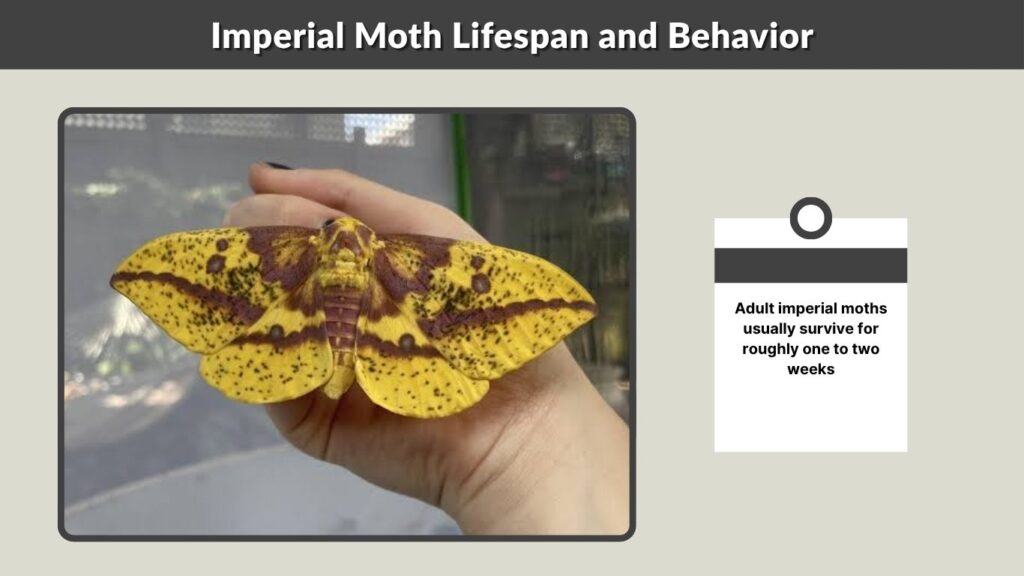
The adult imperial moth has a much shorter lifespan than its earlier developmental stages. Since adults do not feed, they have only the stored energy accumulated while they were caterpillars. Consequently, their behavior is strongly focused on mating and reproduction rather than finding food.
How Long Do Imperial Moths Live?
Adult imperial moths usually survive for roughly one to two weeks, although lifespan varies with temperature, sex, and activity.
During adulthood, they mainly:
- Rest during daylight
- Become active after dark
- Search for mates
- Mate
- Lay eggs
After reproduction, adults eventually die as their stored energy reserves are depleted.
Interesting Imperial Moth Facts
Imperial moths are impressive examples of giant silk moth biology. Their colorful adults, highly variable caterpillars, underground pupation, and non-feeding adult stage make them quite different from the smaller moths commonly encountered around homes.
Quick Imperial Moth Facts
- Scientific name: Eacles imperialis
- Family: Saturniidae
- Adults are mostly yellow with darker markings.
- Females are generally larger than males.
- Males have more strongly feathered antennae.
- Caterpillars may be green, brown, red, or orange.
- Caterpillars feed on many types of trees.
- Mature larvae generally pupate underground.
- Adults do not normally feed.
- Imperial moths are mainly nocturnal.
- Adults commonly live only about one to two weeks.
- They are not considered dangerous to humans.
FAQs
Imperial moths often generate questions because the caterpillar looks spiny and intimidating, while the adult is unusually large and colorful. Their unusual pupation behavior and extremely short adult feeding period also make them quite different from many familiar insects.
Are imperial moths poisonous?
No. Adult imperial moths are not poisonous or venomous and do not pose a significant threat to people. Their caterpillars have hairs and spines that may cause mild irritation if handled, but they are not regarded as dangerously venomous caterpillars.
Do imperial moths bite?
Adult imperial moths do not normally bite people. Their mouthparts are greatly reduced, and adults generally do not feed at all. Caterpillars have chewing mouthparts for eating leaves, but they are not aggressive and do not normally attempt to bite humans.
What do imperial moth caterpillars eat?
Imperial moth caterpillars eat leaves from many trees, including oak, pine, maple, hickory, sweetgum, sassafras, sycamore, cedar, elm, and birch. Their broad host range allows them to develop in many different forested habitats.
How long do imperial moths live?
Adult imperial moths usually live for about one to two weeks. Because they do not normally feed as adults, they depend on energy stored during their caterpillar stage. Their brief adult period is therefore concentrated almost entirely on mating and egg laying.
Can you touch an imperial moth caterpillar?
It is better to avoid unnecessary handling. Imperial moth caterpillars are not considered dangerously venomous, but their stiff hairs and spines may irritate sensitive skin. Handling can also injure the caterpillar, so allowing it to crawl onto a leaf or twig is preferable.
