
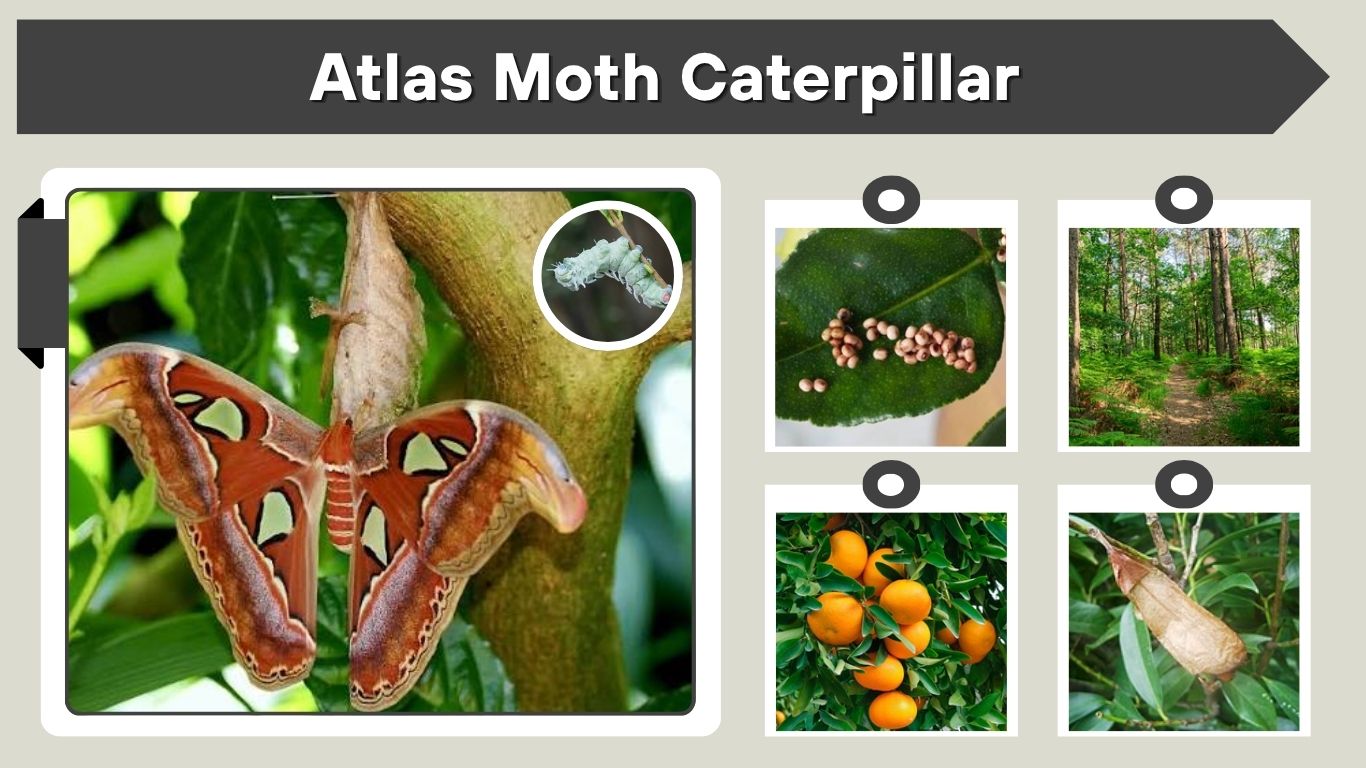
The Atlas moth caterpillar is the larval stage of Attacus atlas, one of the largest moths in the world. This impressive caterpillar is known for its thick pale-green body, waxy-looking projections, and remarkable appetite for leaves. It lives mainly in tropical and subtropical parts of Asia, where it feeds continuously before forming a large silk cocoon. Although its unusual appearance can make it seem dangerous, the caterpillar is generally harmless to people. Here is everything you need to know about its size, diet, care, and life cycle.
What Does an Atlas Moth Caterpillar Look Like?
Atlas moth caterpillars have a distinctive appearance that makes mature individuals relatively easy to recognize. Their bodies become large and thick as they grow, while pale colors help them blend among leaves and branches. Young caterpillars may look different from fully developed larvae because their color, body proportions, and protective surface structures change through several molts before pupation.
Atlas Moth Caterpillar Identification
Look for these common characteristics:
- Body color: Usually pale green, bluish-green, or whitish-green.
- Body shape: Thick, cylindrical, and heavy-bodied when mature.
- Waxy coating: The body often appears covered with a whitish or powdery wax.
- Projections: Numerous soft, fleshy projections or tubercles occur along the body.
- Head: Relatively small compared with the thick body.
- Legs: Six true legs are located near the front, with fleshy prolegs farther back.
- Movement: It usually moves slowly and spends much of its time feeding or resting on foliage.
- Size: Mature caterpillars can grow several inches long.
Giant Atlas Moth Caterpillar
The term giant Atlas moth caterpillar usually refers to a mature larva approaching the end of its feeding stage. At this point, the caterpillar may look exceptionally thick and heavy. Its large size is necessary because the adult Atlas moth does not rely heavily on feeding. Much of the energy required for adulthood is accumulated during the caterpillar stage.
Atlas Moth Caterpillar Size
Atlas moth caterpillars begin life extremely small after hatching but increase dramatically in size during their development. They pass through several larval stages known as instars, shedding their outer skin whenever it becomes too restrictive. Growth becomes especially noticeable during the later instars when the caterpillar consumes large amounts of foliage and stores energy for metamorphosis.
How Big Does an Atlas Moth Caterpillar Get?
A mature Atlas moth caterpillar can commonly reach around 4 to 4.5 inches (10–12 cm) in length, although exact size varies with nutrition, temperature, genetics, and developmental conditions.
The caterpillar’s body also becomes remarkably thick. Mature larvae may appear almost finger-sized, particularly after a period of heavy feeding.
When the caterpillar reaches full size, feeding eventually slows. It then begins searching for an appropriate location where it can spin its cocoon and enter the pupal stage.
Why Do Atlas Caterpillars Grow So Large?
Atlas caterpillars need to store substantial amounts of nutrients before becoming adults. Unlike many butterflies and moths that regularly feed after emerging, adult Atlas moths have greatly reduced mouthparts and generally live mainly on energy stored during larval development.
For this reason, the caterpillar stage is largely devoted to eating, growing, and accumulating reserves.
What Do Atlas Moth Caterpillars Eat?
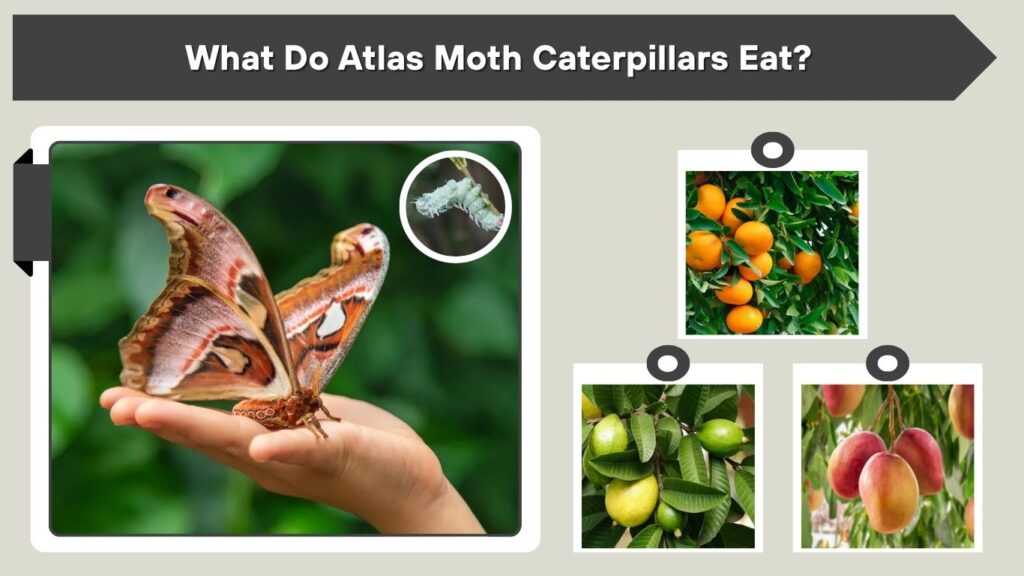
The Atlas moth caterpillar diet consists almost entirely of leaves. They are herbivorous larvae and require a steady supply of suitable fresh foliage throughout development. Host plants may vary depending on geographical location and availability. Caterpillars usually perform best when they continue eating the same plant species they became accustomed to after hatching.
Atlas Moth Caterpillar Food
Commonly reported host plants include:
- Citrus leaves
- Guava leaves
- Cinnamon-related plants
- Privet
- Indian almond
- Mango
- Avocado
- Several other broadleaf trees and shrubs
Not every caterpillar will readily switch between different plants. Sudden diet changes can cause larvae to stop feeding.
How Much Do They Eat?
Young larvae eat relatively small portions of leaves, but their appetite increases enormously as they grow. Large caterpillars may spend much of the day consuming foliage.
Fresh leaves are particularly important. Wilted, contaminated, or pesticide-treated leaves should be avoided when caterpillars are being raised in captivity.
Are Atlas Moth Caterpillars Poisonous?
The strange projections and waxy covering of Atlas moth caterpillars can make them look threatening. However, they are not generally considered dangerous caterpillars. Their appearance functions more as camouflage and protection than as a serious threat to humans. Normal observation presents little risk, although unnecessary handling should still be avoided because caterpillars are delicate animals.
Are Atlas Moth Caterpillars Poisonous to Humans?
Atlas moth caterpillars are not known as dangerously poisonous or venomous to humans. Their soft projections are quite different from the specialized stinging hairs found on certain venomous caterpillar species.
Touching one normally does not produce the painful sting associated with species such as puss caterpillars or some giant silkworm moth larvae.
However, sensitive individuals could potentially experience mild skin irritation after contact with insects, plant material, or defensive secretions.
Can You Touch an Atlas Moth Caterpillar?
It is better to observe the caterpillar rather than frequently handle it. Its body and gripping legs can be damaged if someone pulls it from a branch.
If relocation is necessary, allowing the caterpillar to crawl naturally onto another leaf or twig is safer than grabbing it directly.
Atlas Moth Caterpillar Life Cycle
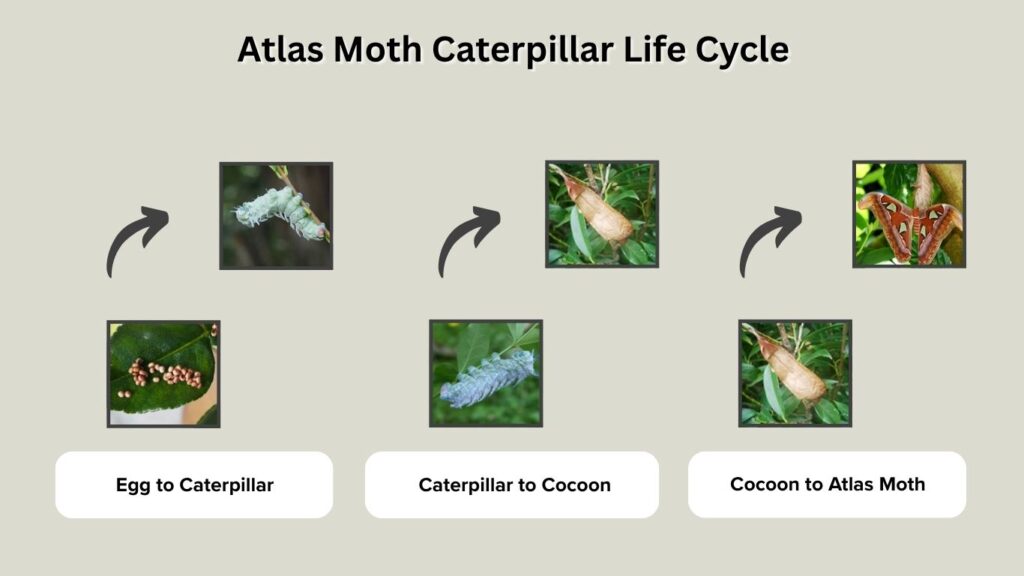
The transformation from a tiny caterpillar into an enormous Atlas moth involves complete metamorphosis. Each developmental stage has a different purpose. Larvae concentrate primarily on feeding and growth, whereas the pupal stage reorganizes the insect’s body into its adult form. Environmental conditions such as temperature, humidity, food availability, and season can influence how quickly development occurs.
Egg to Caterpillar
Female Atlas moths lay eggs on or close to suitable host plants. After development inside the egg, tiny caterpillars hatch and begin eating leaves.
The larvae pass through several instars. Between each stage, they molt and grow larger. Their appearance may also change noticeably during development.
Caterpillar to Cocoon
Once fully grown, the caterpillar stops feeding and prepares to pupate. It produces silk and constructs a tough cocoon, commonly incorporating a leaf into the structure.
Inside the cocoon, the caterpillar becomes a pupa. During this stage, its body undergoes extensive transformation.
Cocoon to Atlas Moth
Eventually, an adult Atlas moth emerges from the cocoon. Its wings initially appear soft and folded. The moth pumps fluid into them until they expand to their full size.
Adult Atlas moths are famous for their enormous wings, reddish-brown coloration, translucent wing patches, and snake-like patterns near the wing tips.
Atlas Moth Caterpillar Care
Keeping an Atlas moth caterpillar successfully requires appropriate food, ventilation, cleanliness, and enough room for growth. These caterpillars can consume substantial quantities of foliage during their final stages. Anyone raising them should also make sure the species can legally be kept in their location, especially when insects or eggs would need to be transported across borders.
Basic Care Requirements
Important care considerations include:
- Provide fresh leaves from an accepted host plant.
- Avoid plants treated with pesticides or other chemicals.
- Keep the enclosure well ventilated.
- Remove old leaves and droppings regularly.
- Provide enough space for mature caterpillars.
- Avoid excessive handling.
- Keep environmental conditions appropriate for a tropical species.
- Supply branches or leaves suitable for cocoon construction.
Feeding Atlas Moth Caterpillars
Fresh food should remain available while caterpillars are actively feeding. Leaves can be replaced whenever they begin drying significantly.
Maintaining cleanliness is equally important. Caterpillar droppings and decaying foliage can encourage mold and poor conditions. The enclosure should therefore be cleaned regularly without unnecessarily disturbing the larvae.
Preparing for Pupation
A fully grown caterpillar eventually becomes less interested in food and may wander around looking for a suitable pupation site.
Provide sturdy leaves and branches where it can attach its silk. Once cocoon construction begins, avoid unnecessary disturbance. The pupa should remain protected while metamorphosis takes place inside.
Atlas Moth Caterpillar Habitat and Distribution
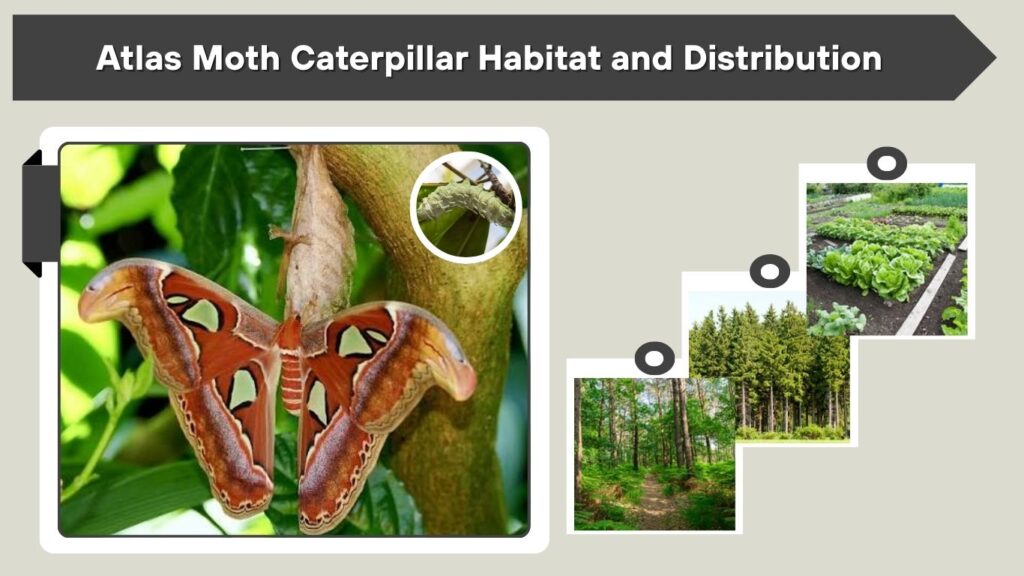
Atlas moths naturally occur across parts of South and Southeast Asia. Their caterpillars live wherever appropriate host plants and suitable warm conditions are available. Because larvae spend much of their development on vegetation, forests, woodland edges, gardens, plantations, and other leafy environments may provide appropriate habitat within the species’ natural distribution.
Where Are Atlas Moth Caterpillars Found?
Atlas moths occur in countries and regions including India, southern China, Malaysia, Indonesia, Thailand, and other areas of tropical and subtropical Asia.
The species is also particularly well known in Singapore, where sightings of giant Atlas moths and their caterpillars occasionally attract considerable attention.
Caterpillars are usually found directly on host vegetation rather than wandering on the ground. However, mature larvae may move away from feeding areas when searching for a suitable place to pupate.
Quick Facts About the Atlas Moth Caterpillar
Atlas moth caterpillars are remarkable not only because of their size but because nearly their entire larval existence is devoted to preparing for adulthood. Their rapid growth, enormous appetite, unusual wax-covered bodies, and transformation inside a silk cocoon make them one of Asia’s most fascinating moth larvae.
Interesting Atlas Moth Caterpillar Facts
- The scientific name of the Atlas moth is Attacus atlas.
- Caterpillars may grow roughly 4 inches or more in length.
- Their primary food consists of leaves.
- Mature larvae are pale green or bluish-green.
- Their bodies have noticeable soft projections.
- They produce silk when preparing to pupate.
- The cocoon is often attached to or incorporated into a leaf.
- They are not regarded as dangerously poisonous to humans.
- Caterpillars store much of the energy used by adult moths.
- The adult Atlas moth is among the world’s largest moths by wing area.
FAQs
Atlas moth caterpillars attract many questions because their enormous size and unusual appearance can make them seem mysterious or even dangerous. Most questions concern their toxicity, food, adult transformation, and suitability as captive insects. Understanding their natural development also makes it easier to appreciate why these caterpillars spend so much of their larval stage continuously feeding.
Is an Atlas moth caterpillar poisonous?
No. Atlas moth caterpillars are not generally considered poisonous or dangerously venomous to humans. Their fleshy projections may look intimidating, but they are not comparable to the specialized stinging hairs of highly venomous caterpillars. Nevertheless, handling wild caterpillars unnecessarily is best avoided.
What does an Atlas moth caterpillar eat?
Atlas moth caterpillars eat leaves from several trees and shrubs. Reported food plants include citrus, guava, privet, mango, avocado, and other broadleaf plants. The exact preferred host can vary, and captive caterpillars should generally be kept on a plant species they already accept.
How big is a full-size Atlas moth caterpillar?
A fully grown Atlas moth caterpillar can reach approximately 4 to 4.5 inches, or about 10–12 centimeters, in length. Mature larvae also become extremely thick. Their impressive size results from intensive feeding and the need to store energy before entering the pupal and adult stages.
How long does an Atlas moth caterpillar live?
The length of the caterpillar stage varies according to temperature, food quality, humidity, and other environmental conditions. During this period, the larva passes through several instars before reaching full size. It then stops eating, spins a silk cocoon, and transforms into a pupa.
Can you keep an Atlas moth caterpillar as a pet?
Atlas moth caterpillars can be raised in captivity by experienced keepers where legally permitted. They require fresh host-plant leaves, good ventilation, sufficient space, and careful hygiene. Because regulations concerning live insects differ between countries and regions, local rules should be checked before buying, importing, or keeping them.
