
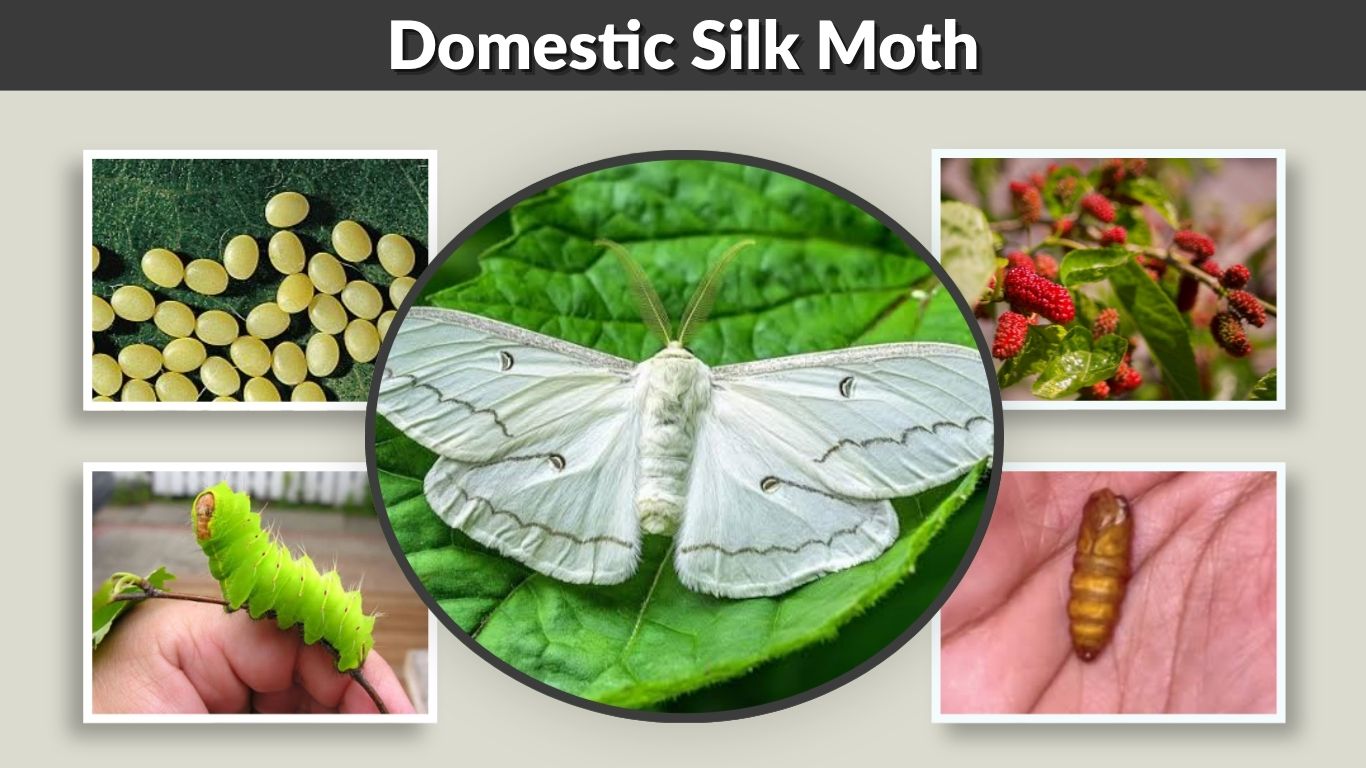
The domestic silk moth is one of the best-known insects associated with natural silk production. Scientifically called Bombyx mori, it has been domesticated by humans for thousands of years and is now highly dependent on people for survival and reproduction. Its caterpillars, commonly called silkworms, feed mainly on mulberry leaves before spinning valuable silk cocoons. Adult moths are pale, soft-bodied, and usually unable to fly effectively. This guide covers domestic silk moth identification, lifespan, diet, life cycle, size, wings, behavior, domestication, and differences from wild silk moths.
What Is a Domestic Silk Moth?
The domestic silk moth is a fully domesticated species raised mainly for silk production. Unlike most wild moths, Bombyx mori has undergone generations of selective breeding that changed its body shape, flight ability, behavior, and dependence on humans. Its caterpillar produces a strong silk fiber when making its cocoon, which has made the species economically important for centuries.
Domestic Silk Moth Scientific Name
The scientific name of the domestic silk moth is Bombyx mori.
Its general classification includes:
- Order: Lepidoptera
- Family: Bombycidae
- Genus: Bombyx
- Species: Bombyx mori
- Common name: Domestic silk moth
- Larval name: Silkworm
The caterpillar is responsible for producing the silk used in sericulture.
Are Silk Moths Domesticated?
Not all silk moths are domesticated. Many wild species naturally occur in forests and woodlands.
The term “domestic silk moth” specifically refers to Bombyx mori, which has been bred by humans for such a long period that it differs greatly from its wild relatives.
What Does a Domestic Silk Moth Look Like?
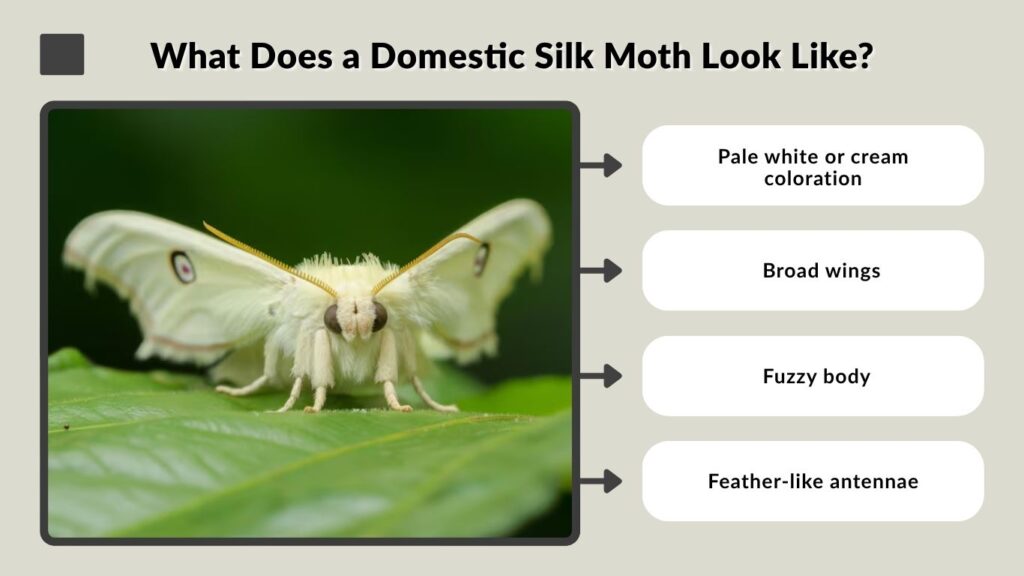
Adult domestic silk moths are usually pale cream, white, or light beige. They have relatively thick, fuzzy bodies and broad wings. Compared with many colorful wild silk moths, their appearance is fairly simple.
They are also smaller than most giant silk moth species.
Domestic Silk Moth Identification
Typical characteristics include:
- Pale white or cream coloration
- Broad wings
- Fuzzy body
- Feather-like antennae
- Relatively small head
- Thick abdomen
- Wingspan of roughly 1.5 to 2.5 inches
- Poor flying ability
- Reduced adult mouthparts
Males generally have larger, more feathery antennae that help them detect female pheromones.
Domestic Silk Moth Wings
Domestic silk moth wings are fully formed, but most adults cannot use them for strong sustained flight.
Their wings are generally cream-colored with subtle brownish markings. Despite having functional-looking wings, generations of domestication have reduced the moth’s flight capability.
Can Domestic Silk Moths Fly?
Domestic silk moths generally cannot fly effectively. Some individuals may flutter or move their wings, but sustained natural flight is uncommon.
This characteristic is one of the clearest differences between domesticated and wild moth species.
Why Can’t Domestic Silk Moths Fly?
Thousands of years of selective breeding reduced the need for strong flight. Humans provided food, protection, mates, and controlled environments, so traits associated with long-distance flight became less important.
Modern domestic silk moths also tend to have relatively heavy bodies compared with their wing size.
Because of these changes, they are poorly adapted to surviving independently in the wild.
Domestic Silk Moth Caterpillar
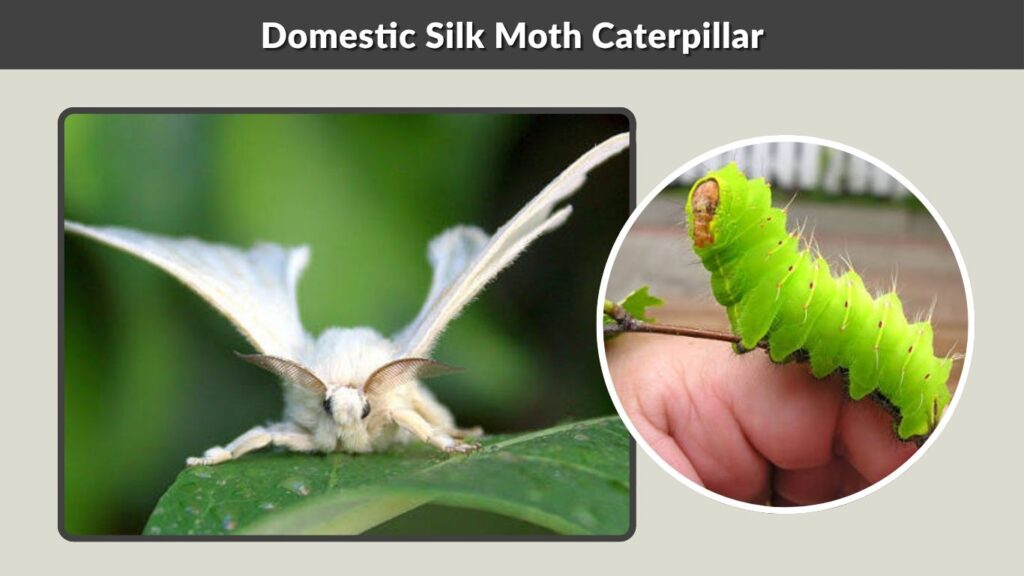
The domestic silk moth caterpillar is better known as the silkworm.
It is the most economically important stage of the moth’s life because this is when feeding, rapid growth, and silk production occur.
What Does a Domestic Silk Moth Caterpillar Look Like?
Silkworms are generally:
- White to pale cream
- Soft-bodied
- Relatively smooth
- Segmented
- Equipped with chewing mouthparts
- Larger and thicker as they mature
Newly hatched larvae are extremely small and darker in appearance. They become progressively lighter and larger after repeated molts.
What Do Domestic Silk Moth Caterpillars Eat?
Domestic silkworms primarily eat mulberry leaves.
Mulberry provides the nutrition and moisture needed for development.
Fresh leaves are preferred, although commercially raised silkworms may also receive specially formulated artificial diets containing mulberry-based ingredients.
What Do Domestic Silk Moths Eat?
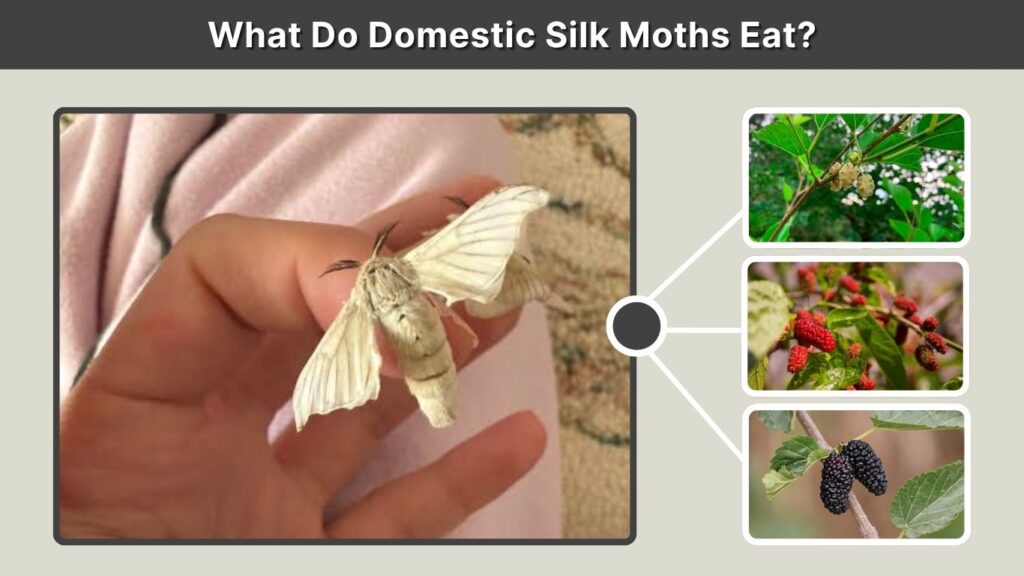
The answer depends on the life stage.
Domestic silk moth caterpillars feed heavily, whereas adults typically do not eat at all.
Caterpillar Diet
Silkworm caterpillars primarily consume:
- White mulberry leaves
- Red mulberry leaves
- Black mulberry leaves
- Prepared silkworm food
- Mulberry-based artificial diets
They may eat almost continuously during periods of rapid growth.
Do Adult Domestic Silk Moths Eat?
Adult domestic silk moths generally do not eat.
Their mouthparts are greatly reduced and not designed for normal feeding. Adults survive on stored energy accumulated during the caterpillar stage.
Their main adult functions are mating and reproduction.
Domestic Silk Moth Life Cycle
The domestic silk moth undergoes complete metamorphosis, meaning it develops through four distinct life stages. Each stage looks and functions differently.
The complete cycle can often be finished within several weeks under favorable controlled conditions.
Four Life Cycle Stages
- Egg
- Larva or silkworm
- Pupa inside a cocoon
- Adult moth
After mating, the female lays eggs, beginning the cycle again.
Domestic Silk Moth Eggs
A female may lay several hundred tiny eggs.
The eggs are initially pale but often darken as development progresses. Under suitable warm conditions, larvae usually hatch after several days.
Once hatched, the young silkworms begin eating mulberry leaves almost immediately.
Larval Stage
The larval stage lasts several weeks.
During this period, silkworms feed heavily and undergo a series of molts. Their primary goal is to grow and accumulate enough energy for pupation and adulthood.
When fully grown, the larva stops eating and prepares to spin a cocoon.
Domestic Silk Moth Cocoon
The silkworm produces silk from specialized glands.
It moves its head repeatedly while wrapping a continuous silk filament around its body. Eventually, this creates a dense protective cocoon.
Inside the cocoon, the caterpillar becomes a pupa and begins transforming into an adult moth.
Adult Stage
When development is complete, the adult moth emerges.
Domestic adults generally do not feed. They focus on finding mates and reproducing.
After females lay their eggs, both males and females usually die within a relatively short period.
Domestic Silk Moth Lifespan
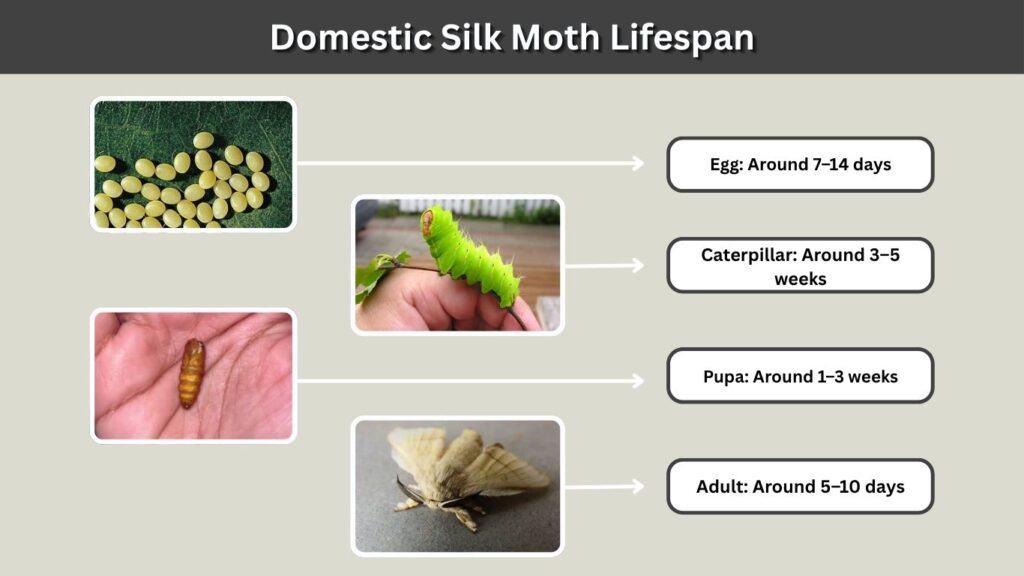
The lifespan of a domestic silk moth depends on whether you mean the complete life cycle or only the adult stage.
Most of its life is spent as an egg, caterpillar, or pupa rather than as an adult moth.
How Long Do Domestic Silk Moths Live?
Adult domestic silk moths usually live around 5 to 10 days, although environmental conditions can affect survival.
The complete life cycle may last approximately 6 to 8 weeks under favorable conditions.
Typical timing may include:
- Egg: Around 7–14 days
- Caterpillar: Around 3–5 weeks
- Pupa: Around 1–3 weeks
- Adult: Around 5–10 days
Temperature, genetics, feeding conditions, and breeding practices can change these periods.
Domestic Silk Moth Size
Domestic silk moths are much smaller than giant wild silk moths such as Cecropia or Polyphemus moths.
Adult size can vary somewhat among strains.
How Big Are Domestic Silk Moths?
Adults generally have:
- A wingspan around 1.5–2.5 inches
- A thick, fuzzy body
- Females that are often heavier than males
- Males with broader, more feathery antennae
Females may appear especially large around the abdomen because they carry numerous eggs.
Domestic Silk Moth vs. Wild Silk Moth
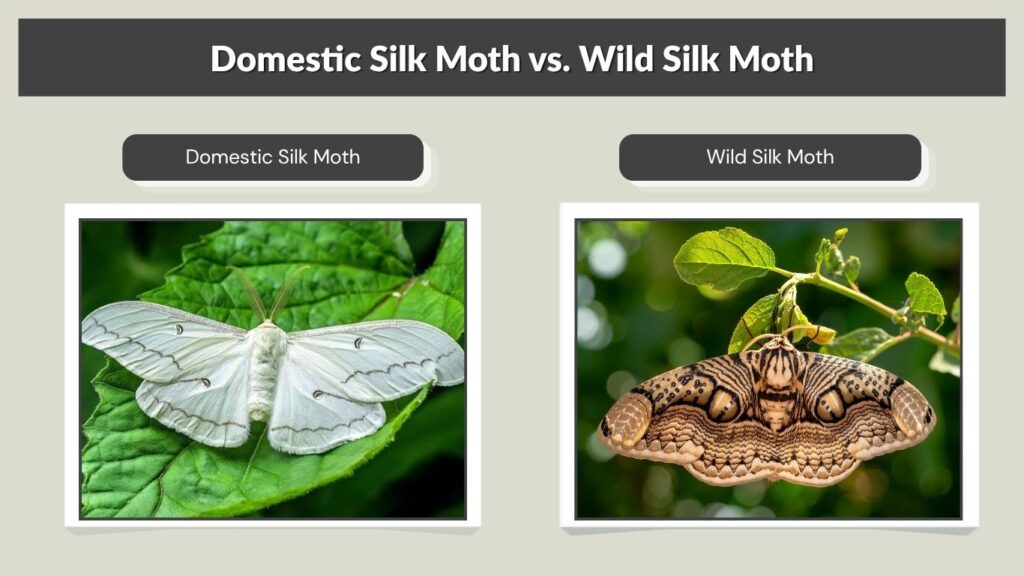
Domestic and wild silk moths can both produce silk as caterpillars, but their lifestyles are significantly different.
Wild moths have evolved to survive independently, while domestic silk moths depend strongly on human-controlled environments.
Main Differences
| Feature | Domestic Silk Moth | Wild Silk Moth |
| Scientific group | Bombyx mori | Several species |
| Flight | Very poor or absent | Usually capable of flight |
| Main caterpillar food | Mulberry | Varies by species |
| Human dependence | Very high | Low |
| Adult feeding | Does not eat | Many species do not eat |
| Silk production | Commercially important | Mostly natural/wild |
| Color | Usually pale | Highly variable |
| Survival in wild | Poor | Naturally adapted |
Wild silk moths also tend to have stronger flight abilities and greater camouflage or defensive adaptations.
Silk Moth Domestication
The domestication of the silk moth is closely connected with the history of silk production.
Humans selectively bred silkworms for desirable traits such as larger cocoons, greater silk yield, predictable development, and easier handling.
How Domestication Changed Silk Moths
Domestication resulted in several major changes:
- Reduced flight ability
- Greater dependence on humans
- High silk production
- Reduced ability to avoid predators
- More predictable reproduction
- Reliance on controlled food supplies
- Less effective natural survival behavior
Modern Bombyx mori is therefore one of the clearest examples of complete insect domestication.
Are Domestic Silk Moths Dangerous?
Domestic silk moths are harmless to humans.
They do not have stingers, do not aggressively bite, and are not poisonous.
Can Domestic Silk Moths Bite?
Adult domestic silk moths cannot meaningfully bite humans because their mouthparts are greatly reduced.
Silkworm caterpillars have chewing mouthparts for eating leaves but are not aggressive toward people.
They are generally safe to observe and handle carefully.
Can You Keep a Domestic Silk Moth as a Pet?
Domestic silk moths and silkworms are sometimes kept for educational projects, classroom observations, insect raising, or as feeder insects during their larval stage.
They require appropriate food and a clean environment.
Basic Requirements for Raising Domestic Silk Moths
Silkworms need:
- Fresh mulberry leaves or suitable prepared food
- Good ventilation
- Clean containers
- Appropriate temperature
- Dry conditions
- Enough space as they grow
- A suitable place for cocoon formation
Because adult moths have short lifespans, most of the care involves the caterpillar stage.
Interesting Domestic Silk Moth Facts
Domestic silk moths have several unusual characteristics created through thousands of years of association with humans.
Quick Facts
- Their scientific name is Bombyx mori.
- Their caterpillars are called silkworms.
- Silkworms mainly eat mulberry leaves.
- Adults usually cannot fly effectively.
- Adult moths generally do not eat.
- Caterpillars produce silk when making cocoons.
- Females can lay hundreds of eggs.
- Adults usually live for only several days.
- They depend heavily on human care.
- They have been selectively bred for silk production.
FAQs
How Long Do Domestic Silk Moths Live?
Adult domestic silk moths normally live for approximately 5 to 10 days. They do not eat during adulthood and survive on energy stored during the caterpillar stage. Their complete life cycle may last roughly six to eight weeks under favorable conditions.
Can Domestic Silk Moths Fly?
Domestic silk moths generally cannot fly effectively. Although adults possess wings, generations of selective breeding have reduced their flight ability. They may flutter their wings or move short distances, but they are very different from strongly flying wild moths.
Do Domestic Silk Moths Have Mouths?
Adult domestic silk moths have greatly reduced mouthparts and do not normally feed. Their caterpillars have strong chewing mouthparts and consume large amounts of mulberry foliage. Adults rely on nutritional reserves collected during the larval stage.
What Do Domestic Silk Moths Eat?
Domestic silk moth caterpillars primarily eat mulberry leaves. Adult moths generally eat nothing because they lack functional feeding mouthparts. This makes the caterpillar stage responsible for collecting almost all of the nutrients needed throughout the moth’s life.
Are Domestic Silk Moths Good Pets?
Domestic silk moths can be interesting insects to raise for observation or education. Their caterpillars are relatively easy to care for when suitable mulberry leaves or prepared food are available. However, adults live only briefly, so they are better considered short-term educational insects than conventional pets.
