
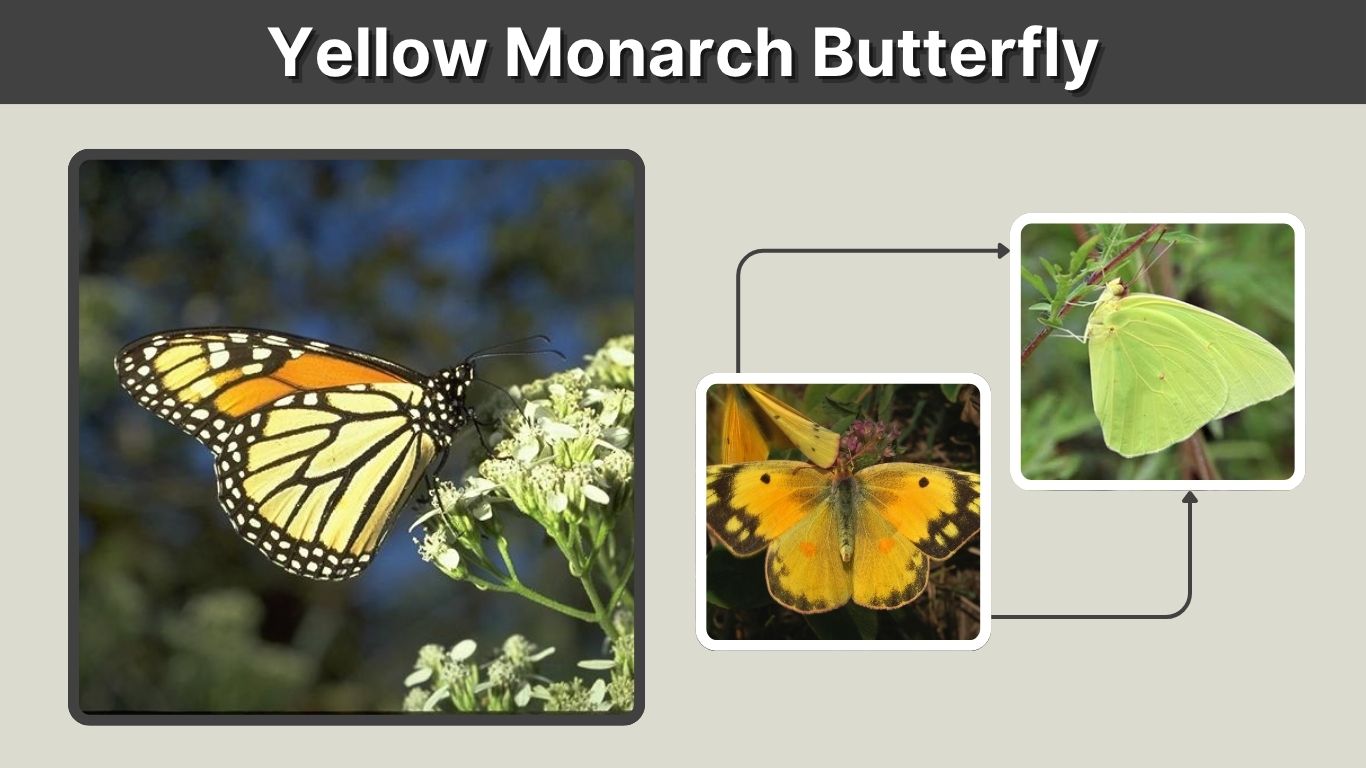
A bright yellow-and-black butterfly can easily be mistaken for a yellow monarch, especially when it has large wings and dark markings. However, adult monarch butterflies are naturally orange, black, and white—not bright yellow. A butterfly described as a “yellow monarch” is usually a swallowtail, sulphur, or another look-alike. In some cases, an old monarch may appear pale or yellowish after losing colorful wing scales. Correct identification depends on wing shape, markings, size, and flight behavior.
Is There a Yellow Monarch Butterfly?
There is no recognized yellow form of the North American monarch butterfly, Danaus plexippus. Fresh adult monarchs have rich orange wings crossed by black veins, with black borders containing small white spots. Their wingspan is generally about 3.5–4.8 inches.
Therefore, a large butterfly with lemon-yellow wings is unlikely to be a monarch. The term “yellow monarch butterfly” is commonly used informally when someone sees:
- A yellow swallowtail with black markings
- A yellow sulphur butterfly
- A faded or worn monarch
- A monarch caterpillar with yellow bands
- A butterfly photographed under unusual lighting
Monarch caterpillars are genuinely yellow, black, and white. This may also cause confusion when people use the phrase “yellow monarch” while referring to the larval stage rather than the adult butterfly.
Why Can a Monarch Look Yellow?
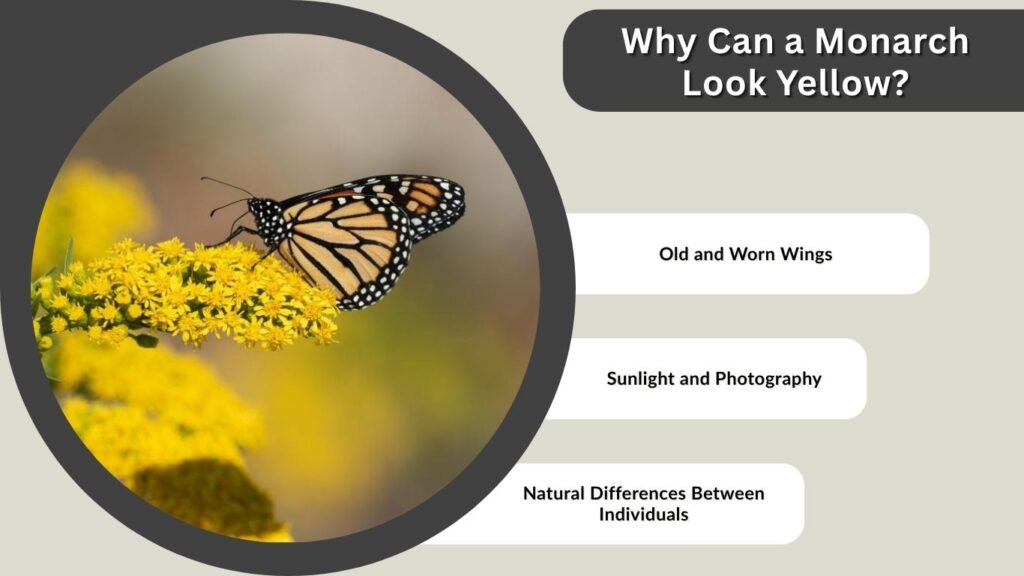
Although healthy adult monarchs are orange, several factors can make one appear lighter, duller, or yellowish.
Old and Worn Wings
Butterfly wings are covered with thousands of tiny colored scales. These scales gradually wear away as the butterfly encounters plants, wind, rain, predators, and other rough surfaces.
As an older monarch loses orange scales, its wings may become faded and pale. The thin, partly transparent wing membrane underneath can make the remaining color look cream, tan, or yellowish. Long-lived overwintering monarchs can look particularly faded near the end of their lives.
Sunlight and Photography
Strong sunlight can wash out the orange color in a photograph. Camera settings, filters, reflections, and screen displays can also change orange into a more yellow shade.
A reliable identification should therefore consider the pattern rather than color alone. A real monarch should still have black veins, broad black margins, and white spots around the outer edges.
Natural Differences Between Individuals
Monarch coloration varies slightly. Females often appear darker and have wider black veins, while males generally have thinner veins and a black scent spot on each hindwing. The underside of either sex is naturally paler than the upper surface. However, these differences do not normally create a truly bright-yellow adult.
Yellow Butterflies That Look Like Monarchs
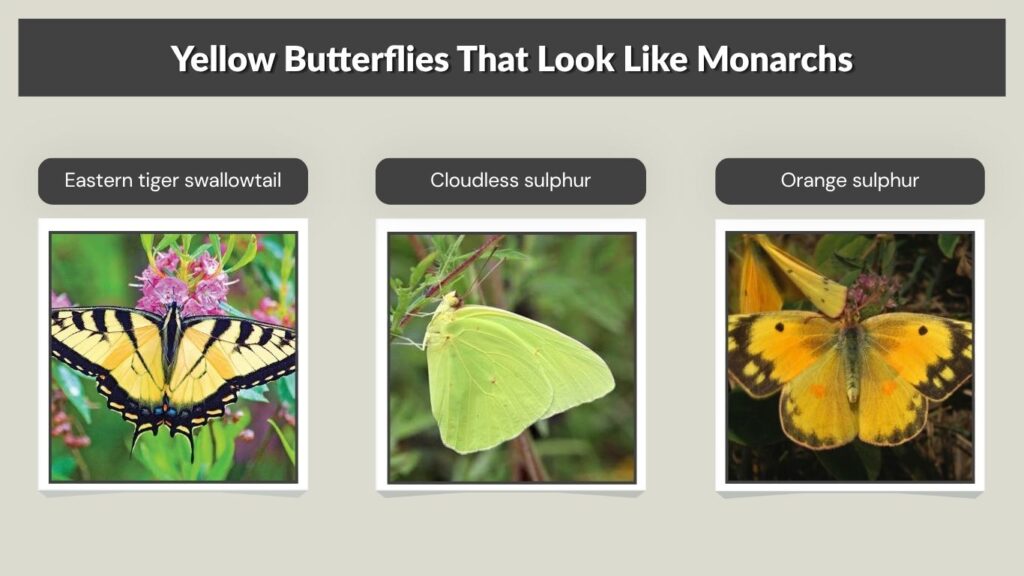
Several yellow-and-black butterflies may be called yellow monarchs by people unfamiliar with their distinguishing features.
| Butterfly | Main color | Best identification feature |
| Eastern tiger swallowtail | Yellow and black | Four tiger-like stripes and long tails |
| Western tiger swallowtail | Yellow and black | Black stripes with tails on the hindwings |
| Cloudless sulphur | Bright yellow | Mostly plain wings without monarch-like veins |
| Orange sulphur | Yellow-orange | Small size and dark forewing border |
| Palamedes swallowtail | Black and yellow | Yellow bands on dark wings |
| Faded monarch | Pale orange or tan | Monarch wing pattern remains visible |
Eastern Tiger Swallowtail
The eastern tiger swallowtail is probably the most likely butterfly to be called a yellow monarch. It is large and has yellow wings with bold black markings.
Its most obvious features are four dark tiger-like stripes on each forewing and a pair of narrow tails extending from the hindwings. A monarch does not have these tails. Female tiger swallowtails may be yellow or almost entirely dark.
Western Tiger Swallowtail
The western tiger swallowtail resembles the eastern species and occurs mainly in western North America. It has pale-yellow wings, black stripes, blue and orange markings near the hindwings, and prominent tails.
Its broad wings and slow gliding flight may remind observers of a monarch, but the striped pattern and tails quickly separate it from one.
Cloudless Sulphur
The cloudless sulphur is a large yellow butterfly that sometimes migrates in noticeable numbers. Males are generally solid yellow, while females may have darker wing borders and a dark spot on each forewing.
It can be mistaken for a yellow monarch because of its size and migratory behavior. However, its wings lack the monarch’s network of heavy black veins and white-spotted border.
Orange and Clouded Sulphurs
Orange sulphurs and clouded sulphurs are smaller than monarchs. Their wings range from pale yellow to deep orange-yellow and may have black margins.
These butterflies often fly quickly and close to the ground. Monarchs usually have a slower, more powerful pattern of flapping and gliding.
Palamedes Swallowtail
The Palamedes swallowtail is predominantly dark brown or black, with noticeable yellow bands across both pairs of wings. Its hindwing tails are also marked with yellow.
Because its colors are the reverse of a typical yellow tiger swallowtail, it might be described as either a black-and-yellow monarch or yellow-and-black monarch.
Yellow Monarch Butterfly vs. Swallowtail
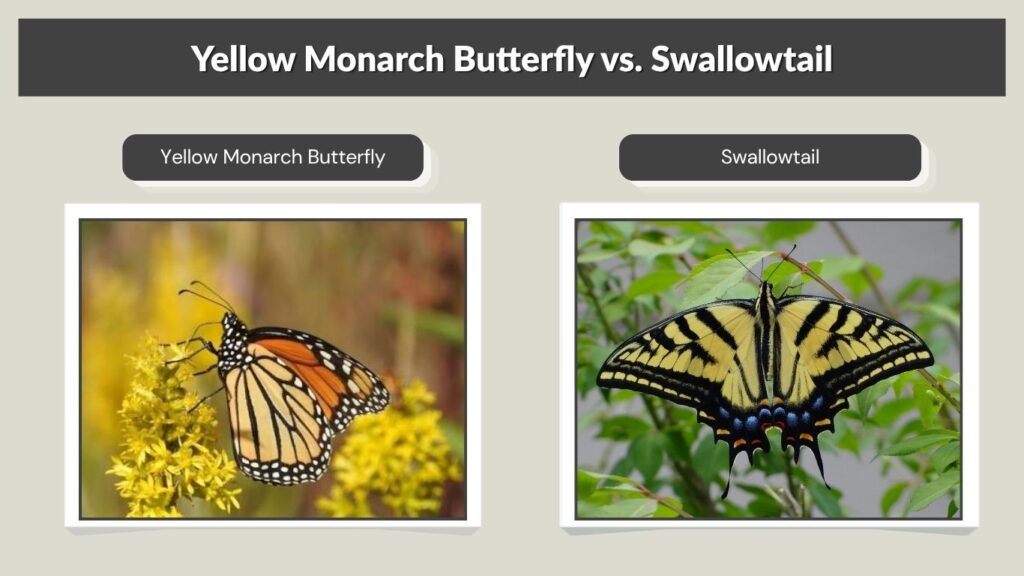
The easiest way to separate a monarch from a yellow swallowtail is to examine the hindwings.
Wing Shape
Swallowtails usually have one tail extending from each hindwing. Monarch wings are rounded and have no tails.
A swallowtail’s wings may also look broader and more angular. The tails can become damaged, however, so their absence does not always rule out a swallowtail.
Wing Pattern
Monarchs have:
- Orange central wing cells
- Heavy black veins
- Wide black outer borders
- Two rows of small white spots
- No tiger-like stripes
- No hindwing tails
Yellow tiger swallowtails have:
- Yellow central wing areas
- Several vertical black stripes
- Black borders
- Blue and orange hindwing spots
- One tail on each hindwing
Body and Flight
Monarchs have black bodies covered with white dots. They frequently alternate steady wingbeats with long glides.
Tiger swallowtails also glide, but they often fly higher around trees. Sulphurs tend to use faster, more irregular flight and may rarely remain still with their wings fully open.
Is a Yellow and Black Caterpillar a Monarch?
A yellow, black, and white striped caterpillar may be a monarch, but color alone is insufficient for identification.
Monarch Caterpillar Identification
A mature monarch caterpillar has:
- Repeated black, yellow, and white bands
- Two pairs of flexible black filaments
- One filament pair near the head
- One shorter pair near the rear
- A smooth body without sharp spines
- A strong association with milkweed
Second-instar monarch larvae already display clear black, yellow, and white banding. Their sole host plants are milkweeds, so finding the caterpillar feeding on milkweed is an important clue.
Swallowtail caterpillars look different. Many become mostly green with eyespots or yellow dots. A black swallowtail caterpillar can have black, green, yellow, and white markings, but it feeds on plants such as parsley, dill, fennel, and carrots rather than milkweed.
What Does a Yellow Monarch Butterfly Mean?
The phrase “yellow monarch butterfly” has no established scientific meaning because yellow monarchs are not recognized as a separate biological form. However, butterflies often carry personal or cultural symbolism.
Yellow butterflies are commonly associated with:
- Happiness and optimism
- Personal transformation
- Hope and renewal
- Creativity and energy
- New opportunities
- Memories of a loved one
These meanings are spiritual or cultural interpretations rather than biological facts. Seeing a yellow butterfly does not scientifically predict a future event. Its meaning depends on the observer’s beliefs, culture, and personal experience.
How to Identify a Butterfly Accurately
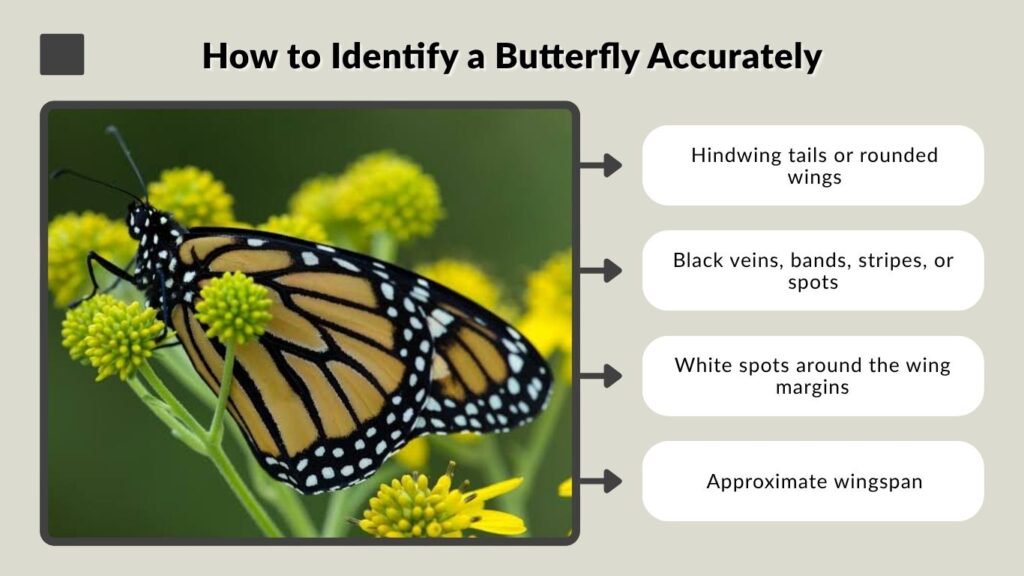
Do not rely on color alone. Observe the butterfly from several angles and record as many details as possible.
Look for:
- Hindwing tails or rounded wings
- Black veins, bands, stripes, or spots
- White spots around the wing margins
- Approximate wingspan
- Flight pattern
- Plants on which it lands or lays eggs
- Geographic location and season
A clear photograph showing both the upper and lower sides of the wings can make identification much easier. Newly emerged, worn, wet, and backlit butterflies may look very different from standard field-guide images.
FAQs
Can monarch butterflies be yellow?
Adult monarchs are orange, black, and white. They may appear pale, tan, or slightly yellowish because of scale loss, strong light, wing wear, or camera effects. A naturally bright-yellow butterfly is more likely to be a swallowtail or sulphur.
What butterfly looks like a monarch but is yellow?
The eastern tiger swallowtail is a common possibility. It is large and yellow with bold black markings. Unlike a monarch, it has vertical tiger-like stripes and long tails projecting from its hindwings.
Are yellow monarch butterflies rare?
A true yellow adult form is not generally recognized. Reports of rare yellow monarchs usually involve faded individuals, misleading photographs, or incorrectly identified species. Genuine monarchs retain their characteristic black-veined wing pattern even when their orange scales become worn.
What do yellow monarch butterflies eat?
A butterfly mistaken for a yellow monarch may drink nectar from many flowering plants. Its caterpillar diet depends on its actual species. Monarch caterpillars eat milkweed, tiger swallowtail caterpillars feed on certain trees, and sulphur caterpillars commonly use plants in the legume family.
What is the difference between a yellow monarch and a swallowtail?
A monarch has orange wings with black veins, rounded hindwings, and no tails. A yellow swallowtail has yellow wings with black stripes or bands and normally has a tail extending from each hindwing.
