
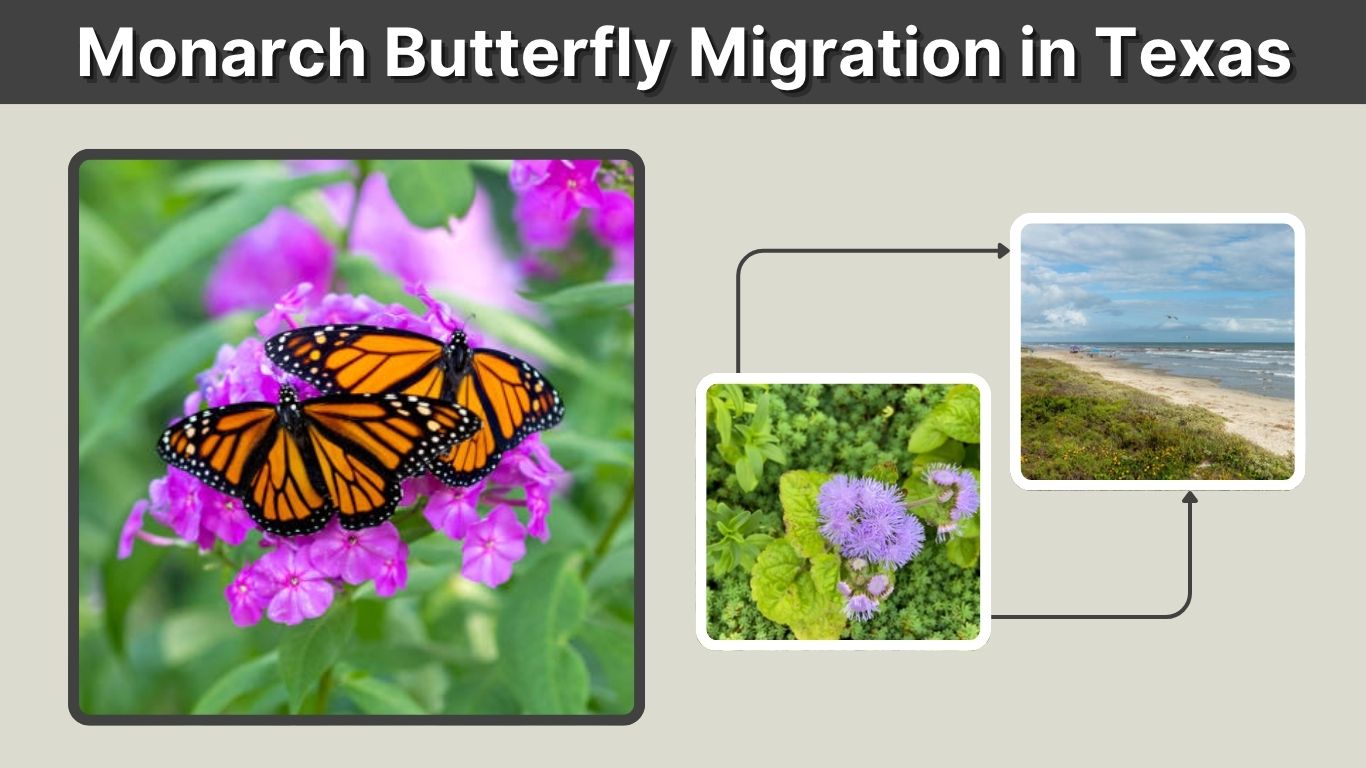
Texas lies at the center of one of North America’s most remarkable wildlife journeys. Monarch butterflies travel through the state twice each year—northward in spring and southward in fall. During these migrations, they depend on Texas milkweed, wildflowers, gardens, prairies, and river corridors for food and shelter. Although monarchs may appear across much of the state, timing, weather, location, and plant availability determine where the largest gatherings occur.
Why Is Texas Important to Monarch Butterflies?
Texas connects the monarchs’ winter habitat in central Mexico with their spring and summer breeding grounds across the United States and southern Canada. Nearly the entire eastern migratory population must cross at least part of Texas during its annual journey.
The state provides two particularly important resources:
- Native milkweed for egg laying and caterpillar development
- Nectar-producing flowers that fuel adult butterflies during migration
Texas also named the monarch its official state insect in 1995, recognizing both its beauty and its importance to the state’s natural heritage.
When Do Monarch Butterflies Migrate Through Texas?
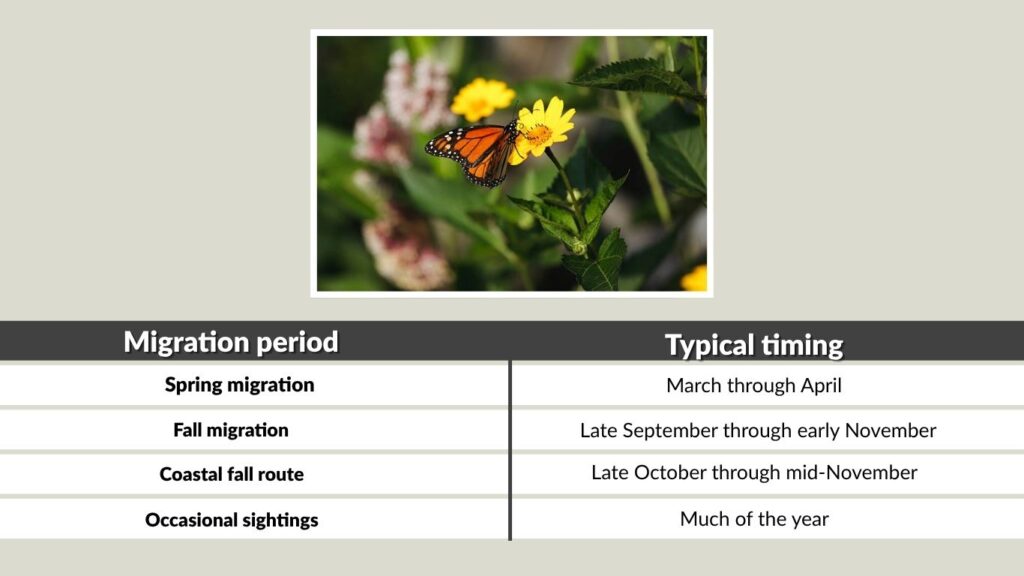
Texas has two monarch seasons. The spring movement is usually more spread out, while the fall migration can produce dramatic concentrations of butterflies.
| Migration period | Typical timing | Direction and activity |
| Spring migration | March through April | Adults move north from Mexico, lay eggs and seek nectar |
| Fall migration | Late September through early November | Monarchs travel south toward Mexico |
| Coastal fall route | Late October through mid-November | Smaller numbers follow the Gulf Coast |
| Occasional sightings | Much of the year | A few monarchs may remain in southern or coastal Texas |
These dates are approximate. Cold fronts, heat, drought, wind direction, storms, and flowering conditions can shift peak movement by several days or weeks.
Spring Monarch Migration in Texas
Monarchs begin leaving their mountain forests in central Mexico around March. The overwintering generation crosses into Texas, where females search for newly emerging milkweed and deposit eggs as they continue north.
Spring movement is generally most noticeable from late March through the middle of April. However, it is less concentrated than the fall migration. Instead of seeing huge groups, observers often notice individual butterflies or small numbers moving through gardens, fields, roadsides, and coastal areas.
The adults arriving from Mexico do not complete the entire journey to Canada. After laying eggs in Texas and other southern states, they die. Their offspring develop into adults and continue north during late April and May.
Fall Monarch Migration in Texas
Fall migration typically begins reaching northern Texas during the final days of September. Most monarchs following the main inland route pass through the state by early November.
Fall monarchs belong to a long-lived migratory generation. Unlike summer butterflies, they delay reproduction and direct their energy toward flying, feeding, and building fat reserves. These reserves help them survive the winter in Mexico.
Cold fronts often produce the most noticeable movement. Monarchs use favorable northerly winds to travel south and may pause in large groups when conditions become unsuitable.
Monarch Butterfly Migration Route Through Texas
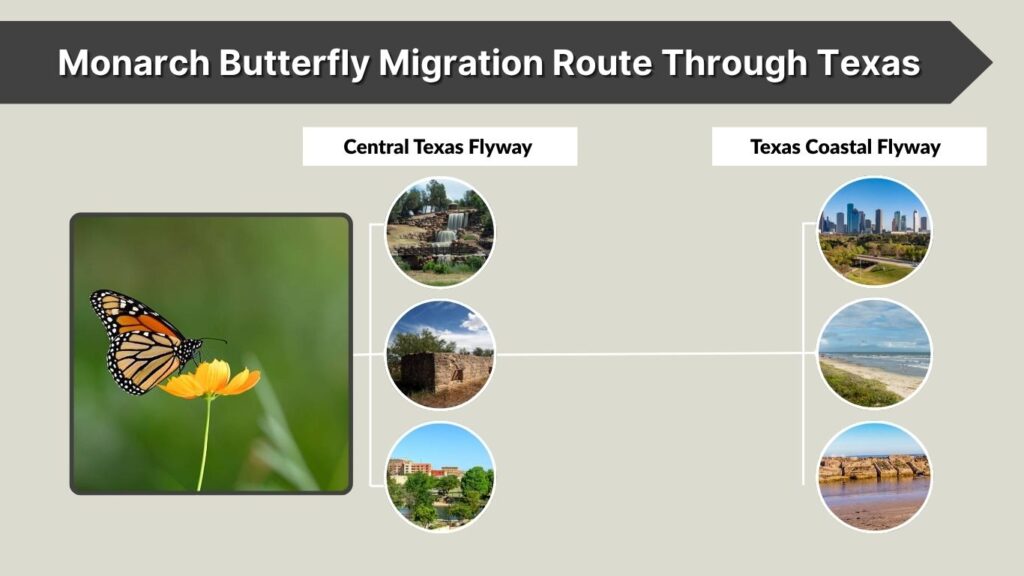
Texas has two main fall migration routes: a broad central pathway and a smaller coastal pathway.
Central Texas Flyway
The largest route forms a corridor approximately 300 miles wide, stretching from the Wichita Falls region south toward Eagle Pass. It includes parts of North Texas, West-Central Texas, the Hill Country, and the area around San Antonio.
This route is sometimes called the Texas Funnel because monarchs from large areas of the United States and Canada gradually converge as they approach Mexico.
Important areas along or near this pathway include:
- Wichita Falls
- Abilene
- San Angelo
- Austin
- The Texas Hill Country
- San Antonio
- Del Rio and Eagle Pass
The Interstate 35 corridor between Austin and Dallas is also called the Monarch Highway. Several highway rest areas contain native-plant waystations designed to offer nectar and milkweed to migrating butterflies.
Texas Coastal Flyway
A second, generally smaller migration route follows the Gulf Coast. This movement often occurs later, roughly from the third week of October through the middle of November.
Coastal monarchs may pass through areas around:
- Houston
- Galveston
- Matagorda Bay
- Corpus Christi
- Rockport
- The Lower Rio Grande Valley
Some butterflies may remain in southern coastal Texas during mild winters, although most eastern monarchs continue into Mexico.
Best Places to See Monarch Butterflies in Texas
Monarchs can appear almost anywhere with suitable flowering plants, but several parks and protected areas lie close to major migration routes.
Balcones Canyonlands National Wildlife Refuge
Balcones Canyonlands, northwest of Austin, is among the best-known viewing locations. When weather and flowering conditions are favorable, thousands of monarchs may pass through its prairies and oak savannas during late September and early October.
Visitors should search around wildflower areas during the day. Near evening, butterflies may gather in protected trees to form temporary overnight roosts.
Texas State Parks
Texas Parks and Wildlife identifies several parks with good seasonal monarch-viewing opportunities, including:
- Abilene State Park
- Enchanted Rock State Natural Area
- Garner State Park
- Guadalupe River State Park
- Devil’s Sinkhole State Natural Area
- Kickapoo Cavern State Park
- Colorado Bend State Park
Actual numbers vary yearly, so no location can guarantee a large gathering.
Gardens, Prairies and River Corridors
A well-planted backyard can sometimes provide better viewing than a large park. Monarchs regularly stop at gardens containing abundant fall flowers, especially when those gardens are near the central migration corridor.
Riverbanks and creeks are also useful places to look. Monarchs frequently select sheltered trees near water for overnight roosting.
Plants for Monarch Butterflies in Texas
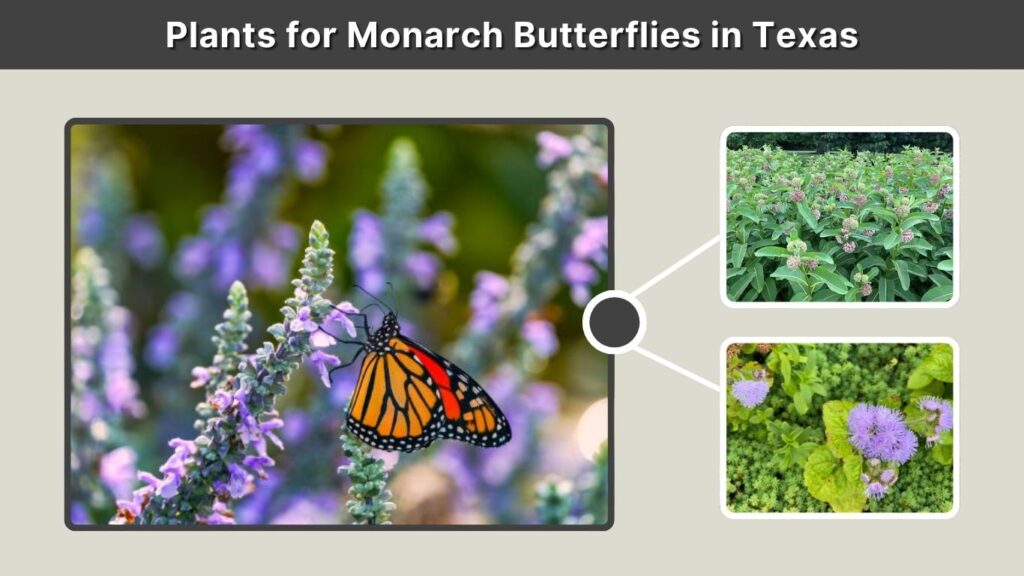
Monarch caterpillars can eat only milkweed, while adults drink nectar from many kinds of flowers.
Native Texas Milkweed
More than 35 milkweed species have been recorded in Texas. Suitable options vary by region, soil, rainfall, and available space.
Common native choices include:
- Green milkweed
- Antelope-horns milkweed
- Zizotes milkweed
- Butterfly weed
- Aquatic milkweed
Native plants adapted to the local region are generally preferable to tropical milkweed. Tropical milkweed may remain green through winter in warm areas, potentially encouraging monarchs to stop migrating and allowing disease-causing parasites to accumulate.
Nectar Plants
Adult monarchs need flowers from early spring through late fall. Useful Texas nectar plants include frostweed, Gregg’s mistflower, goldenrod, asters, blazing star, autumn sage, sunflowers, verbena, and native lantana.
A productive monarch garden should contain groups of pesticide-free plants with overlapping bloom periods. Milkweed supports reproduction, while nectar plants provide energy for the journey.
How to Attract Monarch Butterflies in Texas
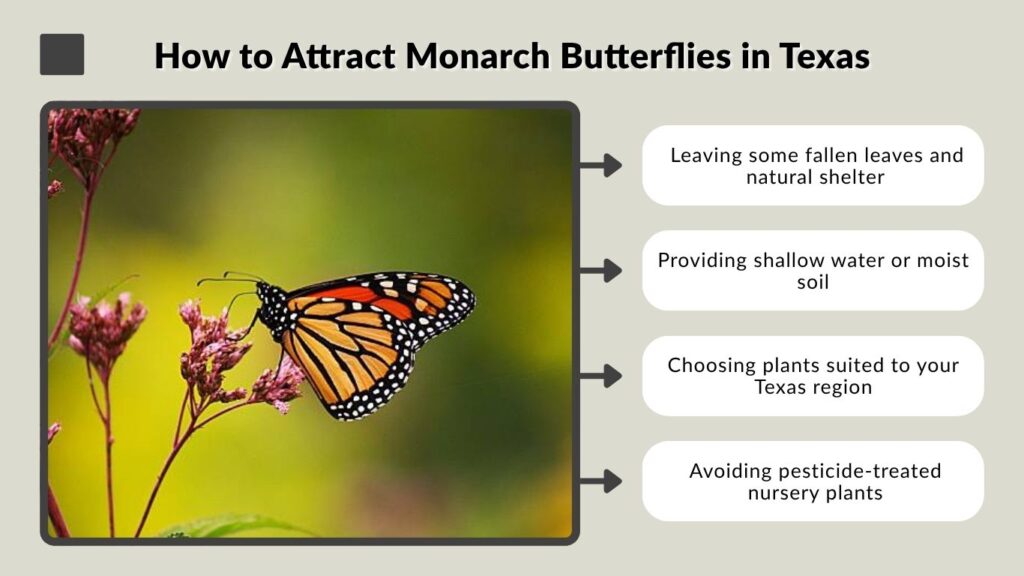
Create an open, sunny garden protected from strong wind. Plant several native milkweeds together and surround them with nectar flowers that bloom during spring and fall migration.
Avoid spraying insecticides, including products advertised as natural or organic, directly on butterfly plants. These chemicals may kill monarch eggs, caterpillars, and adults along with unwanted insects.
Other helpful actions include:
- Leaving some fallen leaves and natural shelter
- Providing shallow water or moist soil
- Choosing plants suited to your Texas region
- Avoiding pesticide-treated nursery plants
- Reporting sightings through community-science programs
Even a small garden can become a valuable stopping point when it provides reliable food at the right time.
Monarch Butterfly Conservation in Texas
Monarch numbers across North America have declined because of habitat loss, reduced milkweed availability, pesticide exposure, extreme weather, and changing conditions at breeding, migration, and overwintering sites.
As of July 2026, the U.S. Fish and Wildlife Service has proposed listing the monarch as threatened under the Endangered Species Act, but no final decision has been issued. Therefore, the monarch is not currently federally protected under that proposal.
Texans can assist conservation by protecting native grasslands, planting regionally appropriate milkweed and nectar flowers, reducing pesticide use, and documenting monarchs through organized monitoring programs.
FAQs
When is monarch butterfly season in Texas?
The main seasons are March through April and late September through early November. Spring monarchs travel north and reproduce, while fall monarchs move south toward Mexico. Coastal fall migration may continue into the middle of November.
What is the best time to see monarch migration in Texas?
Late September through October usually provides the most impressive viewing. Peak timing depends on latitude and weather. North Texas often sees monarchs first, followed by Central Texas, South Texas, and the Gulf Coast.
Where is the best place to see monarch butterflies in Texas?
Balcones Canyonlands National Wildlife Refuge is a notable viewing destination. Enchanted Rock, Garner, Guadalupe River, Colorado Bend, Abilene, and Kickapoo Cavern state parks are also positioned near migration routes.
Are monarch butterflies native to Texas?
Yes. Monarchs naturally breed, feed, and migrate through Texas. Most do not remain year-round, but occasional butterflies may be seen during winter in warm southern and coastal areas.
Why is the monarch butterfly important to Texas?
Texas provides an essential bridge between the monarch’s Mexican winter habitat and northern breeding grounds. The state’s milkweed supports spring reproduction, while its autumn wildflowers provide fuel for the southbound journey. The monarch is also Texas’s official state insect.
