
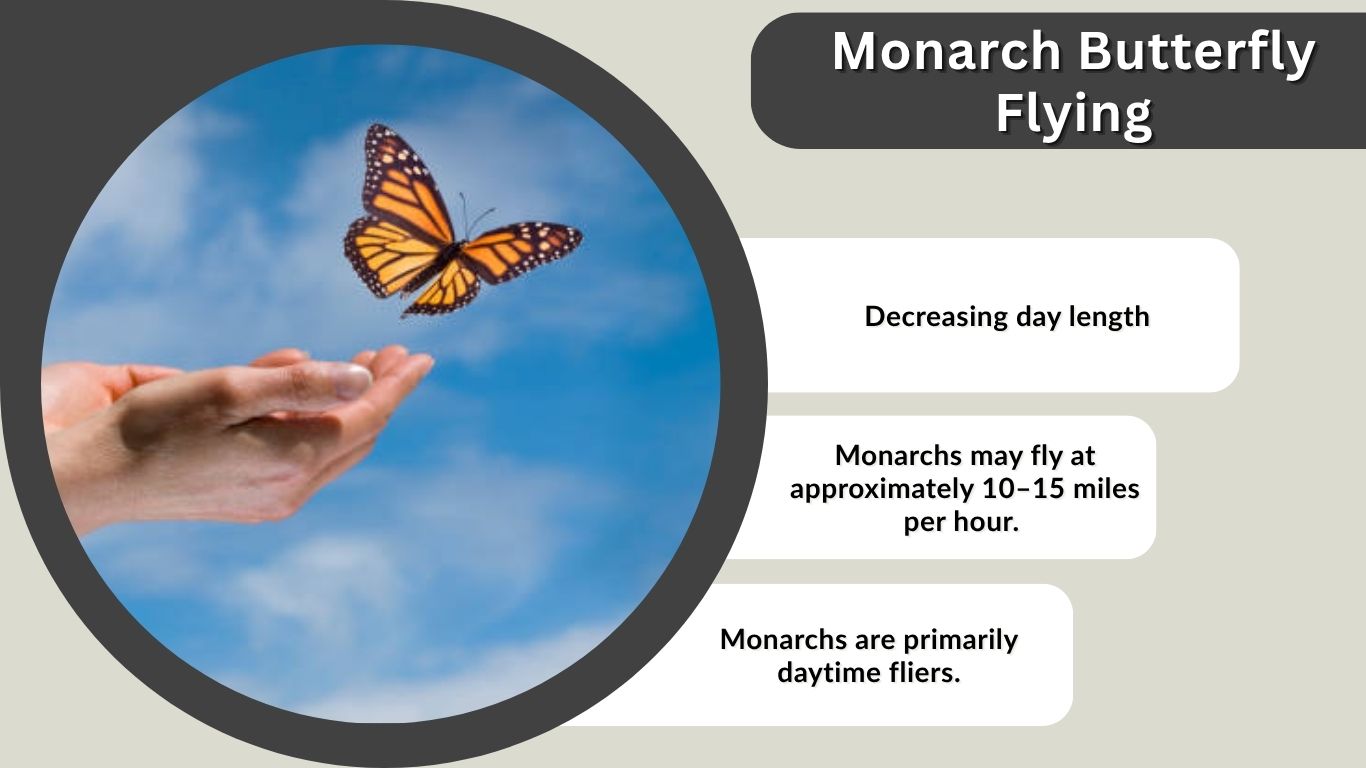
A monarch butterfly in flight may appear delicate, but it is capable of completing one of the longest insect migrations in the world. Monarchs combine active wingbeats with gliding and soaring, allowing them to conserve energy while traveling toward seasonal breeding or overwintering grounds. Weather, temperature, wind, nectar availability, and wing condition all influence how fast, high, and far a monarch can fly.
How Do Monarch Butterflies Fly?
Monarchs fly by moving their forewings and hindwings together in repeated strokes. Downstrokes generate lift and forward movement, while changes in wing angle help the butterfly turn, rise, descend, and remain stable.
During ordinary local activity, monarchs often alternate between flapping and brief glides as they move between flowers. Migrating monarchs use a more energy-efficient technique: they enter rising columns of warm air called thermals, circle upward, and then glide forward while gradually losing altitude. This allows them to cover distance without continuously beating their wings.
| Flight feature | Typical behavior |
| Normal speed | Often around 10–15 mph |
| Daily migration | Commonly about 25–30 miles |
| Longer travel days | May exceed 50–100 miles |
| Total migration | Sometimes 2,000–3,000 miles |
| Active period | Mainly during daylight |
| Flying conditions | Warm, dry, and moderately windy |
How Fast Do Monarch Butterflies Fly?
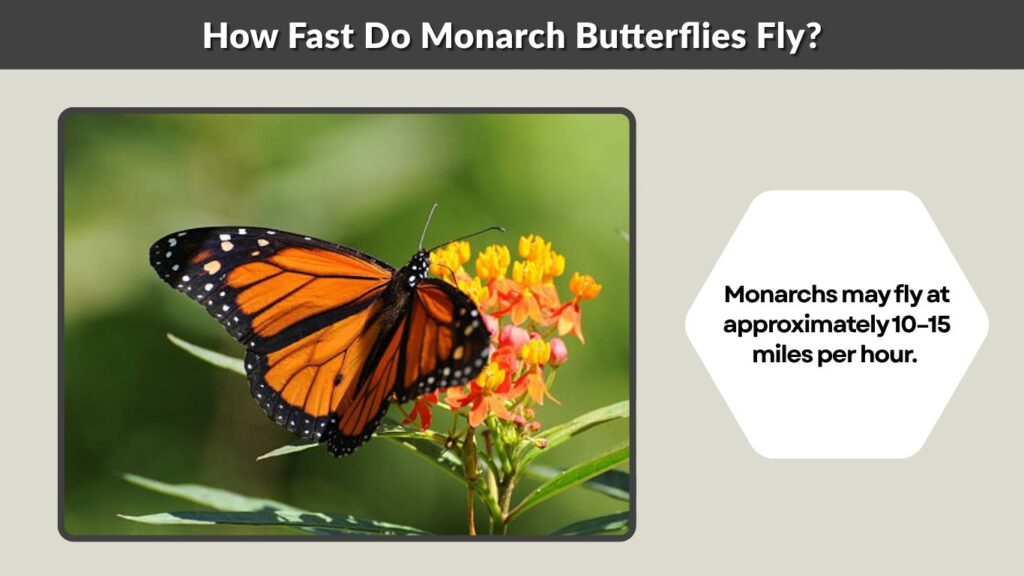
A monarch’s speed varies with wind, temperature, flight purpose, and whether it is actively flapping or gliding. Under favorable conditions, monarchs may fly at approximately 10–15 miles per hour using their own wing power. A supporting tailwind can increase their speed over the ground, while headwinds and cold conditions slow them down.
Migrating butterflies do not maintain maximum speed throughout the day. They frequently stop to drink nectar, rest, warm their flight muscles, and wait for suitable weather. Therefore, migration progress is slower than a simple calculation based on top speed would suggest.
How Far Can a Monarch Butterfly Fly?
During migration, monarchs commonly advance about 25–30 miles per day. However, daily distance varies widely. Butterflies using strong favorable winds may travel 50–100 miles in one day, and exceptional tagged individuals have covered much greater distances.
One historical tagging record documented a monarch recovered 265 miles from where it had been released the previous day. Such exceptional movement probably involved favorable high-altitude winds rather than continuous powered flight at ordinary speed.
Total Migration Distance
Some eastern monarchs fly from southern Canada and the northern United States to overwintering forests in central Mexico. Depending on where their journey begins, the route may cover more than 2,000 miles and sometimes approaches 3,000 miles.
The southward journey is completed by one unusually long-lived migratory generation. The return north occurs over several generations: butterflies move north, reproduce, die, and are replaced by their offspring, which continue the journey.
How High Can Monarch Butterflies Fly?
Most monarchs seen feeding or moving locally fly relatively close to the ground. During migration, however, they may rise much higher to find favorable air currents.
Flight altitude changes with temperature and wind. Warm rising air can carry monarchs hundreds or thousands of feet above the landscape, where they may become impossible to see from the ground. Strong high-altitude winds can also transport them beyond their normal route.
Monarchs do not simply seek the highest possible altitude. They select air layers that provide suitable temperatures and winds. Cold air restricts muscle performance, while powerful crosswinds can push them away from their intended direction.
Why Do Monarch Butterflies Fly to Mexico?
Eastern migratory monarchs fly south to escape freezing northern winters. They gather in high-elevation oyamel fir forests in central Mexico, where the cool but protected climate slows their metabolism and helps them conserve stored energy.
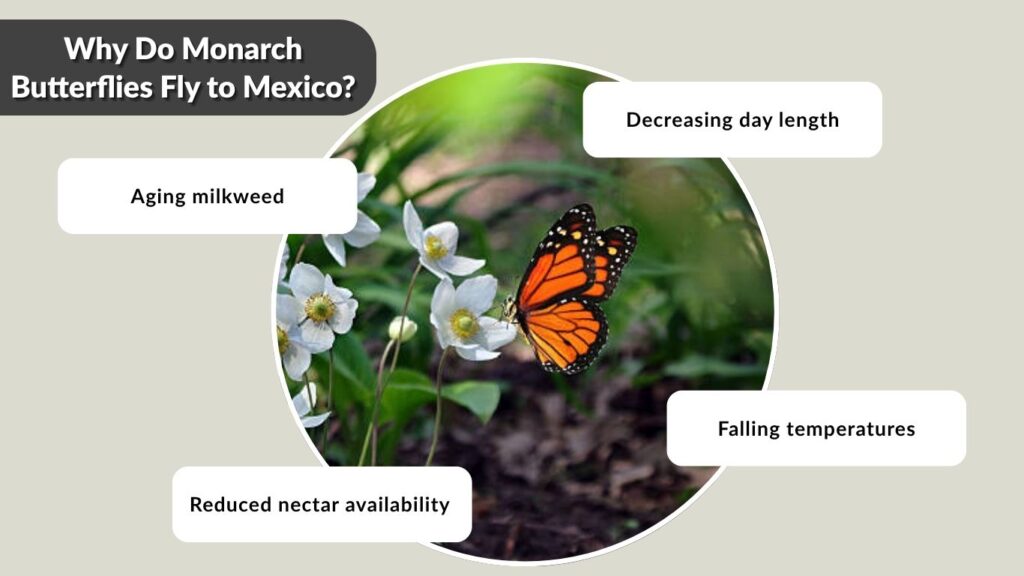
Decreasing day length, falling temperatures, aging milkweed, and reduced nectar availability help trigger migratory behavior. Monarchs use a sun compass influenced by their internal biological clock to maintain a generally southwesterly direction.
They stop frequently along the route to drink nectar. The sugars provide immediate energy, while some of the food is converted into fat reserves needed during winter.
Monarch Butterflies Flying Through Oklahoma
Oklahoma lies near the center of the eastern monarch migration route. Butterflies move north through the state during spring and return south in greater numbers during fall. Oklahoma’s grasslands, gardens, roadsides, and wetlands provide important nectar stops during the journey.
Weather influences exactly when migrating monarchs appear. Strong winds, rain, and changing temperatures can delay movement, alter their path, or cause large numbers to gather temporarily at sheltered roosting locations.
Do Monarch Butterflies Fly at Night?
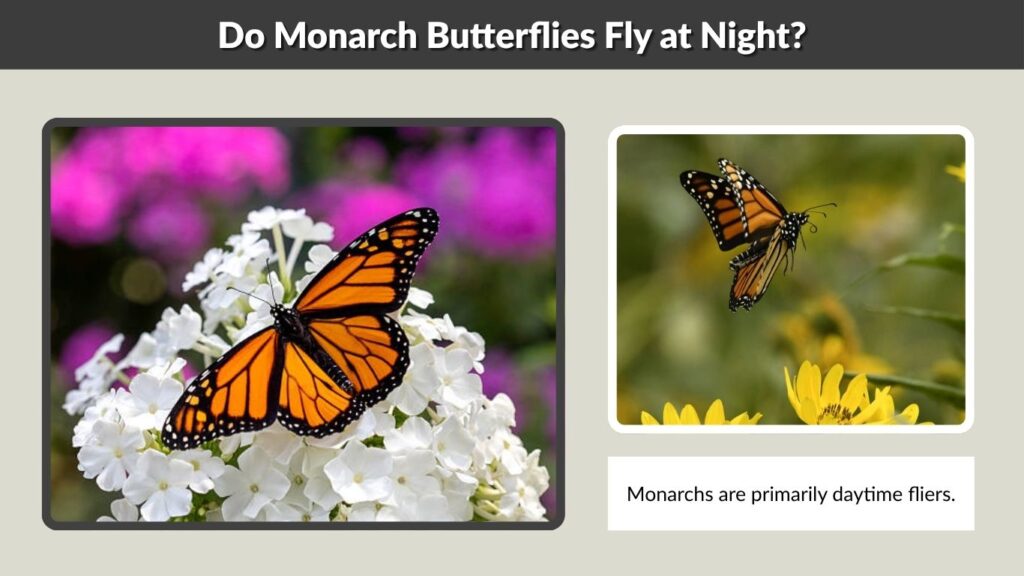
Monarchs are primarily daytime fliers. They need warmth from sunlight to raise their flight muscles to a suitable operating temperature. Their approximate flight threshold is around 55°F, although sunlight, wind, and individual condition affect activity.
Near evening, migrating monarchs descend and gather in trees. These temporary overnight groups are called roosts. They may contain a few butterflies or thousands of individuals when migration is intense.
Do Monarchs Fly in the Rain?
Monarchs generally avoid flying during rain. Wet wings become heavier and less effective, while wind and falling droplets make controlled flight difficult.
During storms, monarchs shelter beneath leaves, inside dense vegetation, or among tree branches. They may resume flying when the rain stops, their wings dry, and the temperature rises. Excessive rain and out-of-season storms can disrupt migration and reduce access to nectar.
Do Monarch Butterflies Fly Together?
Monarchs usually travel as individuals rather than in tightly coordinated flocks. However, large numbers follow the same seasonal route, so they may appear to be flying together.
They become especially concentrated near nectar-rich fields, geographic barriers, narrow migration corridors, and evening roosts. Warm morning temperatures may cause hundreds or thousands to leave a roost within a relatively short period, creating a visible stream of orange wings.
Two monarchs flying close together may be feeding in the same area, courting, competing, or simply following favorable wind. Their proximity does not necessarily mean they are a permanent pair.
How Long Before a New Monarch Can Fly?
After emerging from its chrysalis, a monarch has soft, folded wings. It hangs vertically while fluid is pumped through the wing veins, causing the wings to expand.
The butterfly then waits for its wings to dry and harden. This usually requires several hours, although cool or humid conditions may slow the process. A newly emerged monarch should not be forced to fly before its wings are fully expanded and firm.
Why Won’t a Monarch Butterfly Fly Away?
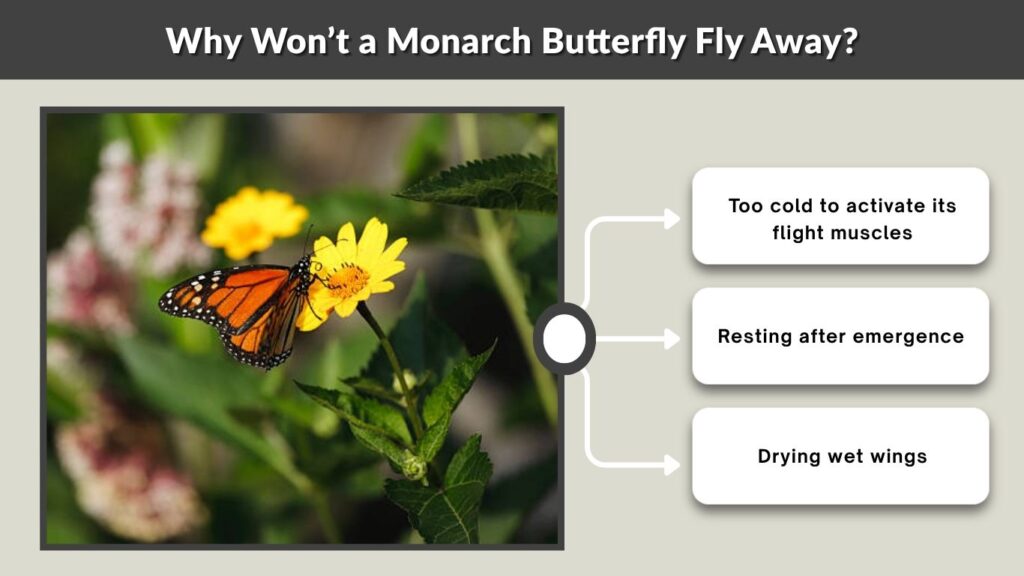
A monarch that does not fly is not always injured. It may be:
- Too cold to activate its flight muscles
- Resting after emergence
- Drying wet wings
- Feeding or conserving energy
- Near the end of its natural life
- Affected by damaged or deformed wings
- Weak from disease, dehydration, or poor nutrition
Place a cold but otherwise healthy butterfly in a sheltered, sunny location near nectar flowers. Avoid throwing it into the air, pulling on its wings, or repeatedly handling it.
A monarch with severely crumpled wings may have experienced difficulty during emergence. The protozoan parasite Ophryocystis elektroscirrha can also weaken monarchs and contribute to wing deformity or reduced flight ability.
Spiritual Meaning of a Monarch Flying Around You
In symbolic traditions, a monarch flying nearby may represent transformation, renewal, endurance, freedom, or the memory of a loved one. In parts of Mexico, the annual monarch arrival is culturally associated with Día de los Muertos and the return of departed relatives’ souls.
These are cultural and personal interpretations rather than scientific explanations. Biologically, a monarch may circle someone because it is exploring flowers, following air currents, seeking warmth, or investigating colors and movement.
FAQs
How far can a monarch butterfly fly in one day?
Monarchs commonly advance approximately 25–30 miles per migration day, but favorable wind can help them cover 50–100 miles. Exceptional tagged butterflies have traveled much farther within a 24-hour period.
Can monarch butterflies fly from Canada to Mexico?
Yes. Monarchs from southern Canada may travel through the United States to overwintering forests in central Mexico. The longest routes can approach 3,000 miles and take several weeks to complete.
Why do monarchs sit with their wings open?
A monarch may spread its wings to absorb solar heat and warm its flight muscles. It may also be drying its wings after rain or immediately after emerging from a chrysalis.
When do monarch butterflies fly south?
Eastern monarchs generally begin moving south in late summer and fall. Timing varies by latitude, weather, temperature, nectar availability, and day length. Northern butterflies usually begin before populations farther south.
What does it mean when two monarch butterflies fly together?
They may be courting, competing, sharing a nectar source, or moving through the same favorable air current. Symbolically, some people associate two monarchs with partnership or connection, but their behavior does not have one fixed spiritual meaning.
