
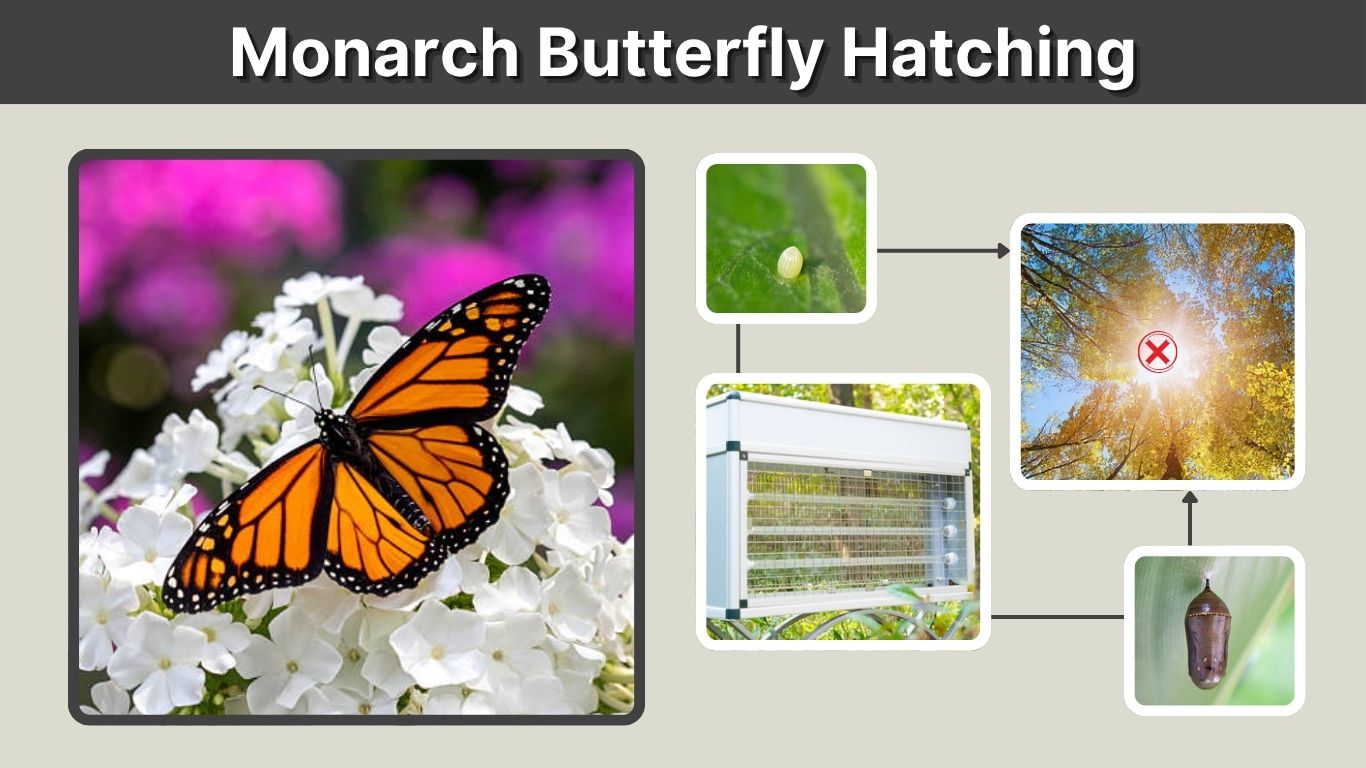
Monarch butterfly hatching can refer to two different events: a caterpillar hatching from an egg or an adult butterfly emerging from a chrysalis. Monarch eggs usually hatch within three to five days, while the chrysalis stage generally lasts about eight to fifteen days. Temperature, humidity, health, and seasonal conditions can make development slightly faster or slower.
Monarch Butterfly Hatching Timeline
Monarchs undergo complete metamorphosis with four distinct life stages. Under warm summer conditions, the entire journey from egg to adult often takes approximately one month.
| Life stage | Typical duration | What happens |
| Egg | 3–5 days | A tiny caterpillar develops and hatches |
| Caterpillar | 10–14 days | It eats milkweed and grows through five instars |
| Chrysalis | 8–15 days | The caterpillar transforms into an adult |
| Newly emerged adult | Several hours | Wings expand, dry, and harden |
Development speeds up in suitable warmth and slows during cooler conditions. Excessive heat, dehydration, disease, and unsuitable rearing conditions can interfere with normal development.
When Do Monarch Butterfly Eggs Hatch?
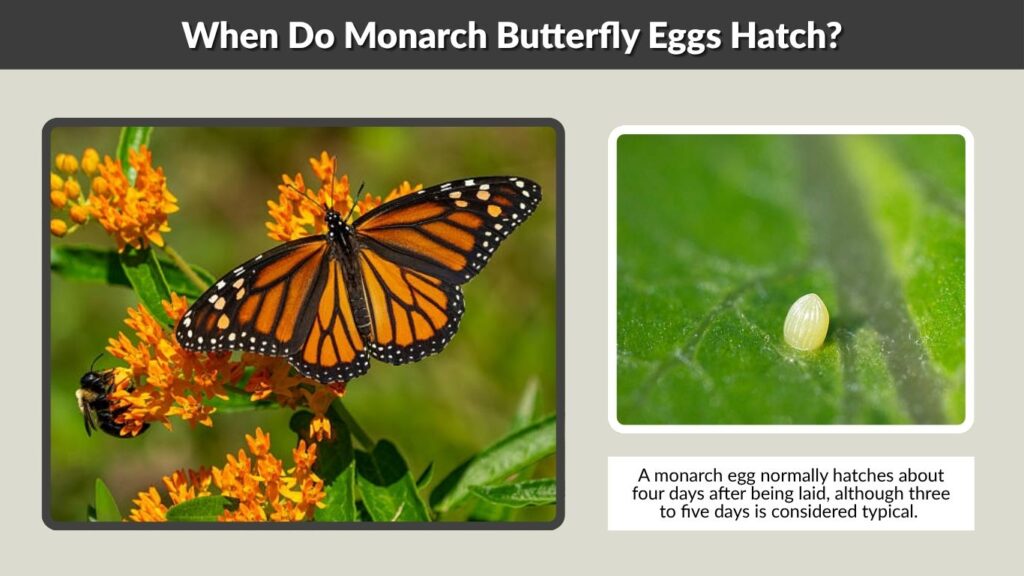
A monarch egg normally hatches about four days after being laid, although three to five days is considered typical. Female monarchs usually attach one egg at a time to milkweed, often beneath a young leaf near the plant’s upper portion.
Signs an Egg Is About to Hatch
A healthy monarch egg is initially pale cream or yellowish, with fine vertical ridges. As hatching approaches, the egg may look darker because the caterpillar’s black head capsule becomes visible through the shell.
Shortly before hatching, look for:
- A dark spot near the egg’s top
- A less uniformly cream-colored shell
- A clearly visible black head inside
- A tiny opening appearing in the shell
The newly hatched caterpillar is extremely small and may be difficult to see without close inspection.
What Does a Newly Hatched Monarch Caterpillar Eat?
The caterpillar commonly begins by eating part or all of its eggshell. It then starts feeding on the milkweed leaf where the egg was placed. Monarch caterpillars require milkweed and should not be given ordinary garden leaves, lettuce, or adult butterfly nectar.
Fresh milkweed must be free from insecticides. Young caterpillars are especially vulnerable to pesticide residue, dehydration, and contaminated food.
When Does a Monarch Emerge From Its Chrysalis?
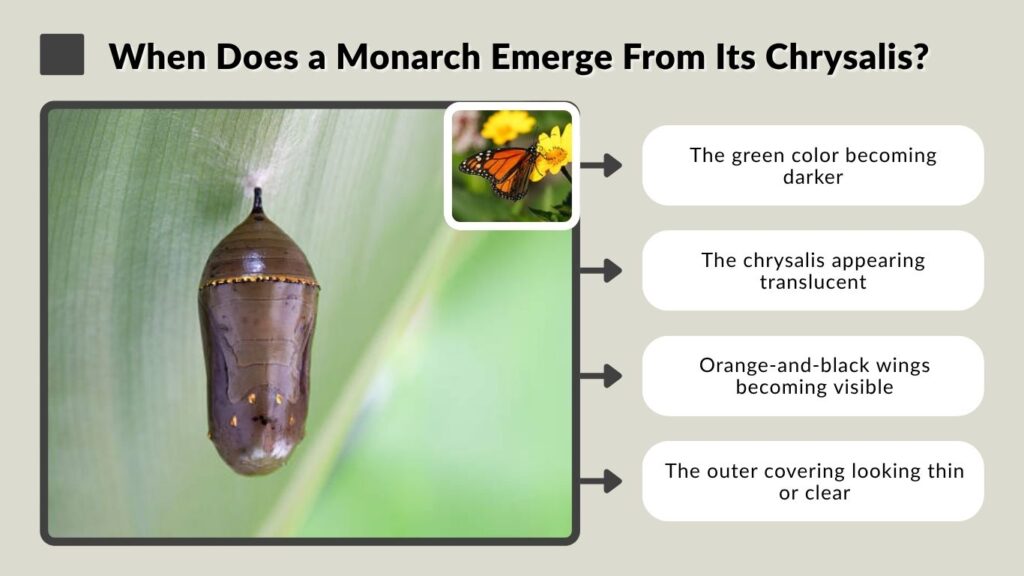
The adult monarch generally emerges eight to fifteen days after the chrysalis forms under normal summer conditions. Monarch Watch gives a common room-temperature range of about ten to fourteen days. Cooler temperatures can delay emergence, while warmer conditions may shorten development.
The technically correct word for an adult emerging from a chrysalis is eclosion, although it is frequently called hatching.
Signs a Monarch Chrysalis Is Ready to Hatch
A monarch chrysalis is jade green during most of its development. As emergence approaches, it darkens and the butterfly’s orange, black, and white wing pattern becomes visible through the covering.
Common signs include:
- The green color becoming darker
- The chrysalis appearing translucent
- Orange-and-black wings becoming visible
- The outer covering looking thin or clear
- Noticeable movement immediately before emergence
Darkening is normal when a clear wing pattern is visible. A chrysalis that becomes uniformly black, remains opaque for more than about 48 hours, smells unpleasant, or leaks fluid may contain a dead or diseased insect.
What Time of Day Do Monarchs Emerge?
Monarch adults commonly emerge during the morning, particularly around mid-morning. However, emergence may occur at other times depending on temperature and development.
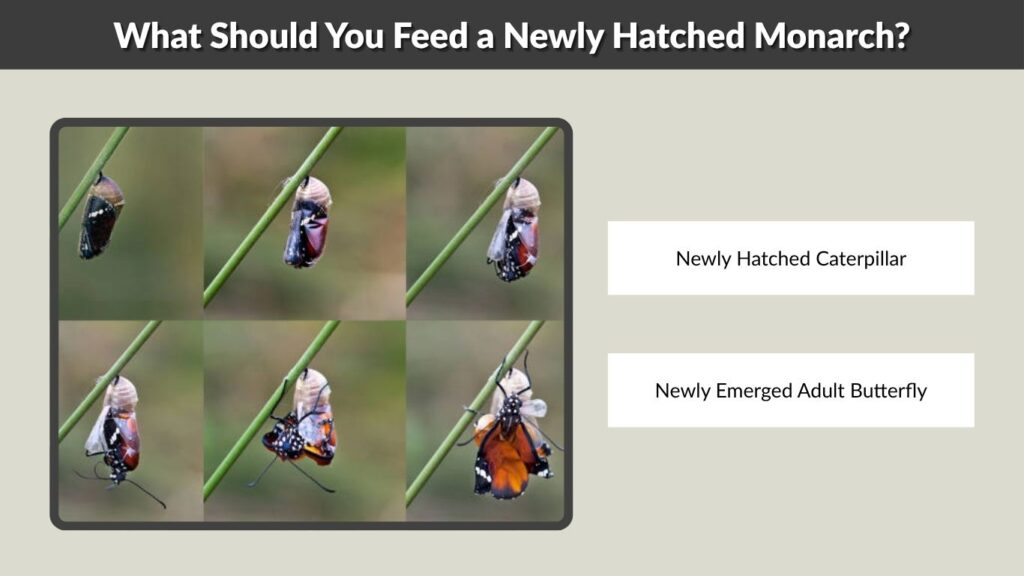
The actual emergence happens quickly. The chrysalis splits, the adult pulls itself free, and it immediately searches for a secure surface from which it can hang vertically.
What Happens After a Monarch Butterfly Hatches?
A freshly emerged monarch has a large abdomen and small, folded, wrinkled wings. It hangs beneath the empty chrysalis while pumping fluid from its abdomen into its wing veins. The wings gradually expand to their normal size and shape.
The butterfly then remains still while its wings dry and harden. It must have enough vertical space to hang without its wings touching the floor or nearby objects. Falling during this period may lead to permanently bent or crumpled wings.
How Long Before a Newly Hatched Monarch Can Fly?
A monarch may be able to make a short flight after approximately 90–120 minutes, but several hours are usually needed for the wings to become sufficiently firm. Monarch Watch recommends allowing three to four hours before handling and suggests waiting until the following day to release a captive-reared butterfly when possible.
Do not throw a newly emerged monarch into the air. Allow it to climb onto a finger, plant, or rough vertical surface and leave when it is ready.
What Should You Feed a Newly Hatched Monarch?
The answer depends on which life stage has hatched.
Newly Hatched Caterpillar
Provide fresh, pesticide-free milkweed. The tiny caterpillar may first eat its eggshell and then begin creating small feeding marks in the leaf. Keep the milkweed fresh, but avoid placing an exposed caterpillar where it could drown in water used to hold cut stems.
Newly Emerged Adult Butterfly
A healthy adult usually does not need food on its first day because it still has stored energy. When it must be held longer, Monarch Watch recommends offering butterfly nectar or a solution made with one part sugar or honey and nine parts water. The solution should be presented safely in a shallow feeder and replaced daily.
Outdoor nectar flowers provide a natural food source after release.
When Should You Release a Monarch?
Release a captive-reared monarch after its wings are fully expanded, dry, and firm. Waiting until the day after emergence provides additional time for the butterfly to strengthen and allows you to confirm that it can grip, walk, and move its wings normally.
Choose:
- Warm, dry daylight conditions
- A sheltered place away from heavy traffic
- An area containing nectar flowers
- A time when rain or strong wind is not expected
Avoid releasing a monarch at night, during cold weather, or in heavy rain. Keep it in a ventilated enclosure with a rough vertical surface when weather temporarily prevents release.
Using a Monarch Butterfly Hatching Kit
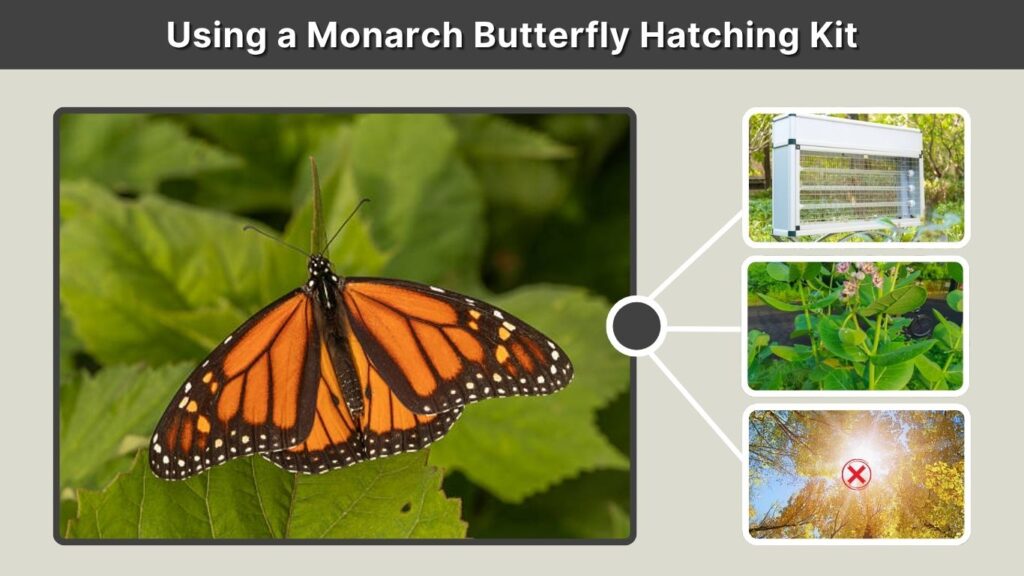
A suitable hatching or rearing kit should provide ventilation, cleanliness, fresh milkweed, and enough vertical space for molting and adult emergence. Crowded containers allow disease to spread more easily and can cause caterpillars to encounter contaminated waste.
Basic requirements include:
- A ventilated enclosure
- Fresh pesticide-free milkweed
- Daily removal of waste and spoiled leaves
- Protection from direct sunlight and overheating
- Adequate room for caterpillars to molt
- Several inches of clear space beneath each chrysalis
- Rough surfaces that newly emerged adults can climb
Avoid disturbing a caterpillar when it hangs in a J shape or begins forming its chrysalis. Never pull an adult from its chrysalis or attempt to unfold its wings manually.
Why Is My Monarch Butterfly Not Hatching?
Development may take longer during cool weather. A chrysalis that still appears healthy, firm, and normally colored may simply need additional time.
Possible signs of failure include:
- Remaining black and opaque for over two days
- Collapsing or becoming unusually soft
- Leaking dark fluid
- Developing an unpleasant odor
- Fly larvae emerging from the chrysalis
- The adult becoming trapped and unable to emerge
White maggots emerging from a monarch caterpillar or chrysalis are generally tachinid fly larvae. These parasitoids develop inside the monarch and eventually kill it.
How Long Do Monarch Butterflies Live After Hatching?
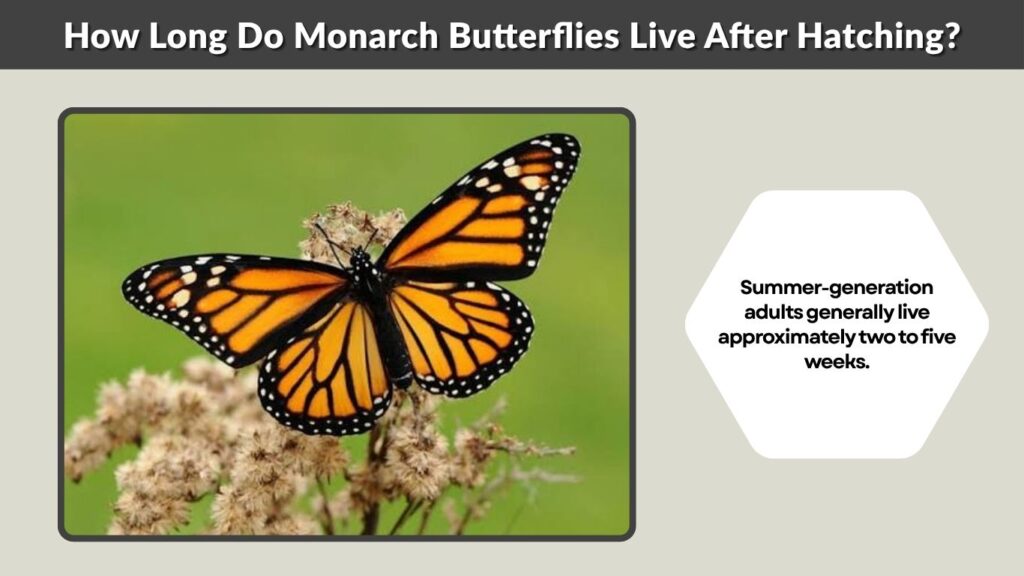
Summer-generation adults generally live approximately two to five weeks. During that period, they feed, mate, and reproduce. The migratory generation emerging in late summer or fall lives much longer because it delays reproduction and travels to an overwintering location.
FAQs
How long do monarch butterfly eggs take to hatch?
Monarch eggs usually hatch three to five days after being laid, with approximately four days being common in warm conditions. Cooler temperatures may slow development. A dark spot near the egg’s top often appears shortly before the caterpillar emerges.
How long does a monarch chrysalis take to hatch?
The adult usually emerges from its chrysalis after eight to fifteen days. Ten to fourteen days is common at room temperature. The chrysalis becomes dark and reveals the orange-and-black wing pattern shortly before emergence.
What should I do when my monarch butterfly hatches?
Leave it hanging undisturbed so it can expand and harden its wings. Ensure that it has several inches of vertical space. Do not touch the soft wings, force it to fly, or remove it from the chrysalis.
When can I release a newly emerged monarch?
A monarch may make short flights within a few hours, but releasing it the next day is often preferable. Choose warm, dry daylight conditions and place it near pesticide-free nectar flowers.
Do monarch butterflies return to where they hatched?
They do not necessarily return to the exact plant or location. Monarchs may travel through large areas to find nectar and milkweed. Migratory generations can move hundreds or thousands of miles from where they emerged.
