
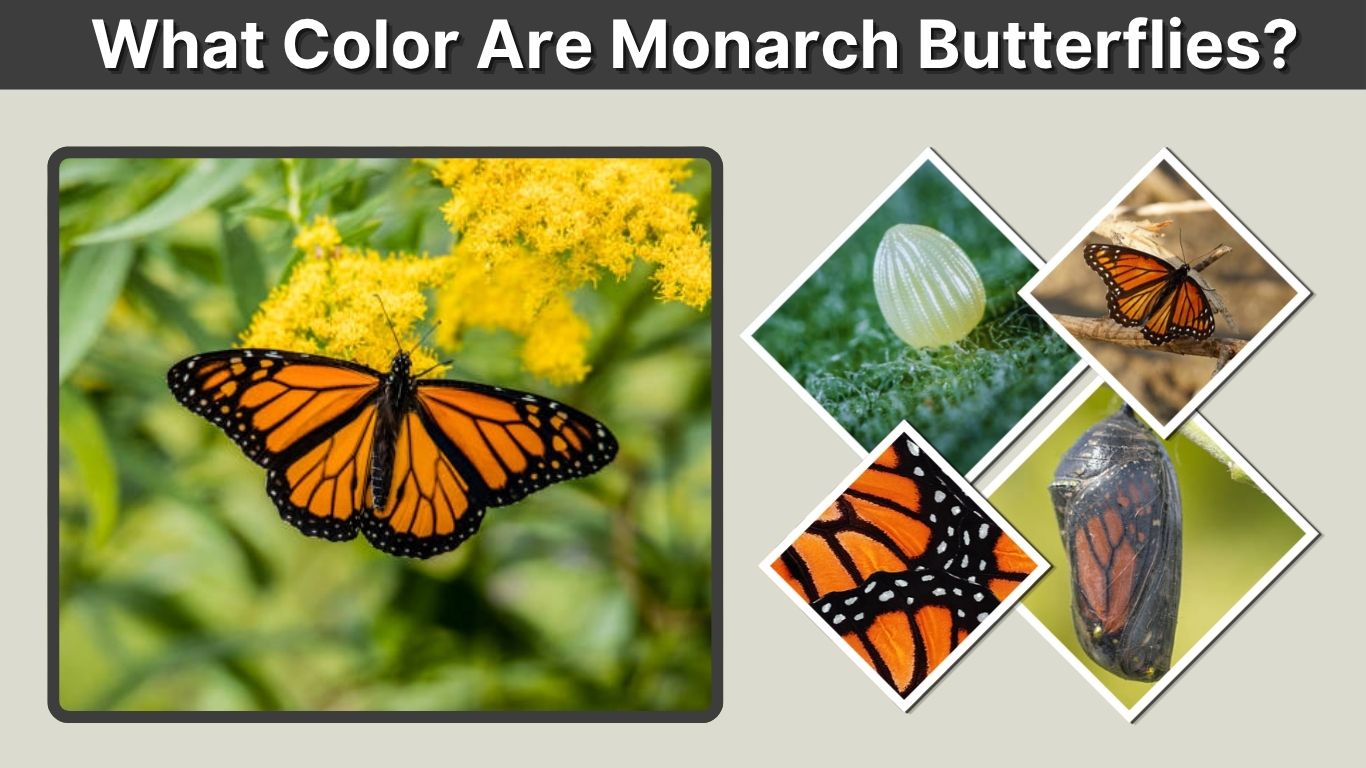
Adult monarch butterflies are primarily bright orange, black, and white. Their wings contain rich orange panels divided by black veins, surrounded by broad black borders marked with small white spots. This bold pattern makes monarchs among the easiest butterflies to recognize. Their colors change considerably throughout the life cycle, however: eggs are cream-colored, caterpillars are striped, and the chrysalis is jade green before becoming transparent.
Main Colors of an Adult Monarch Butterfly
The upper surfaces of a monarch’s wings contain three dominant colors:
- Bright orange wing panels
- Black veins and outer borders
- White spots inside the black borders
The body is mostly black, with small white markings on the head and thorax. The underside of the wings has the same basic pattern but often appears paler, with a softer yellow-orange or tan-orange tone.
| Body part | Typical color |
| Main wing panels | Orange |
| Wing veins | Black |
| Outer wing borders | Black |
| Border spots | White |
| Body | Black with white spots |
| Antennae and legs | Mostly black |
| Underside of wings | Pale orange or yellow-orange |
Individual monarchs do not all display exactly the same shade. Lighting, wing age, wear, sex, development, and natural variation can make one butterfly look brighter, darker, yellower, or more faded than another.
Why Are Monarch Butterflies Orange and Black?
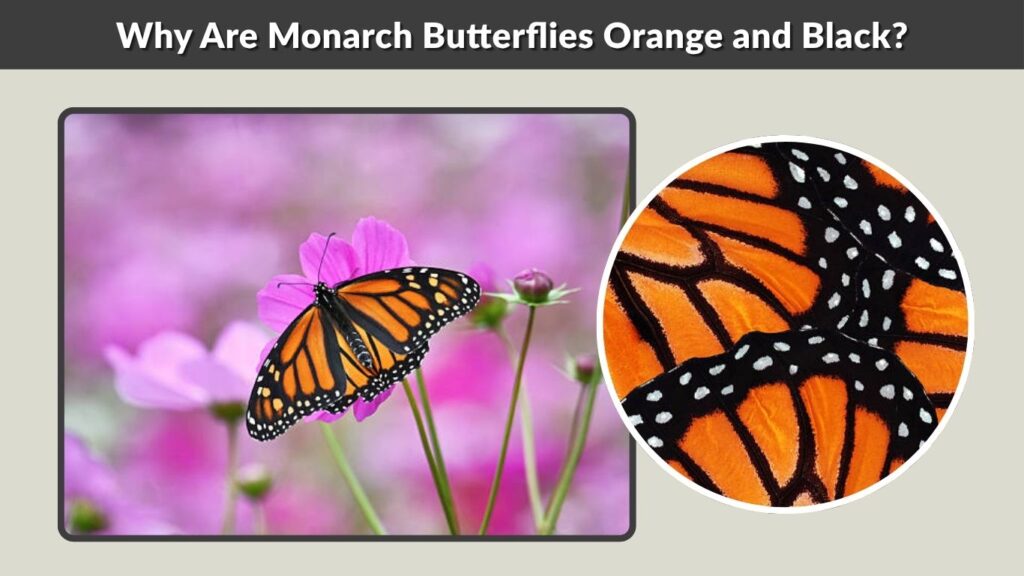
The monarch’s orange-and-black pattern acts as warning coloration. Monarch caterpillars eat milkweed, which contains defensive chemicals called cardenolides. Some of these compounds remain in the butterfly after metamorphosis and can make it unpleasant or harmful to certain predators.
The noticeable colors help predators associate the monarch’s appearance with an undesirable meal. Birds that have a bad experience may avoid similarly colored butterflies afterward.
Older monarchs may appear lighter or duller because the tiny scales covering their wings gradually wear away. A faded butterfly is not a separate color variety; it is often simply an older or heavily traveled individual.
Male vs. Female Monarch Colors
Male and female monarchs have nearly identical orange, black, and white coloration. However, their wing patterns contain small differences that can help determine sex.
Male Monarch
A male has a round black scent patch on a vein of each hindwing. His black wing veins generally appear slightly thinner, giving the wings a more open orange appearance. Males may also be marginally larger in some populations.
Female Monarch
A female does not have the two round hindwing patches. Her black veins are typically thicker, making her wings look slightly darker overall. These distinctions are more reliable than trying to identify sex from the exact shade of orange.
What Color Are Monarch Butterfly Eggs?
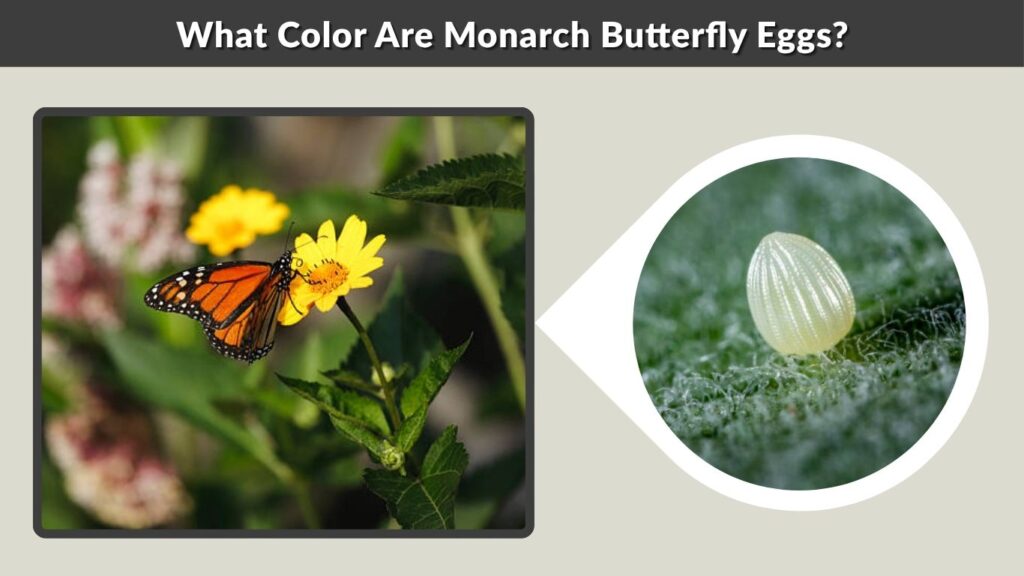
Monarch eggs are usually creamy white, pale yellow, or light greenish white. They are extremely small—approximately the size of a pinhead—and have a rounded, cone-like shape with vertical ridges.
A female generally places an egg individually on the underside of a milkweed leaf. As the caterpillar develops, the egg may darken slightly shortly before hatching. A completely brown or black egg that does not hatch could be infertile, damaged, diseased, or parasitized.
What Color Are Monarch Caterpillars?
Monarch caterpillars have bold bands of:
- Yellow
- Black
- White
Newly hatched caterpillars are extremely small and may initially look pale gray, translucent, or greenish. Their characteristic yellow, black, and white stripes become more noticeable as they grow through five larval stages, known as instars.
Older caterpillars also develop two pairs of black filaments. One pair projects near the head, while the other extends from the rear. These soft structures resemble antennae but are not stingers.
The striped pattern is another form of conspicuous coloration associated with the caterpillar’s milkweed diet. However, monarch caterpillars can be confused with queen butterfly caterpillars, which have a similar color scheme but possess an additional pair of filaments along the middle of the body.
What Color Is a Monarch Chrysalis?
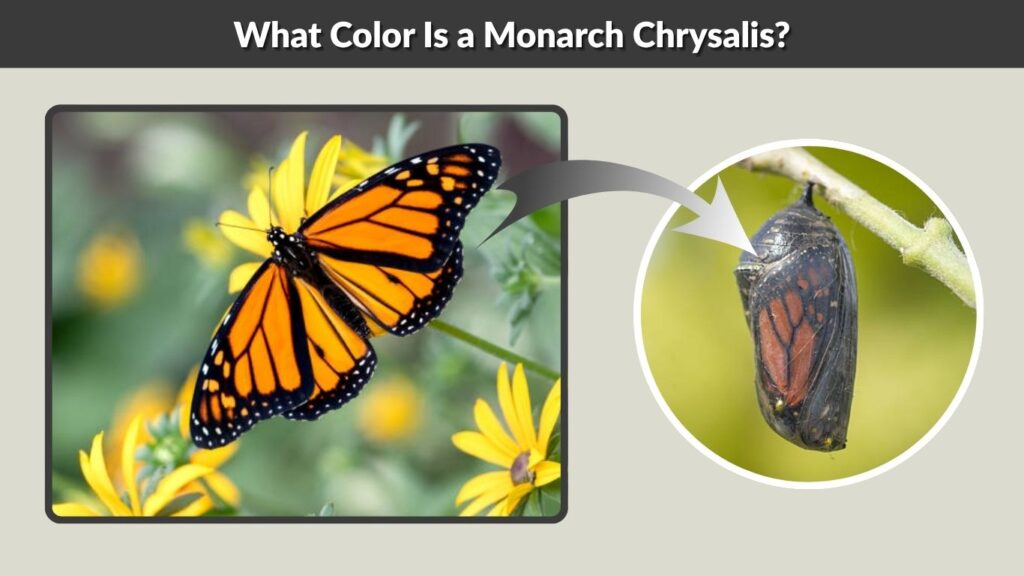
A healthy monarch chrysalis is normally jade green, with a black-and-metallic-gold band and several reflective gold dots. The gold markings do not contain actual gold; their structure reflects light and creates a metallic effect.
The chrysalis changes color as development progresses:
| Developmental point | Typical appearance |
| Newly formed | Pale green and soft |
| Most of pupal stage | Smooth jade green with gold markings |
| Near emergence | Darker and increasingly transparent |
| Final day | Orange, black, and white wings visible inside |
| After emergence | Empty, clear or pale casing |
The chrysalis does not remain orange throughout development. The adult’s orange-and-black pattern normally becomes visible only shortly before emergence, when the pupal case turns transparent.
Does a Black Chrysalis Mean the Monarch Is Dead?
Not necessarily. A dark chrysalis can indicate that a healthy monarch is ready to emerge, especially when recognizable orange-and-black wings are visible through the transparent covering.
Possible warning signs include premature blackening, spreading brown patches, leakage, a bad smell, severe wrinkling, or remaining completely dark without emergence. Normal final-stage darkening is usually followed by emergence within roughly one or two days.
Are All Monarch Butterflies the Same Shade of Orange?
Monarchs vary naturally from deep reddish orange to lighter yellow-orange. Their appearance can also be affected by:
- Sunlight and viewing angle
- Photography and screen settings
- Wing scale wear
- Age and migration distance
- Developmental conditions
- Whether the upper or lower wing surface is visible
Very pale monarchs occasionally occur, but naturally blue, purple, or fully black monarchs are not standard color forms. Images showing such colors may depict another species, unusual lighting, editing, wing damage, or a rare pigment abnormality.
Monarch Butterfly vs. Viceroy Colors
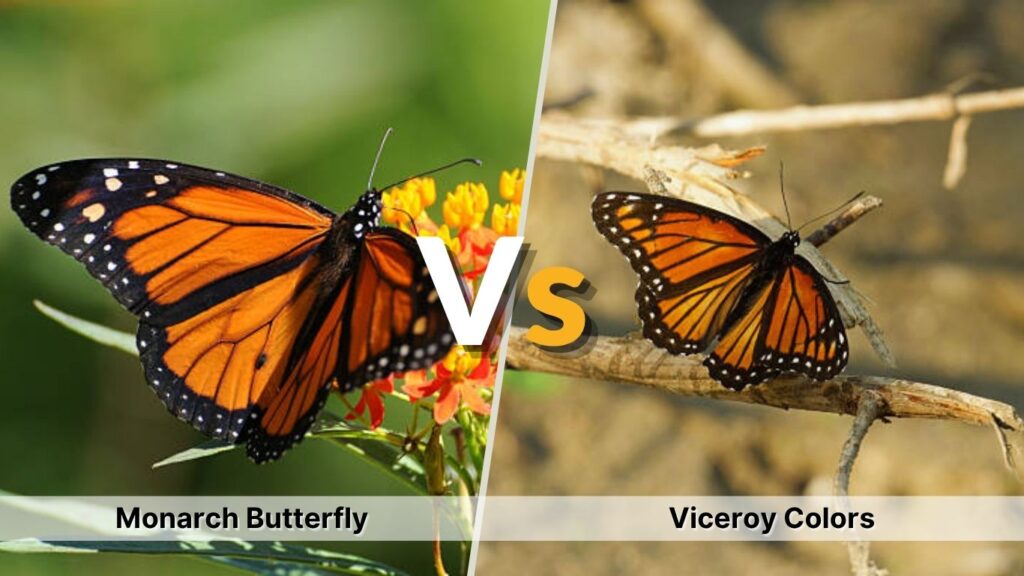
Viceroy butterflies also have orange, black, and white wings and are frequently mistaken for monarchs. The easiest visual distinction is the black line running across each viceroy’s hindwing.
| Feature | Monarch | Viceroy |
| Main colors | Orange, black and white | Orange, black and white |
| Hindwing line | Absent | Black line crosses each hindwing |
| Size | Usually larger | Usually smaller |
| Flight | Slow, floating wingbeats | Faster and more erratic |
Color alone is therefore not always sufficient for identification. Examining the complete wing pattern provides a more dependable answer.
What Flower Colors Attract Monarch Butterflies?
Monarchs possess true color vision and can learn to associate different colors with nectar. Controlled research found strong initial responses to orange and yellow model flowers, although the results changed depending on which color choices were offered. Monarchs could also learn to visit red, green, blue, and purple targets when those colors provided a sugar reward.
In a garden, they may feed from flowers that are:
- Orange
- Yellow
- Pink
- Purple
- Red
- White
Color should not be the only consideration. Flower structure, nectar quality, fragrance, plant species, bloom timing, and previous feeding experience also influence visits. A garden containing diverse native nectar plants that bloom across the growing season is more useful than one planted around a single preferred color.
FAQs
What Are the Three Main Colors of a Monarch Butterfly?
The three main colors are orange, black, and white. Orange fills most wing panels, black forms the veins and borders, and white spots decorate the black wing edges. The butterfly’s body is also primarily black with small white markings.
Are Female Monarch Butterflies a Different Color?
Females have the same general colors as males. However, females usually have thicker black wing veins and lack the two round black scent patches found on male hindwings. As a result, females may look slightly darker.
What Color Is a Newly Hatched Monarch Caterpillar?
A newly hatched caterpillar can appear pale gray, cream, translucent, or slightly greenish. Its recognizable black, white, and yellow stripes become stronger as it eats milkweed and develops through its five growth stages.
Why Is My Monarch Butterfly Pale Orange?
The butterfly may be older, worn, viewed through its paler wing underside, or naturally lighter than average. Wing scales are gradually lost during flight, making older monarchs appear faded. Lighting and camera settings can also change the apparent color.
Can Monarch Butterflies See Colors?
Yes. Experiments demonstrate that monarchs have true color vision and can distinguish colors independently of brightness. They also learn to connect different flower colors with nectar rewards, helping them adjust as food availability changes during migration.
