
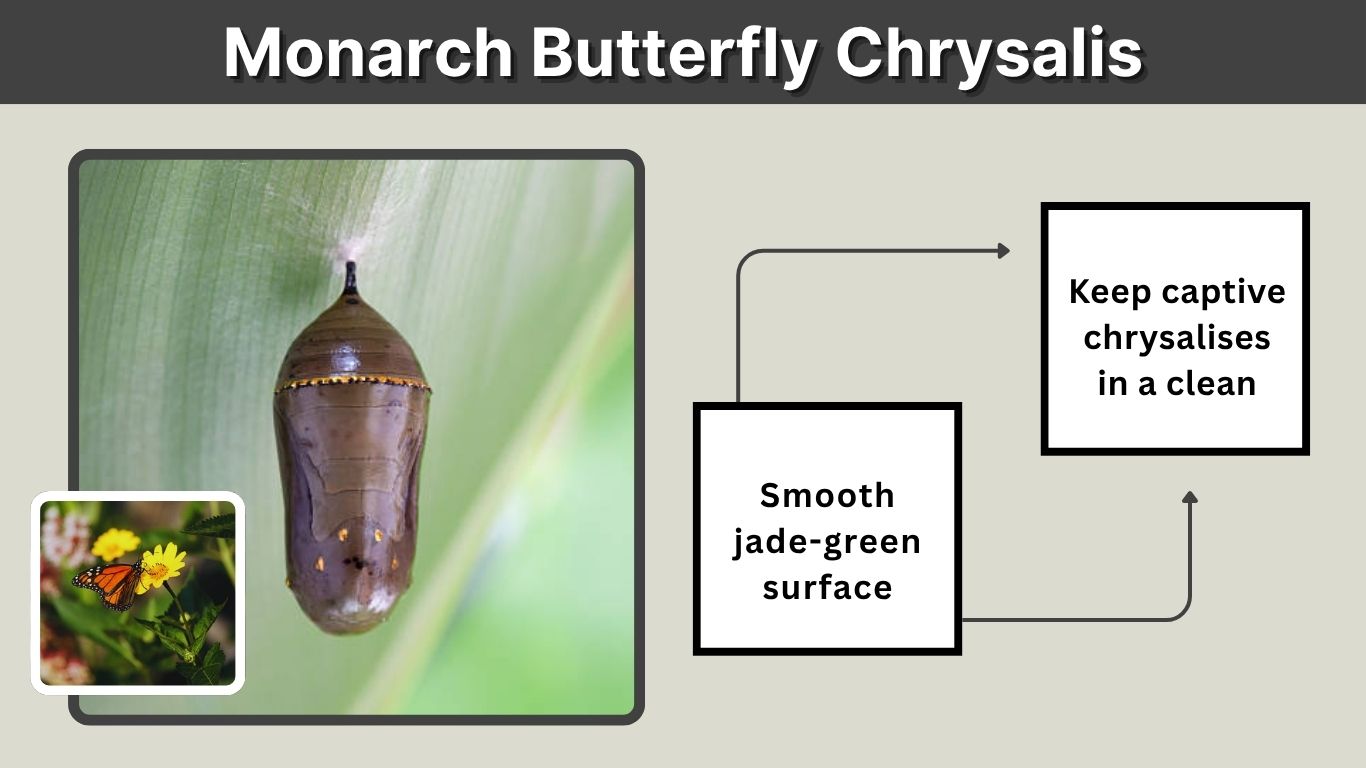
The monarch butterfly chrysalis is a jade-green pupal case decorated with striking metallic-looking gold markings. Inside, the caterpillar completes its transformation into an orange-and-black adult butterfly. This stage normally lasts a little over a week, although temperature and environmental conditions can affect the timeline. Learning what healthy color changes look like can help distinguish normal development from disease or failure.
Is It a Chrysalis or a Cocoon?
Monarch butterflies form a chrysalis, not a cocoon. A chrysalis is the exposed pupal stage of a butterfly. A cocoon is a protective silk covering produced by many moth caterpillars around their pupae.
A monarch caterpillar spins only a small silk pad from which it hangs. It does not surround its entire body with silk. After attaching itself, it sheds its final caterpillar skin and reveals the chrysalis underneath.
| Term | Meaning |
| Larva | The caterpillar stage |
| Pupa | The transformation stage |
| Chrysalis | A butterfly’s exposed pupal case |
| Cocoon | A silk covering made by many moths |
| Eclosion | The adult emerging from the chrysalis |
What Does a Monarch Chrysalis Look Like?
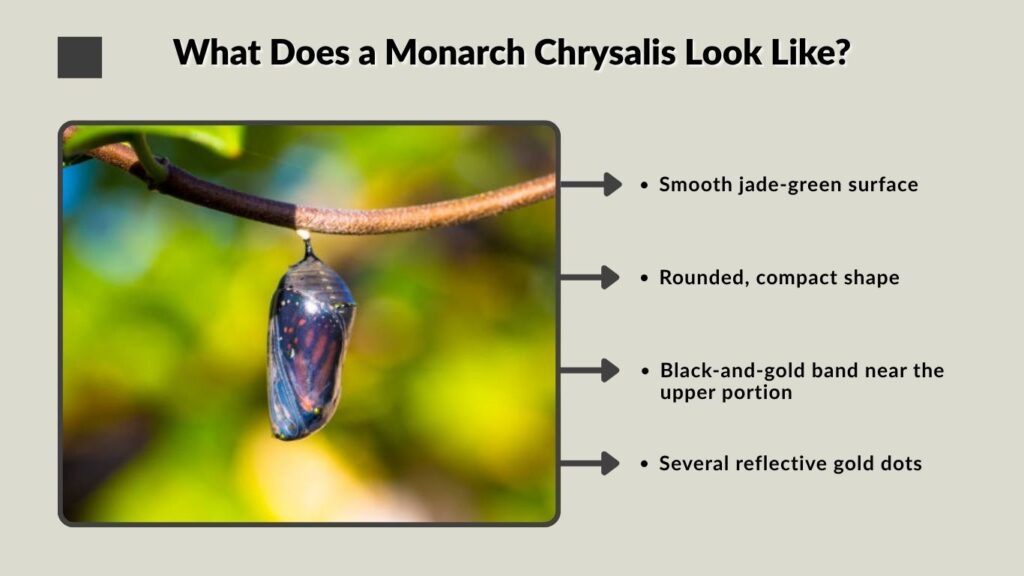
A newly formed monarch chrysalis is soft, pale green, and somewhat irregular. Within several hours, it becomes firmer, smoother, and darker green.
Identification Features
- Smooth jade-green surface
- Rounded, compact shape
- Black-and-gold band near the upper portion
- Several reflective gold dots
- Small black attachment structure at the top
- No silk covering around the body
- Orange-and-black wing pattern visible before emergence
The black attachment structure is called the cremaster. It hooks securely into the silk pad produced by the caterpillar and supports the chrysalis throughout development.
Monarch Butterfly Chrysalis Stages
Although the chrysalis may appear inactive, major developmental changes are taking place inside it. Adult organs begin developing during the caterpillar stage, and the transformation is completed during pupation.
1. The Caterpillar Stops Eating
A mature fifth-instar caterpillar eventually stops feeding and begins searching for a secure pupation site. It may leave the milkweed plant and travel to another plant, fence, wall, branch, porch, container lid, or protected structure.
This explains why monarch chrysalises can be difficult to find around milkweed patches. The caterpillars commonly move away before pupating.
2. It Forms a Silk Pad
After selecting a location, the caterpillar produces a small mat of silk. It secures its rear prolegs to this pad and releases the rest of its body.
The caterpillar then hangs upside down with its body curved into a shape resembling the letter J. It may remain in this position for hours while preparing for its final molt.
3. The Chrysalis Appears
The caterpillar’s striped skin splits near its head. As it twists and contracts, the old skin moves upward and exposes the soft green pupa underneath.
The developing chrysalis must then secure its cremaster into the silk pad before the discarded skin falls away. The entire transformation from caterpillar to visible chrysalis happens surprisingly quickly.
4. The Chrysalis Hardens
A fresh chrysalis may appear soft, stretched, or uneven. Over the next several hours, its outer covering hardens and develops the familiar smooth, rounded shape.
It should not be touched or moved during this vulnerable period. Disturbing a newly formed chrysalis could damage its soft outer case or cause it to fall.
5. The Butterfly Develops
The chrysalis remains green through most of its development. Inside, the transformation into an adult is completed, including the development of functional wings, legs, antennae, eyes, and reproductive structures.
Under normal summer conditions, the pupal stage lasts approximately 8–15 days. Monarch Watch commonly gives a range of 10–14 days. Cooler conditions usually slow the process, while suitable warmth generally speeds it up.
6. The Chrysalis Darkens
Shortly before emergence, the chrysalis appears much darker. Its black, orange, and white wing pattern becomes visible through the pupal covering as pigmentation develops during the final part of the pupal stage.
This darkening is normally a healthy sign when:
- It happens near the expected emergence date
- Orange-and-black wings become visible
- The chrysalis maintains its normal shape
- The adult emerges within approximately one or two days
7. The Monarch Emerges
The adult breaks open the lower part of the chrysalis and gradually pulls itself free. Its abdomen initially appears large, while its wings look small, wet, and wrinkled.
The butterfly hangs vertically and pumps fluid into its wings until they expand. It then needs several hours for the wings to dry and harden before normal flight is possible.
How Long Is a Monarch in Its Chrysalis?
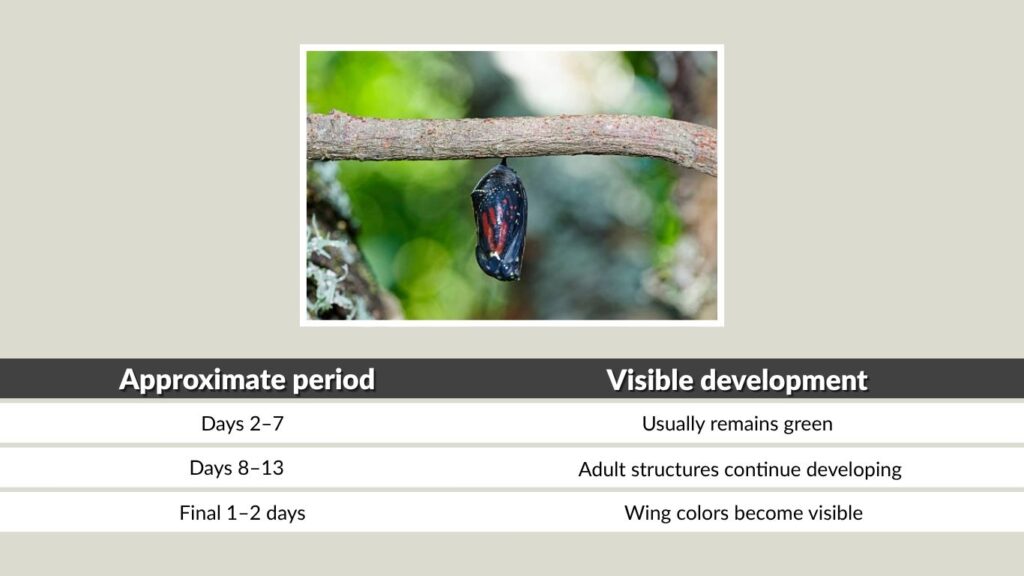
Most monarchs remain in the chrysalis for 8–15 days, with approximately 10–14 days being common. The adult may develop in as little as one week under some warm conditions, while cooler temperatures can extend the process.
| Approximate period | Visible development |
| First day | Chrysalis forms and hardens |
| Days 2–7 | Usually remains green |
| Days 8–13 | Adult structures continue developing |
| Final 1–2 days | Wing colors become visible |
| Emergence day | Adult exits and expands its wings |
A chrysalis does not truly “hatch.” Hatching refers to a caterpillar leaving an egg. The adult butterfly emerges, or undergoes eclosion, from the chrysalis.
Why Does a Monarch Chrysalis Have Gold Spots?
The gold markings do not contain actual gold or metal. Specialized structures reflect light in a way that gives them a metallic appearance. Related danaine butterflies may have gold, silver, or copper-colored pupal markings.
Scientists have suggested several possible functions, including camouflage, warning coloration, light filtering, oxygen exchange, or simply a structural effect of the chrysalis covering. However, there is not yet one confirmed explanation for every gold marking.
Is a Black Monarch Chrysalis Dead?
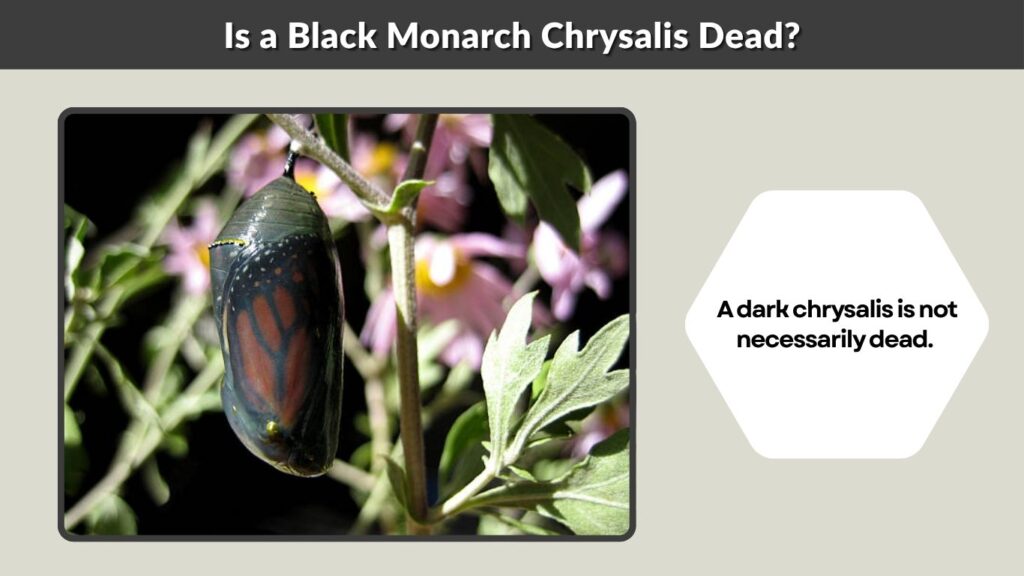
A dark chrysalis is not necessarily dead. Normal darkening occurs shortly before emergence, when the adult’s wing colors become visible.
A problem may be present when the chrysalis:
- Turns black unusually early
- Develops irregular brown or black patches
- Becomes soft, wrinkled, or misshapen
- Leaks dark liquid
- Produces an unpleasant smell
- Remains completely dark for more than 48 hours
- Shows no recognizable orange wing pattern
Darkening can sometimes result from bacterial infection or parasitism by flies or wasps. The protozoan parasite Ophryocystis elektroscirrha, commonly called OE, may also cause developmental problems, although infection cannot always be identified by appearance alone.
What If the Chrysalis Falls?
A fallen chrysalis may still produce a healthy butterfly when it has not been punctured, crushed, or badly damaged. It should be positioned where the emerging adult will have enough room to climb and hang vertically.
When relocation is necessary, wait until the chrysalis is hard and dry. Monarch Watch recommends carefully preserving the silk around the cremaster and using thread to suspend the pupa securely. A freshly formed, soft chrysalis should never be moved.
How to Care for a Monarch Chrysalis
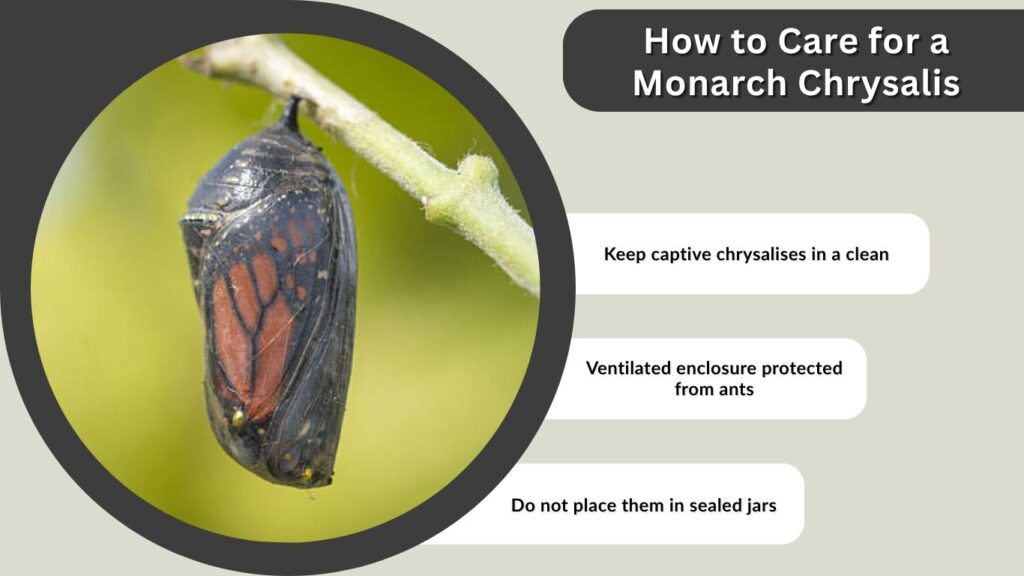
A wild chrysalis in a protected location usually needs no intervention. Do not repeatedly touch, rotate, spray, or expose it to indoor heating or direct intense sunlight.
Provide several inches of clear vertical space underneath it. The emerging butterfly must hang with its wings pointing downward while they expand. The area should also contain a textured surface that it can grip if it falls.
Keep captive chrysalises in a clean, ventilated enclosure protected from ants, pesticides, extreme temperatures, and pets. Do not place them in sealed jars, and avoid excessive moisture that could encourage mold or disease.
FAQs
Where Do Monarch Butterflies Make Their Chrysalis?
Monarch caterpillars may pupate beneath leaves, branches, fences, walls, porch rails, outdoor furniture, or enclosure lids. They frequently crawl away from milkweed before forming a chrysalis, so the pupal site may be some distance from the feeding plant.
How Long After the Chrysalis Turns Black Will It Open?
A healthy monarch commonly emerges within about 24 hours after its orange-and-black wings become clearly visible. Temperature may affect the timing. A completely dark chrysalis that remains unchanged for more than 48 hours may no longer be viable.
Do Monarch Butterflies Eat Their Chrysalis?
No. The adult butterfly leaves the empty chrysalis behind and does not eat it. After its wings harden, the monarch feeds on flower nectar using its long, coiled proboscis.
Can You Touch a Monarch Chrysalis?
It is best to avoid unnecessary handling. Never touch one while it is forming or still soft. A hardened chrysalis may be carefully relocated when it is in danger, but improper handling can damage the case or attachment point.
What Should I Do If a Monarch Is Stuck in Its Chrysalis?
Do not immediately pull it free. Emergence naturally requires effort, and manual assistance can damage the soft wings, legs, or body. A butterfly that cannot emerge successfully may have an infection, deformity, injury, or developmental problem that cannot be corrected by removing the case.
