
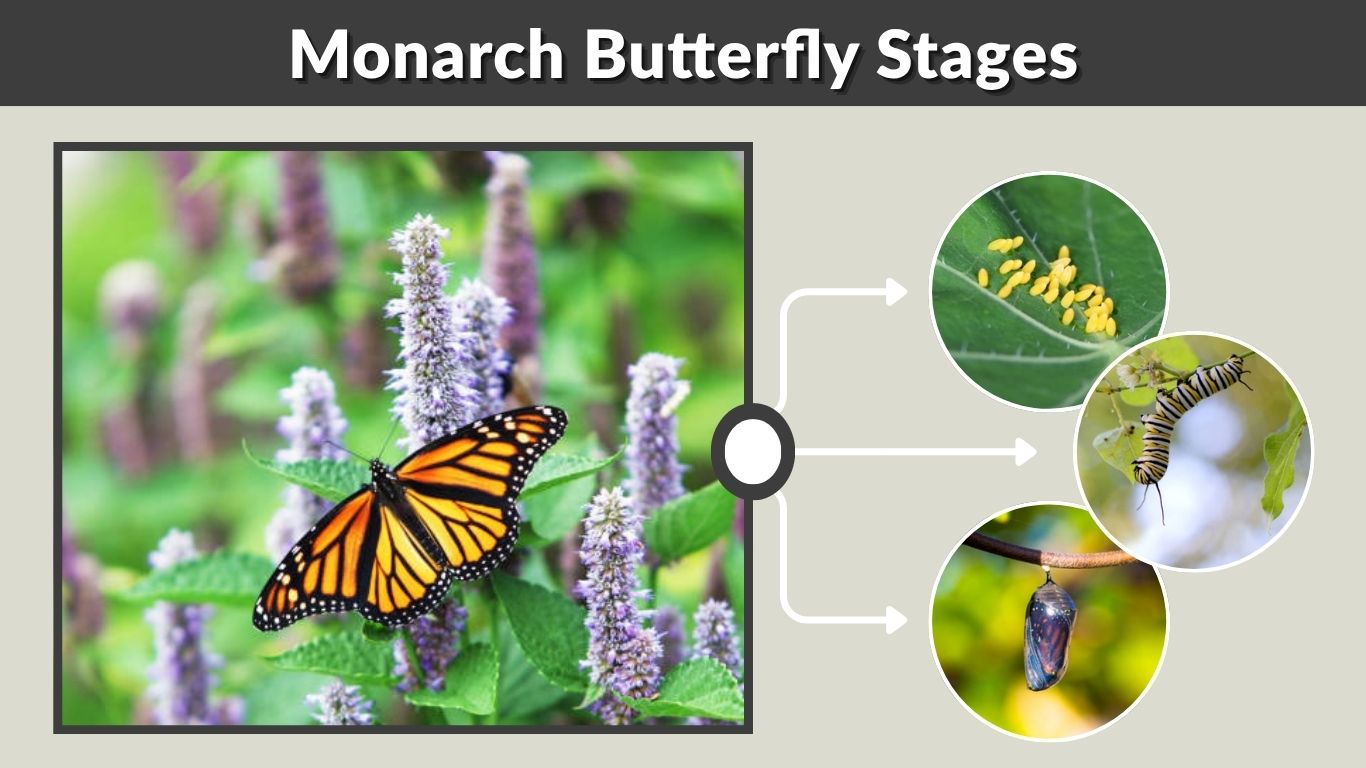
The monarch butterfly stages reveal one of nature’s most remarkable transformations. Every monarch begins as a tiny egg, develops into a striped caterpillar, forms a green chrysalis, and finally emerges as an orange-and-black adult butterfly. This process is called complete metamorphosis. Under suitable conditions, the journey from egg to adult generally takes about three to five weeks, although temperature, food quality, and weather can change the timeline.
What Are the Four Stages of a Monarch Butterfly?
A monarch butterfly has four main life stages: egg, larva, pupa, and adult. The larval stage is commonly called the caterpillar stage, while the pupal stage takes place inside a chrysalis.
| Life stage | Approximate duration | Main development |
| Egg | 3–5 days | Embryo develops inside the egg |
| Caterpillar | 9–14 days | Larva feeds, grows, and passes through five instars |
| Chrysalis | 8–15 days | Caterpillar transforms into a butterfly |
| Adult | Several weeks to months | Butterfly feeds, mates, migrates, and lays eggs |
Development usually happens faster in warm conditions and more slowly when temperatures are cool.
Stage 1: Monarch Butterfly Egg
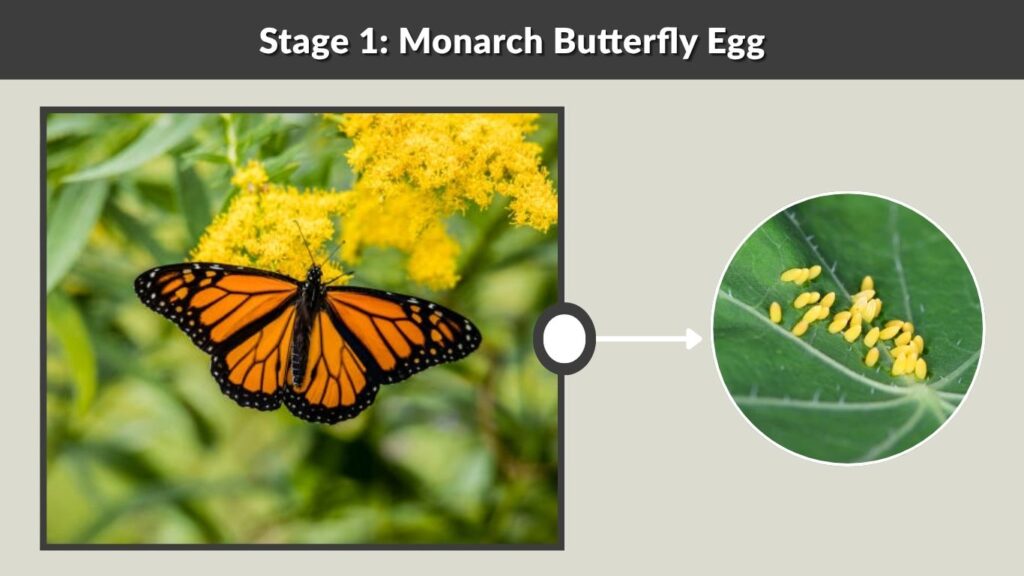
The monarch life cycle begins when an adult female finds a suitable milkweed plant. Milkweed is essential because newly hatched monarch caterpillars depend on it as their host plant.
What Does a Monarch Egg Look Like?
A monarch egg is creamy white or pale green and measures only about 1.2 millimeters tall. It has an oval or dome-like shape with vertical ridges running from top to bottom.
The egg is sometimes confused with a tiny drop of dried milkweed sap. However, monarch eggs have a more regular shape and a visibly ridged surface when viewed closely.
Where Are the Eggs Laid?
Female monarchs usually place their eggs individually on milkweed leaves, often on the underside where they receive some protection from sunlight and weather. Eggs may also appear on milkweed stems, flower buds, or the upper surfaces of leaves.
Monarch caterpillars rely on milkweed and closely related plants for their growth and development.
How Long Does the Egg Stage Last?
The monarch butterfly egg stage normally lasts between three and five days. Shortly before hatching, the egg may darken as the developing caterpillar becomes visible through the shell.
After emerging, the tiny caterpillar may eat part or all of its empty eggshell before beginning to feed on milkweed.
Stage 2: Monarch Butterfly Caterpillar
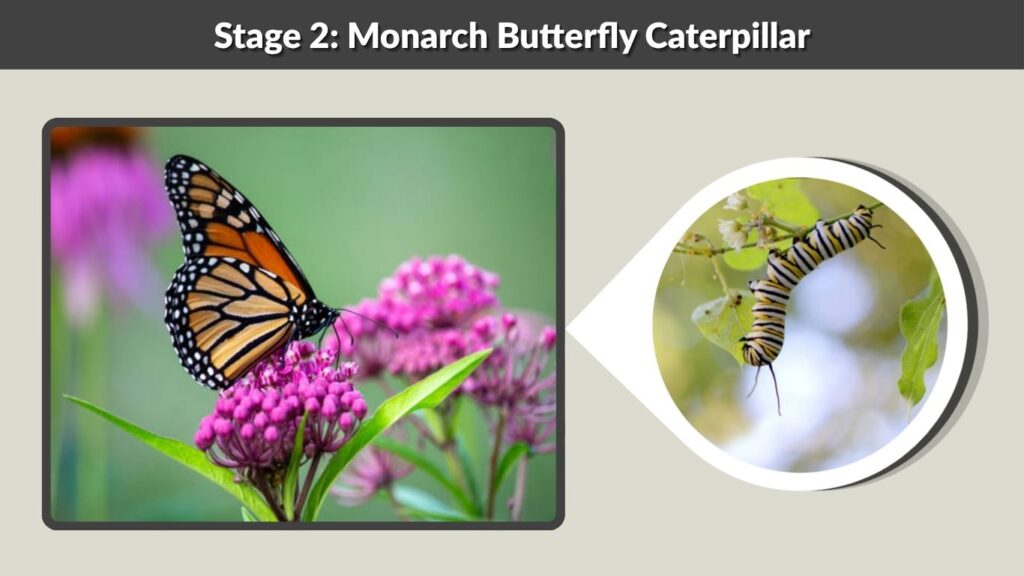
The caterpillar, or larval stage, is devoted mainly to eating and growing. A newly hatched monarch caterpillar is extremely small, but it grows rapidly during the following one to two weeks.
The Five Monarch Caterpillar Instars
Monarch caterpillars pass through five growth periods called instars. Each instar ends when the caterpillar sheds its old skin.
- First instar: The caterpillar is tiny, pale, and may have few visible stripes.
- Second instar: Black, white, and yellow bands become more noticeable.
- Third instar: The body grows longer, and the paired tentacles become easier to see.
- Fourth instar: The caterpillar develops bold stripes and feeds heavily.
- Fifth instar: The mature caterpillar becomes thick-bodied and may reach about 5 centimeters long.
The caterpillar sheds its skin repeatedly as it grows through these five instars.
What Do Monarch Caterpillars Eat?
Monarch caterpillars feed primarily on milkweed leaves. They may also consume milkweed flowers, seed pods, and tender stems when leaves are limited.
Milkweed contains defensive chemicals called cardenolides. Monarch larvae can store some of these compounds in their bodies, helping make both caterpillars and adult butterflies unpleasant or toxic to certain predators.
The Pre-Pupa or J Stage
When the fifth-instar caterpillar finishes growing, it stops eating and searches for a protected location. It produces a small silk pad and attaches itself using a structure at the end of its body.
The caterpillar then hangs upside down in a shape resembling the letter J. This is known as the J stage. After hanging for several hours, it sheds its final caterpillar skin and reveals the chrysalis underneath.
Stage 3: Monarch Butterfly Chrysalis
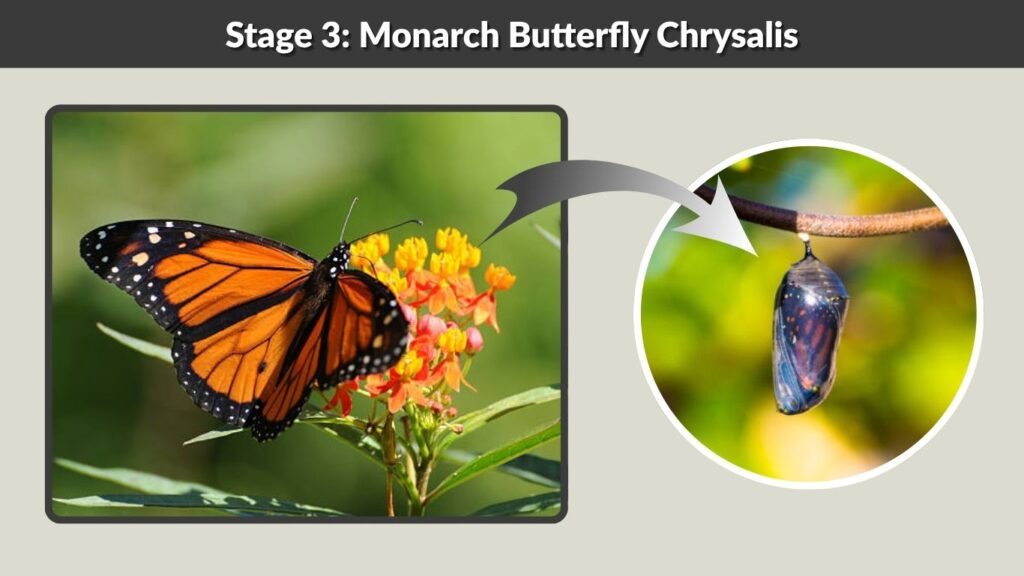
The chrysalis stage is one of the most dramatic monarch butterfly stages. Although the pupa appears inactive from the outside, extensive changes are occurring inside.
Chrysalis or Cocoon?
Monarch butterflies do not make cocoons. A butterfly’s pupa is called a chrysalis, while cocoons are silk coverings produced by many moth caterpillars.
The monarch chrysalis is jade green with small metallic-looking gold spots and a black band near the top. Its coloring helps it blend with surrounding vegetation.
What Happens Inside the Chrysalis?
Inside the chrysalis, larval tissues are reorganized into adult butterfly structures. Wings, compound eyes, antennae, legs, reproductive organs, and other adult features complete their development during this period.
The pupa does not eat or move from place to place. It depends on energy stored during the caterpillar stage.
How Long Is the Monarch Chrysalis Stage?
A monarch generally remains in its chrysalis for approximately 8 to 15 days. Warm temperatures may shorten development, while cooler weather can make the stage last longer.
Near the end of the chrysalis stage, the green covering becomes darker and then transparent. The butterfly’s orange-and-black wings can become visible through the chrysalis shortly before emergence.
Stage 4: Adult Monarch Butterfly
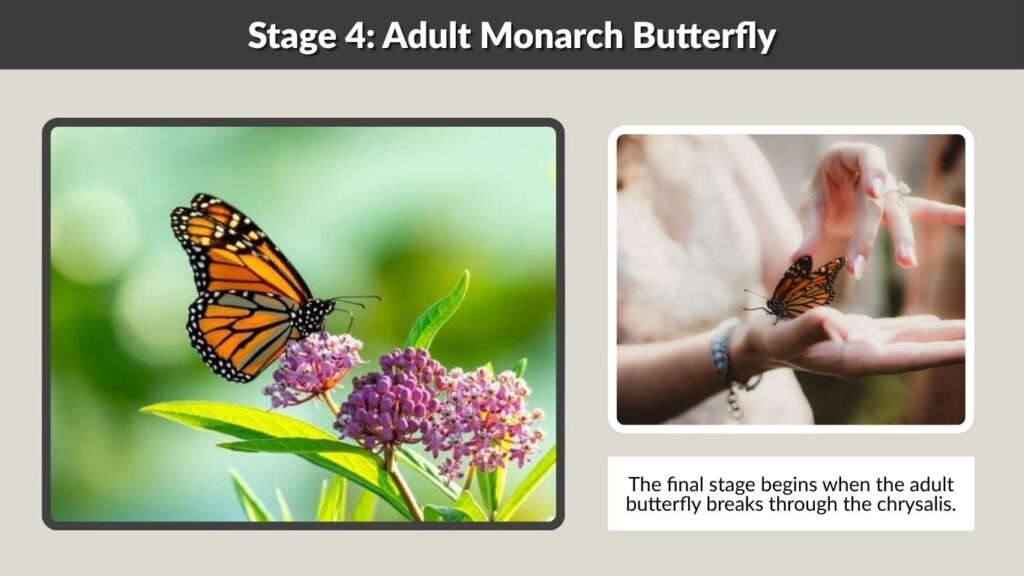
The final stage begins when the adult butterfly breaks through the chrysalis. This process is called eclosion.
Emerging From the Chrysalis
A newly emerged monarch has small, folded, and wet-looking wings. It hangs from the empty chrysalis while pumping fluid through the wing veins, causing the wings to expand.
The butterfly must remain suspended while its wings straighten, dry, and harden. It is not ready for normal flight immediately after emerging.
Adult Appearance
Adult monarch butterflies have bright orange wings marked by black veins and black borders containing white spots. Males and females look similar, but males have thinner wing veins and a small black scent patch on each hindwing. Females generally have thicker black veins and lack these patches.
Adult Lifespan and Reproduction
Most monarchs produced during spring and summer live for approximately two to six weeks. During that time, they drink nectar, mate, and produce another generation.
The migratory generation that emerges near the end of summer is different. These butterflies delay reproduction and may live for eight or nine months while migrating and overwintering.
Monarch Butterfly Stages Timeline
The exact schedule varies, but a typical warm-weather timeline may look like this:
| Approximate days | Development |
| Days 1–4 | Egg develops on a milkweed plant |
| Days 4–7 | Caterpillar hatches and enters its first instars |
| Days 7–12 | Caterpillar grows rapidly and develops bold stripes |
| Days 12–18 | Fifth-instar caterpillar finishes feeding |
| Days 18–19 | Caterpillar forms the J shape and becomes a chrysalis |
| Days 19–30 | Adult structures develop inside the chrysalis |
| Around days 25–35 | Adult monarch emerges |
This is only an approximate monarch butterfly stages day-by-day guide. Some monarchs can complete development in about 25 days in warm conditions, while others require more than a month.
What Affects the Length of Each Stage?
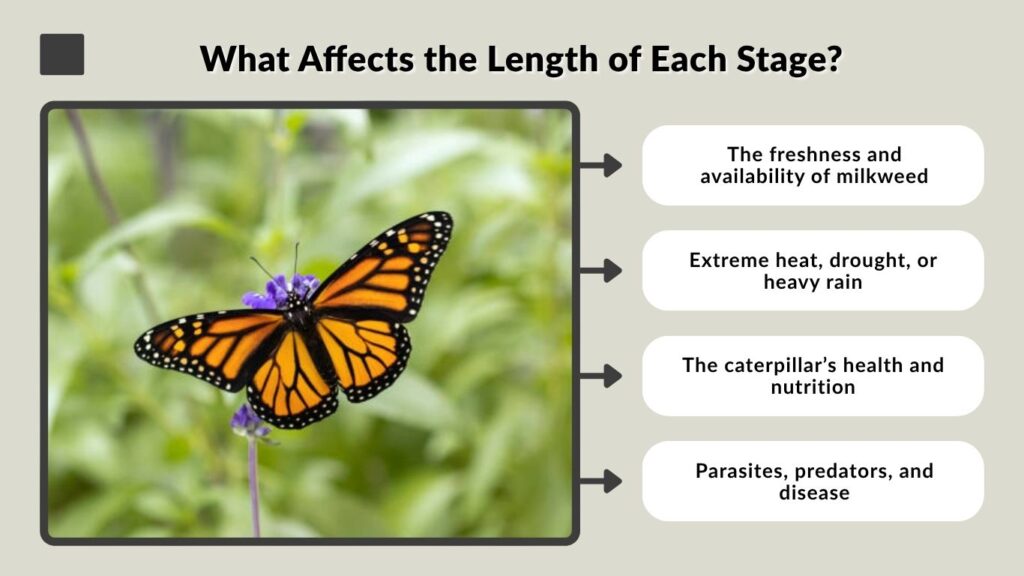
Temperature has a major influence on monarch development. Consistently warm conditions generally speed up growth, whereas cold weather slows it down.
Other influences include:
- The freshness and availability of milkweed
- Extreme heat, drought, or heavy rain
- The caterpillar’s health and nutrition
- Parasites, predators, and disease
- The particular milkweed species being eaten
Developmental times should therefore be treated as ranges rather than fixed schedules.
FAQs
How many stages does a monarch butterfly have?
A monarch butterfly has four main life stages: egg, larva, pupa, and adult. The larva is the familiar striped caterpillar, while the pupa develops inside a green chrysalis. Together, these stages form a process called complete metamorphosis.
How long is the caterpillar stage of a monarch butterfly?
The monarch caterpillar stage commonly lasts about 9 to 14 days. During that period, the caterpillar eats milkweed, sheds its skin several times, and passes through five separate instars before forming a chrysalis.
How long does a monarch stay in its chrysalis?
A monarch usually stays in the chrysalis for approximately 8 to 15 days. The exact duration depends largely on temperature. Shortly before emergence, the chrysalis becomes transparent enough for the butterfly’s orange-and-black wings to be seen.
Do monarch butterflies form cocoons?
Monarch butterflies do not form cocoons. They develop inside a chrysalis. A chrysalis is the exposed pupal structure of a butterfly, while a cocoon is an outer silk covering typically spun by certain moth caterpillars.
How long does the full monarch life cycle take?
Development from egg to adult commonly takes about three to five weeks. In warm weather, the entire process may finish in around 25 days. Cooler temperatures and other environmental conditions can extend the timeline to more than a month.
