
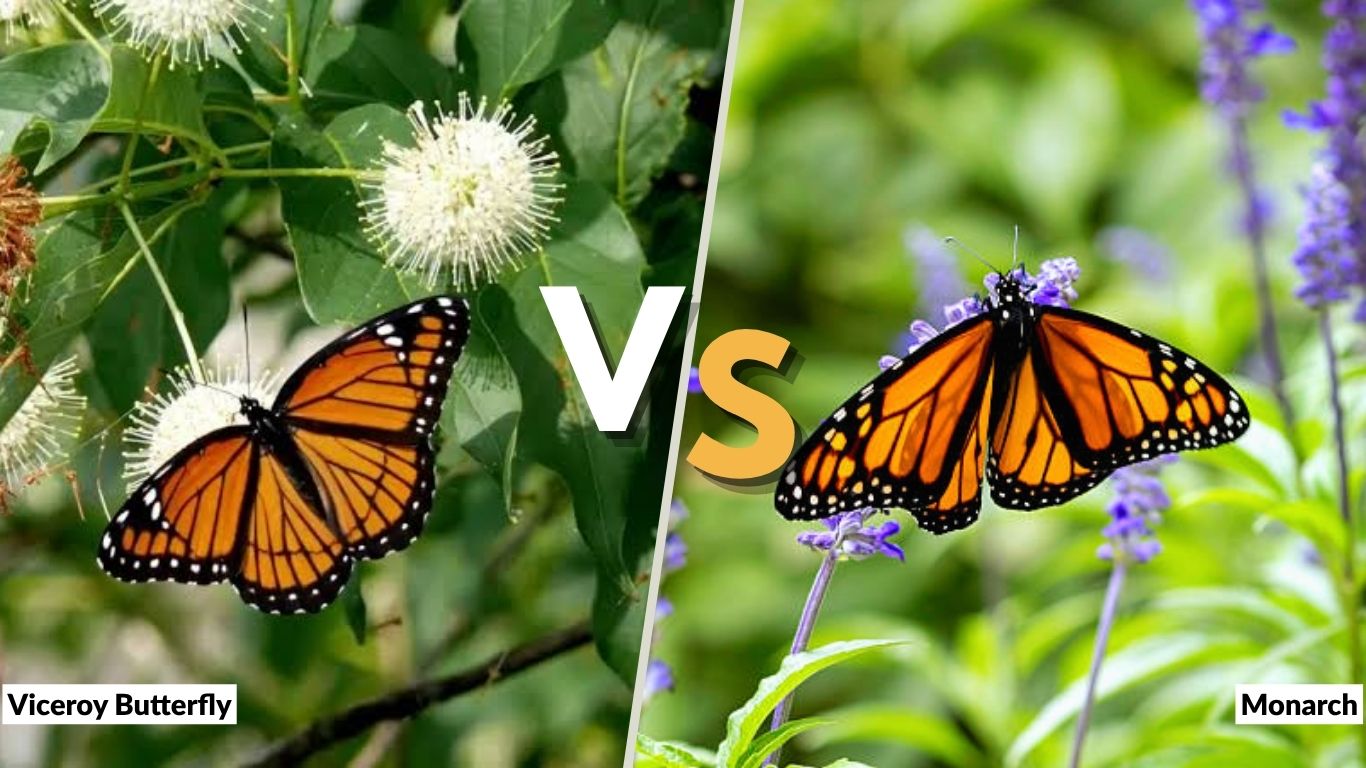
The viceroy butterfly and monarch look remarkably similar, with orange wings, black veins, and white-spotted borders. However, they are separate species with clear differences in wing markings, size, flight, caterpillars, host plants, and migration. The quickest identification method is to examine the hindwings: a viceroy has a curved black line crossing each hindwing, while a monarch does not. Learning a few additional features makes distinguishing these butterflies much easier.
Viceroy vs Monarch Butterfly: Quick Comparison
Both butterflies belong to the brush-footed butterfly family, but they are not closely related within that family. The monarch’s scientific name is Danaus plexippus, while the viceroy is Limenitis archippus.
| Feature | Monarch butterfly | Viceroy butterfly |
| Scientific name | Danaus plexippus | Limenitis archippus |
| Main identifying mark | No black line across hindwing | Black line crosses hindwing |
| Wingspan | Usually 3.5–4 inches | Usually 2.5–3.5 inches |
| Flight | Slow, powerful, and gliding | Faster and more irregular |
| Caterpillar food | Milkweed | Willow, poplar, cottonwood, and aspen |
| Migration | Famous long-distance migrant | Generally remains within its region |
| Caterpillar appearance | Black, white, and yellow stripes | Brown-and-white, resembling a bird dropping |
The black hindwing line is the most dependable field mark because size and flight can be difficult to judge when only one butterfly is present.
Wing Markings and Physical Appearance
At a distance, both species display bright orange wings divided by dark veins. Their outer wing margins are black and contain rows of white spots, creating the warning pattern that often causes confusion.
Look for the Black Hindwing Line
A viceroy has a thin, curved black band running across the veins of each hindwing. This line is located toward the lower half of the orange wing and appears on both the upper and lower surfaces.
Monarchs lack this cross-band. Their black veins run outward from the body without being connected by an additional curved line. Checking this feature is usually enough to identify an adult butterfly accurately.
Size Difference
Monarchs are generally larger. Their wingspan commonly measures around 3.5 to 4 inches, although some individuals may be slightly larger. Viceroys usually span approximately 2.5 to 3.5 inches.
Size should be used as a secondary clue rather than the only identification method. A large viceroy and a small monarch may appear nearly equal, especially when they are not seen together.
Rows of White Spots
Both species have white spots along their black wing borders. However, the viceroy typically has a more orderly single row of white spots in the dark marginal band, while the monarch often appears more heavily spotted.
Spot patterns can vary because of wear, lighting, and viewing angle. The hindwing stripe remains the more reliable difference.
Monarch vs Viceroy Caterpillar
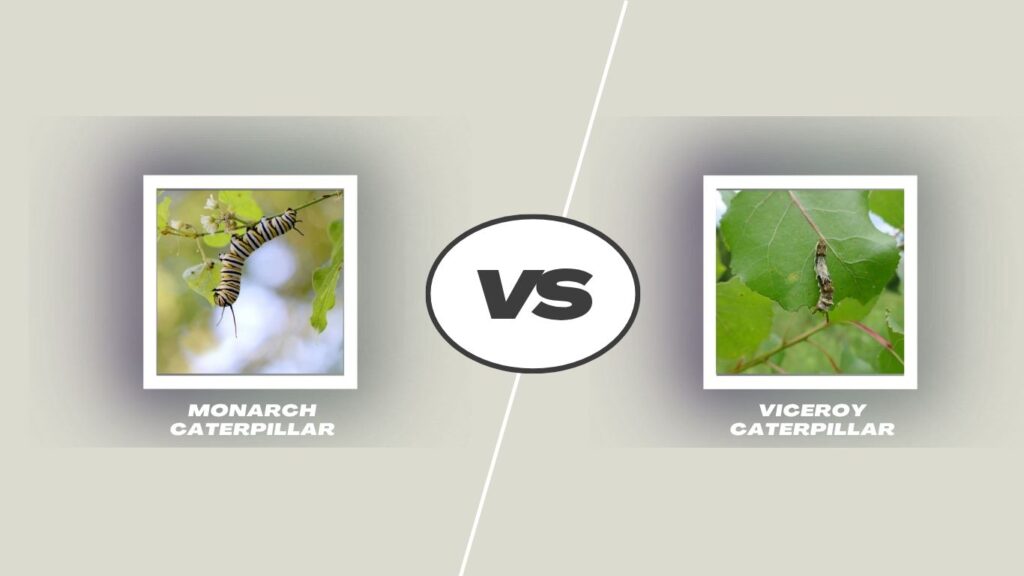
The adult butterflies look similar, but their caterpillars are completely different. Caterpillar appearance and the plant on which it is feeding can provide immediate identification.
| Caterpillar feature | Monarch | Viceroy |
| Main colors | Black, white, and yellow | Brown, cream, green, and white |
| Body pattern | Bold horizontal bands | Blotchy and irregular |
| Projections | Two pairs of flexible filaments | Knobby projections behind the head |
| Appearance | Brightly striped | Resembles a bird dropping |
| Primary host plant | Milkweed | Willow-family trees |
Monarch Caterpillar Identification
A monarch caterpillar has noticeable black, white, and yellow bands around its body. It also possesses two pairs of thin, flexible filaments—one pair near the head and another near the rear.
Monarch larvae feed on milkweed. They obtain defensive cardenolide compounds from these plants, which can make the caterpillars and adults unpalatable or toxic to some predators.
Viceroy Caterpillar Identification
A viceroy caterpillar is mottled brown, cream, white, and green. Its uneven shape and coloration make it resemble a small bird dropping, providing camouflage against predators.
Viceroy larvae feed primarily on trees in the willow family, including willows, poplars, cottonwoods, and aspens. They do not normally feed on milkweed.
Flight and Behavior Differences
The way the butterfly flies can offer another clue. However, flight should support identification rather than replace examination of the wing pattern.
Monarch Flight
Monarchs commonly use a steady “flap-flap-glide” pattern. They may sail for noticeable distances with their wings held open, giving their flight a smooth, floating appearance.
Their relatively large wings are well suited for long-distance travel. Eastern North American monarchs are especially known for their multigenerational migration between breeding areas in the United States and Canada and overwintering sites in central Mexico.
Viceroy Flight
Viceroys tend to fly more quickly and with shorter, less predictable movements. Their flight can look more active or erratic than the slow, gliding motion of a monarch.
They often perch on vegetation and patrol around suitable host plants. Unlike migratory monarch populations, viceroys generally remain within their wider home region and survive cold seasons in the caterpillar stage.
Habitat and Host Plants
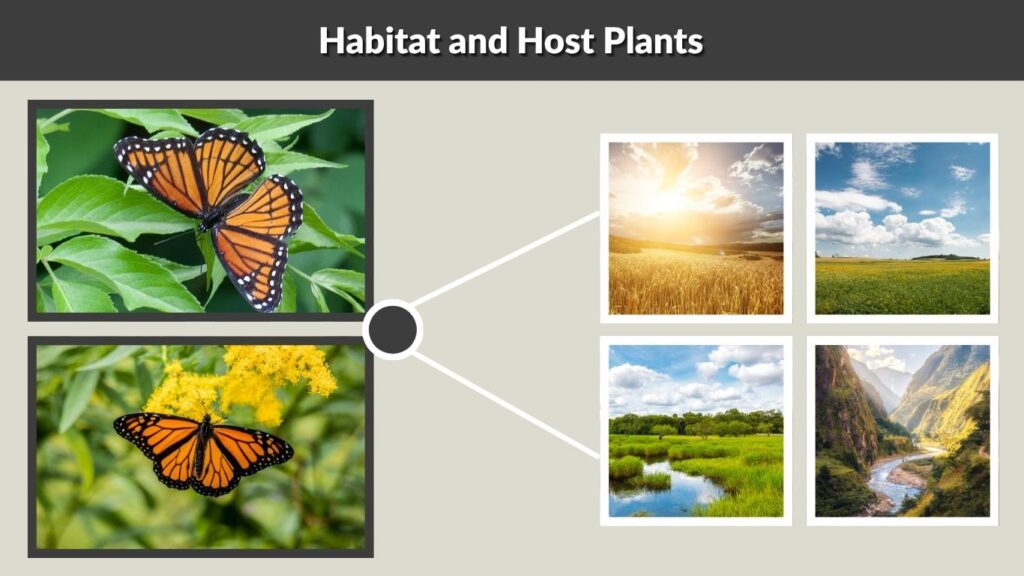
The surrounding environment can help determine which butterfly you are observing. Adults of both species visit flowers, but their breeding habitats differ because their caterpillars require different plants.
| Habitat feature | Monarch | Viceroy |
| Main larval plant | Milkweed | Willow-family trees |
| Common breeding habitat | Fields, gardens, roadsides, and prairies | Wet meadows, pond edges, and willow thickets |
| Adult feeding | Flower nectar | Nectar, honeydew, sap, and other organic fluids |
| Winter strategy | Migrates or overwinters in warmer regions | Overwinters as a caterpillar in a leaf shelter |
Where Monarchs Are Found
Monarchs are often seen in sunny fields, grasslands, roadsides, gardens, and other places where milkweed and nectar-producing flowers grow. Females must locate milkweed because it is the essential food source for their caterpillars.
Where Viceroys Are Found
Viceroys favor moist, open environments containing their host trees. Typical locations include lake edges, swamp margins, wet meadows, river valleys, roadsides, and willow thickets.
Adults visit flowers but may also feed on aphid honeydew, decaying fruit, carrion, dung, or moist soil.
Viceroy vs Monarch Mimicry
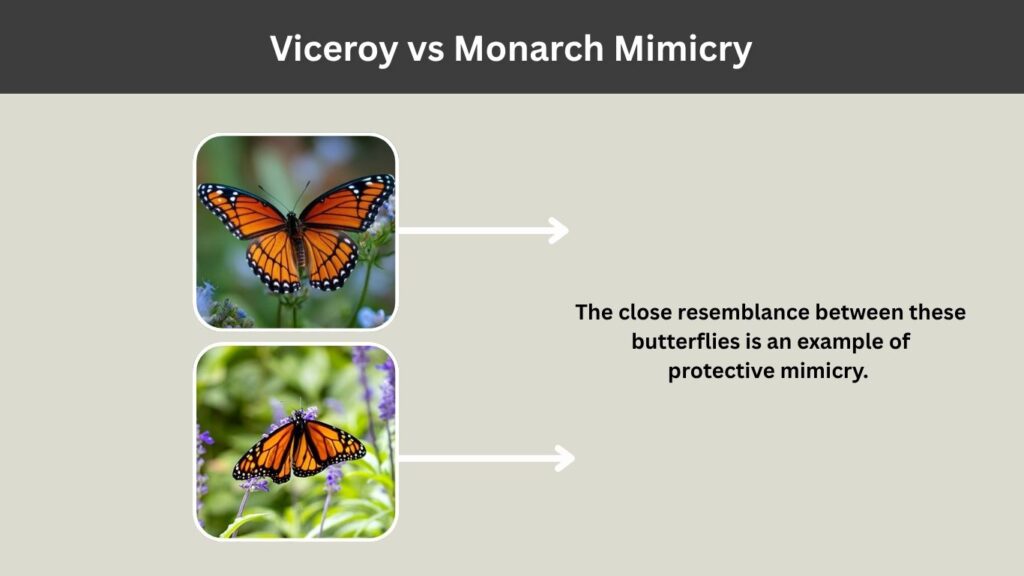
The close resemblance between these butterflies is an example of protective mimicry. Their shared orange-and-black pattern acts as a warning signal to predators.
Viceroys were once commonly described as harmless Batesian mimics that received protection by copying toxic monarchs. Research later showed that viceroys can also taste unpleasant because their larvae consume willow and poplar foliage containing defensive compounds. As a result, the relationship is now generally described as Müllerian mimicry, in which two defended species benefit from displaying a similar warning pattern.
Are Monarch and Viceroy Butterflies Poisonous?
Monarchs contain cardenolides obtained from milkweed during the caterpillar stage. The amount varies according to the milkweed species and individual butterfly, but these compounds can make monarchs unpleasant or harmful to certain predators.
Viceroys are also considered distasteful rather than completely harmless. Chemicals obtained from willow-family host plants contribute to their defensive taste. Neither butterfly is dangerous to touch, and neither can bite or sting people.
FAQs
What is the easiest way to identify a viceroy butterfly?
Look for a curved black line crossing each hindwing. Viceroys have this extra band, while monarchs do not. The viceroy is also generally smaller, but comparing size can be unreliable unless both butterflies are visible together.
Is a viceroy butterfly smaller than a monarch?
Yes. Viceroys usually have a wingspan of approximately 2.5 to 3.5 inches, while monarchs commonly measure around 3.5 to 4 inches. Natural variation may cause their sizes to overlap slightly.
Do viceroy caterpillars eat milkweed?
Viceroy caterpillars do not normally eat milkweed. Their primary host plants are willows, poplars, cottonwoods, and aspens. Milkweed is the essential caterpillar host plant for monarch butterflies.
Do viceroy butterflies migrate like monarchs?
Viceroys do not perform the monarch’s famous continental migration. In colder parts of their range, young viceroy caterpillars create protective leaf shelters called hibernacula and remain inside them during winter.
Is the viceroy a type of monarch butterfly?
No. They are separate species. The monarch is Danaus plexippus, while the viceroy is Limenitis archippus. Their similar appearance developed as protective mimicry rather than because one is a variety of the other.
