
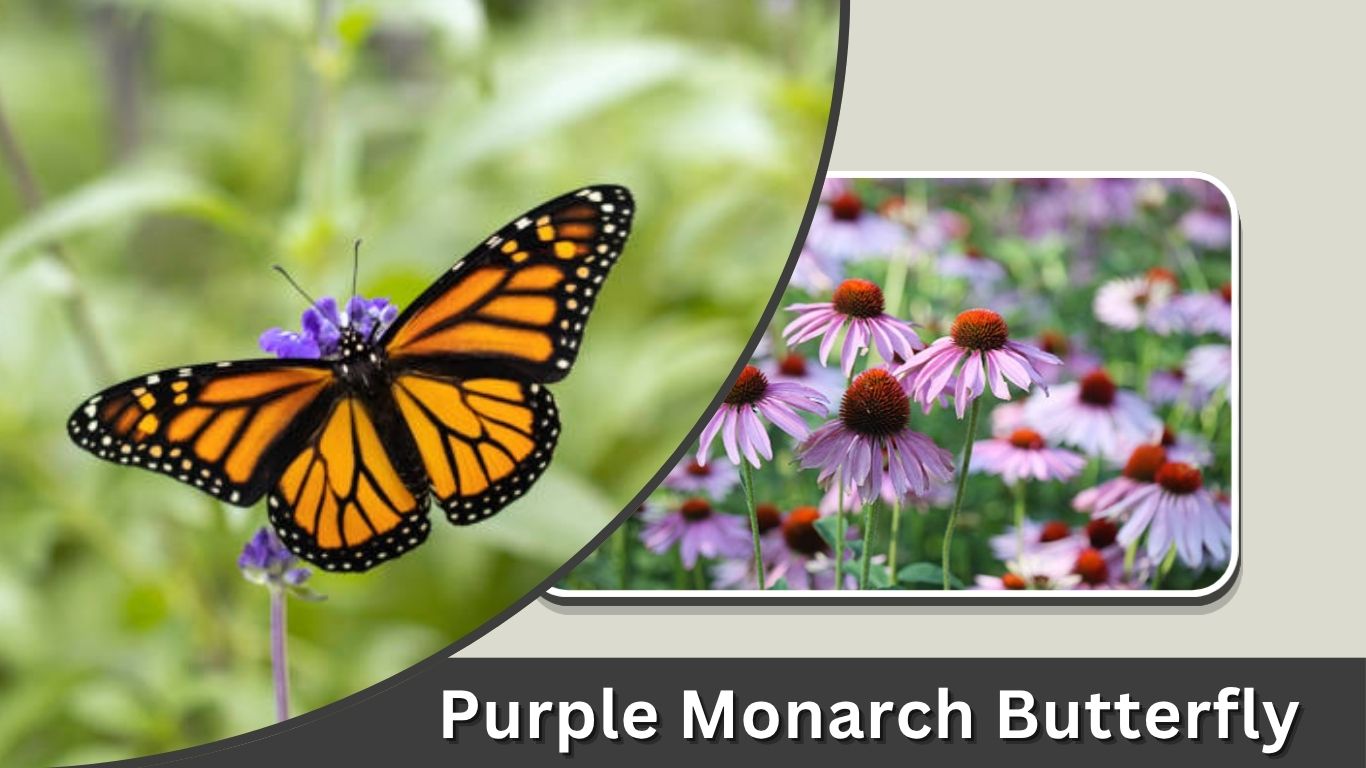
Purple monarch butterfly images appear frequently in artwork, tattoos, costumes, digital illustrations, and edited photographs. However, the familiar North American monarch butterfly, Danaus plexippus, does not naturally have bright purple or blue wings. A real monarch is primarily orange with black veins, broad black borders, and white spots. Therefore, a vivid purple butterfly with a monarch-like pattern is usually an artistic creation, a digitally altered image, unusual lighting, or a different butterfly species.
Are Purple Monarch Butterflies Real?
A naturally occurring purple form of the North American monarch is not recognized in standard butterfly identification guides. Adult monarchs have orange upper wings divided by black veins, with black margins containing white spots. Their scientific name is Danaus plexippus.
The wings can sometimes appear darker, reddish, faded, or slightly different in photographs. Camera settings, colored lighting, reflections, filters, and photo editing may turn orange areas into purple, pink, or blue.
Why Do Purple Monarch Images Appear Online?
Images labeled as purple monarch butterflies may be:
- Digitally recolored photographs
- Artificial-intelligence-generated pictures
- Fantasy artwork or illustrations
- Tattoo, costume, or decorative designs
- Real monarchs photographed under colored lighting
- Different blue or purple butterflies incorrectly labeled as monarchs
A bright purple monarch pattern should be treated as artistic unless the specimen has been documented and identified by a reliable butterfly expert.
What Does a Real Monarch Butterfly Look Like?
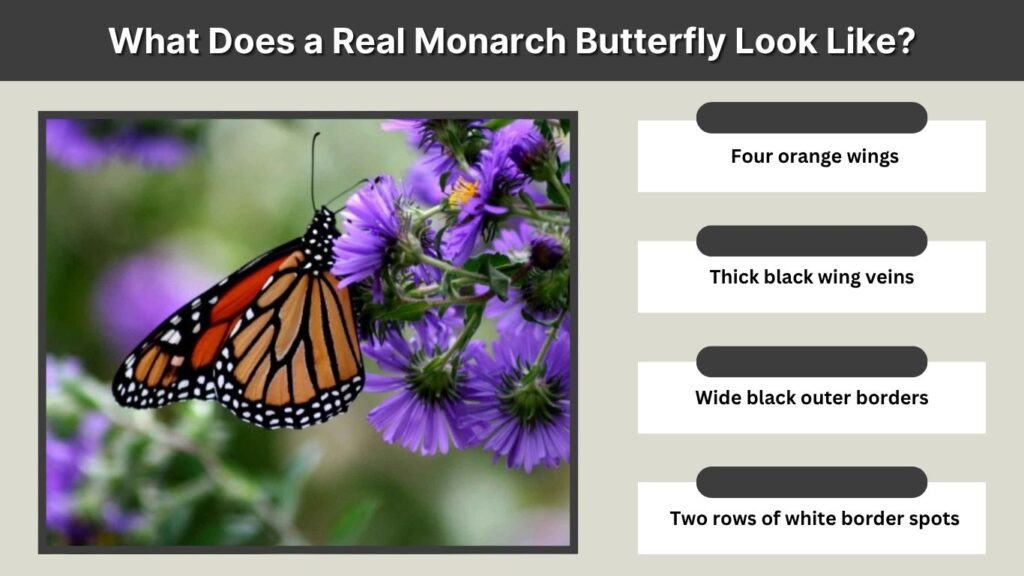
A real monarch has orange wings with heavy black veins. Black borders surround all four wings, while small white spots occur within the dark edges. These bold orange, black, and white colors make the species easy to recognize.
Monarch Identification Features
Look for:
- Four orange wings
- Thick black wing veins
- Wide black outer borders
- Two rows of white border spots
- A black body covered with white spots
- A wingspan of roughly 3½–4 inches
- Slow, powerful, gliding flight
The monarch’s warning colors help advertise its chemical defenses to potential predators. Monarch caterpillars obtain defensive compounds from milkweed, their only caterpillar food source.
Male vs. Female Monarchs
Male and female monarchs have the same basic orange, black, and white coloration. Males have a small black scent-scale spot on a vein of each hindwing. Females lack these spots and usually have thicker black wing veins, which can make them look slightly darker.
Neither sex naturally develops purple wings.
Can Monarch Butterflies Be Blue?
The North American monarch does not naturally turn blue. Some photographs may appear bluish because of image processing, reflections, shadows, or artificial lighting.
The name “blue monarch” has also been applied to a separate African butterfly, Tirumala petiverana, commonly called the African Blue Tiger. Although it belongs to the same broader butterfly subfamily, it is not the orange North American monarch, Danaus plexippus.
Blue morphos and several other tropical butterflies may also be mislabeled as blue or purple monarchs in artwork and social media posts.
Rare Color Forms of Monarch Butterflies
Although a true purple monarch is not a recognized form, monarchs can occasionally display unusual coloration.
White Monarchs
A rare pale form known as nivosus occurs most famously in Hawaii. Instead of the usual orange, much of the wing surface appears creamy white. This is a genuine color variation, but it does not produce blue or purple wings.
Faded or Worn Monarchs
As monarchs age, their wing scales become worn and the edges may become faded, scratched, or tattered. A worn butterfly may appear paler than a newly emerged adult, but it will not naturally change from orange to purple.
Newly Emerging Monarchs
Shortly before an adult emerges from its chrysalis, the black, orange, and white wing pattern becomes visible through the pupal covering. A newly emerged adult may initially look darker because its folded wings are moist and compressed. The normal colors become clearer as the wings expand and dry.
Is the Red-Spotted Purple a Monarch?
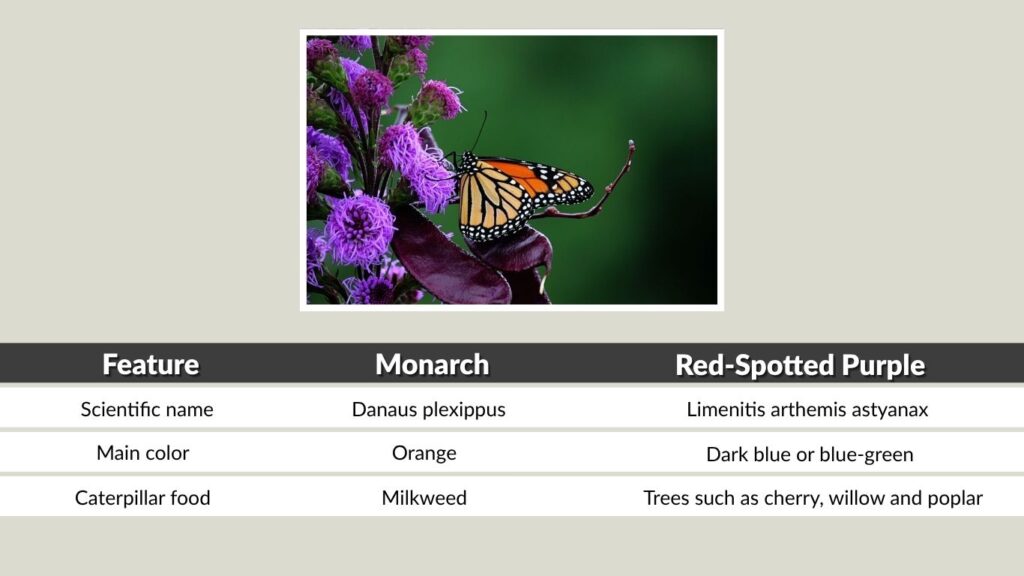
The red-spotted purple is a real butterfly, but it is not a monarch. Its scientific name is Limenitis arthemis astyanax.
This butterfly has dark wings covered with blue or blue-green iridescence. Red-orange spots appear on the underside and near the bases of the wings. It lacks the monarch’s orange wing cells, heavy black veins, and white-spotted borders.
| Feature | Monarch | Red-Spotted Purple |
| Scientific name | Danaus plexippus | Limenitis arthemis astyanax |
| Main color | Orange | Dark blue or blue-green |
| Wing pattern | Black veins and white-spotted borders | Iridescent wings with red-orange spots |
| Caterpillar food | Milkweed | Trees such as cherry, willow and poplar |
| Adult food | Mainly flower nectar | Sap, fruit, dung and occasional nectar |
| Naturally purple-looking | No | Can appear blue-purple |
Someone reporting a real purple monarch may have seen a red-spotted purple or another iridescent butterfly.
Can Monarch Caterpillars Be Purple?
A healthy monarch caterpillar is normally striped with yellow, white, and black. It also has two pairs of black, flexible tentacle-like filaments—one pair near the head and another near the rear.
A strongly purple caterpillar should not automatically be identified as a monarch. Dark lighting, camera filters, illness, injury, discoloration after death, or another caterpillar species may explain the appearance. Monarch caterpillars should also be found feeding on milkweed; caterpillars eating unrelated plants are unlikely to be monarchs.
Purple Flowers That Attract Monarch Butterflies
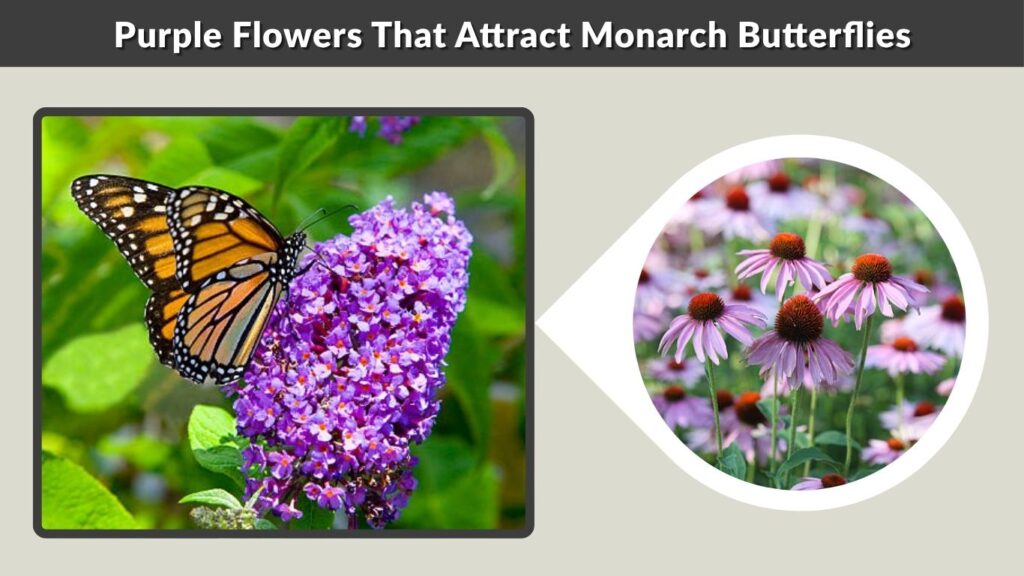
Although monarch butterflies are not purple, they frequently visit purple, pink, and violet flowers. Adults need nectar from many flowering plants, particularly during breeding and migration.
Purple Coneflower
Purple coneflower, especially Echinacea purpurea, produces large nectar-rich flower heads that provide convenient landing areas. Monarchs and other butterflies can feed by moving across the central cone.
Blazing Star
Blazing stars in the genus Liatris produce tall spikes of purple flowers. Their many small blossoms supply nectar over an extended period and can attract monarchs during seasonal movements.
Native Asters
Purple and blue native asters are particularly valuable in late summer and fall. Their flowering period often overlaps with monarch migration, when butterflies need abundant nectar to fuel long-distance flight.
US Forest Service monarch resources include purple coneflower, blazing star, and asters among valuable nectar plants for monarch habitat.
Other useful purple-flowering plants may include:
- New England aster
- Smooth blue aster
- Gayfeather
- Joe-Pye weed
- Ironweed
- Wild bergamot
- Native vervain
Choose species native to your region, provide flowers across several seasons, and avoid treating the blooms with insecticides.
Milkweed and Purple Monarch Gardens
Purple nectar flowers provide food for adults, but milkweed is essential for reproduction. Monarch females lay their eggs on milkweed, and the caterpillars eat no other type of plant.
A complete monarch garden should contain:
- Regionally native milkweed for eggs and caterpillars
- Spring, summer, and autumn nectar flowers
- Several plants of each species grouped together
- Sunny, sheltered growing areas
- No broad-spectrum insecticide use
Purple flowers can make the garden visually attractive while supporting adult monarchs, but they cannot replace milkweed.
Purple Monarch Butterfly Meaning
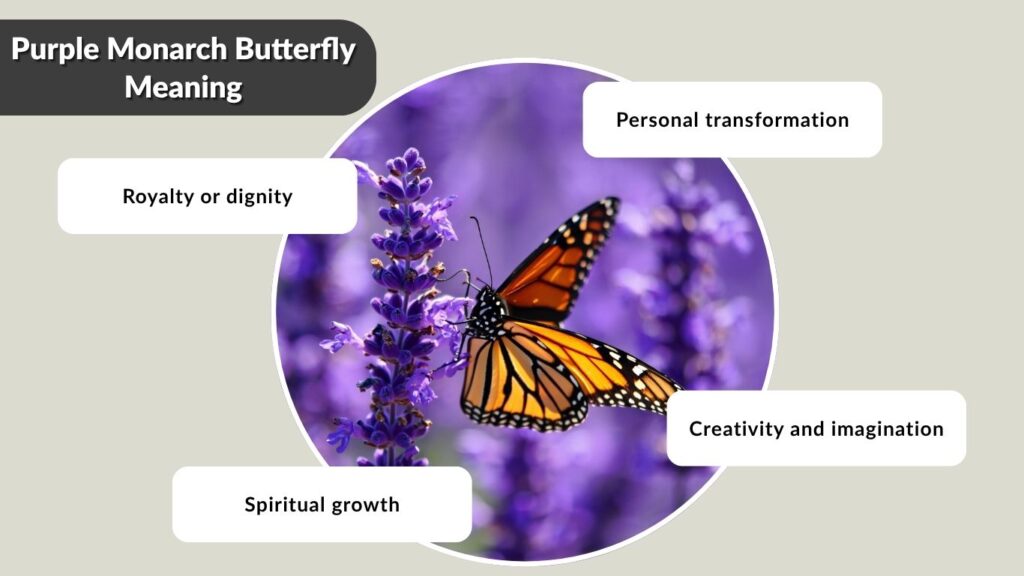
Because a naturally purple monarch is generally an artistic image, its meaning comes from symbolism rather than biology.
A purple monarch design may represent:
- Personal transformation
- Creativity and imagination
- Royalty or dignity
- Spiritual growth
- Independence
- Mystery and individuality
- Healing after a difficult change
The monarch already symbolizes transformation because it develops from an egg into a caterpillar, chrysalis, and adult butterfly. Purple adds cultural associations with imagination, spirituality, and royalty. These interpretations are personal and are not scientific properties of the butterfly.
FAQs
Are there real purple monarch butterflies?
No naturally bright purple form of Danaus plexippus is recognized in standard identification sources. Real monarchs are orange, black, and white. Purple examples online are generally edited photographs, fantasy illustrations, decorative designs, unusual lighting, or misidentified butterfly species.
Is a blue and purple monarch butterfly real?
A North American monarch does not naturally have blue and purple wings. The image may depict another species, such as a blue morpho or red-spotted purple, or it may have been digitally recolored. The African Blue Tiger is sometimes called a blue monarch but is a separate species.
What purple flowers do monarch butterflies like?
Monarchs commonly visit purple coneflower, native asters, blazing star, Joe-Pye weed, ironweed, wild bergamot, and other nectar-producing flowers. Locally native species are generally the best choices because they are adapted to regional conditions and support additional pollinators.
Is the red-spotted purple butterfly a monarch?
No. The red-spotted purple belongs to a different genus and has dark, iridescent blue-green wings with red-orange markings. It does not have the monarch’s orange wing cells, bold black veins, or white-spotted black borders.
What does seeing a purple monarch mean?
A purple monarch normally appears in art rather than nature. Symbolically, it may represent transformation, creativity, royalty, spiritual change, or individuality. Its meaning depends on the artist, wearer, or observer rather than an established biological or cultural rule.
