
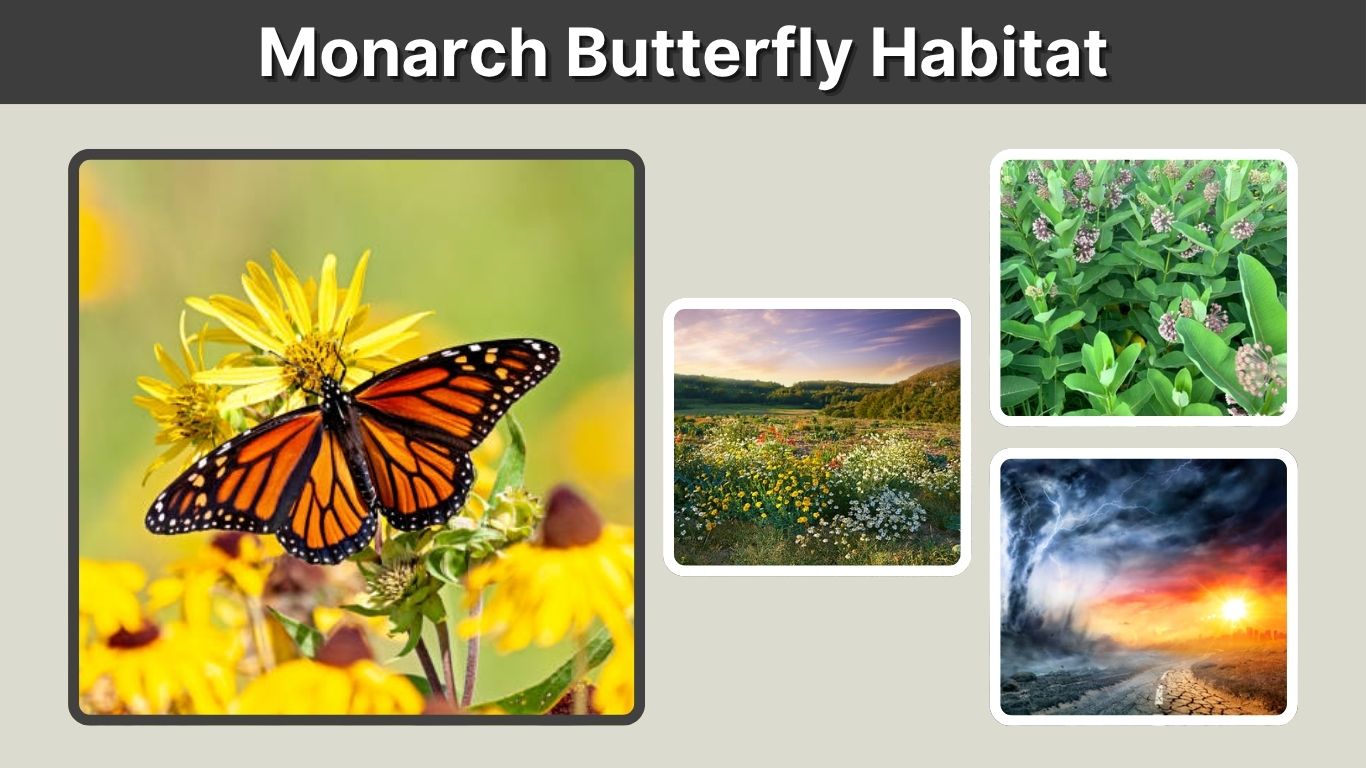
Monarch butterflies live in several different habitats during their lives. They breed in milkweed-rich fields, feed in flower-filled meadows, travel through migration corridors, and spend winter in sheltered forests or coastal groves.
Their habitat stretches across much of North America, including the United States, southern Canada, Mexico, and coastal California. Monarchs can also be found in Australia, New Zealand, parts of Central and South America, and several Pacific islands.
The most important features of monarch habitat are milkweed for caterpillars, nectar flowers for adults, safe migration stopovers, and protected winter roosting sites.
What Is the Natural Habitat of a Monarch Butterfly?
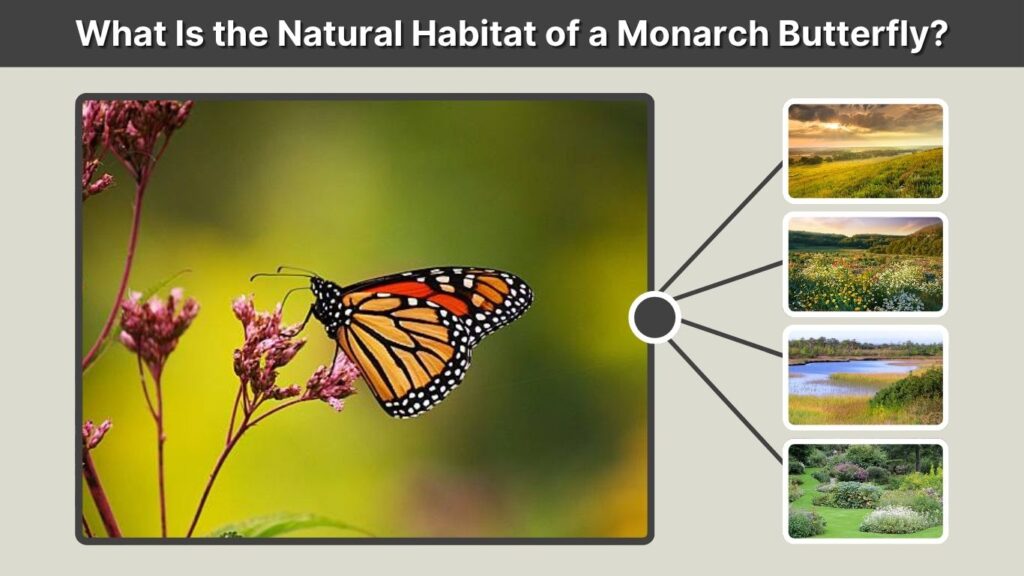
Monarchs usually live in open, sunny environments where milkweed and flowering plants grow. They can survive in natural landscapes as well as places influenced by people.
Common monarch habitats include:
- Prairies and grasslands
- Meadows and open fields
- Roadsides and railway corridors
- Wetlands and marsh edges
- Farms and pastures
- Woodland edges
- Parks and gardens
- Coastal groves
- High-elevation forests
Adult monarchs can visit many habitats because they drink nectar from numerous types of flowers. Caterpillars have stricter requirements because they can develop only where suitable milkweed is available.
Monarch Butterfly Habitat Requirements
A complete monarch habitat must support different activities throughout the butterfly’s annual cycle. A good breeding site may not provide suitable winter conditions, while a winter grove may contain little or no milkweed.
| Habitat requirement | Why monarchs need it |
| Milkweed plants | Egg-laying sites and caterpillar food |
| Nectar-rich flowers | Energy for adults and migrating monarchs |
| Sunny open areas | Warmth for flying and feeding |
| Shelter from wind | Protection during rest and winter |
| Water and minerals | Hydration and nutrient intake |
| Connected habitat patches | Safe movement across the landscape |
| Limited pesticide use | Protection for eggs, larvae, and adults |
Milkweed for Eggs and Caterpillars
Female monarchs normally lay their eggs on milkweed plants. After hatching, the caterpillars eat milkweed leaves and grow through five larval stages.
Milkweed is essential because it is the monarch caterpillar’s required host plant. Caterpillars also absorb defensive chemicals called cardenolides from milkweed. These substances make many predators less likely to eat them.
North America has many native milkweed species adapted to different soils and climates. Examples include common milkweed, swamp milkweed, butterfly weed, showy milkweed, narrowleaf milkweed, and antelope-horns milkweed.
Nectar Flowers for Adult Monarchs
Adult monarchs do not eat milkweed leaves. Instead, they drink nectar from flowers using a long, coiled mouthpart called a proboscis.
They need flowers throughout the breeding season and along their migration routes. Late-blooming flowers are especially important because fall migrants must accumulate enough energy to reach their winter habitats and survive for several months.
A useful habitat contains multiple native flower species that bloom at different times. This provides nectar from spring through fall rather than during a single short flowering period.
Breeding Habitat of Monarch Butterflies
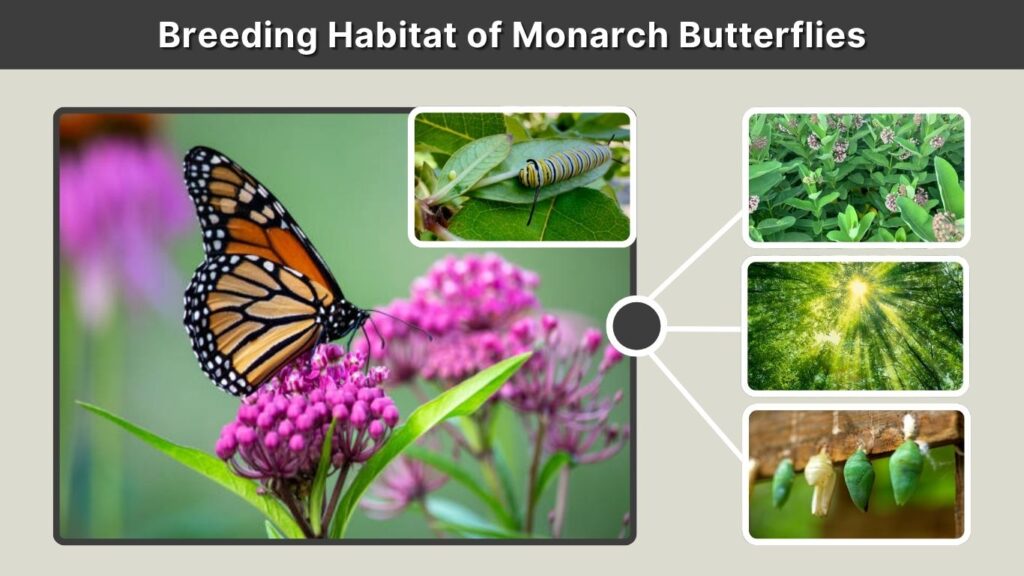
Monarch breeding habitat extends across much of the United States and southern Canada. Breeding generally occurs wherever temperatures are suitable and milkweed is actively growing.
Eastern monarchs reproduce throughout the central and eastern United States and parts of Canada. Western monarchs breed across many western states. The Rocky Mountains broadly separate the two major migratory populations, although some movement occurs between them.
Monarch Caterpillar Habitat
A monarch caterpillar’s habitat is normally the milkweed plant on which it hatched and the nearby vegetation. Young caterpillars may remain on a small part of one leaf, while larger ones move among leaves and neighboring plants.
Suitable caterpillar habitat should contain:
- Healthy, pesticide-free milkweed
- Enough leaves to support growing larvae
- Protection from mowing and disturbance
- Natural airflow and sunlight
- Nearby vegetation for pupation
- Limited exposure to insecticides
A mature caterpillar may leave its milkweed plant before forming a chrysalis. It can attach itself to a branch, fence, wall, stem, or another stable surface nearby.
Monarch Butterfly Migration Habitat
Monarchs need connected habitat throughout their migration routes. They cannot complete their journeys using only breeding grounds and winter forests. They also require stopping places where they can rest and drink nectar.
These temporary habitats function like steppingstones across the landscape. Gardens, parks, farms, roadsides, restored prairies, and protected natural areas can all contribute when they contain suitable flowering plants.
Migrating monarchs may concentrate along coastlines, mountain passes, river valleys, and other landscape features. Eastern monarchs can travel as far as approximately 3,000 miles during their southward migration.
Habitat connectivity is especially important because monarch migration occurs across several countries and multiple generations. Losing too many nectar-rich stopovers can increase exhaustion and reduce the number of butterflies that successfully reach their winter destinations.
Monarch Butterfly Winter Habitat
Migratory monarchs spend winter in cool, protected environments that allow them to conserve energy. These habitats must prevent severe freezing while remaining cool enough to slow the butterflies’ metabolism.
Winter Habitat in Mexico
Most eastern North American monarchs spend winter in the mountains of central Mexico. They gather in high-elevation forests dominated by oyamel fir trees.
These forests create a stable microclimate that protects butterflies from strong winds, heavy precipitation, and extreme temperature changes. Monarchs cluster densely on trunks and branches, sometimes covering large sections of the trees.
The butterflies remain relatively inactive during cool weather but may fly to drink water or nectar on warm, sunny days. In late winter, they become more active and begin the northward journey.
Winter Habitat in California
Many western monarchs spend winter in sheltered groves along the California coast and into Baja California. They may cluster in Monterey cypress, eucalyptus, pine, and other trees.
Important California overwintering habitats include Pacific Grove, Pismo Beach, Santa Cruz, and coastal areas around Santa Barbara.
A functional winter grove contains more than the trees where butterflies cluster. It also needs surrounding vegetation that blocks wind, maintains moisture, provides nectar, and protects the grove’s internal climate. The U.S. Fish and Wildlife Service describes these habitats as having core clustering zones, shelter zones, and support zones containing resources such as flowers and water.
Monarch Butterfly Habitat Map and Range
The monarch’s North American range changes with the seasons.
During spring, eastern monarchs leave Mexico and begin moving through Texas and other southern states. Their descendants continue north and east, eventually reaching the northern United States and southern Canada.
In late summer and fall, a special long-lived generation travels south to Mexico. Western populations generally move between inland breeding areas and overwintering sites along coastal California, although their movements are more varied.
Monarchs are also established outside North America. Populations occur in parts of Central and South America, Australia, New Zealand, Hawaii, and other Pacific regions. Not every population completes the same long-distance migration.
Monarch Butterfly Habitat Loss
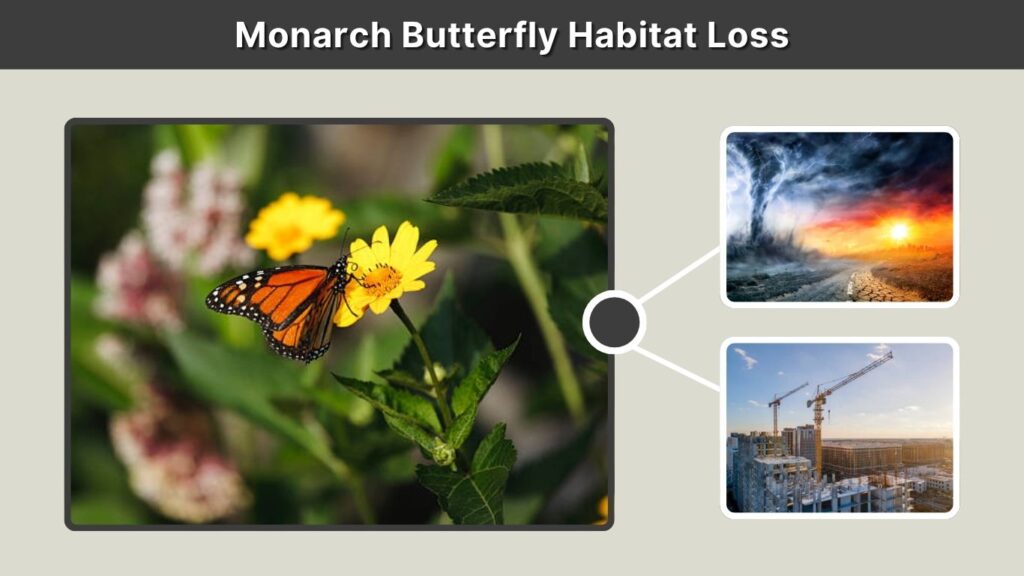
Monarchs are affected by habitat loss during breeding, migration, and winter. Because each habitat serves a different purpose, damage in one part of the annual cycle can affect the entire population.
Loss of Milkweed
Urban development, intensive agriculture, roadside management, herbicide use, and frequent mowing can remove milkweed from the landscape.
Without milkweed, female monarchs cannot find suitable places to lay eggs, and caterpillars have no food. Even areas with abundant flowers cannot function as breeding habitat when milkweed is absent.
Loss of Nectar Sources
Migrating adults require flowering plants for energy. Drought, mowing, development, herbicides, and changes in land use can reduce nectar availability.
This is especially harmful during fall migration, when monarchs must build fat reserves for both the journey and the winter period.
Destruction of Winter Habitat
Logging, development, drought, severe storms, tree disease, and changes in forest structure can damage monarch overwintering sites in Mexico and California.
Winter groves depend on a carefully balanced microclimate. Removing trees from surrounding shelter zones can expose clustering monarchs to wind, rain, and rapid temperature changes.
Climate Change
Changing temperatures and rainfall patterns can alter milkweed growth, flower availability, migration timing, and winter conditions.
Severe storms, prolonged drought, excessive heat, and unusual cold events may also increase mortality. Climate-related changes can create timing mismatches in which monarchs arrive after important flowers have finished blooming.
How to Create a Monarch Butterfly Habitat
A backyard, schoolyard, farm, or community garden can provide valuable monarch habitat when it includes the correct plants and avoids harmful chemicals.
Choose Native Milkweed
Select milkweed species native to your geographic area and appropriate for the site’s moisture, sunlight, and soil conditions.
Plant several milkweed plants together rather than placing one isolated plant in the garden. A larger patch gives female monarchs more egg-laying options and provides more food for caterpillars.
In coastal California, planting recommendations are different near overwintering areas. The U.S. Fish and Wildlife Service advises avoiding milkweed within approximately one mile of the coast because it may interfere with normal winter behavior. Native nectar plants are a better choice in those locations.
Add Nectar Flowers
Include native flowers with overlapping blooming periods. Spring flowers support northward-moving monarchs, summer flowers feed breeding adults, and fall flowers help southward migrants.
Arrange flowers in broad clusters where butterflies can find and access them easily. Choose sunny areas protected from strong wind.
Avoid Pesticides
Do not apply insecticides to milkweed or nectar plants used by monarchs. Products advertised for controlling caterpillars can also kill monarch larvae.
Plants purchased from a nursery should be confirmed as free from systemic insecticides. These chemicals may remain inside the plant tissues even when no residue is visible.
Maintain the Habitat Naturally
Leave some stems and vegetation standing rather than keeping every part of the garden closely trimmed. Caterpillars may use nearby structures and plants when preparing to form a chrysalis.
Remove diseased plant material when necessary, but avoid cutting all milkweed during active breeding. Regularly inspect plants for eggs and caterpillars before pruning.
FAQs
Where Do Monarch Butterflies Normally Live?
Monarchs live in meadows, fields, grasslands, wetlands, gardens, roadsides, and other sunny places containing milkweed and nectar flowers. Migratory monarchs spend winter in sheltered forests in central Mexico or coastal tree groves in California.
What Plant Does a Monarch Need in Its Habitat?
Milkweed is the essential plant for monarch reproduction. Females lay eggs on milkweed, and the caterpillars eat its leaves. Adult monarchs also need a variety of nectar-producing flowers for energy.
Can Monarchs Live in a Backyard Garden?
Yes. A garden can support monarchs when it contains native milkweed, pesticide-free nectar plants, sunlight, shelter, and flowers blooming across multiple seasons. Even a small garden can serve as a stopover within a larger habitat corridor.
Do Monarch Butterflies Live in Forests?
Monarchs usually feed and reproduce in open habitats rather than dense forests. However, migratory monarchs use protected forests and coastal tree groves as winter habitat because the trees create shelter and stable temperatures.
Why Is Monarch Habitat Disappearing?
Major causes include development, agricultural land-use changes, herbicide and pesticide use, removal of milkweed, loss of flowering plants, logging, drought, severe weather, and degradation of migration and overwintering sites.
