
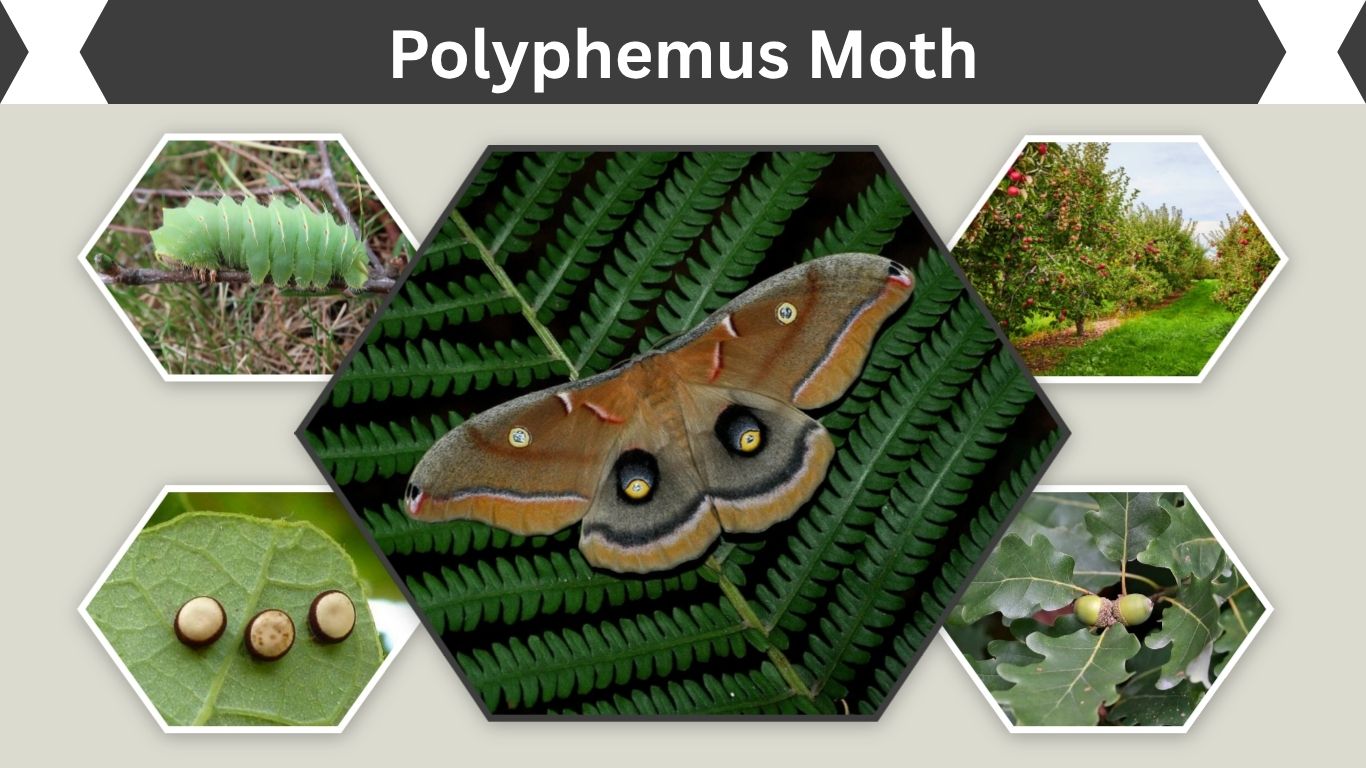
The Polyphemus moth is a large North American silk moth known for its huge eye-like spots on the hindwings. Its scientific name is Antheraea polyphemus, and the name comes from Polyphemus, the one-eyed Cyclops in Greek mythology, because of the moth’s dramatic eyespots. It is a harmless giant moth, but many people notice it because of its size, fuzzy body, green caterpillar, large cocoon, or short adult lifespan.
What Is a Polyphemus Moth?
The Polyphemus moth is a giant silk moth in the family Saturniidae. It is one of the most widespread large silk moths in North America, found from southern Canada into Mexico and in nearly all lower 48 U.S. states except Arizona and Nevada.
| Feature | Polyphemus Moth |
| Scientific name | Antheraea polyphemus |
| Family | Saturniidae |
| Adult wingspan | About 4–6 inches |
| Caterpillar color | Bright green |
| Adult food | Adults do not feed |
| Caterpillar food | Leaves of broadleaf trees and shrubs |
| Main ID mark | Large hindwing eyespots |
| Dangerous? | Generally harmless |
Adult Polyphemus moths are usually tan, reddish-brown, gray-brown, or yellow-brown. Their most famous markings are the large transparent eyespots on the hindwings, ringed with yellow, white, and black.
Polyphemus Moth Identification
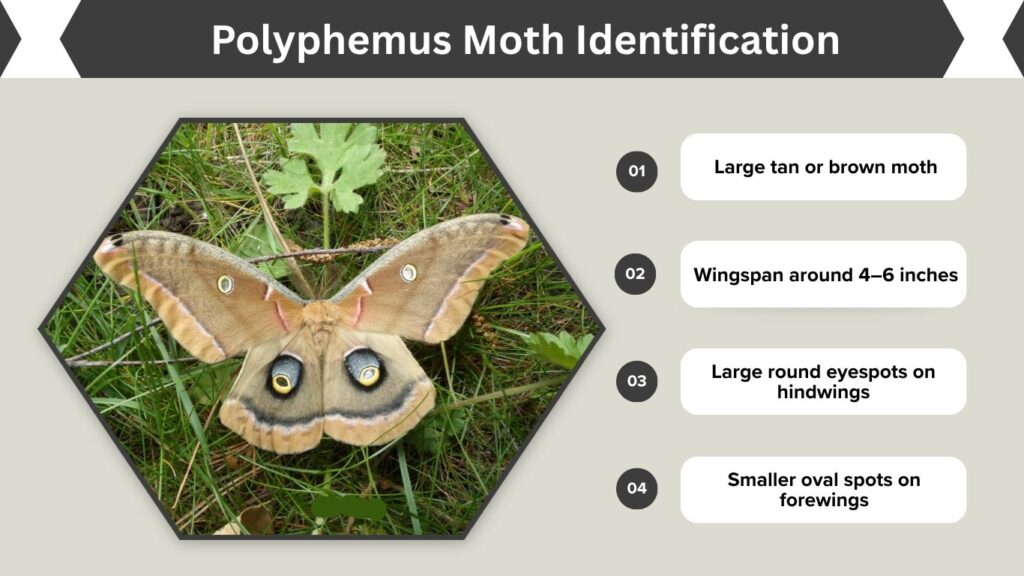
A Polyphemus moth is usually easy to identify because of its size and eyespots. The forewings have smaller oval spots, while the hindwings show much larger eye-like markings. These eyespots can startle predators and make the moth look larger or more threatening than it really is.
Key Identification Features
Look for these signs:
- Large tan or brown moth
- Wingspan around 4–6 inches
- Large round eyespots on hindwings
- Smaller oval spots on forewings
- Thick, fuzzy body
- Feather-like antennae
- Wavy wing margins
- Often attracted to lights at night
Butterflies and Moths of North America lists the Polyphemus moth wingspan as about 3 15/16 to 5 7/8 inches, or 10–15 cm.
Polyphemus Moth Caterpillar
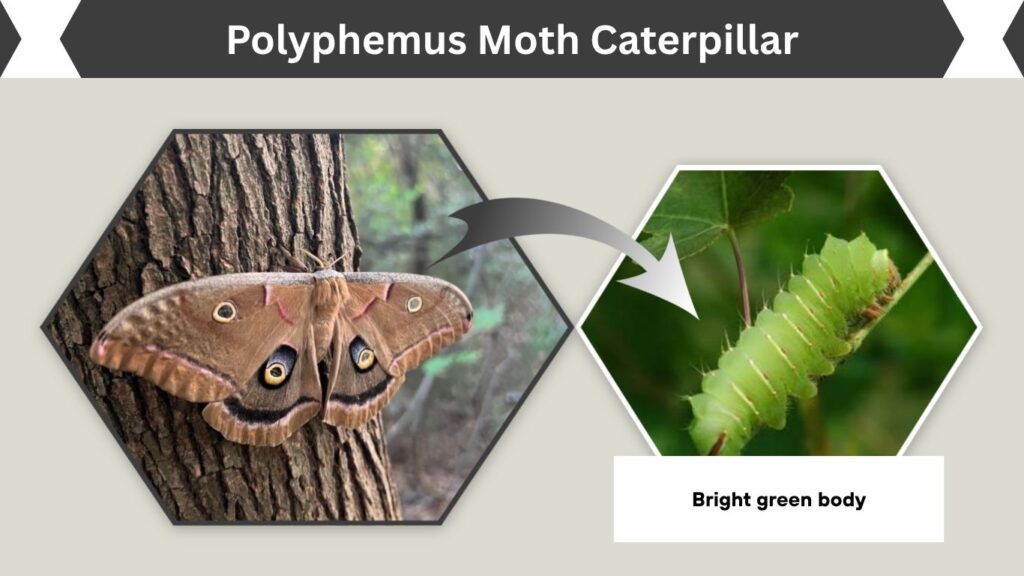
The Polyphemus moth caterpillar is large, bright green, and smooth-looking. Mature caterpillars can reach about 2.3–3 inches long. They have yellowish lines, small orange or red tubercles, and a brownish head.
Caterpillar ID Features
A Polyphemus caterpillar may have:
- Bright green body
- Brown head
- Yellow diagonal side lines
- Small orange or reddish bumps
- Smooth, thick body
- Large size before pupation
- Solitary feeding habit
BugGuide describes the larva as large and bright green, with red and silvery spots below the setae and oblique yellow lines on the abdomen.
Is the Polyphemus Moth Poisonous?
The adult Polyphemus moth is not dangerous to people. Adults have vestigial mouthparts and do not feed, so they do not bite, sting, or chew clothing, wood, or garden plants.
The caterpillar is also not known as a stinging caterpillar like a puss caterpillar or saddleback caterpillar. Still, it is best to avoid rough handling. Large caterpillars are delicate, and some people may have sensitive skin around insects. If you need to move one, use a leaf or let it crawl onto a stick.
What Do Polyphemus Moths Eat?
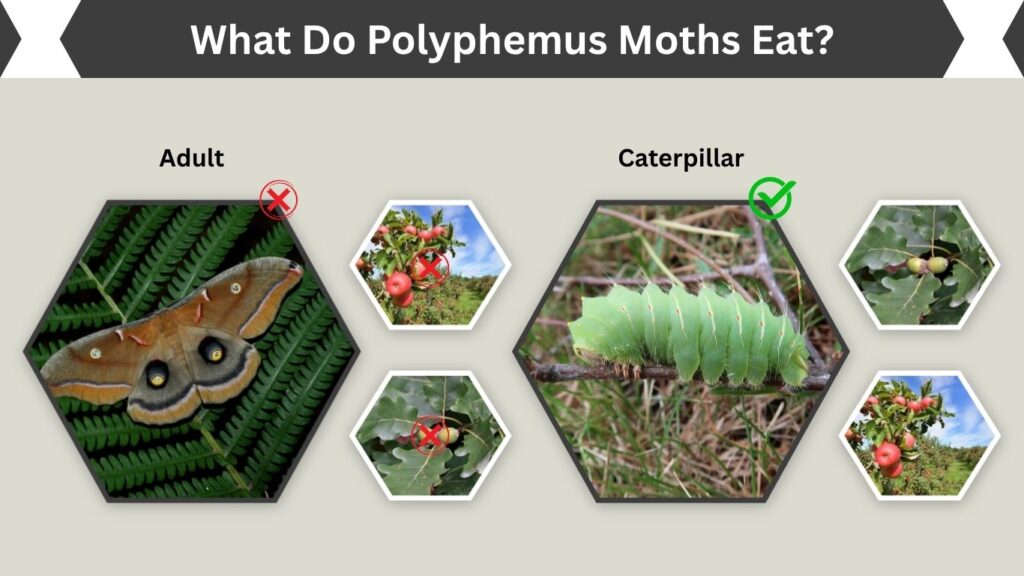
Adult Polyphemus moths do not eat at all. Their adult life is short because they rely on energy stored from the caterpillar stage.
The caterpillar is the feeding stage. Polyphemus moth caterpillars eat leaves from many broadleaf trees and shrubs. BugGuide lists host plants such as birch, grape, hickory, maple, oak, willow, and members of the rose family.
Common Host Plants
Polyphemus caterpillars may feed on:
- Oak
- Maple
- Birch
- Willow
- Hickory
- Grape
- Apple
- Ash
- Dogwood
- Elm
- Hazel
- Rose family plants
Carnegie Museum of Natural History notes that reared Polyphemus caterpillars were fed oak leaves, but the species also uses apple, ash, birch, dogwood, elm, hazel, hickory, maple, rose, and willow.
Polyphemus Moth Life Cycle
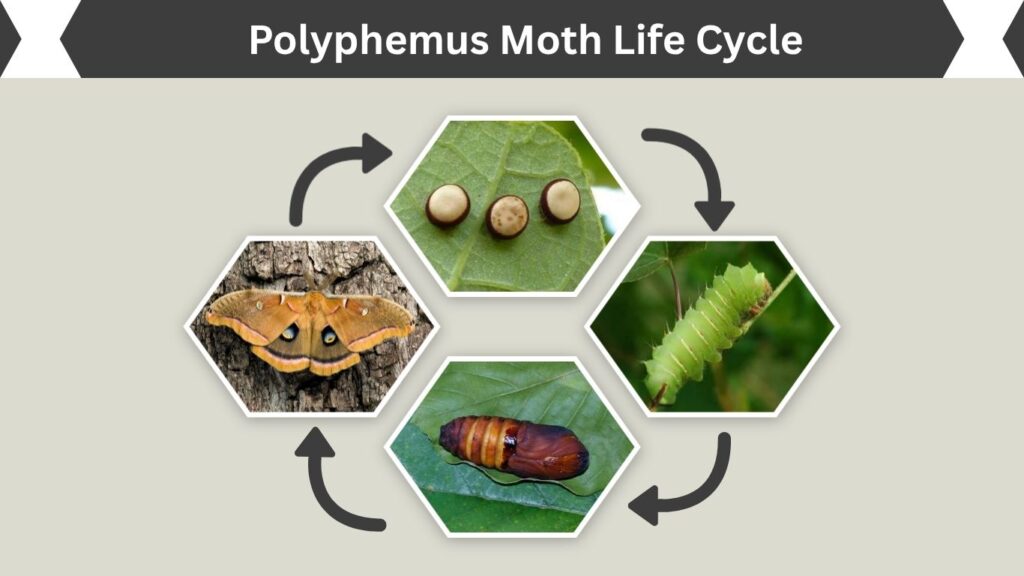
The Polyphemus moth has four main life stages: egg, caterpillar, pupa, and adult moth. The female lays eggs on host plant leaves. Caterpillars hatch, feed, molt through several stages, spin cocoons, pupate, and later emerge as adult moths.
| Stage | What Happens |
| Egg | Laid on leaves of host plants |
| Caterpillar | Feeds heavily and grows through instars |
| Cocoon/pupa | Protected transformation stage |
| Adult moth | Emerges, mates, lays eggs, then dies |
Animal Diversity Web reports that eggs hatch after about 10 days, larvae grow for about 5–6 weeks, and adults live only a few days. If the moth overwinters as a pupa, the full cycle becomes longer.
Polyphemus Moth Cocoon and Pupa
A mature caterpillar spins a tough silk cocoon. The cocoon may be attached to a twig, wrapped in a leaf, or found in leaf litter. UF/IFAS notes that Polyphemus cocoons can be attached to twigs, attached by a silk stalk, or spun among leaves that later fall to the ground.
If you find a Polyphemus moth cocoon, do not bring it into a warm house unless you are prepared to care for it properly. Warm indoor conditions may cause the adult moth to emerge too early. A sheltered outdoor location is usually better.
Polyphemus Moth Eggs
Polyphemus moth eggs are slightly flattened and oval. UF/IFAS describes them as white with two broad brown rings and attached to the surface with a dark adhesive.
Females begin laying eggs after mating, often placing them singly or in small groups on host plant leaves. The young caterpillars may eat their eggshells after hatching before moving on to leaves.
Polyphemus Moth Male vs Female
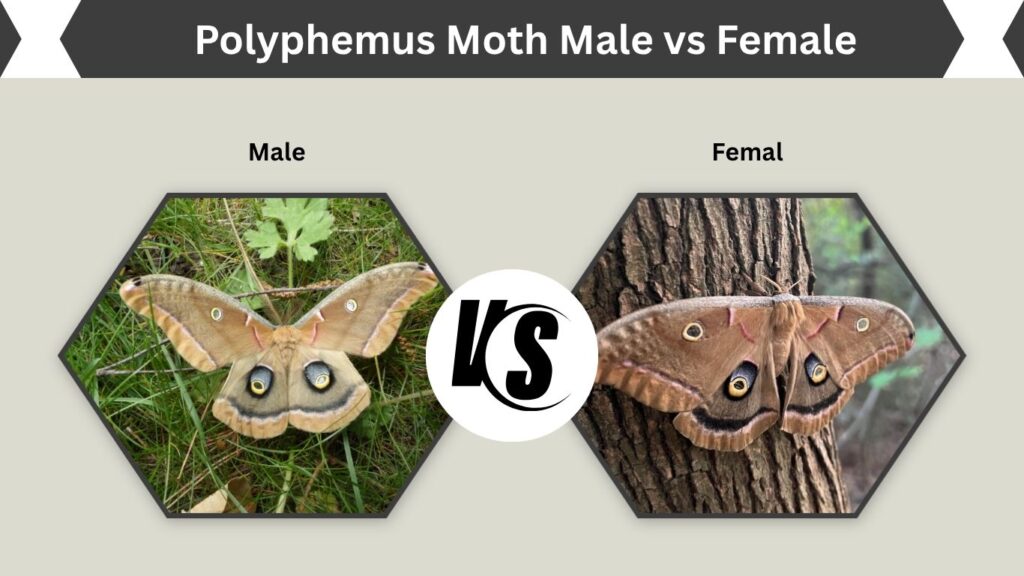
Male and female Polyphemus moths look similar, but there are clear differences. Males usually have smaller bodies and much larger, more feather-like antennae. Females usually have heavier bodies because they carry eggs. BugGuide specifically notes that males have much more feathery antennae than females.
Male vs Female Differences
| Feature | Male Polyphemus Moth | Female Polyphemus Moth |
| Antennae | Larger, bushier, more feathery | Smaller and less feathery |
| Body | Usually smaller/slimmer | Usually heavier |
| Main role | Finds females by scent | Releases pheromones and lays eggs |
| Flight behavior | More active searching | Often rests after emergence |
Female Polyphemus moths release pheromones late in the evening, and males use their large antennae to detect those chemical signals.
Polyphemus Moth Lifespan
Adult Polyphemus moths live for a very short time because they do not feed. Animal Diversity Web gives the adult lifespan as a maximum of about four days, while the full life cycle averages about three months when not overwintering.
This short adult lifespan explains why adult moths are focused on mating. They do not visit flowers for nectar, and they do not damage plants as adults.
Polyphemus Moth Range and Habitat
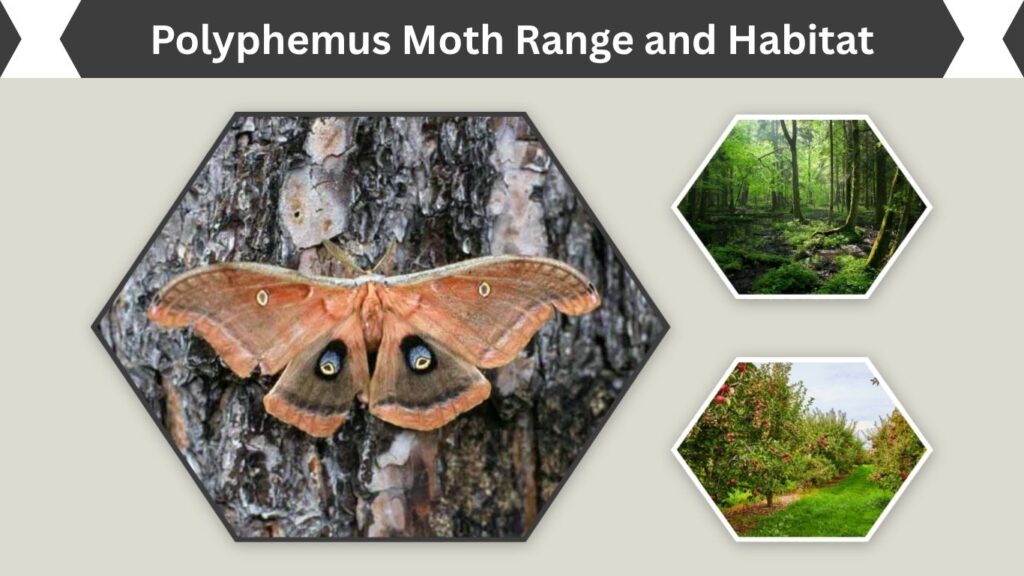
Polyphemus moths live in many habitats with suitable host trees and shrubs. BugGuide lists deciduous forests, orchards, and some wetlands as habitats, and notes that adults of both sexes may come to light.
Searches for Polyphemus moth in Florida, Texas, Ohio, Oregon, Michigan, Illinois, and Ontario are common because this species is widespread. In northern areas, there is often one brood per year; in southern areas, there may be two or more generations.
Polyphemus Moth vs Luna Moth
Polyphemus and luna moths are both giant silk moths, but they are easy to separate as adults. A luna moth is pale green with long tail-like hindwings. A Polyphemus moth is tan or brown with large round hindwing eyespots.
| Feature | Polyphemus Moth | Luna Moth |
| Adult color | Tan, brown, reddish-brown | Pale green |
| Hindwings | Large round eyespots | Long tails |
| Caterpillar | Green with yellow lines and brown head | Green, smoother-looking |
| Cocoon | Tough silk cocoon, often with leaf | Thin silk cocoon in leaf litter |
| Adult feeding | Does not feed | Does not feed |
BugGuide notes that luna moth caterpillars are superficially similar to Polyphemus larvae, but luna larvae have a yellow spiracular stripe on the first eight abdominal segments.
Polyphemus Moth Meaning and Symbolism
Because the Polyphemus moth has giant eyespots and a short adult life, it is often used symbolically for transformation, hidden beauty, protection, night, mystery, and rebirth. Its name also connects it to the Cyclops Polyphemus from Greek mythology, because of the large eye-like wing markings.
For tattoo ideas, the most recognizable design elements are the huge hindwing eyespots, feathery antennae, tan wings, and fuzzy body.
Polyphemus Moth Care and For Sale Searches
Some people search for Polyphemus moth eggs, cocoons, caterpillars, or pupae for sale. Before buying or raising them, check local rules and avoid releasing insects outside their natural range. Moving moths between areas can spread parasites, diseases, or nonlocal genetics.
If you found a local caterpillar, the safest care method is to feed it the same host plant it was already eating. Keep the container clean, provide ventilation, remove frass daily, and give it a place to spin a cocoon when mature.
FAQs
Are Polyphemus moths poisonous?
No, Polyphemus moths are not considered poisonous to people. Adults do not feed because they have vestigial mouthparts, and they do not bite or sting.
What do Polyphemus moth caterpillars eat?
They eat leaves from broadleaf trees and shrubs such as oak, maple, birch, willow, hickory, grape, and rose-family plants.
How long do Polyphemus moths live?
Adult Polyphemus moths live only a few days. Animal Diversity Web reports a maximum adult lifespan of about four days, while the full life cycle averages about three months when not overwintering.
How can you tell a male Polyphemus moth from a female?
Males usually have larger, bushier antennae and smaller bodies. Females usually have heavier bodies and less feathery antennae.
Are Polyphemus moths rare?
They are not usually considered rare across North America. They are widespread, but people may not see them often because adults are nocturnal, short-lived, and active mainly during mating periods.
