
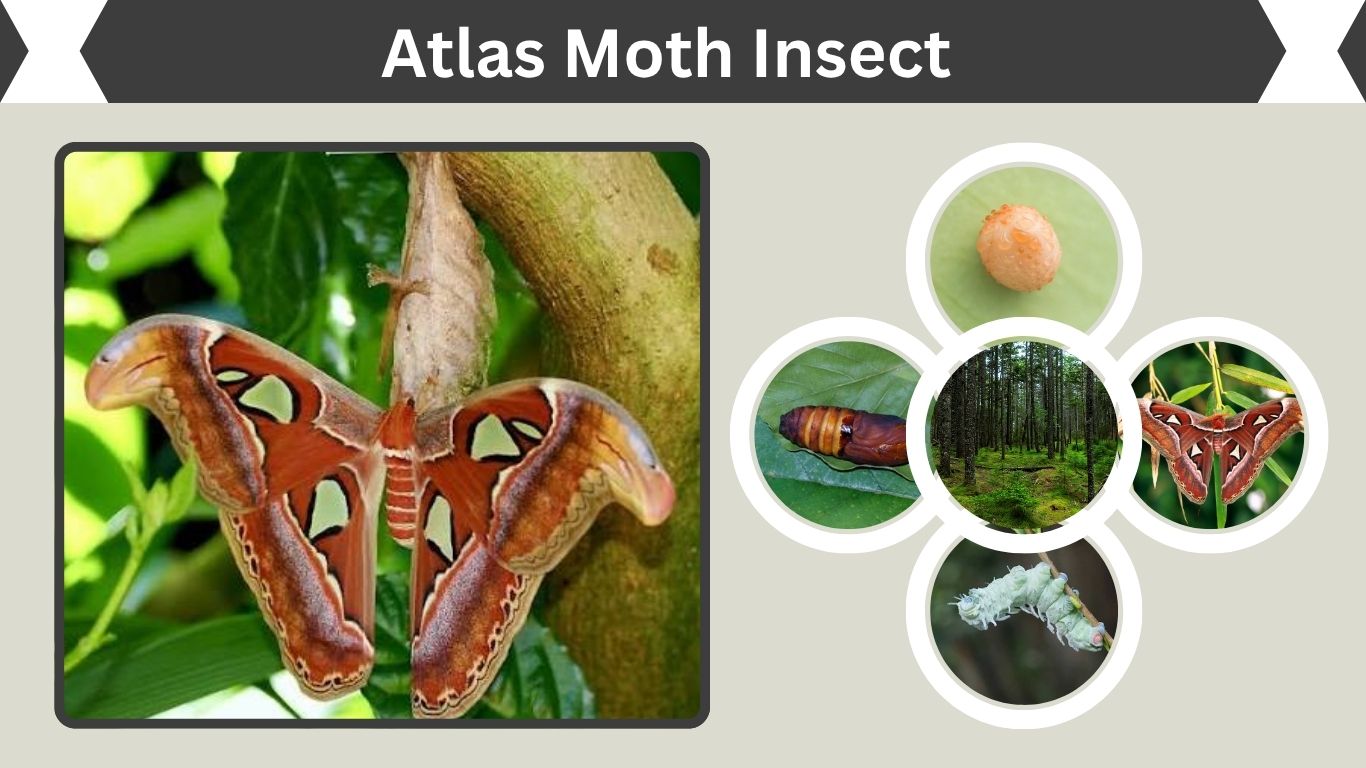
The atlas moth insect is one of the most impressive moths in the world. Known scientifically as Attacus atlas, this giant moth is famous for its huge reddish-brown wings, snake-like wing tips, and short adult life. Many people first notice it because of its size, but the atlas moth is also interesting because adults do not eat after emerging from the cocoon. This guide explains what the atlas moth is, where it lives, what it eats, and how its life cycle works.
What Is an Atlas Moth Insect?
The atlas moth insect is a large silk moth from the family Saturniidae. It is native to parts of Asia and is often described as one of the largest moths in the world. The Natural History Museum says atlas moths can have a wingspan of up to about 27 centimeters, making them wider than a human handspan.
The moth’s scientific name is Attacus atlas. It belongs to a group of giant silk moths whose caterpillars feed heavily before becoming adults. Once the adult moth emerges, it relies on stored energy from its caterpillar stage because its mouthparts do not work for feeding.
Why Is It Called the Atlas Moth?
The name “atlas” may be linked to Atlas, the giant Titan from Greek mythology, or possibly to the map-like patterns on the moth’s wings. The Natural History Museum notes that the exact naming reason is not fully clear, but both ideas are commonly mentioned.
The moth is also sometimes called a “snake’s head moth” because the tips of its wings can look like the head of a snake. This appearance may help scare away predators.
Is the Atlas Moth a Butterfly or a Moth?
The atlas moth is a moth, not a butterfly. Like many moths, it has a thick, furry body and feathery antennae. It is also mostly active around dusk or night rather than during bright daylight.
Many people confuse large, colorful moths with butterflies because they look beautiful and dramatic. However, the atlas moth insect has typical moth features, including broad wings, a heavy body, and adult behavior focused mostly on mating.
How to Identify an Atlas Moth
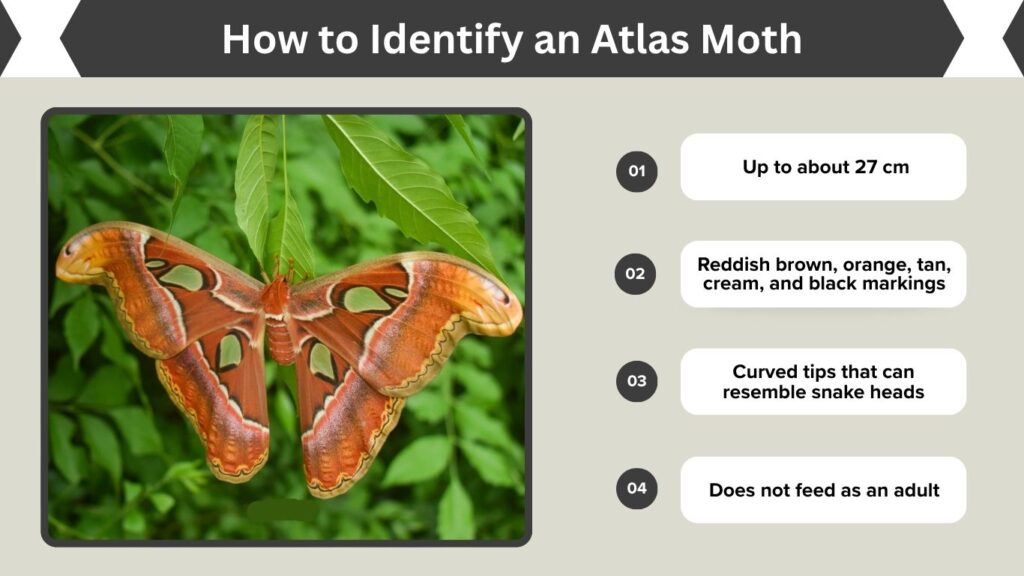
The atlas moth is easy to recognize once you know its main features. It has huge wings, warm reddish-brown coloring, translucent wing patches, and snake-like wing tips. These markings make it one of the most recognizable moths in the world.
| Feature | Atlas Moth Appearance |
| Scientific name | Attacus atlas |
| Family | Saturniidae |
| Wingspan | Up to about 27 cm |
| Color | Reddish brown, orange, tan, cream, and black markings |
| Wing tips | Curved tips that can resemble snake heads |
| Adult feeding | Does not feed as an adult |
| Main adult purpose | Mating and laying eggs |
Size and Wingspan
The atlas moth is famous for its size. Its wingspan can reach about 27 centimeters, and its caterpillar can grow up to around 12 centimeters long.
Although people often call it the biggest moth, “biggest” can be measured in different ways. Some moths may have a wider wingspan, while others may have greater wing surface area. Still, the atlas moth is clearly among the giant moth species.
Wing Patterns and Snake-Like Tips
One of the most interesting atlas moth facts is that its wing tips resemble snake heads. National Geographic describes Attacus atlas as being known for a cobra-like design on the upper wings that works as a defense against predators.
The moth may also move its wings when threatened, making the pattern seem more lifelike. This kind of mimicry can make birds or other predators hesitate before attacking.
Male vs Female Atlas Moths
Female atlas moths are usually larger and heavier than males. Males often have broader, more feather-like antennae that help them detect female pheromones.
Animal Diversity Web explains that female atlas moths release pheromones, and males use their large feathery antennae to locate them. This is important because adult atlas moths have very limited time to reproduce.
Atlas Moth Habitat and Distribution
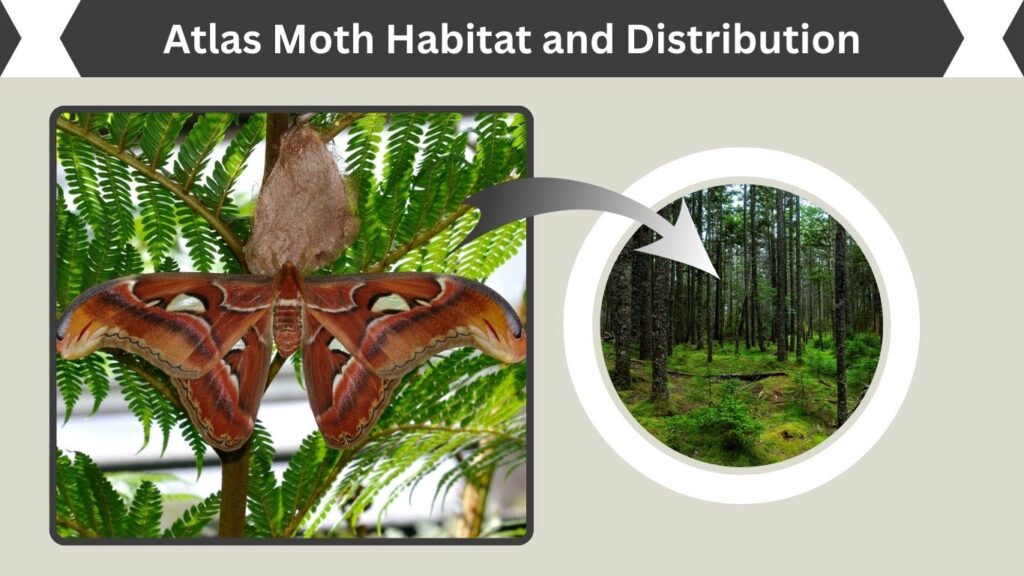
Atlas moths are naturally found in parts of Asia, especially in warm forested regions. They are associated with tropical and subtropical habitats where suitable host plants are available for the caterpillars.
The Natural History Museum lists the atlas moth as native to China, India, Malaysia, and Indonesia. Animal Diversity Web also describes its range as the Oriental region, including India and Southeast Asia.
These moths are not usually backyard insects in North America or Europe unless seen in butterfly houses, insect exhibits, or private captive collections. In their natural range, they may live in forests, plantations, gardens, and areas with suitable trees and shrubs.
Atlas Moth Life Cycle
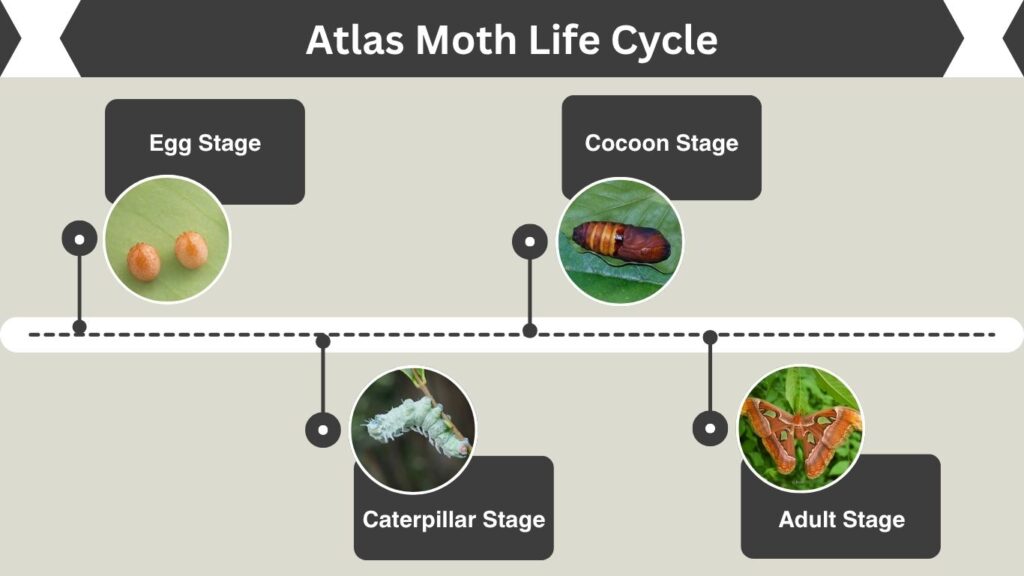
The atlas moth life cycle has four main stages: egg, caterpillar, pupa inside a cocoon, and adult moth. The adult stage gets the most attention because of the moth’s huge wings, but the caterpillar stage is where most growth happens.
Egg Stage
After mating, a female atlas moth lays eggs on or near host plant leaves. Animal Diversity Web reports that females can lay more than 100 eggs, with one cited range of 134 to 169 eggs.
The eggs hatch into caterpillars that begin feeding on leaves. At this stage, the young larvae must eat enough to support all later life stages.
Caterpillar Stage
The atlas moth caterpillar is large, greenish, and heavily built. It spends much of its time eating leaves. The Natural History Museum notes that atlas moth caterpillars can reach about 12 centimeters long and feed heavily before pupating.
Caterpillars may feed on plants such as cinnamon, citrus, guava, Jamaican cherry, mango, tea, and other host plants, depending on location and availability.
Cocoon Stage
When fully grown, the caterpillar spins a strong silk cocoon. Atlas moth silk is not the same as common domesticated silkworm silk, but it has been used in some places. The Natural History Museum explains that atlas moth caterpillars produce strong brown silk called fagara, which is used to form the cocoon.
Inside the cocoon, the caterpillar changes into a pupa. Later, the adult moth emerges, expands its wings, and begins its short adult life.
Adult Stage
Adult atlas moths do not eat. Their proboscis is tiny and nonfunctional, so they survive on stored energy from the caterpillar stage. The Natural History Museum states that adult atlas moths usually live only one to two weeks after emerging.
Because they cannot replace lost energy by feeding, adults do not waste much movement. They rest during the day and become more active when looking for mates.
What Do Atlas Moths Eat?
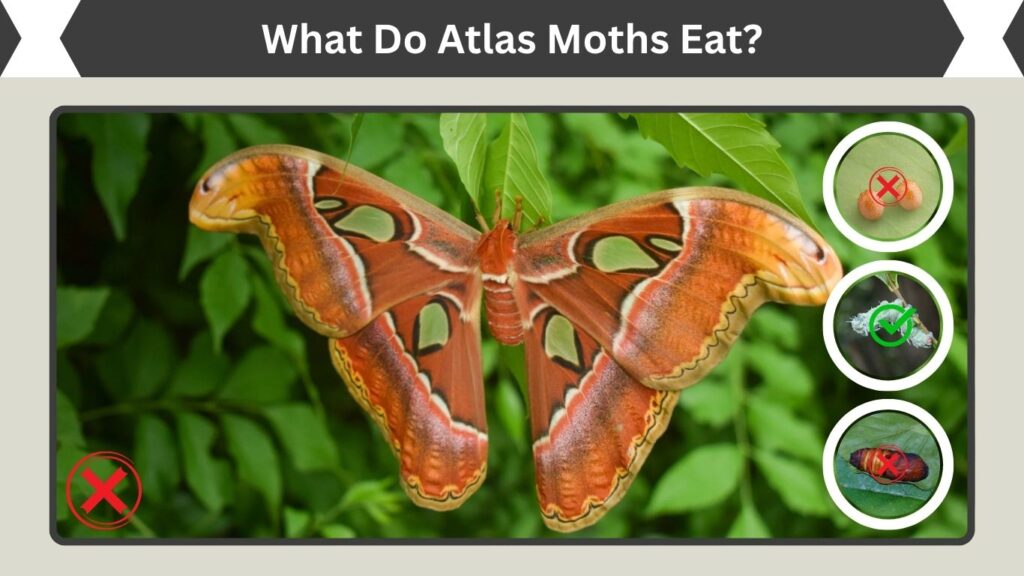
The answer depends on the life stage. Atlas moth caterpillars eat leaves, but adult atlas moths do not eat at all.
| Life Stage | Diet |
| Egg | Does not eat |
| Caterpillar | Leaves of host plants |
| Pupa | Does not eat inside the cocoon |
| Adult moth | Does not feed |
Caterpillars are the only feeding stage. Animal Diversity Web describes atlas moth larvae as folivores, meaning they eat leaves. It lists several host plants, including mango, guava, avocado, litchi, cardamom, water apple, and other plants.
Adult atlas moths are different from nectar-feeding butterflies. They do not visit flowers for food, and they do not damage clothes, stored food, or furniture.
Is the Atlas Moth Dangerous?
The atlas moth insect is not dangerous to humans. It does not bite, sting, or feed on people. Adult atlas moths are gentle and mostly focused on reproduction.
The caterpillars feed on leaves and can be heavy eaters, especially in captivity or where many are present on host plants. However, the adult moth is harmless. If you see one in an exhibit or garden, it is best to avoid touching its wings because moth wings are delicate.
The snake-like wing pattern may look intimidating, but it is a defensive trick rather than a sign of danger. The moth uses appearance, size, and movement to discourage predators.
Atlas Moth Care and Keeping Notes
Some people search for atlas moth care because Attacus atlas is sometimes kept by experienced insect keepers, butterfly houses, and educational exhibits. Keeping atlas moth insects requires proper host plants, temperature, humidity, space, and ethical sourcing.
Atlas moth caterpillars need fresh leaves from suitable host plants. Since the adults do not eat, the success of the adult moth depends heavily on how well the caterpillar fed and developed.
Before keeping atlas moths, check local laws and avoid collecting wild insects without permission. Non-native insects can create ecological risks if released outside their natural range. Anyone keeping them should use responsible captive-bred stock and prevent escapes.
Basic care considerations include:
- Fresh, pesticide-free host plant leaves for caterpillars
- Clean containers with good airflow
- Enough space for large caterpillars and emerging adults
- Proper humidity so pupae and adults do not dry out
- A safe place for adults to hang while their wings expand
Atlas moth care is not the same as caring for a pet that eats daily as an adult. The adult moth’s short life is natural, not usually a sign that something is wrong.
Interesting Atlas Moth Facts
Atlas moths are popular because almost every part of their biology feels unusual. They are giant, beautiful, short-lived, and built around one main adult purpose: reproduction.
Important facts include:
- The atlas moth is one of the largest moths in the world.
- Adult atlas moths do not eat after emerging.
- The caterpillar must store enough energy for the adult stage.
- Wing tips may mimic snake heads to scare predators.
- Females release pheromones to attract males.
- Males use large feathery antennae to detect those pheromones.
- The cocoon is made from strong brown silk.
These details make the atlas moth insect one of the most fascinating examples of moth adaptation.
FAQs
What is an atlas moth insect?
An atlas moth insect is a giant silk moth known scientifically as Attacus atlas. It is famous for its large reddish-brown wings, snake-like wing tips, and short adult life. It is native to parts of Asia, including India and Southeast Asia.
How big is an atlas moth?
An atlas moth can have a wingspan of up to about 27 centimeters. Its caterpillar can also grow large, reaching around 12 centimeters long before forming a cocoon.
Do atlas moths eat?
Adult atlas moths do not eat because their proboscis does not function. They live on energy stored during the caterpillar stage and usually survive as adults for only one to two weeks.
Are atlas moths dangerous?
No, atlas moths are not dangerous to people. They do not bite or sting. Their snake-like wing tips are mainly a defense feature that may help scare predators, not a sign that the moth is harmful.
Can you keep an atlas moth as a pet?
Atlas moths can be kept by experienced insect keepers, but they need proper host plants, humidity, space, and responsible sourcing. Local rules matter, especially outside the moth’s natural range, because non-native insects should never be released into the wild.
