
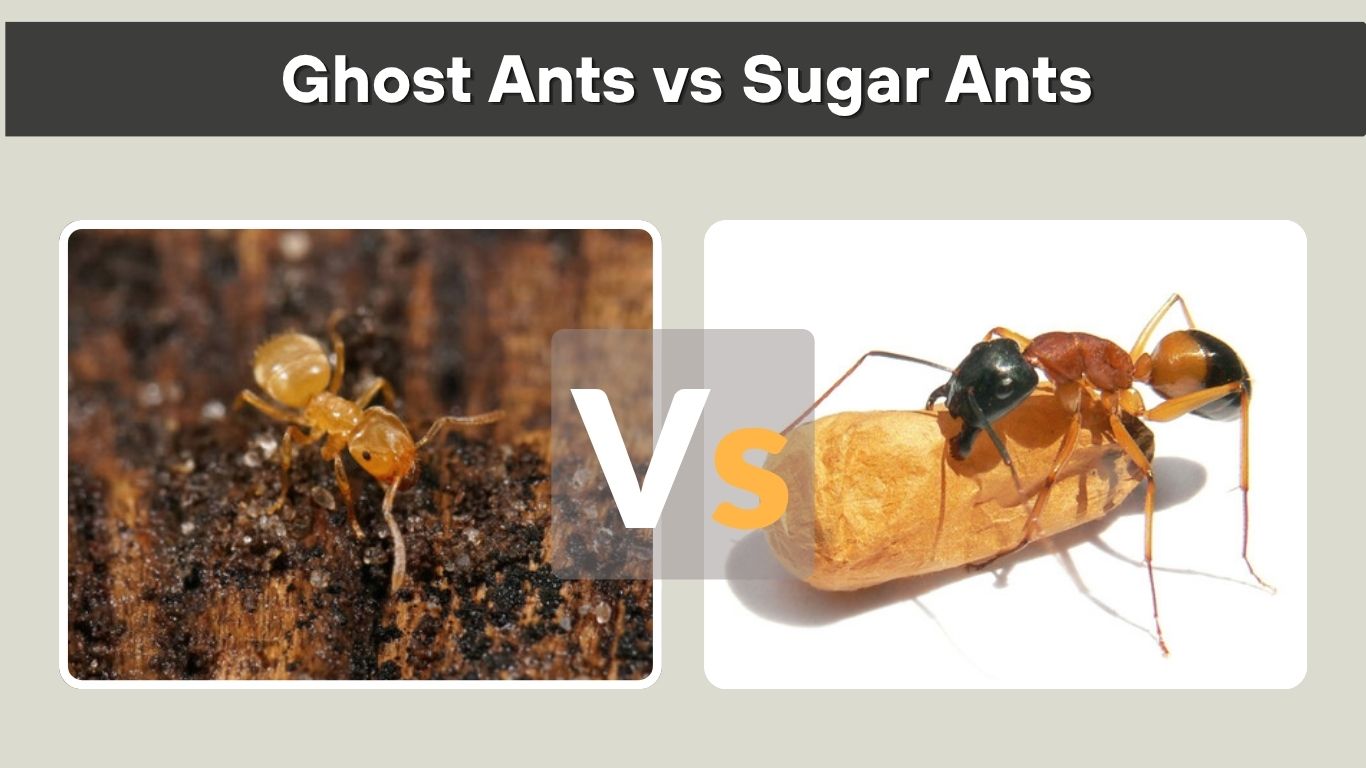
Ghost ants and sugar ants are often confused because both are tiny ants that commonly appear around sweet foods. Homeowners may see them trailing across kitchen counters, sinks, pantry shelves, or bathroom walls and assume they are the same pest. However, “ghost ant” is a specific ant, while “sugar ant” is often a general nickname. Knowing the difference helps you choose the right control method.
What Are Ghost Ants?
Ghost ants are tiny household ants known for their pale, almost transparent abdomen and legs. Their head and thorax are darker, while the back half of the body is very light. This two-tone color makes them difficult to see on pale surfaces, which is why they are called ghost ants.
They are common in warm, humid places and often invade kitchens and bathrooms. They like sweet foods, but they may also feed on grease, protein, and other small food particles. Ghost ants can nest indoors or outdoors, making them difficult to control if the colony spreads into wall voids, cabinets, potted plants, or landscaping.
Common Ghost Ant Traits
Ghost ants are usually found near moisture and food. They may appear around sinks, dishwashers, showers, windowsills, baseboards, and pantry areas. They are especially frustrating because they may have multiple nests and queens. If disturbed by sprays, they may scatter and form new nesting sites.
What Are Sugar Ants?
The name sugar ant is often used for any small ant attracted to sweet food. In some regions, sugar ant may refer to a specific species, but in many homes, it is simply a casual name for ants found near sugar, syrup, fruit, honey, candy, or juice.
This means a “sugar ant” problem could actually be ghost ants, pharaoh ants, odorous house ants, Argentine ants, rover ants, or another small ant species. Because the name is not always precise, identification matters before choosing treatment.
Why the Name Causes Confusion
People often name ants by what they eat instead of what they are. If ants are eating sugar, they call them sugar ants. But many ant species like sugar. Ghost ants also love sweet foods, so they are commonly mislabeled as sugar ants.
Ghost Ants vs Sugar Ants: Quick Comparison
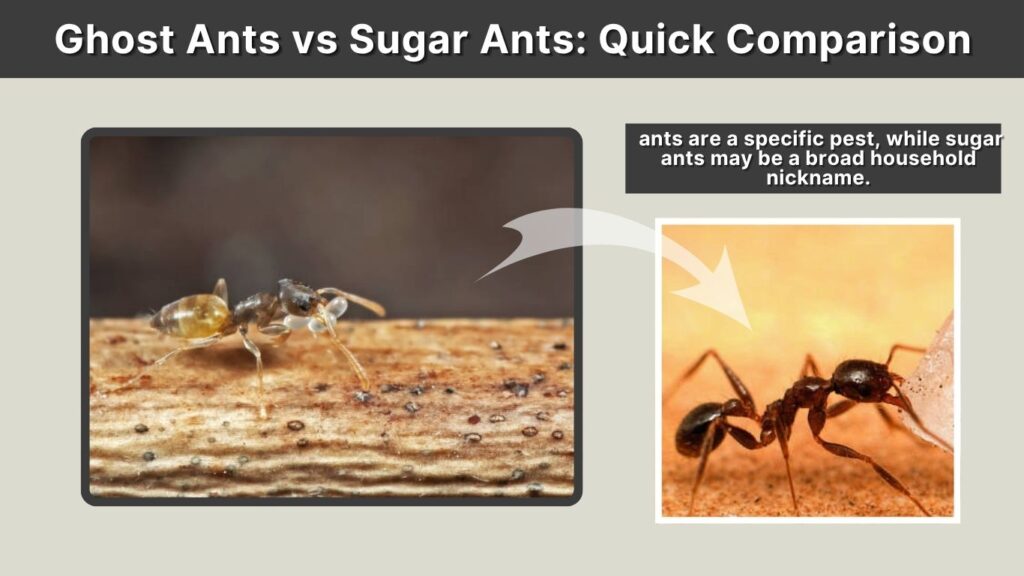
The easiest way to compare ghost ants and sugar ants is to remember that ghost ants are a specific pest, while sugar ants may be a broad household nickname.
| Feature | Ghost Ants | Sugar Ants |
|---|---|---|
| Meaning | A specific ant species | Often a general nickname |
| Size | Very tiny | Varies by species |
| Color | Dark head, pale abdomen and legs | Varies; may be brown, black, yellow, or mixed |
| Food preference | Sweets, grease, moisture, crumbs | Usually sweet foods |
| Common areas | Kitchens, bathrooms, sinks, walls | Kitchens, pantries, counters |
| Control difficulty | Often difficult due to multiple nests | Depends on actual species |
| Best treatment | Baiting, moisture control, sealing | Identify species first, then bait or treat |
How to Identify Ghost Ants
Ghost ants are very small, often only about 1.3 to 1.5 mm long. Their front half is darker, while the abdomen and legs are pale yellowish or nearly translucent. On a white counter or tile floor, they may look like tiny dark dots moving quickly because the pale back half blends into the background.
They often trail along edges, cracks, cabinets, and plumbing lines. If you see tiny ants in the bathroom, around a wet sink, or near potted plants, ghost ants are a strong possibility.
Best Identification Clues
Look for:
- Very small size
- Dark head and thorax
- Pale or translucent abdomen
- Pale legs
- Trails near moisture
- Ants around sinks and bathrooms
- Activity in kitchens and pantries
- Sudden movement from wall cracks or baseboards
A magnifying glass can help. Without close inspection, ghost ants can look like many other tiny ants.
How to Identify Sugar Ants
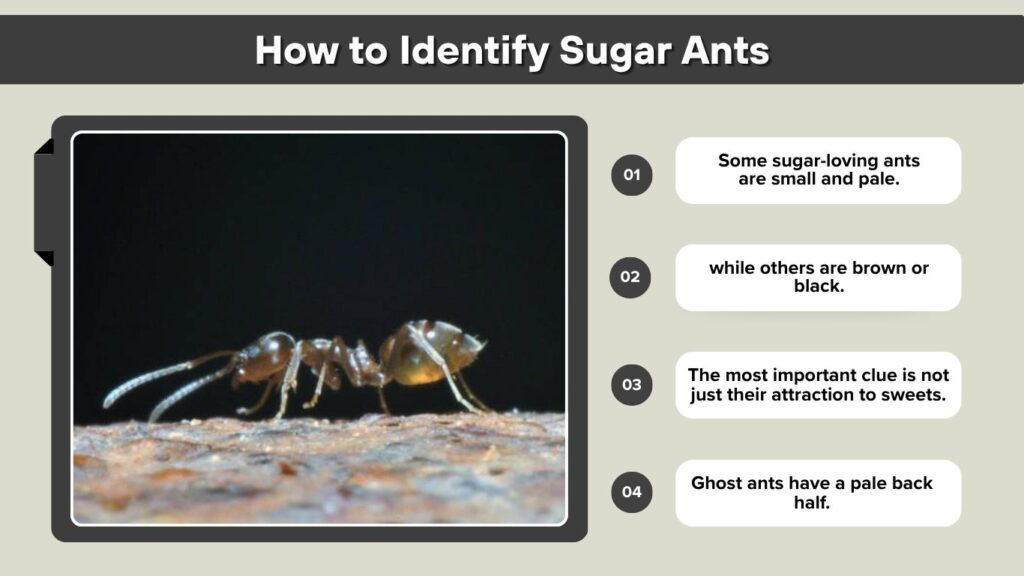
Because sugar ant is often a general name, identification depends on the actual ant species. Some sugar-loving ants are small and pale, while others are brown or black. The most important clue is not just their attraction to sweets, but their body shape, color, size, smell, nesting behavior, and trail pattern.
For example, odorous house ants give off a rotten coconut-like smell when crushed. Pharaoh ants are tiny yellowish ants that can be difficult to eliminate. Argentine ants often form large trails. Ghost ants have a pale back half.
Why Food Preference Is Not Enough
Seeing ants on sugar does not prove they are sugar ants. Many ants need carbohydrates for energy, especially worker ants. They may switch between sweet foods and protein depending on colony needs. That is why bait success can change from week to week.
Ghost Ants vs Pharaoh Ants
Ghost ants and pharaoh ants are commonly confused because both are tiny indoor ants that can spread through buildings. However, they look different and may respond differently to control.
Pharaoh ants are usually yellowish to reddish with a darker abdomen. Ghost ants have a darker head and a pale, almost invisible abdomen. Both can have multiple queens, and both may spread if sprayed incorrectly.
Why This Comparison Matters
Pharaoh ants are especially difficult in apartments, hospitals, offices, and large buildings because they can split colonies when disturbed. Ghost ants can also relocate and form multiple nests. For both pests, baiting is usually better than spraying visible trails.
Ghost Ants vs Termites
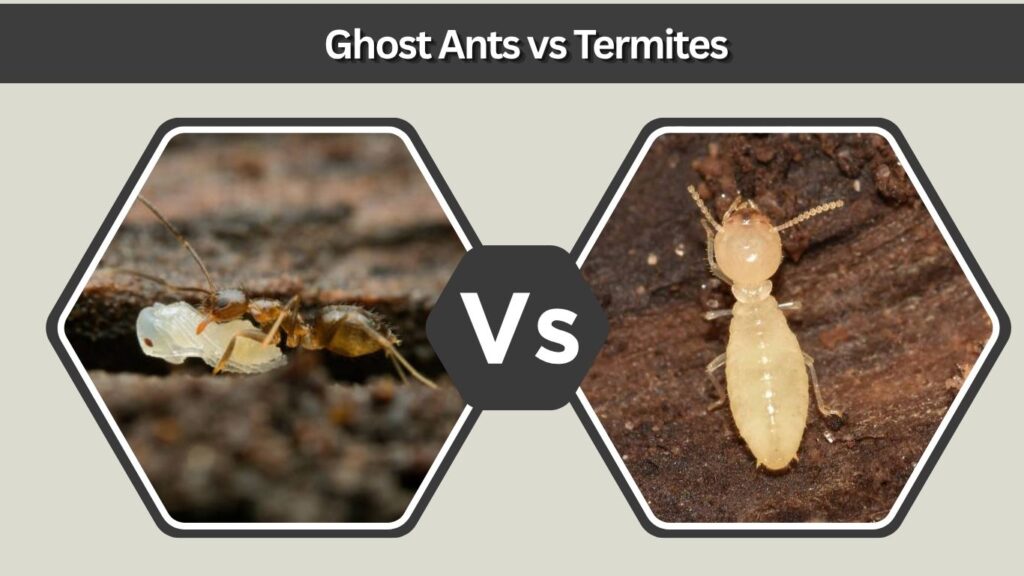
Ghost ants are sometimes confused with termites because both may be small and appear indoors. However, they are very different insects. Ants have narrow waists and bent antennae, while termites have thicker waists and straight antennae.
Termites are much more serious because they can damage wood and structural materials. Ghost ants are nuisance pests and do not eat wood like termites.
| Feature | Ghost Ants | Termites |
|---|---|---|
| Body shape | Narrow waist | Thick, straight body |
| Antennae | Bent | Straight |
| Wings, if present | Front wings larger than back wings | Wings equal in size |
| Main concern | Food contamination and nuisance | Wood and structural damage |
| Diet | Sweets, grease, crumbs, insects | Cellulose, wood, plant material |
| Treatment | Ant bait and exclusion | Professional termite treatment |
| Urgency | Usually moderate | Often high |
If you see winged insects indoors, do not assume they are ants. Winged termites may signal a serious infestation and should be inspected quickly.
Ghost Ants vs Crazy Ants
Crazy ants are another small ant group that may be confused with ghost ants. Crazy ants are known for fast, erratic movement. They do not always follow neat trails, and some species can form huge outdoor infestations.
Ghost ants are also tiny and fast, but they are more often recognized by their pale abdomen and indoor moisture-seeking behavior. Crazy ants may be larger and more noticeable outdoors, depending on the species.
Simple Difference
Ghost ants often look two-toned and nearly transparent in the back. Crazy ants are named more for their irregular movement. If the ants run wildly in scattered patterns, crazy ants may be possible. If they are tiny with pale abdomens around sinks and sweets, ghost ants are more likely.
Why Ghost Ants Are Often Called Sugar Ants
Ghost ants are frequently called sugar ants because they commonly invade kitchens for sweet food. They may trail to sugar, syrup, honey, soda, fruit juice, cake crumbs, or candy. Their love of sweets makes the nickname understandable.
However, using the wrong name can lead to the wrong treatment. If you buy a product for “sugar ants” but the problem is actually ghost ants with multiple nests, a simple spray may not solve anything.
Which Ant Is Harder to Get Rid Of?
Ghost ants can be harder to eliminate than a typical sugar ant problem because they may nest in several places. They can live inside walls, under cabinets, in potted plants, outdoors in mulch, and near plumbing. If one nest is disturbed, the colony may shift.
Sugar ants vary. Some are easy to control with basic baiting and cleaning. Others, like pharaoh ants or Argentine ants, may be more difficult.
| Problem | Ghost Ants | General Sugar Ants |
|---|---|---|
| Easy to identify? | Moderate if you check color | Hard because name is vague |
| Attracted to sweets? | Yes | Yes |
| Likes moisture? | Strongly | Depends on species |
| Multiple nests? | Common | Depends on species |
| Spray recommended? | Usually not ideal | Depends on species |
| Bait effective? | Often, if chosen correctly | Often, if species accepts it |
| Professional help needed? | Sometimes | Depends on infestation |
Best Way to Control Ghost Ants
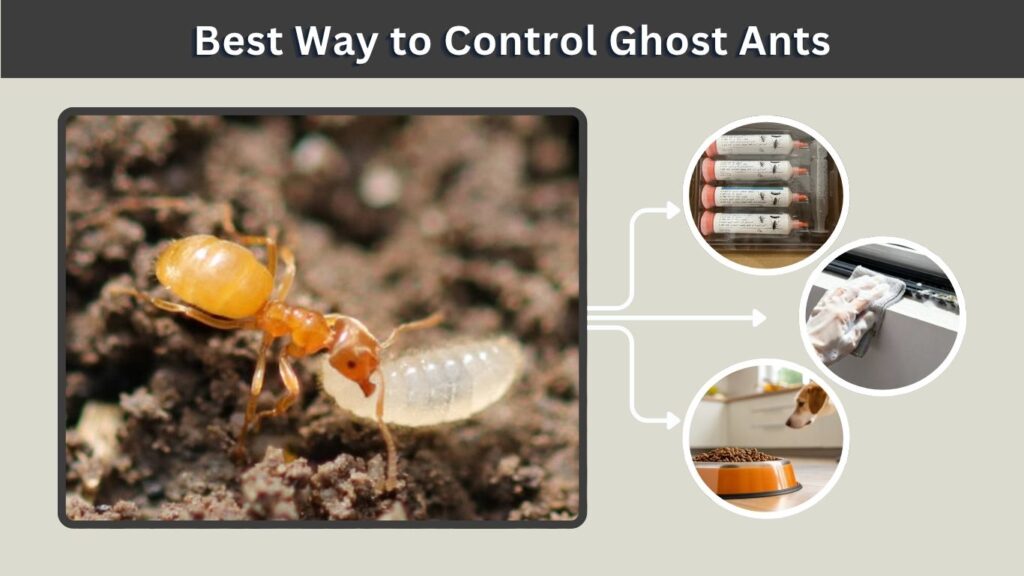
The best way to control ghost ants is to combine cleaning, baiting, moisture control, and sealing. Spraying visible ants may give quick relief, but it usually does not remove the colony. It may also cause the ants to scatter.
Control Steps
Start by wiping trails with soapy water. Clean sticky spills, crumbs, pet food, and pantry residue. Fix leaks and dry sinks at night. Place ant bait near trails, but do not spray near the bait. Let the ants carry the bait back to the colony.
Seal entry points after activity decreases. Caulk gaps around windows, doors, pipes, and baseboards. Check potted plants because ghost ants may nest in damp soil.
Best Way to Control Sugar Ants
Since sugar ants may be different species, first identify the ant. If the ants are simply attracted to sweets, cleaning and baiting may work. If the ants keep returning, the species may require a more specific strategy.
General Sugar Ant Control
Remove sweet foods, seal pantry items, clean sticky bottles, and rinse drink spills quickly. Use a bait that matches what the ants are eating. If they ignore sweet bait, try protein or grease-based bait.
Avoid random spraying. Sprays can kill workers but leave nests untouched. In multi-queen ants, sprays may cause the colony to split.
Common Mistakes to Avoid
Many ant problems become worse because of simple mistakes. The most common mistake is spraying the visible trail and assuming the problem is solved. Another mistake is using the wrong bait or removing bait too quickly.
Avoid These Errors
Do not spray around bait. Do not leave sugar, fruit, or pet food exposed. Do not ignore moisture problems. Do not seal entry points before reducing indoor ant activity. Do not assume every tiny ant is the same species.
If ants are spreading across several rooms, coming from outlets, or returning after repeated treatments, professional identification may save time and money.
FAQs
Are ghost ants the same as sugar ants?
Ghost ants are not exactly the same as sugar ants. Ghost ant is a specific ant species with a dark head and pale abdomen. Sugar ant is often a general nickname for ants attracted to sweet foods. Many different ants may be called sugar ants by homeowners.
How can I tell ghost ants from sugar ants?
Ghost ants are extremely tiny and have a dark front body with pale legs and a translucent abdomen. Sugar ants vary because the name may refer to different species. If the ants look nearly invisible in the back half and appear near sweets or moisture, they may be ghost ants.
Are ghost ants worse than sugar ants?
Ghost ants can be harder to control than some sugar ants because they may form multiple nests indoors and outdoors. However, “sugar ant” is not always a specific species, so difficulty depends on the actual ant. Proper identification is the first step to effective control.
Are ghost ants termites?
No, ghost ants are not termites. Ghost ants are tiny nuisance ants that search for food and moisture. Termites feed on cellulose and may damage wood. Ants have narrow waists and bent antennae, while termites have thicker bodies and straight antennae. Termite concerns need professional inspection.
What is the best treatment for ghost ants?
The best treatment is baiting combined with cleaning, moisture control, and sealing entry points. Place bait near trails and avoid spraying nearby. Workers need to carry bait back to hidden nests. If ghost ants keep returning, a pest control professional may be needed.
