
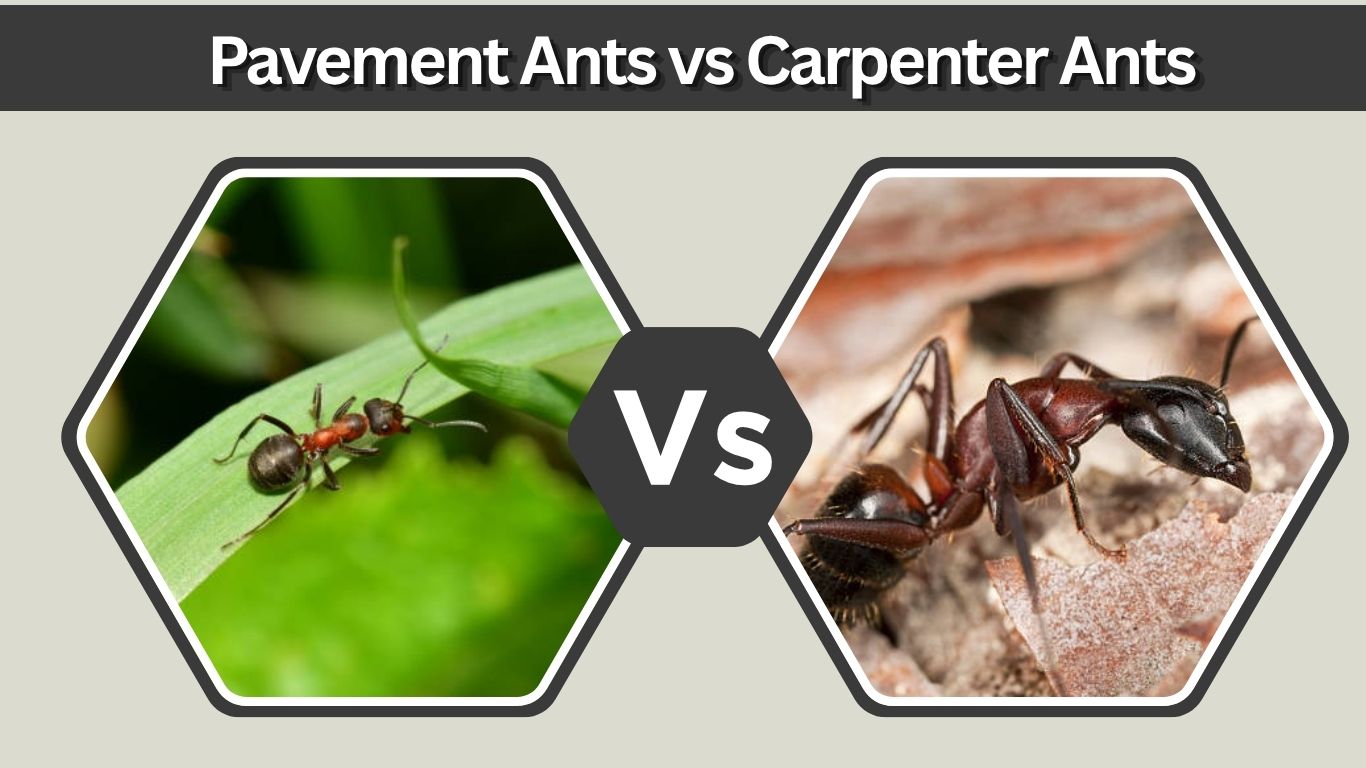
Pavement ants and carpenter ants are often confused because both can show up around homes, foundations, kitchens, and outdoor structures. However, they are very different pests. Pavement ants are usually small nuisance ants that nest under concrete, while carpenter ants are larger ants that can tunnel through damaged wood. Knowing the differences helps homeowners choose the right treatment and avoid costly mistakes.
Pavement Ants vs Carpenter Ants: Quick Comparison
Before looking closely at size, color, nesting habits, and damage, it helps to understand the main difference. Pavement ants are usually a food-seeking nuisance. Carpenter ants are more concerning because they can excavate wood to build nesting galleries.
| Feature | Pavement Ants | Carpenter Ants |
|---|---|---|
| Average worker size | About 1/8 inch | About 1/4 to 1/2 inch |
| Color | Dark brown to black | Black, red, brown, or mixed |
| Main nesting area | Soil under pavement, slabs, sidewalks, patios | Moist, damaged, or decaying wood |
| Structural damage | Usually no major damage | Can damage wood over time |
| Indoor concern | Food contamination and nuisance trails | Possible hidden wood nesting |
| Common sign | Soil piles near concrete cracks | Sawdust-like frass near wood |
| Best control method | Baiting and entry-point sealing | Nest location, moisture control, and targeted treatment |
What Are Pavement Ants?
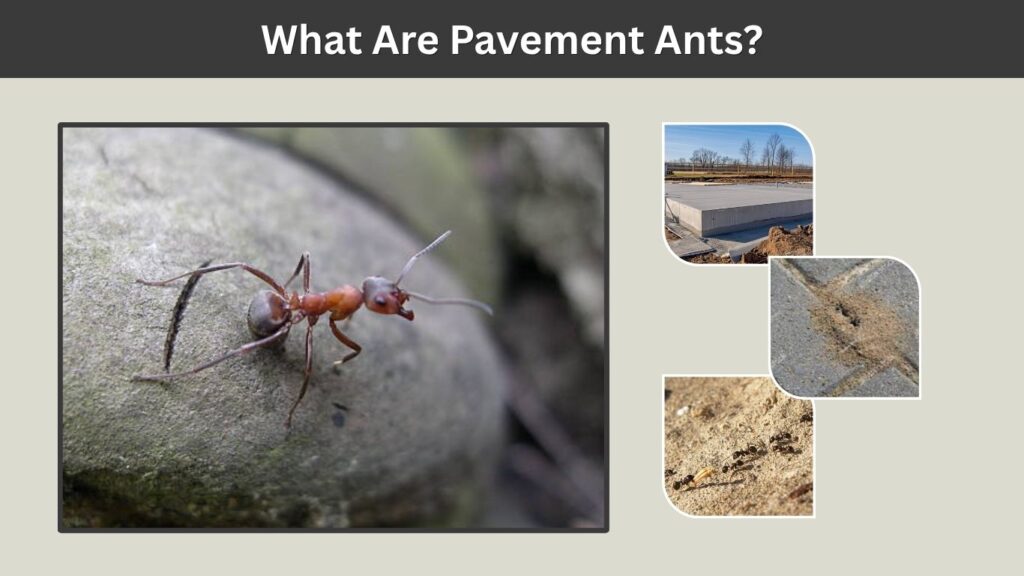
Pavement ants are small ants commonly found nesting under sidewalks, driveways, patios, foundations, and concrete slabs. They get their name from their habit of living around paved surfaces. Outdoors, they often push small piles of soil or sand through cracks in pavement.
These ants are common around homes, restaurants, commercial buildings, and parking areas. They usually enter homes when searching for food or moisture. Once they find a reliable food source, workers create scent trails that other ants follow.
Pavement Ant Appearance
Pavement ants are usually dark brown to black. Their legs and antennae may look slightly lighter than the rest of the body. Worker ants are small, typically about 1/8 inch long.
Under magnification, pavement ants have fine grooves on the head and thorax. They also have two small nodes between the thorax and abdomen. These features help separate them from some other household ants, although professional identification may be needed in difficult cases.
Pavement Ant Habitat
Pavement ants usually nest outdoors in soil beneath hard surfaces. They prefer protected spaces where pavement, concrete, stones, or slabs help shield the colony.
Common pavement ant nesting spots include:
- Under sidewalks and driveways
- Beneath patios and paving stones
- Along foundation edges
- Under basement or garage slabs
- Around landscape stones
- Near curbs and parking lots
Indoors, they may nest behind walls, under floors, near heat sources, or beneath slabs. However, most infestations start outdoors and move inside when ants find food.
What Are Carpenter Ants?
Carpenter ants are larger ants known for tunneling through wood to create nests. Unlike termites, they do not eat wood. Instead, they remove wood to build smooth galleries where the colony can live and grow.
Carpenter ants often prefer damp, decaying, or previously damaged wood. This is why they are commonly found near leaks, roof damage, window frames, crawl spaces, decks, porches, and wall voids.
Carpenter Ant Appearance
Carpenter ants are much larger than pavement ants. Workers may range from about 1/4 inch to 1/2 inch long, depending on the species and colony role. Queens are even larger.
Their color can vary. Many carpenter ants are black, but some are reddish, brown, or a mix of black and red. They usually have a smooth, rounded thorax when viewed from the side and a single node between the thorax and abdomen.
Carpenter Ant Habitat
Carpenter ants may nest outdoors or indoors. Outdoor nests are often found in tree stumps, logs, fence posts, firewood, or dead tree limbs. Indoor nests are more concerning because they may indicate moisture problems or hidden wood damage.
Possible indoor carpenter ant nesting sites include:
- Window and door frames
- Wall voids near plumbing leaks
- Attics with roof leaks
- Crawl spaces
- Decks and porches
- Foam insulation
- Wood around chimneys
- Bathroom and kitchen walls
Seeing a few carpenter ants indoors does not always mean there is a nest inside. They may be foraging from an outdoor colony. However, repeated sightings, especially at night, can suggest a nearby nest.
Size Difference: Carpenter Ant vs Pavement Ant
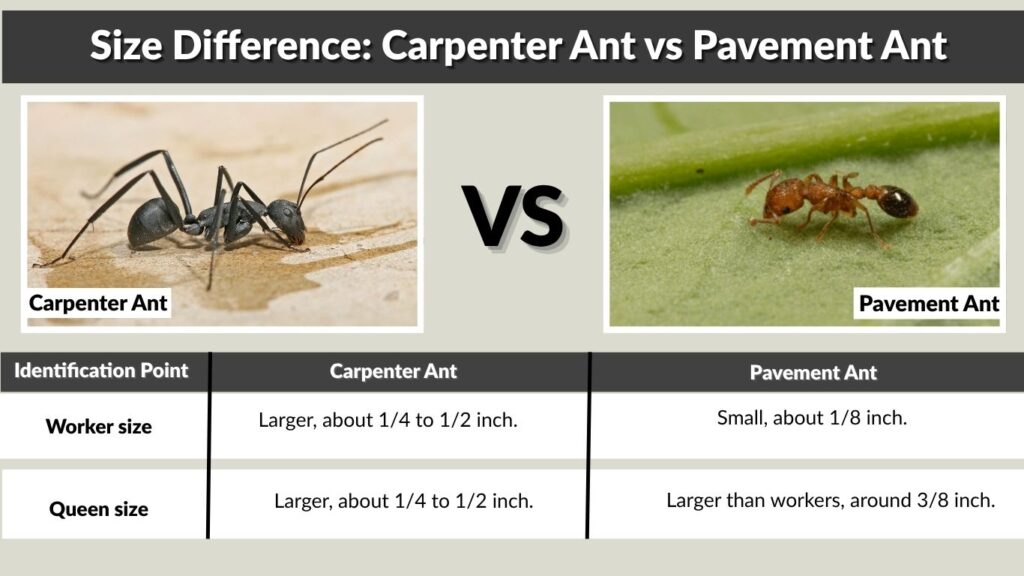
Size is one of the easiest ways to tell these ants apart. Pavement ants are small and fairly uniform in size. Carpenter ants are much larger, and workers can vary in size within the same colony.
| Identification Point | Pavement Ant | Carpenter Ant |
|---|---|---|
| Worker size | Small, about 1/8 inch | Larger, about 1/4 to 1/2 inch |
| Queen size | Larger than workers, around 3/8 inch | Often much larger than workers |
| Body profile | Small and compact | Larger and more robust |
| Waist nodes | Two nodes | One node |
| Thorax shape | Uneven with small spines | Smooth, rounded thorax |
| Easy field clue | Tiny ants trailing near food | Large ants moving near wood or moisture |
If the ants are tiny and moving in trails near a kitchen counter, pavement ants are more likely. If the ants are large, especially near wood, windows, or damp areas, carpenter ants should be considered.
Color Difference Between Pavement and Carpenter Ants
Pavement ants are usually dark brown to black. Their overall color is fairly consistent, though their legs and antennae may be a little lighter.
Carpenter ants have more color variation. Some are solid black, while others are reddish brown or black with a red middle section. Because color can overlap, size and nesting behavior are often more reliable than color alone.
For example, a black ant in the kitchen could be a pavement ant, carpenter ant, odorous house ant, or little black ant. But a large black ant near a water-damaged window frame is more concerning for carpenter ant activity.
Nesting Habits and Damage
The biggest difference between pavement ants and carpenter ants is where they nest and what kind of damage they may cause. Pavement ants usually nest in soil. Carpenter ants nest in wood or wood-like spaces.
Pavement Ant Nesting Signs
Pavement ants often leave small piles of soil, sand, or debris near pavement cracks. These piles may appear along driveways, patios, sidewalks, or foundation edges.
Indoors, they are usually seen trailing to food. They may travel along baseboards, countertops, sinks, or pantry shelves. Their presence is annoying, but they usually do not damage structural wood.
Carpenter Ant Nesting Signs
Carpenter ants can be more serious because they excavate wood. Over time, a large colony can weaken wood, especially if moisture damage already exists.
Common carpenter ant signs include:
- Large ants indoors, especially at night
- Sawdust-like frass near wood
- Rustling sounds inside walls
- Winged ants indoors
- Ants near damp wood or leaks
- Smooth galleries inside damaged wood
Frass is one of the most important warning signs. It may contain wood shavings, dead ants, insect parts, and debris pushed out from the nest.
Diet: What Do These Ants Eat?
Both pavement ants and carpenter ants are attracted to human food, but their feeding habits are not exactly the same. Neither species eats wood as food.
| Food Source | Pavement Ants | Carpenter Ants |
|---|---|---|
| Sweets | Yes | Yes |
| Grease | Yes | Sometimes |
| Protein | Yes | Yes |
| Dead insects | Yes | Yes |
| Honeydew | Yes | Yes |
| Pet food | Yes | Yes |
| Wood | No | No, they excavate it but do not eat it |
| Kitchen crumbs | Very common attraction | Possible attraction |
Pavement ants are strongly attracted to crumbs, grease, sugar, syrup, pet food, and food scraps. This makes kitchens, dining rooms, trash areas, and pantries common activity zones.
Carpenter ants feed on sweets, proteins, insects, honeydew, and household foods. Outdoors, they may forage on tree insects and sugary secretions. Indoors, they may visit kitchens and garbage areas, but their presence near wood or moisture should not be ignored.
Pavement Ants vs Sugar Ants
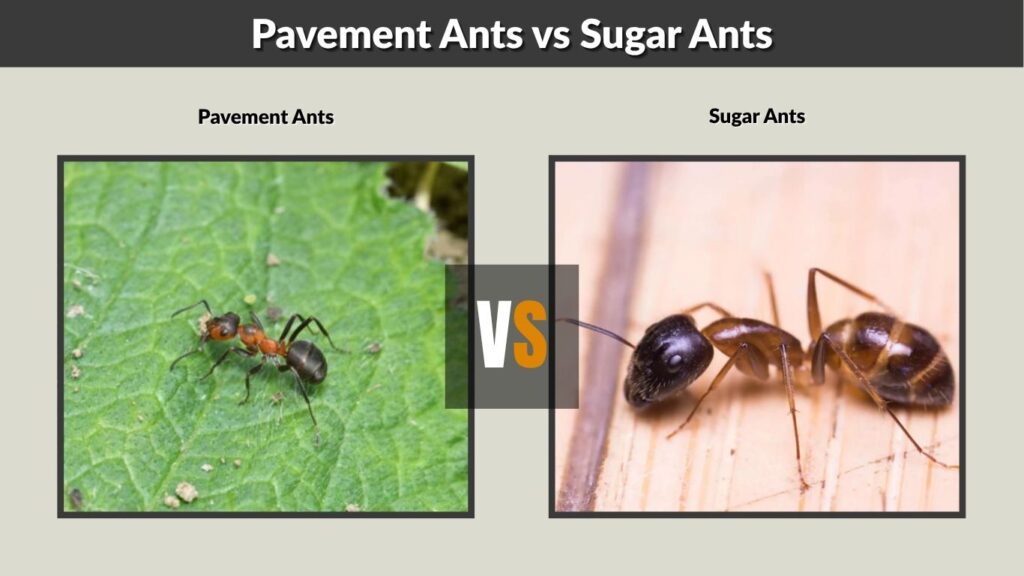
The keyword “pavement ants vs sugar ants” can be confusing because “sugar ant” is a common name, not always a precise species name. Many people use it to describe any small ant attracted to sweets.
Pavement ants can act like sugar ants because they often feed on sweet foods. However, they also eat grease, protein, seeds, dead insects, and pet food. If the ants are small, dark, and coming from cracks near concrete, they may be pavement ants rather than a separate “sugar ant” species.
To identify them, look at where they are nesting. Sugar-seeking ants may come from walls, cabinets, soil, or outdoor nests. Pavement ants are especially linked to sidewalks, slabs, patios, and foundations.
Pavement Ants vs Odorous House Ants
Odorous house ants are another common ant confused with pavement ants. Both are small and dark, and both may enter homes for food.
The easiest difference is smell. Odorous house ants give off a rotten coconut-like odor when crushed. Pavement ants do not have that same strong odor. Pavement ants are also more associated with soil piles near cracks in concrete.
Odorous house ants often nest in wall voids, mulch, logs, and under objects outdoors. They may shift nests often, making them difficult to control. Pavement ants are more likely to maintain colonies under slabs, sidewalks, and paved areas.
Pavement Ants vs Fire Ants
Fire ants are usually more aggressive than pavement ants. They can sting repeatedly and often build noticeable mounds in soil. Pavement ants can sting, but they are not usually a major stinging threat to people.
Fire ants are often reddish brown to dark red, depending on the species. Pavement ants are generally dark brown to black. Fire ants are also more likely to swarm aggressively when their mound is disturbed.
If you are dealing with painful stings, large soil mounds, and aggressive ants, fire ants may be the issue. If you see small dark ants trailing from cracks in pavement, pavement ants are more likely.
Pavement Ants vs Termites
Some homeowners also search for “pavement ants vs termites,” especially when winged insects appear indoors. Pavement ant swarmers can be mistaken for termite swarmers.
Ants have narrow waists, bent antennae, and front wings that are longer than the back wings. Termites have broad waists, straight antennae, and wings that are about equal in length.
This distinction matters because termites can cause serious structural damage by eating cellulose. Pavement ants do not eat wood and are not considered a wood-destroying pest.
Which Ant Is More Serious?
Carpenter ants are usually more serious than pavement ants because they can nest in wood and expand hidden galleries over time. Their presence may also point to moisture damage, leaks, or decaying structural materials.
Pavement ants are usually a nuisance pest. They can contaminate food and become frustrating when colonies keep sending workers indoors, but they rarely cause major property damage.
That said, any ant problem can become persistent if the colony is not addressed. Pavement ants can return again and again if outdoor nests remain active. Carpenter ants can become costly if a hidden nest grows inside the structure.
How to Identify the Ants in Your Home
The best way to identify ants is to look at size, location, behavior, and signs around the home. Do not rely on color alone because many ant species are dark.
Use these clues:
- Tiny ants near pavement cracks: likely pavement ants
- Large ants near damp wood: possible carpenter ants
- Small dark ants with a bad odor when crushed: odorous house ants
- Ants strongly attracted to sweets: may be pavement ants or sugar-seeking ants
- Aggressive reddish ants with painful stings: possible fire ants
- Winged insects with equal wings and straight antennae: possible termites
If you find large ants indoors repeatedly, especially near wood, it is worth investigating further. If you find tiny ants trailing from a sidewalk crack into the kitchen, pavement ants are more likely.
How to Get Rid of Pavement Ants
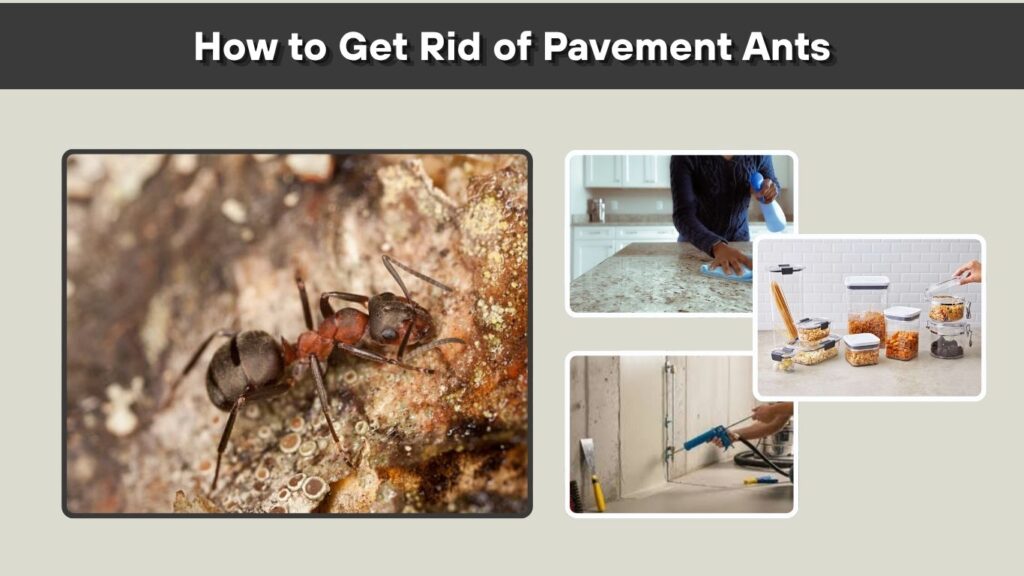
Pavement ant control usually focuses on baiting, sanitation, and sealing entry points. Baits work well because worker ants carry the bait back to the colony.
Helpful steps include:
- Clean crumbs, grease, and spills
- Store food in sealed containers
- Keep pet food areas clean
- Seal foundation cracks and door gaps
- Place ant bait near trails
- Avoid spraying directly on bait trails
- Remove debris near the foundation
Spraying visible ants may provide quick relief, but it often fails to eliminate the colony. Baiting is usually more effective because it targets ants beyond the visible trail.
How to Get Rid of Carpenter Ants
Carpenter ant control requires finding the nest and correcting moisture problems. If the nest is inside wood, surface sprays may not reach the colony.
Important steps include:
- Fix roof, plumbing, or window leaks
- Replace water-damaged wood
- Store firewood away from the house
- Trim tree branches touching the structure
- Look for frass near wood
- Inspect crawl spaces, attics, and wall voids
- Use targeted treatment when the nest is found
For carpenter ants, professional inspection is often helpful. A technician may locate hidden nests, identify moisture conditions, and apply treatment directly to active areas.
FAQs
Are pavement ants the same as carpenter ants?
No. Pavement ants are small ants that usually nest in soil under sidewalks, driveways, patios, and slabs. Carpenter ants are much larger and can tunnel through damp or damaged wood to build nests. Carpenter ants are usually more serious because they may indicate hidden wood damage.
How can I tell pavement ants from carpenter ants?
Look at size and nesting location. Pavement ants are tiny, usually about 1/8 inch long, and are often found near concrete cracks or kitchen food sources. Carpenter ants are larger, often 1/4 to 1/2 inch long, and are commonly linked to damp wood, frass, or structural voids.
Do pavement ants damage wood?
Pavement ants do not usually damage wood. They mostly nest in soil under pavement, slabs, and foundations. If you see wood shavings, large ants, or activity near damp wood, carpenter ants may be more likely than pavement ants.
Which is worse, pavement ants or carpenter ants?
Carpenter ants are usually worse because they can excavate wood and may signal moisture damage inside a home. Pavement ants are mostly a nuisance pest that contaminates food and creates trails. However, both can be difficult to control if the nest is not treated.
Can pavement ants be mistaken for sugar ants?
Yes. Many people call small sweet-feeding ants “sugar ants.” Pavement ants often eat sweet foods, so they may be mistaken for sugar ants. The best clue is nesting location. Pavement ants are strongly associated with cracks near sidewalks, driveways, patios, and foundations.
