

Damselflies and dragonflies are often confused because they share similar colors, habitats, and flying seasons. Both belong to the ancient insect order Odonata and are commonly seen near ponds, rivers, and wetlands. However, when you look closely, their wings, eyes, body shape, flight style, and even their underwater young show clear differences. This guide explains damselfly vs dragonfly in a simple, detailed way, helping you understand how to identify them and how their lifestyles, behaviors, and life stages truly differ.
Classification and Evolution Overview
Damselflies and dragonflies are closely related insects grouped under the order Odonata, an ancient lineage that existed long before dinosaurs. Fossil records show that their ancestors flew over prehistoric swamps more than 300 million years ago. Despite this shared origin, modern odonates are divided into two main suborders based on structure and behavior.
Dragonflies belong to the suborder Anisoptera, known for strong bodies, powerful flight muscles, and wide hindwings. Damselflies belong to Zygoptera, a group characterized by slender bodies, delicate wings, and softer flight patterns. These evolutionary branches adapted to different ecological niches, which is why their appearance and lifestyle are now so distinct.
Both groups are found on every continent except Antarctica. They play essential roles in freshwater ecosystems and are considered living indicators of environmental health, especially water quality.
Body Shape and Size Differences
One of the easiest ways to separate a dragonfly from a damselfly is by body structure. Dragonflies are generally larger, thicker, and more muscular. Their thorax appears bulky because it contains powerful muscles used for sustained and agile flight. Their abdomen is broader, giving them a strong, compact look.
Damselflies, on the other hand, are thin, lightweight, and delicate. Their long, thread-like abdomen and narrow thorax give them a fragile appearance. They often look like small flying needles perched on grass stems or leaves.
Size also differs. Many dragonflies reach lengths of 7–9 cm or more, while most damselflies are noticeably shorter and slimmer. These differences reflect their flight abilities, hunting styles, and habitat use.
Identification Guide: How to Tell Them Apart Quickly
A short overview: If you only have a few seconds to identify one of these insects, focus on wings, eyes, and posture.
- Wing position at rest:
Dragonflies rest with wings spread open and flat.
Damselflies fold their wings together over the body. - Eye placement:
Dragonfly eyes touch or nearly touch on top of the head.
Damselfly eyes are widely separated on each side. - Body build:
Dragonflies have thick, powerful abdomens.
Damselflies have long, thin, delicate abdomens. - Perching posture:
Dragonflies perch boldly on exposed sticks and rocks.
Damselflies perch quietly on grasses and leaves. - Flight strength:
Dragonflies fly fast, straight, and confidently.
Damselflies flutter weakly and stay near plants.
Wings Structure and Wing Types
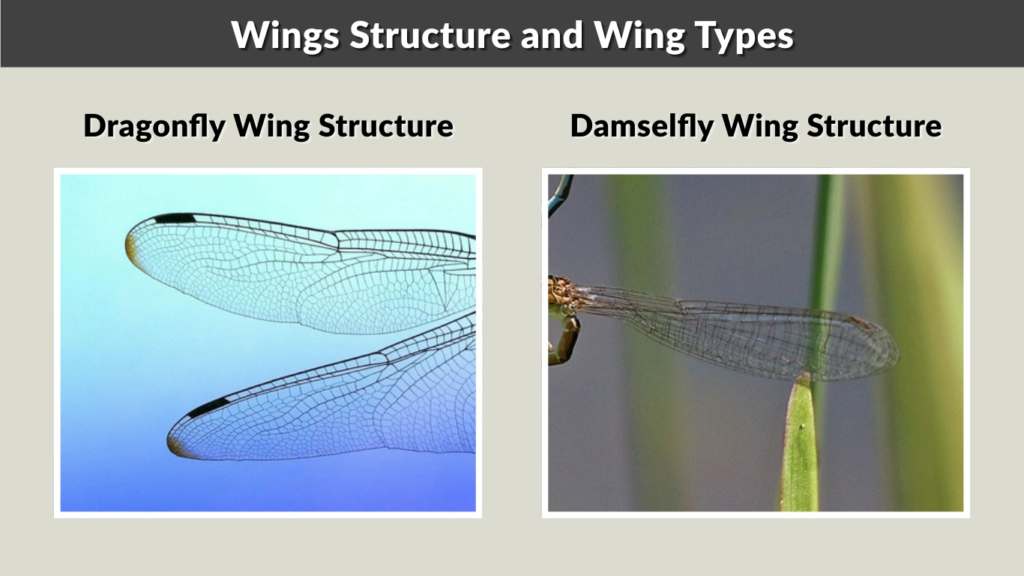
Dragonfly Wing Structure
Dragonflies have two pairs of strong, transparent wings, with the hindwings broader than the front pair. This design gives them excellent lift and control, allowing them to hover, glide, and change direction suddenly. Their wings remain stretched horizontally when resting.
Dragonfly wings are paleopterous, meaning they cannot fold flat over the body like butterflies. Instead, they stay open, making dragonflies appear wider and more dominant when perched.
Damselfly Wing Structure
Damselfly wings are narrower and usually similar in shape between front and back pairs. They are lighter and more flexible, built for gentle, short-distance flight rather than long patrols.
Unlike dragonflies, damselflies can bring their wings together vertically over the abdomen. This folded posture makes them look slim and subtle while resting among vegetation.
Eyes and Head Shape Differences
Dragonflies are famous for their enormous compound eyes, which cover most of the head. In many species, the eyes touch in the middle, forming a nearly continuous visual surface. This provides almost 360-degree vision, allowing dragonflies to detect prey and predators from nearly every direction.
Damselflies have smaller eyes placed far apart on each side of the head. This gives them a more hammer-shaped appearance. While their vision is still excellent, it is better suited for close-range movement among plants rather than high-speed aerial hunting.
Eye placement is one of the most reliable features when identifying photos of damselflies versus dragonflies.
Nymphs and Larvae Comparison
A short overview: Both insects spend most of their lives underwater as nymphs, but their bodies and breathing systems are very different.
- Dragonfly nymphs:
Thick, bulky bodies adapted for ambush hunting.
Breathe through internal gills inside the rectum.
Use jet propulsion to move quickly through water. - Damselfly nymphs:
Slim, delicate bodies suited for plant habitats.
Have three leaf-like external tail gills.
Swim gently with side-to-side movements. - Habitat in water:
Dragonfly nymphs live on muddy or sandy bottoms.
Damselfly nymphs stay among aquatic plants. - Hunting style:
Dragonfly nymphs actively ambush larger prey.
Damselfly nymphs feed on tiny aquatic insects.
Life Cycle and Metamorphosis
Both damselflies and dragonflies undergo incomplete metamorphosis, meaning they do not have a pupal stage like butterflies. Their life cycle includes egg, nymph, and adult stages. Females lay eggs in or near freshwater. Some species drop eggs directly into water, while others insert them into plant tissue.
After hatching, the insects live as aquatic nymphs for several months to several years, depending on species and climate. During this time, they molt multiple times as they grow. When fully developed, the nymph crawls out of the water, splits its skin, and emerges as a winged adult. The wings slowly harden, and within hours, the insect becomes an active aerial hunter.
Dragonfly nymphs often have longer development periods and emerge as larger, more powerful adults. Damselfly nymphs usually mature faster and produce smaller, lighter adults.
Flight Style and Flying Ability
Dragonfly Flight Characteristics
Dragonflies are among the strongest fliers in the insect world. They can hover like helicopters, glide long distances, and even fly backward. Their four wings move independently, giving them exceptional control and speed. Some species reach speeds of over 30 kilometers per hour.
Many dragonflies are long-distance migrants, crossing lakes, seas, and even continents. Their flight allows them to patrol territories, chase rivals, and capture insects midair with remarkable accuracy.
Damselfly Flight Characteristics
Damselflies are much weaker fliers. Their flight is slow, fluttering, and usually limited to short distances. They rarely leave the immediate area around their breeding waters.
Rather than patrolling open spaces, damselflies move between stems, leaves, and reeds. Their lighter wings and narrow bodies are designed for maneuvering within vegetation rather than dominating open airspace.
Habitat and Ecological Niche
A short overview: Although both groups depend on freshwater, they occupy different zones within the same ecosystem.
- Preferred water bodies:
Dragonflies favor lakes, large ponds, rivers, and open wetlands.
Damselflies prefer quiet streams, marsh edges, and plant-filled ponds. - Sunlight exposure:
Dragonflies hunt in open, sunny areas.
Damselflies stay in partially shaded vegetation. - Territorial zones:
Dragonflies defend wide airspaces.
Damselflies defend small perching sites. - Ecological role:
Both control mosquito and fly populations.
Both serve as food for birds, frogs, and fish.
These differences reduce competition and allow both insects to thrive in the same environments.
Behavior and Mating Differences
Territorial and Feeding Behavior
Dragonflies are highly territorial. Males aggressively chase rivals and patrol large hunting areas. They hunt fast-moving insects such as mosquitoes, flies, and even other dragonflies.
Damselflies are less aggressive. They hunt slower, smaller insects and usually remain near plant cover. Their behavior is calmer, and multiple individuals may share the same patch of vegetation.
Mating and Egg-Laying Behavior
Both insects perform a unique mating posture called the “mating wheel,” where the male grasps the female behind the head and the female bends her abdomen to receive sperm. Dragonflies often mate in flight, while damselflies usually mate while perched.
After mating, dragonflies typically drop eggs directly into water. Damselflies often insert eggs into submerged plants, sometimes crawling underwater while still attached to the male.
Damselfly vs Dragonfly vs Mayfly
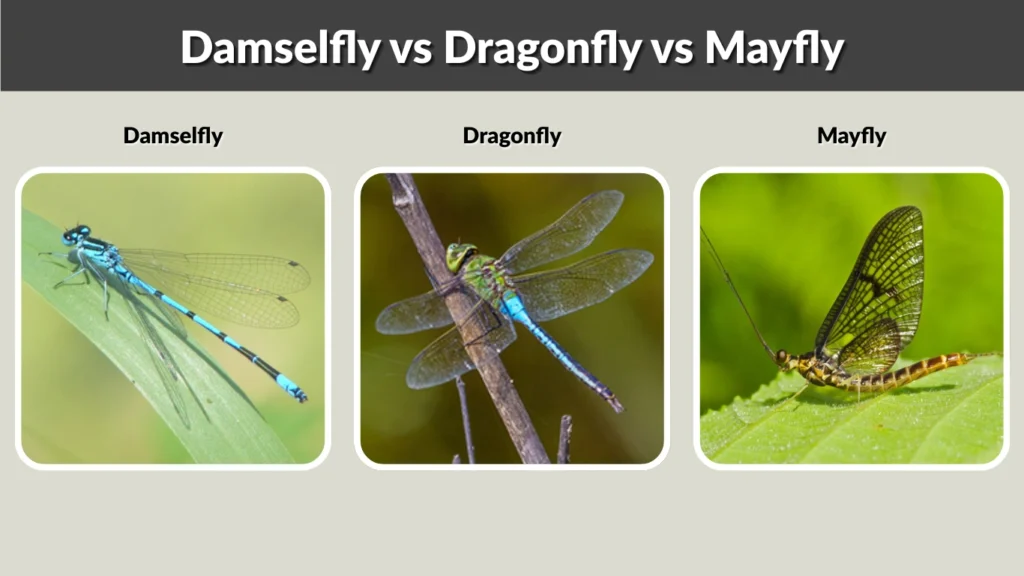
Although mayflies are often mistaken for odonates, they belong to a different insect order. Mayflies have short adult lifespans, often living only one or two days. Their wings are held upright like small sails, and they do not hunt other insects.
Damselflies and dragonflies live much longer as adults and are active predators. Their mouthparts are designed for catching prey, and their flight is stronger and more controlled. Mayflies mainly exist to reproduce, while odonates dominate aerial insect niches.
Dragonfly vs Damselfly vs Darner
A darner is not a separate insect type but a family of dragonflies (Aeshnidae). Darners are among the largest dragonflies, known for powerful, sustained flight and migratory behavior.
When people say “darner vs dragonfly,” they are usually comparing large dragonflies to smaller species. Darners differ from damselflies in every major feature: eye placement, wing posture, body thickness, and flight ability.
Visual Comparison Table
| Feature | Dragonfly | Damselfly |
| Wing position at rest | Open and horizontal | Folded together |
| Eye placement | Touching or nearly touching | Widely separated |
| Body shape | Thick and muscular | Thin and delicate |
| Wing strength | Powerful, unequal wings | Narrow, similar wings |
| Nymph gills | Internal | External tail gills |
| Flight ability | Strong, long-range | Weak, short-range |
| Habitat zone | Open water and airspace | Vegetation edges |
Importance in Nature and to Humans
Damselflies and dragonflies are vital predators that help control mosquitoes and agricultural pests. Because their nymphs are sensitive to pollution, their presence often signals clean water and healthy ecosystems.
They are also popular in wildlife photography, education, and environmental monitoring. Across cultures, dragonflies symbolize strength and speed, while damselflies are often associated with grace, calm, and natural balance.
FAQs
What is the easiest way to tell a damselfly from a dragonfly?
The fastest way is to observe the wings at rest. Dragonflies hold their wings open and flat, while damselflies fold their wings together over their bodies. Eye placement is another reliable sign, since dragonfly eyes almost touch and damselfly eyes are clearly separated.
Are dragonfly nymphs more aggressive than damselfly nymphs?
Dragonfly nymphs are generally larger and more powerful predators. They can capture tadpoles and small fish, while damselfly nymphs usually feed on tiny aquatic insects. Neither is dangerous to humans, but both are important freshwater hunters.
Do damselflies and dragonflies live in the same places?
They often share the same lakes and streams, but they occupy different zones. Dragonflies patrol open water and sunny airspace, while damselflies remain near grasses and shaded vegetation. This separation helps reduce competition between them.
Is a darner a dragonfly or a damselfly?
A darner is a type of dragonfly. It belongs to the family Aeshnidae and is known for large size and strong, continuous flight. Darners are often mistaken for a separate insect, but they are simply a dragonfly subgroup.
Are mayflies closely related to damselflies and dragonflies?
Mayflies are not closely related. They belong to a different insect order and have very short adult lifespans. Unlike dragonflies and damselflies, mayflies do not hunt insects and mainly exist to reproduce.
