

The broad-faced sac spider is a distinctive hunting spider known for its wide, flattened front body and dark, glossy appearance. Unlike web-building spiders, this species actively hunts prey and relies on silk retreats rather than capture webs. It is most often found outdoors in wooded areas but may occasionally wander indoors. Although its appearance can seem intimidating, the broad-faced sac spider is generally shy and avoids human contact. Learning how to identify this spider and understand its habits helps prevent confusion and unnecessary concern.
Broad-Faced Sac Spider Classification and Background
Scientific Classification
The broad-faced sac spider belongs to a group of sac spiders characterized by their active hunting behavior and use of silk shelters instead of webs. These spiders are adapted for ambush and pursuit rather than passive trapping. Their classification reflects evolutionary traits that favor speed, strong front legs, and keen vision over web construction.
Origin of the Common Name
The name “broad-faced sac spider” comes from the spider’s noticeably wide and flattened front body region, particularly around the eyes and mouthparts. This broad facial area gives the spider a unique profile compared to other sac spiders and makes it easier to identify once observed closely.
Broad-Faced Sac Spider Size and Body Structure
Broad-faced sac spiders are medium-sized spiders with a compact, sturdy build. Adults typically measure between 8 and 12 millimeters in body length. Females are usually slightly larger and heavier-bodied than males, though both sexes share similar proportions.
One of the spider’s most distinctive features is its broad cephalothorax, which houses powerful muscles used for fast movement and prey capture. The legs are relatively long and strong, especially the front pair, which are used to grab and restrain prey. This body structure supports an ambush-style hunting strategy rather than prolonged web activity.
Broad-Faced Sac Spider Coloration and Appearance
Broad-faced sac spiders are typically dark brown, reddish-brown, or deep maroon in color. Their bodies often have a smooth, shiny surface that reflects light, making them appear glossy. This darker coloration helps them blend into tree bark, leaf litter, and shaded woodland environments.
Unlike yellow sac spiders, which are pale and translucent, broad-faced sac spiders appear solid and richly colored. The legs may be slightly lighter than the body but usually maintain the same dark tone. Color intensity can vary slightly with age and lighting conditions but remains generally dark.
How to Identify a Broad-Faced Sac Spider
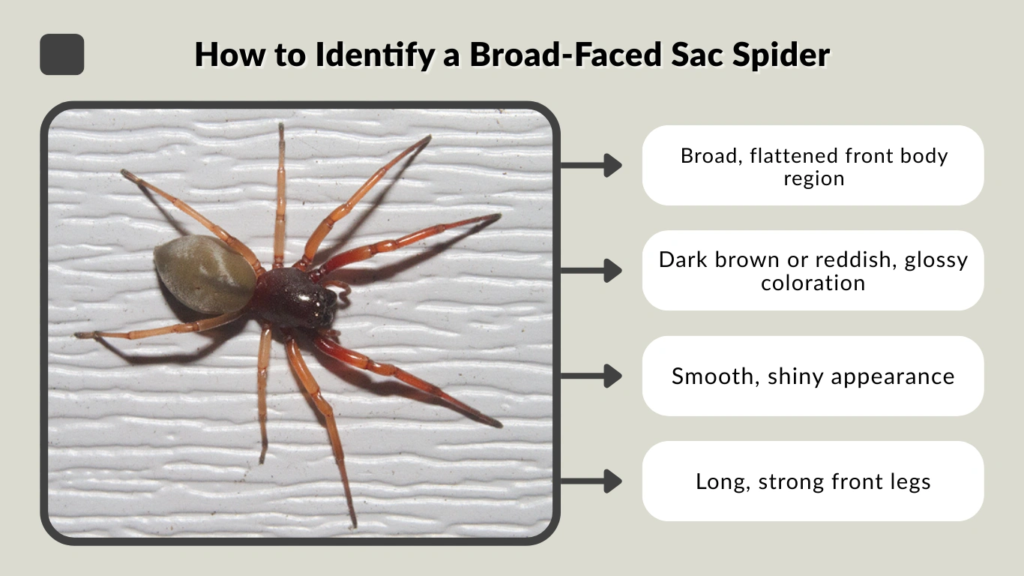
You can identify a broad-faced sac spider by the following characteristics:
- Broad, flattened front body region
- Dark brown or reddish, glossy coloration
- Smooth, shiny appearance
- Long, strong front legs
- Absence of large orb or sheet webs
Broad-Faced Sac Spider Habitat and Range
Typical Living Environments
Broad-faced sac spiders are most commonly found outdoors in wooded habitats. They live under loose bark, within leaf litter, beneath logs, and in crevices on tree trunks. These locations provide shelter, camouflage, and access to insect prey.
Although they prefer natural environments, they may occasionally enter homes, especially those near forests or wooded areas. Indoor encounters are usually accidental rather than permanent infestations.
Geographic Distribution
Broad-faced sac spiders are native to North America and are most commonly encountered in regions with dense vegetation and temperate climates. Their distribution closely follows forested and semi-wooded landscapes, where suitable shelter and prey are readily available.
Broad-Faced Sac Spider Silk and Shelter Use
Rather than building capture webs, the broad-faced sac spider uses silk to create small retreats for resting and hiding. These silk shelters are usually constructed under bark, inside crevices, or beneath debris. The retreat provides protection from predators and environmental exposure during inactive periods.
At night, the spider leaves its shelter to hunt actively. This use of silk as a protective structure rather than a hunting tool distinguishes it from many other common spiders and reflects its active, mobile lifestyle.
Broad-Faced Sac Spider Behavior
Hunting and Activity Patterns
Broad-faced sac spiders are primarily nocturnal hunters. Instead of relying on webs, they actively search for prey along tree trunks, forest floors, and other surfaces. Their strong front legs and quick reflexes allow them to ambush insects at close range. This active hunting style makes them efficient predators in wooded environments.
Resting and Shelter Behavior
During the day, the spider remains hidden inside its silk retreat. These shelters are temporary and may be abandoned or rebuilt as conditions change. The spider relies on concealment rather than defense, which helps it avoid predators and environmental stress.
What the Broad-Faced Sac Spider Eats
Broad-faced sac spiders feed on a variety of small insects and arthropods, including:
- Flies
- Small beetles
- Ants
- Other ground- or tree-dwelling insects
By consuming these insects, they help regulate populations within forest ecosystems.
Broad-Faced Sac Spider Reproduction and Life Cycle
Mating typically occurs during warmer months when adults are most active. After mating, the female produces an egg sac that is placed inside a protected silk retreat. The egg sac is guarded until the spiderlings hatch.
Spiderlings emerge after several weeks and disperse to find their own shelter and food sources. They grow through multiple molts before reaching adulthood. The average lifespan of a broad-faced sac spider is about one year.
Natural Enemies of the Broad-Faced Sac Spider
Despite their stealth and camouflage, broad-faced sac spiders face several natural threats:
- Birds that forage in wooded areas
- Larger spiders
- Parasitic insects
- Environmental hazards such as extreme temperatures
Their preference for hidden retreats helps reduce predation risk.
Broad-Faced Sac Spider and Humans
Broad-faced sac spiders are not aggressive and rarely bite humans. Bites typically occur only if the spider is trapped against the skin. When they do occur, bites may cause mild localized pain, redness, or irritation, but serious reactions are uncommon.
These spiders are generally beneficial, as they help control insect populations. If found indoors, they can be gently relocated outside rather than eliminated.
FAQs
Is the broad-faced sac spider dangerous to humans?
The broad-faced sac spider is not considered dangerous. It is shy and avoids contact with people. Bites are rare and usually cause only mild, localized symptoms that resolve without medical treatment.
How can you identify a broad-faced sac spider?
This spider can be identified by its wide, flattened front body, dark reddish-brown coloration, glossy appearance, and strong front legs. It does not build large webs and is often found in wooded environments.
Where are broad-faced sac spiders most commonly found?
Broad-faced sac spiders are most commonly found in forests, under bark, in leaf litter, and on tree trunks. They may occasionally wander indoors, especially in homes near wooded areas.
Does the broad-faced sac spider build webs?
No, broad-faced sac spiders do not build capture webs. They use silk only to create small shelters for resting and hiding during the day.
What should you do if you find a broad-faced sac spider indoors?
If you find one indoors, gently capture it using a container and release it outside. These spiders are not pests and do not infest homes, so relocation is usually the best option.
