
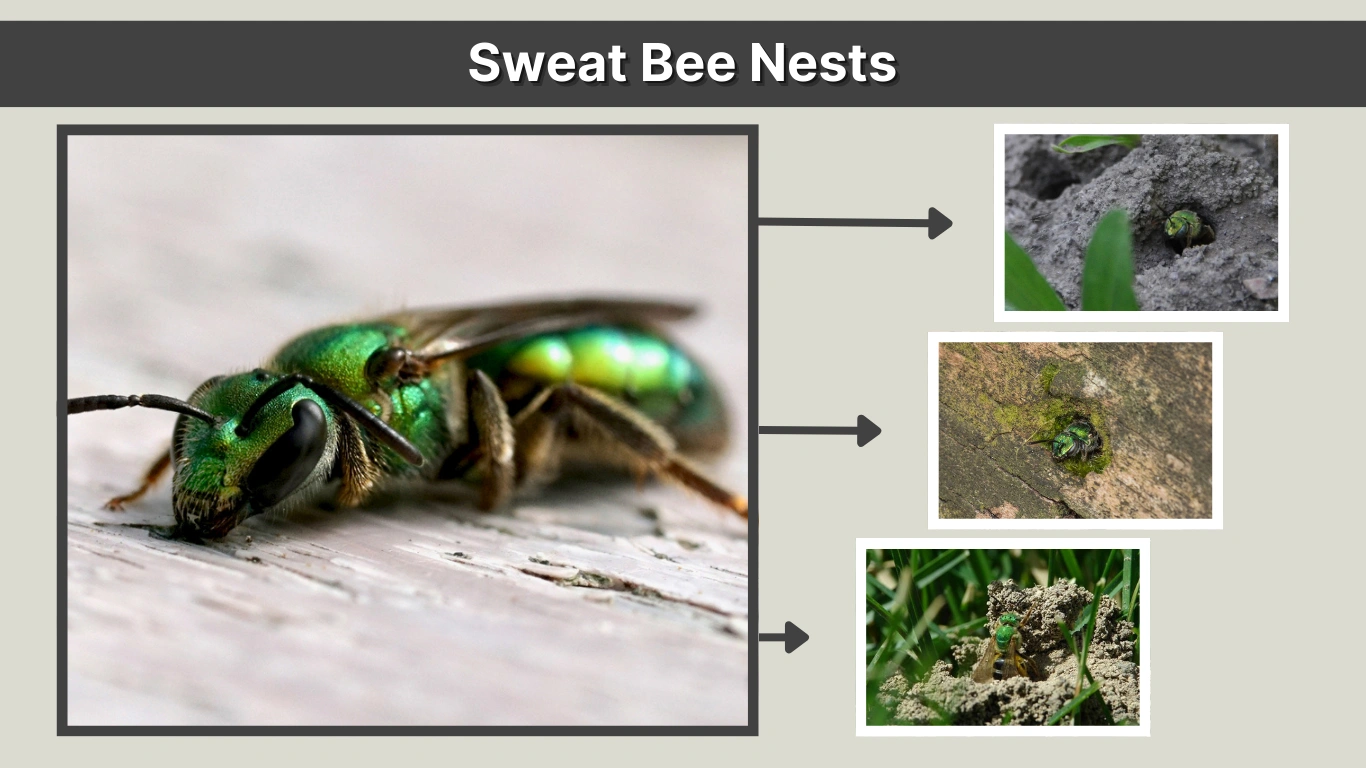
Sweat bees are small, often metallic-colored insects known for their attraction to human sweat and their vital role as pollinators. While many people notice them hovering in gardens or fields, fewer realize that sweat bees also build nests—usually underground. Understanding these nests is key to managing encounters while protecting these beneficial insects. In this guide, we’ll explore where sweat bees nest, what their nests look like, and how to recognize them in your yard.
Do Sweat Bees Build Nests?
General Nesting Behavior
Yes, sweat bees build nests. Unlike honeybees, which live in large colonies, most sweat bee species are solitary or semi-social nesters. This means each female builds and tends her own burrow, though groups of females often create nests close together in favorable soil.
Sweat bees use their mandibles to dig into the ground, creating a system of tunnels. These nests are simple compared to the hives of honeybees but still provide a safe place for eggs, larvae, and food storage.
Species Variations
Different species create slightly different nests:
- Agapostemon sweat bees: Bright metallic green bees often nest communally, with multiple females sharing an entrance but maintaining individual chambers.
- Augochlora sweat bees: Solitary nesters that prefer decayed wood or rotting logs, though some still use soil.
These variations highlight the adaptability of sweat bees to different environments.
Where Do Sweat Bees Nest?
Sweat bee nests are most often found in sunny, dry areas with loose soil. They are less common in shaded, damp zones because their burrows can flood.
Typical nesting locations (List format):
- Underground burrows: The most common type, usually in sandy or compacted soil.
- Lawns and garden beds: Especially in bare patches of soil without heavy grass cover.
- Near houses or sheds: Occasionally, sweat bees nest in cracks or foundations if conditions are right.
- Wild meadows and fields: Open spaces with minimal disturbance make ideal nesting grounds.
For homeowners, spotting these nests in gardens or lawns is common during summer when populations peak.
What Do Sweat Bee Nests Look Like?
Surface Signs
At first glance, a sweat bee nest may look like an ant hill. You’ll often see a small mound of soil with a central hole—about the width of a pencil eraser. This entrance leads underground, where the nest extends in branching tunnels.
Internal Structure
Inside the nest, sweat bees create vertical tunnels with smaller side chambers. Each chamber is provisioned with a ball of pollen and nectar, which serves as food for the developing larvae. Unlike honeybee hives, there is no wax structure; the walls are simply lined soil.
Visual Reference
If you were to look at “sweat bee nest images,” you’d notice they resemble tiny soil volcanoes. Watching bee activity at the entrance—small green or black bees flying in and out—is a clear sign of an active nest.
How Deep Do Sweat Bees Nest in the Ground?
Sweat bee nests vary in depth depending on species and soil conditions. Some are shallow, only a few inches below the surface, while others may extend over a foot into the ground.
- Shallow nests: Often built in compacted lawns where digging is harder.
- Deeper nests: Found in loose, sandy soils where tunneling is easier and safer from flooding.
On average, nests are about 6–12 inches deep, though communal species may dig more elaborate tunnel systems. Depth also helps regulate temperature and protect developing larvae from predators.
How to Find a Sweat Bee Nest
Sweat bee nests can be tricky to locate because they’re small and often blend into the soil. However, there are a few reliable methods to spot them.
Tips for locating nests (List format):
- Follow flight paths: Watch bees during warm afternoons; they often fly low and return repeatedly to the same spot.
- Look for soil mounds: Small conical piles with a central hole are classic nest entrances.
- Check sunny areas: Sweat bees prefer dry, sunny soil over shaded or damp ground.
- Best times to observe: Early morning and late evening, when bees are entering or exiting more frequently.
Identifying nests correctly helps you decide whether to leave them undisturbed or manage them for safety.
Sweat Bee Nesting Behavior
Female Roles
In most species, females are the primary builders and caretakers. They dig burrows, line chambers with secretions to prevent moisture, and provision each cell with pollen and nectar. A single female may manage several chambers at once.
Life Cycle Within the Nest
The nest acts as a secure environment for the entire reproductive cycle:
- Egg laying: Each chamber contains one egg.
- Larvae feeding: Larvae consume the pollen ball provided.
- Pupal stage: Larvae pupate within the chamber.
- Adult emergence: New sweat bees emerge, ready to forage and, eventually, nest themselves.
Unlike honeybee colonies, sweat bee nests are relatively short-lived and usually last just one season.
How to Get Rid of a Sweat Bee Nest Safely
While sweat bee nests are usually harmless, some people prefer to reduce their numbers near play areas, patios, or homes. Eco-friendly approaches are best to avoid harming pollinators.
Safe removal strategies (List format):
- Flood the nest lightly: Pouring water discourages activity but usually doesn’t kill bees.
- Cover bare soil: Mulching or adding sod makes the ground less suitable for nesting.
- Relocate flowers: Move nectar-rich plants farther from patios or play areas.
- Professional help: Pest control specialists can relocate bees safely if nests are numerous.
These methods minimize disruption while still respecting bees’ ecological role.
Dangers and Misconceptions
Sweat bee nests can look intimidating, but in reality, they pose little threat.
- Aggression level: Sweat bees are non-aggressive and sting only when pressed against the skin.
- Sting severity: Their sting is mild, much weaker than wasps or hornets.
- Ecological value: They pollinate wildflowers and crops, making them valuable to ecosystems.
Many homeowners mistake sweat bee nests for wasp colonies. Unlike wasps, sweat bees are gentle and beneficial.
FAQs
What does a sweat bee nest look like?
A sweat bee nest looks like a small mound of soil with a hole in the center. Inside, it contains branching tunnels and cells provisioned with pollen and nectar.
Do sweat bees always nest in the ground?
Most sweat bees nest underground, but some species (like Augochlora) may use rotting wood or logs instead. Ground nests are by far the most common.
How deep are sweat bee nests?
Sweat bee nests usually extend 6–12 inches underground, but depth can vary depending on species, soil type, and weather conditions.
Are sweat bee nests dangerous?
No, sweat bee nests are generally harmless. Bees may sting if directly disturbed, but they are non-aggressive and usually ignore humans.
How can I remove sweat bee nests without pesticides?
Covering soil with mulch, relocating flowers, flooding nests lightly, or calling professionals are safe, pesticide-free ways to discourage sweat bee nests.
