
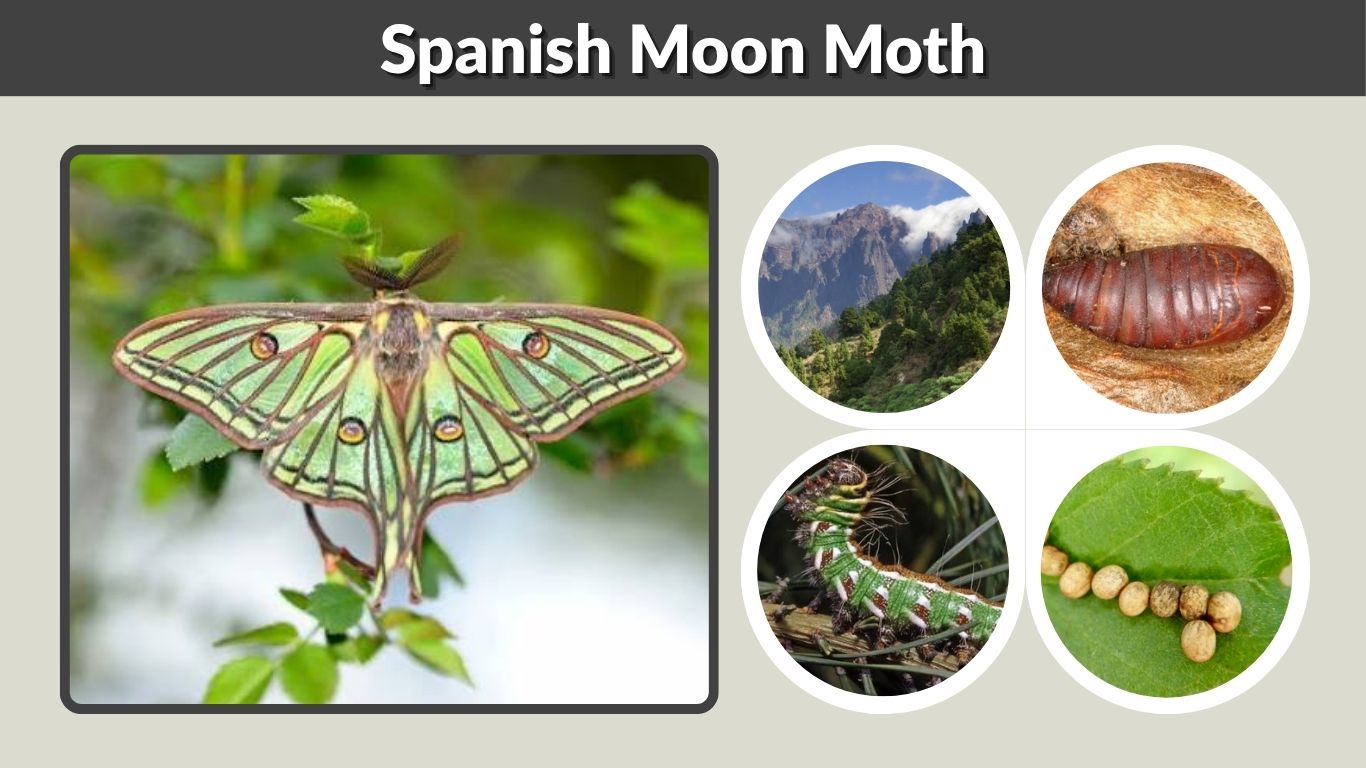
The Spanish moon moth (Graellsia isabellae), also called Isabella’s moon moth, is one of Europe’s most striking silk moths. Its pale green wings, dark veins, long hindwing tails, and prominent eyespots give it an unmistakable appearance. Native mainly to mountainous regions of Spain and parts of France, this rare moth depends heavily on pine forests for survival. This guide covers Spanish moon moth identification, caterpillars, habitat, host plants, size, life cycle, lifespan, males and females, symbolism, and differences from the luna moth.
What Is a Spanish Moon Moth?
The Spanish moon moth belongs to the Saturniidae family, which contains many large silk moths. Its scientific name is Graellsia isabellae. The species is closely associated with pine forests in mountainous parts of southwestern Europe and is admired for its delicate green coloration and unusually long hindwing extensions.
Spanish Moon Moth Identification
Key features include:
- Scientific name: Graellsia isabellae
- Family: Saturniidae
- Wing color: Pale or yellowish green
- Wing veins: Dark and highly visible
- Eyespots: Distinct markings on all four wings
- Hindwings: Long tail-like projections
- Body: Thick and covered with fine hairs
- Activity: Mainly nocturnal
- Overall shape: Broad forewings with elongated hindwing tails
The combination of green wings, strong veins, and long tails makes this species relatively easy to distinguish from most European moths.
Spanish Moon Moth Size
The Spanish moon moth size varies somewhat between individuals and sexes. Adults commonly have a wingspan of roughly 7–10 centimeters.
Females generally have broader bodies because they carry eggs, while males tend to have longer, more exaggerated hindwing tails and strongly feathered antennae.
Spanish Moon Moth Caterpillar
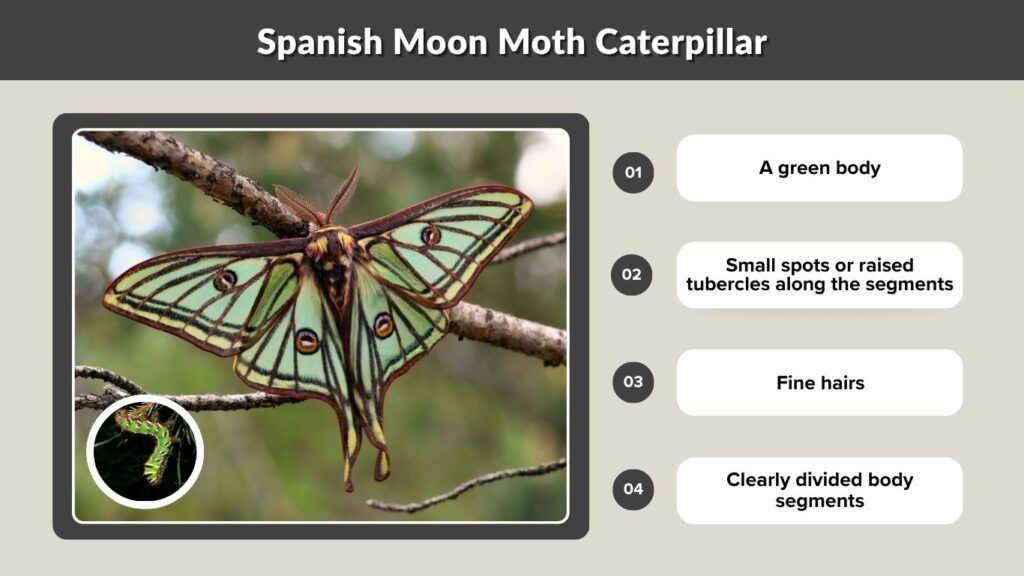
The Spanish moon moth caterpillar is green and well adapted to life among pine needles. Young larvae differ somewhat in appearance from mature caterpillars, changing color and developing more noticeable markings as they progress through several molts.
Its camouflage helps it remain difficult to detect on its host trees.
Caterpillar Identification
A mature caterpillar typically has:
- A green body
- Small spots or raised tubercles along the segments
- Fine hairs
- Clearly divided body segments
- A thick cylindrical shape
- Strong prolegs for gripping pine branches
- Coloration that blends with pine foliage
The green coloration becomes especially useful when caterpillars rest among pine needles.
Is the Caterpillar Dangerous?
Spanish moon moth caterpillars are not generally considered dangerous or medically significant to humans. They do not possess the powerful stinging defenses associated with certain venomous caterpillars.
Even so, unnecessary handling is best avoided. Wild caterpillars can be delicate, and repeated touching may stress or injure them.
Spanish Moon Moth Habitat and Distribution
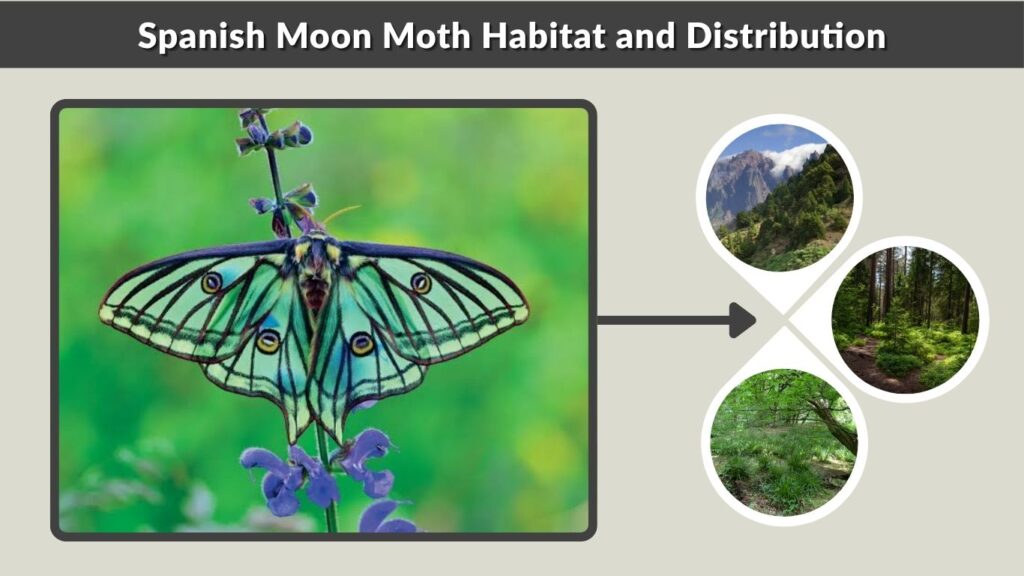
The Spanish moon moth habitat consists mainly of mountainous pine forests. Unlike generalist moths that can use many different landscapes, this species has stronger habitat requirements because its caterpillars depend on particular pine trees for food.
Its limited geographic distribution contributes to its reputation as an unusual and highly sought-after species.
Where Do Spanish Moon Moths Live?
The species is associated primarily with:
- Mountainous regions of Spain
- Parts of the Pyrenees
- Suitable areas of southern France
- Pine forests
- Cool mountain valleys
- Woodland with abundant larval host plants
Populations are often scattered rather than continuously distributed across the landscape.
Spanish Moon Moth Distribution
The Spanish moon moth distribution is considerably more restricted than that of many familiar silk moths. Spain contains important populations, while additional populations occur in neighboring France.
Its range is determined largely by suitable climate, elevation, and the availability of host pines.
Spanish Moon Moth Host Plants and Diet
The Spanish moon moth depends strongly on pine trees during the caterpillar stage. Larvae eat needles and accumulate the energy needed to complete development. Adults, like many silk moths, have reduced mouthparts and generally rely on energy reserves stored during their larval stage.
Spanish Moon Moth Host Plants
Important host plants include several pine species, such as:
- Scots pine
- Black pine
- Maritime pine
- Other suitable regional pines
The exact host used can vary according to geographic location and the trees available within a particular population’s range.
What Do Adult Spanish Moon Moths Eat?
Adult Spanish moon moths generally do not feed significantly. Their adult stage is devoted primarily to reproduction.
The energy required for flying, mating, and egg production comes largely from reserves accumulated when they were caterpillars. This feeding strategy also contributes to their relatively short adult lifespan.
Spanish Moon Moth Life Cycle
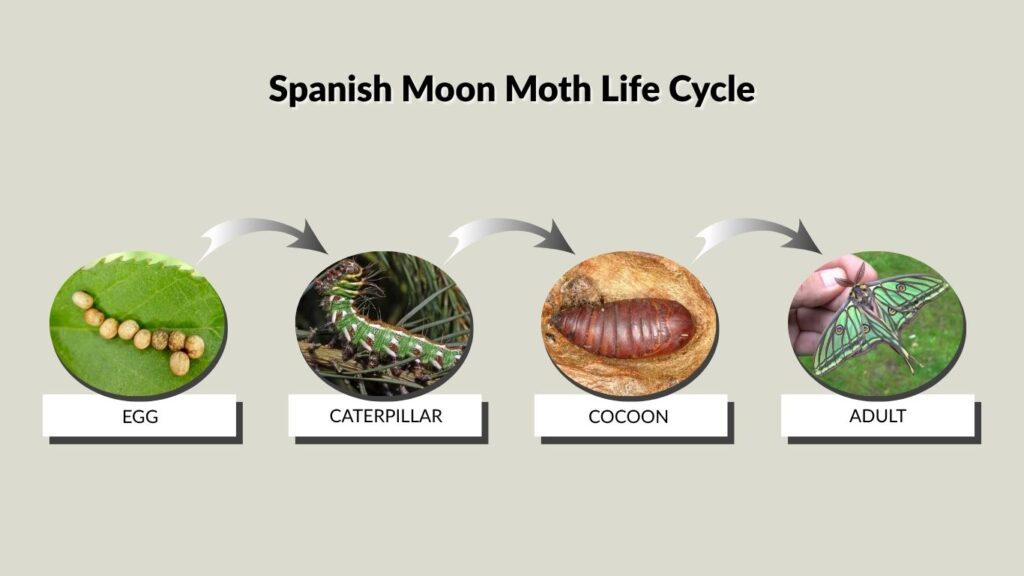
The Spanish moon moth life cycle includes four stages: egg, caterpillar, pupa, and adult. Its annual development is closely connected with seasonal conditions in mountain forests. Caterpillars feed during favorable periods, while the pupal stage provides protection during colder months.
Spanish Moon Moth Eggs
After mating, the female lays eggs on or near suitable pine trees. This placement allows newly emerged caterpillars to reach appropriate food quickly.
The eggs remain attached until development is complete and tiny larvae hatch.
Caterpillar Stage
During the larval stage, caterpillars:
- Feed mainly on pine needles
- Grow through several molts
- Increase substantially in size
- Become progressively greener
- Accumulate energy reserves
- Eventually leave the feeding area to pupate
Most feeding in the moth’s life occurs during this stage.
Cocoon and Pupa
When fully developed, the caterpillar forms a cocoon, usually in a protected location near the ground among vegetation, needles, or leaf litter.
Inside the cocoon, the caterpillar transforms into a pupa. It can spend a lengthy period in this state before the adult emerges when environmental conditions become suitable.
Adult Stage and Lifespan
The adult Spanish moon moth lifespan is relatively short, often lasting only long enough for mating and reproduction.
Males spend much of their adult life searching for females. After mating, females lay eggs and complete the reproductive cycle. Because adults eat little or nothing, they cannot continuously replace the energy they use.
Male vs. Female Spanish Moon Moth
Male and female Spanish moon moths share the same basic coloration and eyespot pattern, but several physical characteristics help distinguish them. These differences are related mainly to how each sex reproduces.
Male and Female Differences
Common differences include:
- Male: Usually more slender
- Female: Larger and heavier-bodied
- Male antennae: Strongly feathered
- Female antennae: Less broadly feathered
- Male hindwing tails: Usually longer
- Female abdomen: Fuller because it contains eggs
Male antennae are especially important because they detect pheromones released by females, helping males locate potential mates at night.
Spanish Moon Moth vs. Luna Moth
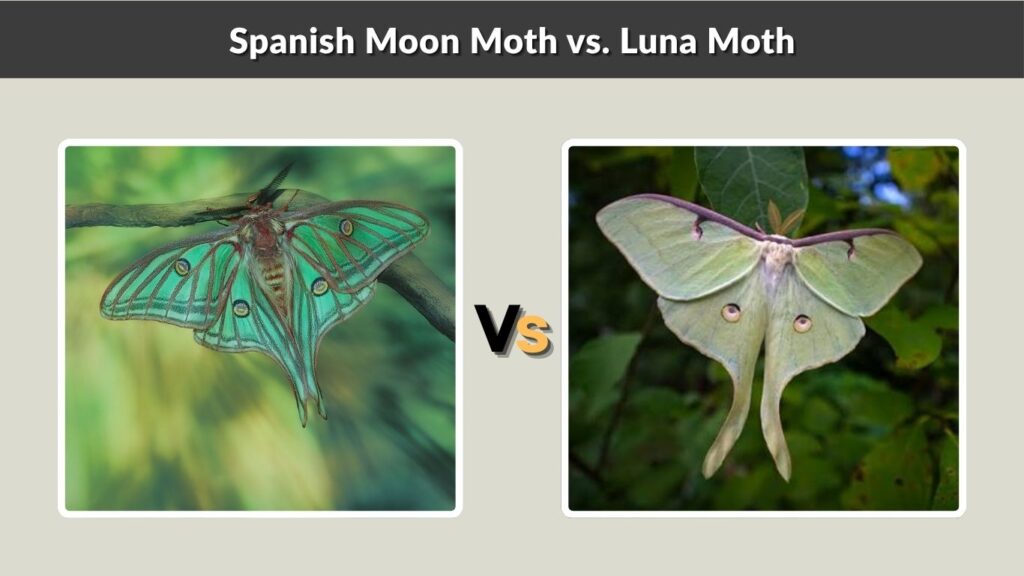
The Spanish moon moth vs. luna moth comparison is common because both species are large, green silk moths with prominent tails. However, they occur in different parts of the world and have several obvious physical differences.
Main Differences
- Spanish moon moth: Native mainly to Spain and parts of France.
- Luna moth: Native to North America.
- Spanish moon moth wings: Strong dark veins and prominent eyespots.
- Luna moth wings: Usually smoother pale-green coloration with less dramatic dark venation.
- Spanish moon moth: Generally has narrower and more sharply patterned wings.
- Luna moth: Usually has broader wings with different eyespot patterns.
- Scientific name: Spanish moon moth is Graellsia isabellae; luna moth is Actias luna.
Although their appearance is similar, they belong to different genera.
Spanish Moon Moth Hybrids
Interest in a Spanish moon moth hybrid often comes from moth-rearing communities. Hybridization is sometimes attempted between related silk moth species under controlled captive conditions.
Can Spanish and Chinese Moon Moths Hybridize?
A Chinese Spanish moon moth hybrid may be discussed among specialist breeders because different moon moths share certain biological similarities. However, successful hybridization depends on genetic compatibility and controlled breeding conditions.
Hybrids should not be released into the wild. Introducing captive or genetically mixed moths could create ecological problems or interfere with naturally occurring populations.
Spanish Moon Moth Meaning and Symbolism
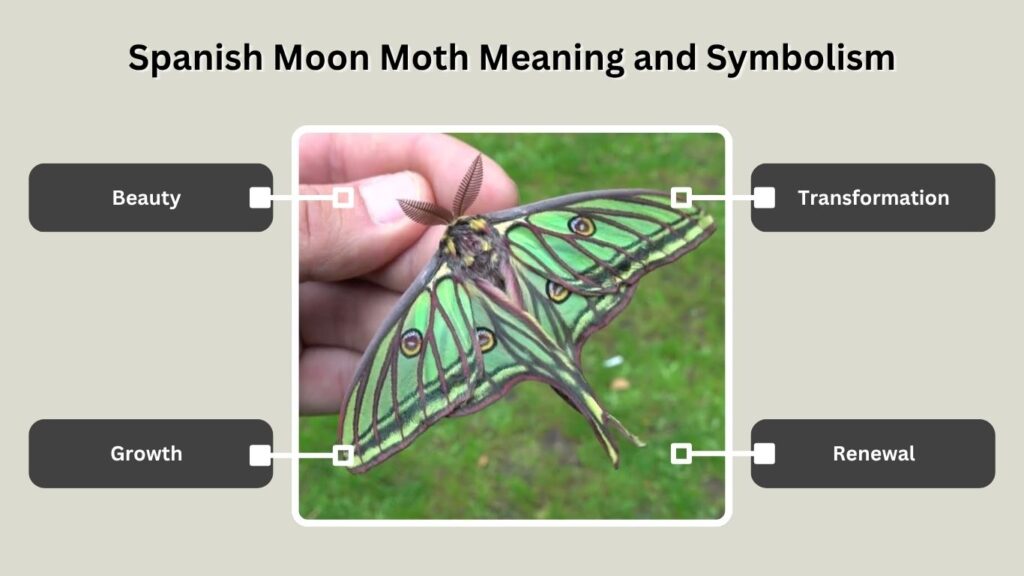
The Spanish moon moth meaning is often associated with the broader symbolism of moths rather than a single traditional interpretation. Its dramatic transformation and short adult life make it especially attractive as a symbol of change.
Common Symbolic Associations
People may associate the Spanish moon moth with:
- Transformation
- Renewal
- Beauty
- Growth
- Impermanence
- Mystery
- Adaptation
These meanings are cultural and personal interpretations rather than scientific qualities of the species.
FAQs
1. Where is the Spanish moon moth found?
The Spanish moon moth occurs mainly in mountainous areas of Spain and parts of southern France, particularly where suitable pine forests are available.
2. What does a Spanish moon moth caterpillar eat?
Its caterpillars primarily eat pine needles. Several pine species can serve as host plants depending on the region.
3. How big is a Spanish moon moth?
Adults commonly have a wingspan of approximately 7–10 centimeters, although individual size varies.
4. Is a Spanish moon moth the same as a luna moth?
No. The Spanish moon moth is Graellsia isabellae and occurs in Europe, while the luna moth is Actias luna and is native to North America.
5. How long does a Spanish moon moth live?
Most of its life is spent developing as an egg, caterpillar, or pupa. The adult stage is relatively short because adults generally do not feed and focus primarily on reproduction.
