
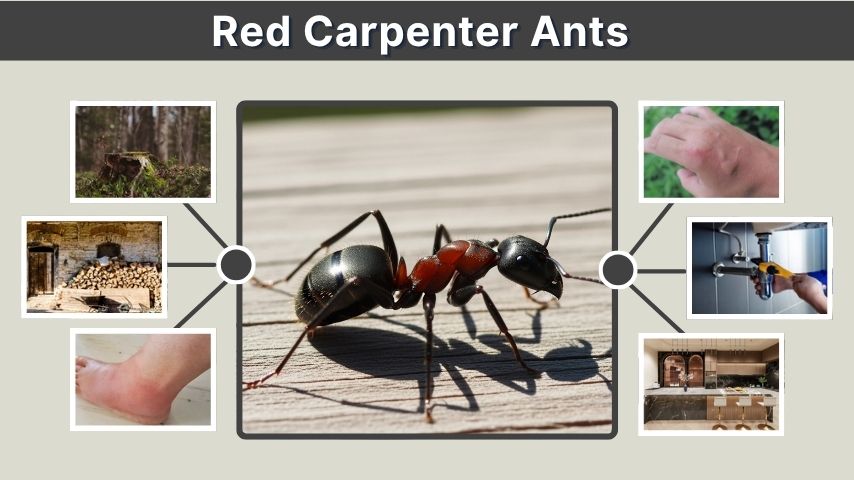
Red carpenter ants are one of the most commonly misunderstood household and outdoor ants. Many homeowners panic when they see large red or red-and-black ants, assuming they are fire ants or signs of severe infestation. In reality, red carpenter ants are part of a broader group of carpenter ants that can vary in color, behavior, and nesting habits depending on species and region.
Understanding how to identify red carpenter ants, whether they are dangerous, and how to eliminate them is key to protecting your home and avoiding unnecessary pesticide use.
What Are Red Carpenter Ants?
Red carpenter ants are a color variation of carpenter ants that may appear reddish, reddish-black, or even a mix of red head and black body segments. These ants belong to the genus Camponotus, a large group of ants known for nesting in wood.
Despite their name, carpenter ants do not eat wood. Instead, they excavate it to build tunnels and galleries for nesting. This behavior can lead to structural damage if colonies are left untreated in homes or buildings.
Red carpenter ants are often found in wooded areas, damp environments, and structures with moisture issues. Their color can vary significantly, which is why people often confuse them with fire ants or other red ant species.
Are Carpenter Ants Red or Black?
One of the most common questions is whether carpenter ants are red or black. The answer is: they can be both.
Carpenter ants come in several color variations depending on species:
- Solid black carpenter ants
- Red and black carpenter ants
- Dark brown carpenter ants
- Large red carpenter ants in some regions
Red coloration is often seen in specific species or in certain castes within a colony. For example, workers may appear darker, while queens or certain workers may show more reddish tones.
This variation leads to confusion when people try to identify infestations based only on color.
Red and Black Carpenter Ants
Red and black carpenter ants are among the most commonly reported household varieties. These ants often have:
- A red head or thorax
- A black abdomen
- Large body size compared to common ants
- Strong mandibles for chewing wood
- Slow, deliberate movement compared to fire ants
Unlike fire ants, which are aggressive and sting repeatedly, carpenter ants are generally less aggressive. They will bite if threatened, but they do not swarm or attack in large numbers.
The presence of red and black carpenter ants inside a home usually indicates moisture problems or nearby outdoor nesting sites.
Red Carpenter Ant Size
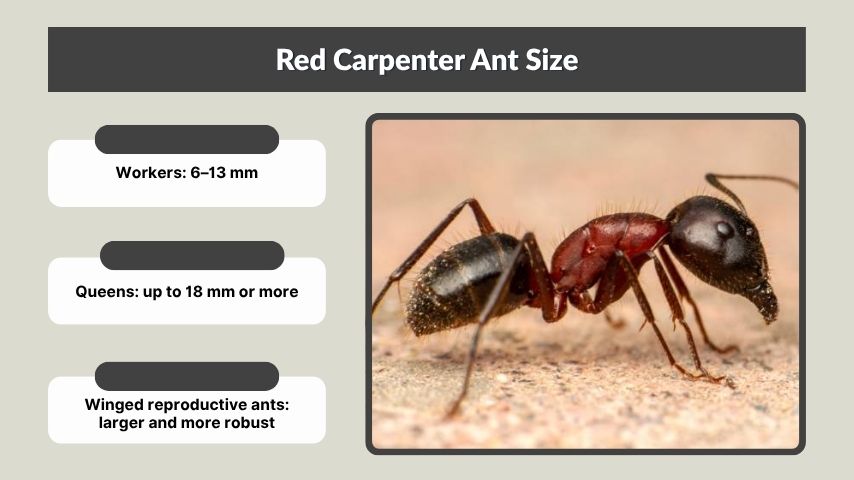
Red carpenter ants are typically large compared to other household ants. Their size often makes them more noticeable and concerning to homeowners.
Typical size range:
- Workers: 6–13 mm
- Queens: up to 18 mm or more
- Winged reproductive ants: larger and more robust
Because of their size, they are sometimes mistaken for “giant ants” or even termites at first glance. However, termites have straight antennae and uniform bodies, while carpenter ants have elbowed antennae and a narrow waist.
Queen Red Carpenter Ant
The queen red carpenter ant plays a central role in the colony. She is responsible for reproduction and can live for many years under the right conditions.
Key features of a queen:
- Largest ant in the colony
- May be winged during mating phase
- Loses wings after mating
- Found deep inside nesting chambers
- Can produce thousands of eggs over her lifetime
A mature carpenter ant colony may contain one or multiple queens depending on species. This is one reason infestations can grow quickly if not controlled early.
Winged and Flying Red Carpenter Ants
Winged red carpenter ants are reproductive ants that appear during mating season. They are often mistaken for termites because both species produce winged swarmers.
However, there are clear differences:
- Carpenter ants have uneven wing sizes (front wings longer than back wings)
- Termites have equal-length wings
- Carpenter ants have narrow waists
- Termites have thick, uniform bodies
Flying ants indoors often indicate a mature colony nearby. If you see winged carpenter ants inside your home, it is a strong sign that a nest may already be established in walls, ceilings, or nearby wood structures.
Are Red Carpenter Ants Dangerous?
Red carpenter ants are not considered dangerous in the same way as fire ants or venomous pests. They do not spread disease and do not attack humans aggressively.
However, they can still cause problems:
- Structural damage to wood over time
- Moisture-related infestation issues
- Occasional bites when handled
- Indication of hidden leaks or decay
Carpenter ants bite using strong mandibles. A bite may cause mild pain or temporary irritation, but they do not sting or inject venom like fire ants.
Do Red Carpenter Ants Bite?
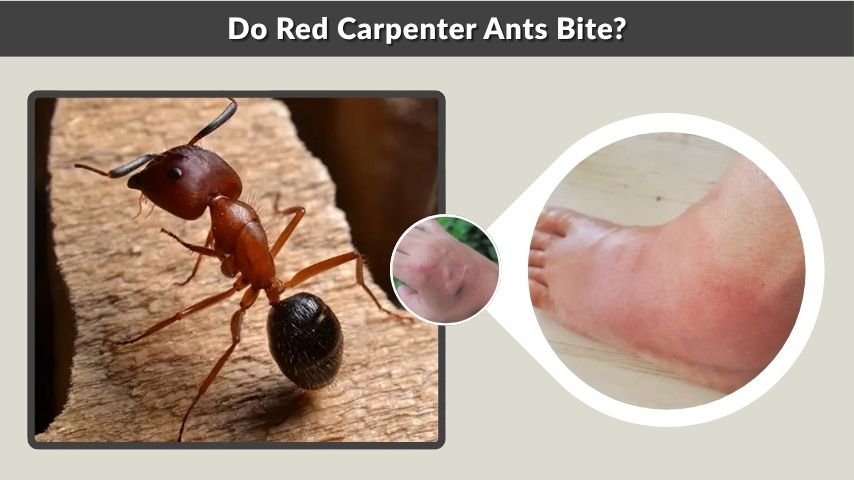
Yes, red carpenter ants can bite, but they rarely do so unless provoked.
A bite may feel like:
- Sharp pinch
- Mild burning sensation
- Temporary redness
- Minor swelling
They do not chase humans or attack in groups. Bites usually occur when someone disturbs a nest or accidentally traps an ant against the skin.
Red Carpenter Ants vs Fire Ants
One of the most important distinctions homeowners need to understand is the difference between red carpenter ants and fire ants.
Red Carpenter Ants:
- Large size
- Slow movement
- Do not sting
- Nest in wood
- Usually solitary or small groups
Fire Ants:
- Smaller size
- Aggressive behavior
- Sting repeatedly
- Build soil mounds
- Swarm when disturbed
Fire ants are far more aggressive and medically significant. Carpenter ants are more of a structural pest than a direct health threat.
Red Ants vs Carpenter Ants
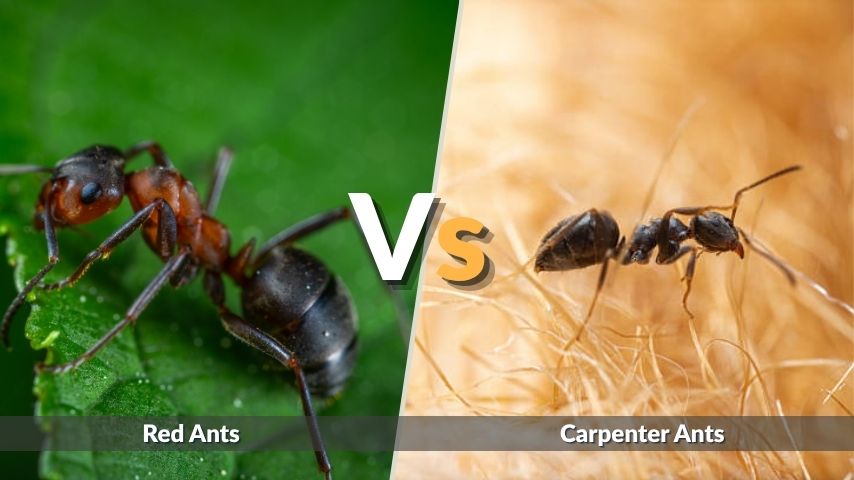
Not all red ants are carpenter ants. Many species of ants appear red, including pavement ants, fire ants, and acrobat ants.
Key differences:
- Carpenter ants are larger
- Carpenter ants nest in wood
- Many red ants nest in soil
- Carpenter ants are less aggressive
Correct identification is essential before choosing treatment methods.
Red Carpenter Ant Habitat
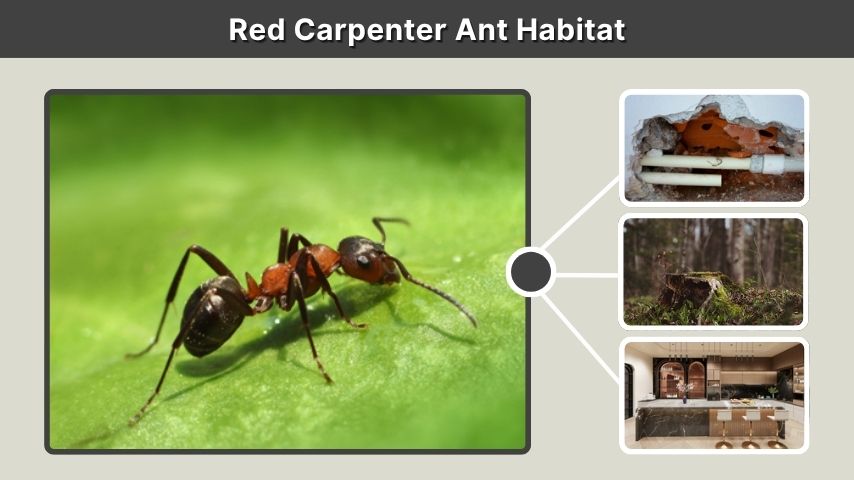
Red carpenter ants prefer moist environments. Common locations include:
- Damp wood inside homes
- Wall voids near leaks
- Bathrooms and kitchens
- Tree stumps and logs
- Firewood piles
- Wooden decks and fences
- Roof leaks or attic spaces
They are especially active in areas with water damage or high humidity.
In regions like Texas, Florida, and the southern United States, carpenter ants are more common due to warm and humid conditions that support wood decay.
How to Get Rid of Red Carpenter Ants
Eliminating red carpenter ants requires a combination of locating the nest, removing moisture, and applying targeted treatment.
Step 1: Locate the Nest
Finding the nest is the most important step. Look for:
- Sawdust-like material (frass)
- Ant trails along walls or baseboards
- Rustling sounds in walls
- Winged ants indoors
- Damp or damaged wood
Carpenter ants often have both a main nest outdoors and satellite nests indoors.
Step 2: Remove Moisture Sources
Moisture is the main factor attracting carpenter ants.
Fix:
- Leaky pipes
- Roof leaks
- Poor ventilation
- Damp crawl spaces
- Rotting wood
Without moisture control, ants are likely to return.
Step 3: Use Carpenter Ant Bait
Bait is one of the most effective control methods.
How it works:
- Worker ants carry bait back to colony
- Colony members share the bait
- Queen and nest eventually die off
Avoid spraying insecticides near bait, as it may prevent ants from taking it.
Step 4: Treat Nest Directly
If the nest is found:
- Use labeled insecticidal dust or foam
- Treat wall voids or wood galleries
- Remove infested wood if necessary
- Repeat treatment if activity continues
Severe infestations may require professional pest control.
Step 5: Seal Entry Points
Prevent reinfestation by sealing:
- Cracks in walls
- Gaps around windows and doors
- Utility pipe openings
- Foundation cracks
How Many Red Carpenter Ants Are in a Colony
A single red carpenter ant colony can range from a few thousand ants to over 50,000 individuals depending on maturity.
A colony may include:
- One or multiple queens
- Worker ants
- Soldier ants
- Winged reproductive ants
Large colonies may also create satellite nests, making control more complex.
Red Carpenter Ants by Region
Red carpenter ants are found across many parts of the United States, including:
- Texas (humid structural infestations common)
- Florida (high moisture and wood decay environments)
- Michigan (outdoor nests and seasonal indoor activity)
- New Jersey and northeastern states
- Southern wooded regions nationwide
Their activity level often increases during warm, humid months.
Prevention Tips
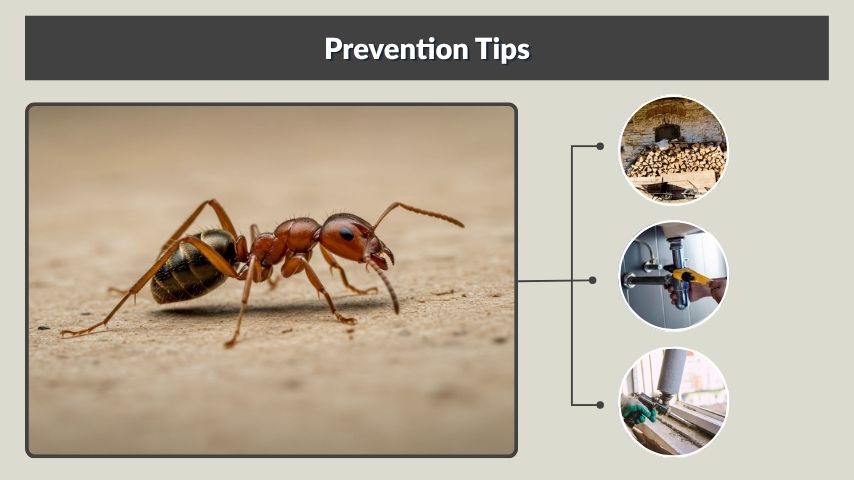
To prevent red carpenter ants:
- Keep wood dry and sealed
- Remove rotting stumps and logs
- Store firewood away from home
- Fix leaks quickly
- Improve ventilation in damp areas
- Trim vegetation away from house
- Seal cracks and openings
Prevention is more effective than treatment because carpenter ants often return if conditions remain favorable.
FAQs
Are red carpenter ants dangerous to homes?
Yes, over time they can damage wood structures by tunneling through damp or softened wood. While they do not eat wood, their nesting behavior can weaken structural integrity if left untreated.
Why do I see red carpenter ants in my house?
They are usually attracted by moisture, leaks, or decaying wood. They may also be foraging indoors from an outdoor nest nearby.
Do red carpenter ants sting like fire ants?
No, they do not sting. They can bite, but their bite is mild compared to fire ants, which sting repeatedly and aggressively.
What kills red carpenter ants the fastest?
Direct nest treatment combined with baiting is most effective. However, eliminating moisture sources is essential to prevent return infestations.
Can red carpenter ants go away on their own?
No. If a nest is inside or near your home, the colony will persist until the source is removed or professionally treated.
