

Carpenter bees (Xylocopa species) are large, buzzing insects often mistaken for bumblebees. Unlike honeybees or wasps, they are solitary wood-nesting pollinators. One of the most common questions homeowners ask is how to tell the difference between male and female carpenter bees. Knowing this matters because only females can sting, while males, though intimidating, are harmless. Let’s break down the key traits that distinguish them.
Male vs. Female Carpenter Bees – Key Differences

At a glance, male and female carpenter bees look similar. However, there are distinct differences in markings, size, behavior, and stinging ability.
Comparison Table: Male vs. Female Carpenter Bees
| Feature | Male Carpenter Bee | Female Carpenter Bee |
| Face Marking | White/yellow patch on face | Entirely black face |
| Stinger | No stinger | Has stinger |
| Aggression | Buzzes defensively but harmless | Can sting if provoked |
| Nesting Behavior | Guards outside nest | Drills holes & provisions nest |
| Size | Slightly smaller, slimmer build | Larger, more robust body |
This quick overview highlights the most important point: only female carpenter bees can sting, while males rely on bluffing behaviors like hovering to ward off threats.
How to Tell Male and Female Carpenter Bees Apart
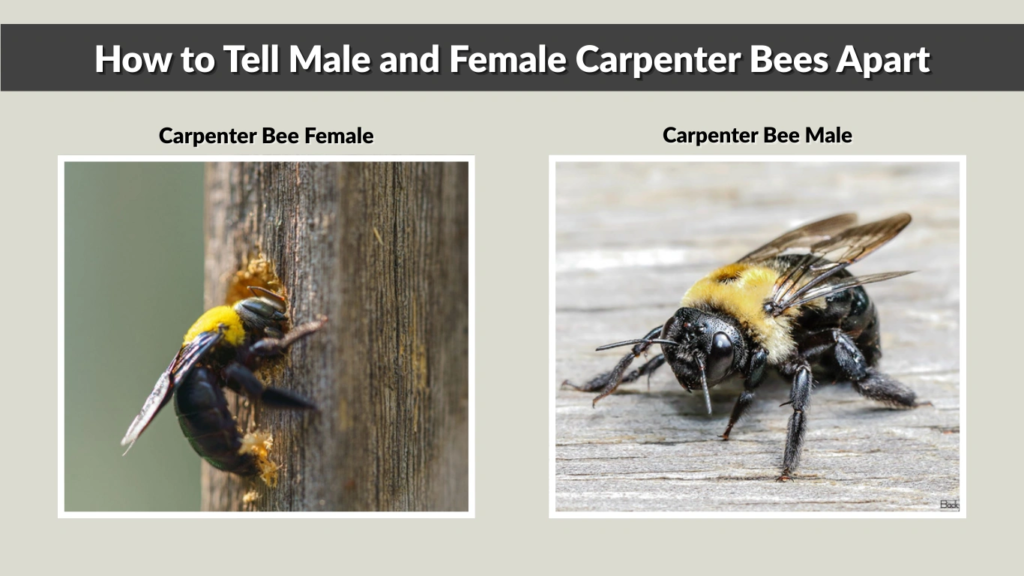
Distinguishing male and female carpenter bees isn’t difficult once you know what to look for. Identification can be made through both physical traits and behavioral patterns.
Physical Identification
Visual cues for telling the difference (List format):
- Face markings:
- Male: noticeable white or yellow patch on the face.
- Female: completely black face.
- Male: noticeable white or yellow patch on the face.
- Body size:
- Female carpenter bees are bulkier and stronger, adapted for drilling into wood.
- Males are slightly smaller and slimmer.
- Female carpenter bees are bulkier and stronger, adapted for drilling into wood.
- Color differences by species:
- Valley carpenter bee (Xylocopa varipuncta): males are golden-brown, females are shiny black.
- Eastern carpenter bee (Xylocopa virginica): males have yellow face patches, females remain dark-faced.
- Valley carpenter bee (Xylocopa varipuncta): males are golden-brown, females are shiny black.
Behavioral Identification
Behavior is another clue for spotting differences between male and female carpenter bees.
- Male carpenter bees:
- Often hover near people or around nest entrances.
- Appear aggressive but cannot sting.
- Often hover near people or around nest entrances.
- Female carpenter bees:
- Usually less visible, busy drilling into wood or tending nests.
- Will sting if directly threatened or handled.
- Usually less visible, busy drilling into wood or tending nests.
These distinctions make identification easier for homeowners dealing with carpenter bees around porches, decks, or garden structures.
Do Female Carpenter Bees Sting?

Female Carpenter Bee Stinger
Female carpenter bees are equipped with stingers, but they are not aggressive by nature. Unlike wasps, which sting repeatedly, females sting only when directly threatened or handled. If left undisturbed, they focus on nesting and foraging rather than defending.
Male Carpenter Bees and Stinging
Male carpenter bees, despite their bold hovering, do not have stingers at all. Their defensive behavior is a bluff meant to deter potential predators or humans from approaching the nest. This is why buzzing males often seem more aggressive than females, but they pose no real danger.
Nesting Roles – Male vs. Female
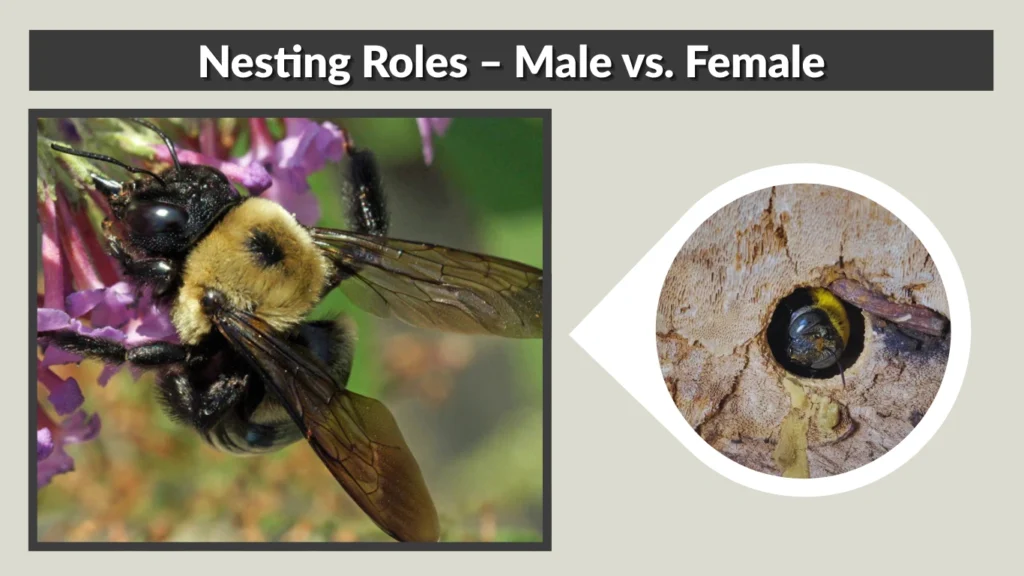
Carpenter bees are solitary nesters, but males and females take on very different roles.
Female Roles
- Drill perfectly round holes into wood surfaces such as fences, eaves, or decks.
- Construct tunnel systems where eggs are laid in separate chambers.
- Provision each chamber with pollen and nectar balls as food for larvae.
- Seal chambers with chewed wood pulp.
Male Roles
- Hover outside the nest entrance, acting as guards.
- Chase away other insects and even humans, though harmless.
- Do not participate in drilling or provisioning but play a defensive role.
This division of labor makes females the builders and caretakers, while males are watchful sentinels.
Eastern and Valley Carpenter Bees – Male vs. Female

The difference between males and females becomes even clearer when comparing specific species.
- Eastern Carpenter Bee (Xylocopa virginica)
- Male: yellow patch on face, slim build.
- Female: black face, larger and stronger, drills holes in wood.
- Male: yellow patch on face, slim build.
- Valley Carpenter Bee (Xylocopa varipuncta)
- Male: covered in golden-brown fuzz, giving a teddy-bear appearance.
- Female: shiny, solid black body, known for wood-drilling activity.
- Male: covered in golden-brown fuzz, giving a teddy-bear appearance.
These regional variations are helpful for quick identification.
Aggression and Behavior Differences
Despite their size and loud buzzing, carpenter bees are not dangerous compared to wasps. Their behavior reflects their gender roles.
Behavior distinctions (List format):
- Male carpenter bees:
- Hover near humans and intruders.
- Loud buzzing is meant to intimidate.
- Cannot sting.
- Hover near humans and intruders.
- Female carpenter bees:
- Focus on drilling and nesting.
- Rarely interact with humans unless provoked.
- Possess a stinger, but seldom use it.
- Focus on drilling and nesting.
Overall, carpenter bees are more of a nuisance to wood structures than to people.
FAQs
What’s the main difference between male and female carpenter bees?
Males have a white or yellow patch on their face and cannot sting. Females have a black face, are larger, and have stingers.
Do male or female carpenter bees drill holes?
Only female carpenter bees drill into wood to create nests. Males guard the nest entrance but do not drill or provide food.
Can female carpenter bees sting humans?
Yes, female carpenter bees can sting, but only if provoked. They are generally non-aggressive and prefer to avoid contact.
Do male carpenter bees guard nests?
Yes, males hover aggressively near nests to protect them. However, this is just a bluff because they lack stingers.
How do I tell male and female carpenter bees apart?
Look at the face color: males have a white or yellow patch, while females have a solid black face. Females are also bulkier and more robust.
