
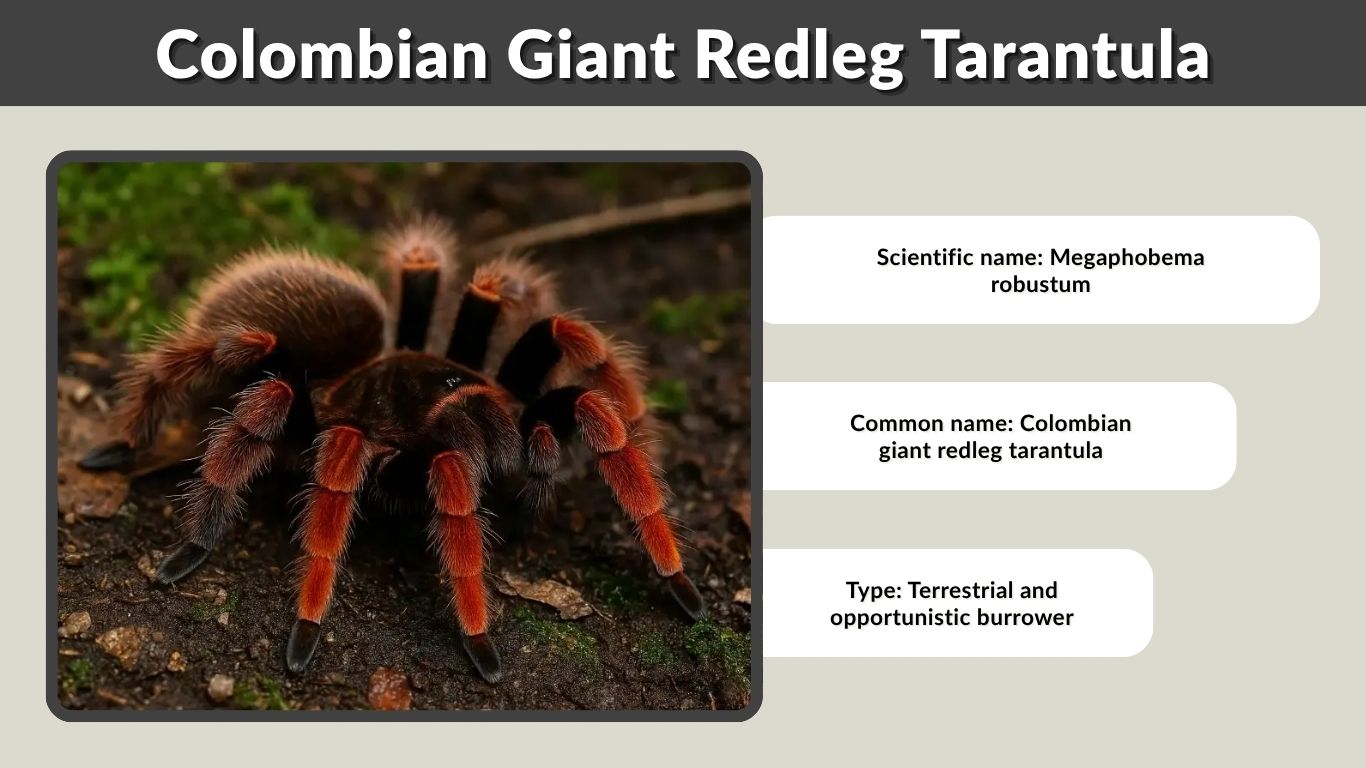
The Colombian giant redleg tarantula is a striking New World species known for its large size, orange-red legs, dark body, and unusual defensive behavior. Scientifically called Megaphobema robustum, this terrestrial tarantula comes from Colombia and is popular among experienced keepers who enjoy large display species. Proper Colombian giant redleg tarantula care depends on deep substrate, moderate warmth, suitable moisture, good ventilation, and minimal handling. This guide covers its size, lifespan, humidity, misting, feeding, enclosure setup, temperament, and what to consider when looking for one for sale.
What Is a Colombian Giant Redleg Tarantula?
The Colombian giant redleg is a large terrestrial tarantula in the family Theraphosidae. Its accepted scientific name is Megaphobema robustum, and the World Spider Catalog records the species from Colombia. It is the type species of the genus Megaphobema. Although impressive in appearance, this spider is better regarded as a display animal than a tarantula intended for frequent handling.
Identification
A Colombian giant redleg can usually be recognized by several characteristics:
- Scientific name: Megaphobema robustum
- Common name: Colombian giant redleg tarantula
- Family: Theraphosidae
- Type: Terrestrial and opportunistic burrower
- Origin: Colombia
- Legs: Orange, rust-red, or salmon-colored sections
- Body: Dark brown to nearly black
- Rear legs: Strong and noticeably thick
- Adult leg span: Commonly around 6–8 inches
- Urticating hairs: Present
Its contrasting dark body and colorful legs make mature specimens particularly distinctive.
Scientific Name: Megaphobema robustum
The name Megaphobema robustum is important because common names can vary between sellers and regions. Older literature may contain different combinations of the scientific name, including Lasiodora robusta, but Megaphobema robustum is currently accepted by the World Spider Catalog.
Natural Range and Habitat
This species is native to Colombia, where it is associated with humid terrestrial habitats. In captivity, that background is best reproduced through moisture-retaining substrate and access to a sheltered retreat rather than by keeping the entire enclosure constantly wet.
Deep substrate is especially useful because the spider may dig or expand the provided hide.
Colombian Giant Redleg Tarantula Size and Lifespan
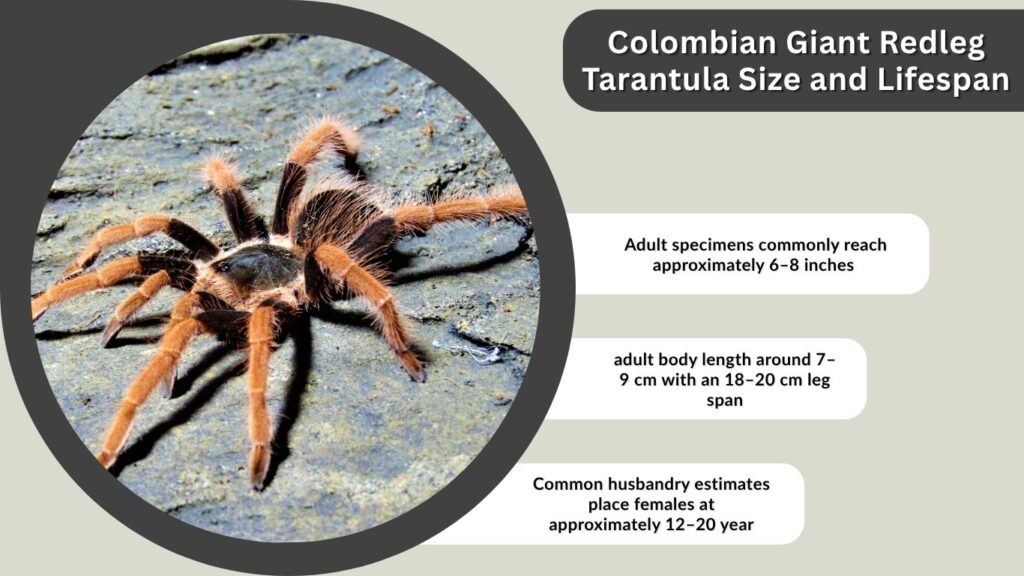
Despite its “giant” name, Megaphobema robustum is not among the absolute largest tarantulas in the world. It is still a substantial species, however, with a broad appearance and impressive leg span. Growth depends on sex, temperature, feeding, and individual variation, while females generally survive dramatically longer than mature males.
Colombian Giant Redleg Tarantula Size
Adult specimens commonly reach approximately 6–8 inches (15–20 cm) in diagonal leg span, although individual measurements vary. Herpeton Academy gives an adult body length around 7–9 cm with an 18–20 cm leg span, while other husbandry references place adults within roughly the same range.
Females generally develop a heavier, more robust appearance. Mature males tend to be slimmer and leggier.
Colombian Giant Redleg Tarantula Lifespan
Female Colombian giant redlegs can be extremely long-lived pets. Common husbandry estimates place females at approximately 12–20 years, with some sources suggesting 15–20 years or more under good captive conditions.
Males have considerably shorter lives. Estimates commonly fall around 3–6 years, especially because males usually live only a limited period after reaching maturity.
Growth and Molting
Growth is generally considered moderate. Younger tarantulas molt more frequently than adults, and warmer conditions combined with regular feeding may speed development.
Before molting, a tarantula may refuse food, become less active, and spend more time inside its retreat. Never disturb or feed a spider while it is actively molting. Remove uneaten insects so they cannot injure a vulnerable freshly molted tarantula.
Colombian Giant Redleg Tarantula Care
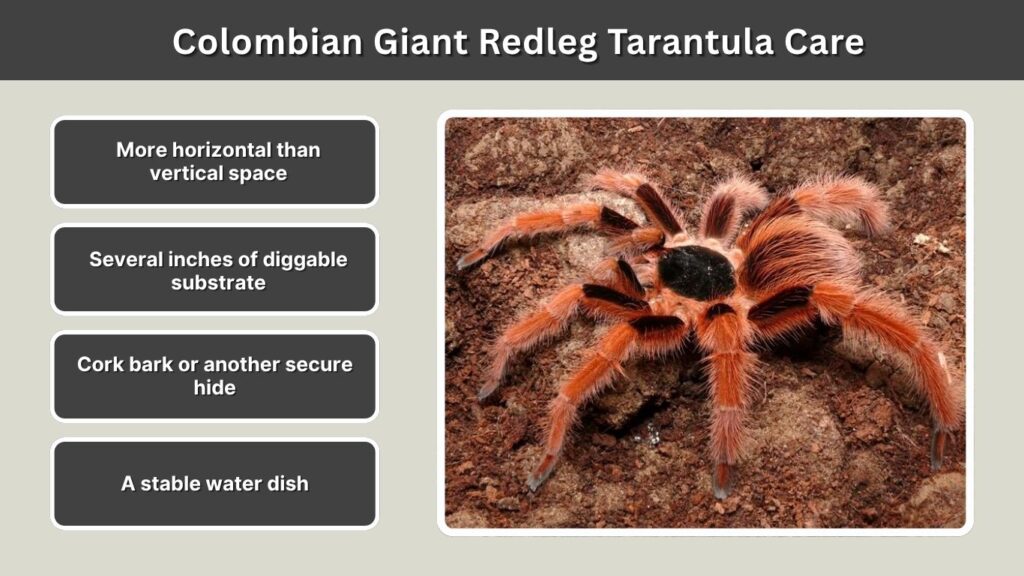
Successful Colombian giant relief care centers on providing space at ground level, deep substrate, a secure hiding location, fresh water, and an appropriate moisture gradient. The enclosure should never become swampy or poorly ventilated. Because this species can grow quite large and may react defensively when disturbed, enclosure design should also make routine maintenance possible without unnecessary interaction.
Enclosure Essentials
For juveniles and adults, include:
- More horizontal than vertical space
- Several inches of diggable substrate
- Cork bark or another secure hide
- A stable water dish
- Good cross-ventilation
- Secure, escape-resistant lid
- Limited climbing height
- Moist lower substrate with some drier surface areas
A deep substrate layer of roughly 4–6 inches is commonly recommended for larger specimens because M. robustum may burrow. Keeping excessive empty vertical space above the substrate is undesirable because a fall can injure a heavy-bodied terrestrial tarantula.
Temperature and Humidity
A reasonable captive temperature range is approximately 72–80°F (22–27°C), although slightly warmer conditions are used successfully by some keepers.
Humidity recommendations commonly fall around 65–80% or 70–80%. However, chasing an exact hygrometer reading is less useful than maintaining an appropriate moisture gradient.
Keep the lower substrate slightly moist while allowing parts of the surface to become less damp. Ventilation is essential because permanently soaked substrate combined with stagnant air encourages mold and other enclosure problems.
Colombian Giant Redleg Misting
Heavy daily misting is usually unnecessary. Spraying frequently wets the surface while doing little to establish lasting moisture deeper in the substrate.
A more effective method is to occasionally pour a small amount of water into one section of the substrate, allowing moisture to move downward while leaving another area comparatively dry.
Keep a clean water dish available. If condensation constantly covers the enclosure walls or the substrate develops widespread mold, reduce moisture and improve ventilation.
Feeding
Colombian giant redlegs can eat appropriately sized feeder insects such as crickets and roaches. Juveniles usually receive smaller meals more frequently, whereas large adults can be fed less often.
Avoid excessive feeding simply to accelerate growth. A heavily overfed terrestrial tarantula may develop an oversized abdomen, which can increase the consequences of a fall.
Remove prey that remains uneaten, particularly when the spider appears to be entering premolt.
Temperament and Defensive Behavior
The Colombian giant redleg is visually impressive but can be more defensive and unpredictable than many commonly kept beginner tarantulas. Individuals differ, yet the species is well known for an unusual rear-leg defense. Because a startled spider can move quickly and urticating hairs can cause irritation, routine hands-on interaction offers little benefit to either spider or keeper.
Defensive Behaviors
When disturbed, the spider may:
- Retreat rapidly
- Kick urticating hairs
- Raise its body defensively
- Turn its abdomen toward the disturbance
- Use its powerful rear legs defensively
- Bite if severely provoked
The unusual rear-leg defense is one of the characteristics for which Megaphobema robustum is particularly well known.
Can You Handle a Colombian Giant Redleg?
Routine handling is not recommended. The primary risk is not simply a bite—the spider itself can be seriously injured if it bolts from the keeper’s hands and falls.
Urticating hairs can also irritate skin and are especially problematic if they reach the eyes. Long tools should be used for enclosure maintenance instead of placing hands close to the tarantula.
For these reasons, the Colombian giant reledge is much better suited to observation.
Colombian Giant Redleg Tarantula for Sale
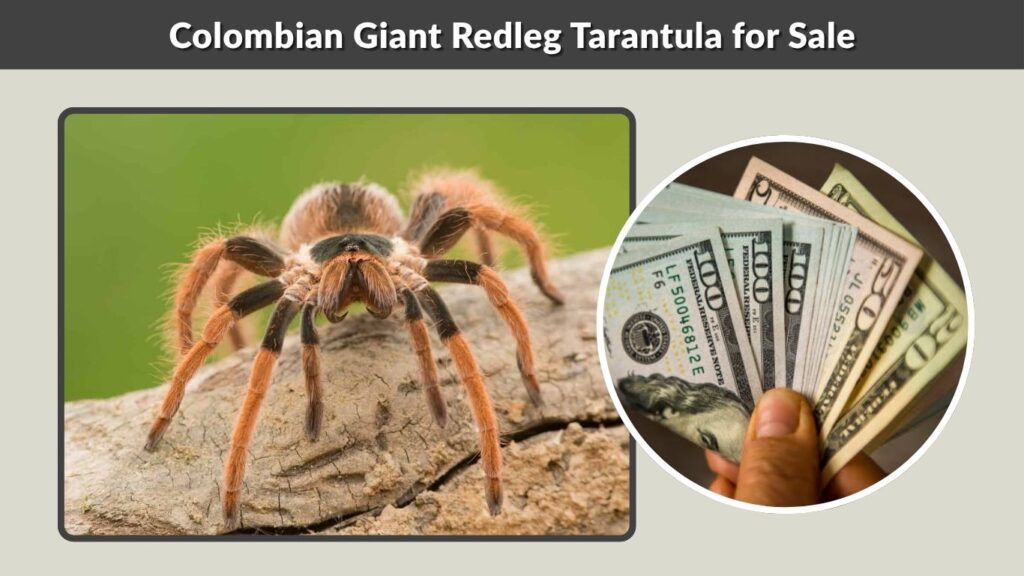
Someone searching for a Colombian giant redleg tarantula for sale should consider more than price. Because this species may live for many years, especially if female, selecting a healthy animal from a knowledgeable breeder or specialist can make long-term care considerably easier. Ask about size, approximate age, feeding history, sex when known, and whether the spider was captive-bred.
What to Check Before Choosing One
Look for:
- Clear identification as Megaphobema robustum
- Reliable information about size or age
- Normal movement and posture
- An abdomen that is neither extremely shriveled nor excessively swollen
- Recent feeding or molting information
- Sex information when available
- Captive-bred origin when possible
Avoid buying solely because a specimen is inexpensive.
Is It Good for Beginners?
Generally, it is better suited to intermediate or experienced tarantula keepers.
Its care requirements are manageable, but its large adult size, moisture requirements, defensive behavior, urticating hairs, and powerful rear-leg defense can make maintenance more challenging for someone keeping a tarantula for the first time.
FAQs
The Colombian giant redleg attracts many questions because of its impressive size and unusual behavior. Most successful husbandry comes from avoiding extremes: do not keep it constantly wet, do not allow it to become chronically dry, minimize unnecessary handling, provide adequate substrate, and give the animal a retreat where it can remain undisturbed.
How big does a Colombian giant redleg tarantula get?
Adults commonly reach roughly 6–8 inches in leg span, with females generally having a heavier appearance than males.
How long does a Colombian giant redleg live?
Females commonly have estimated lifespans of roughly 12–20 years or longer, while males generally live only several years.
What humidity does a Colombian giant redleg need?
Around 65–80% is commonly recommended, but good ventilation and appropriately moist substrate are more important than maintaining one exact percentage.
Should I mist my Colombian giant redleg every day?
Usually not. Maintaining moisture deeper in part of the substrate and providing fresh drinking water is generally preferable to frequent surface spraying.
Is Megaphobema robustum aggressive?
It is more accurate to describe the species as defensive rather than aggressive. When threatened, it may flee, kick hairs, posture, use its hind legs defensively, or potentially bite. For that reason, it should primarily be kept as a hands-off display tarantula.
