

The Australian spider wasp is one of the most remarkable insect predators found in the country. Belonging to the family Pompilidae, these solitary wasps are specialized hunters of spiders, using their painful sting to paralyze prey that will later become food for their larvae. Despite their fearsome hunting tactics, spider wasps are not aggressive toward humans unless provoked. With their striking colors, fascinating life cycle, and ecological importance, Australian spider wasps play a unique role in the balance of nature.
What is the Australian Spider Wasp?
Australian spider wasps are members of the Pompilidae family, a group that includes thousands of species worldwide. Unlike social wasps such as yellow jackets or hornets, spider wasps are solitary. Each female builds her own nest, hunts spiders, and provisions it with paralyzed prey to feed her offspring.
What makes these wasps stand out is their ability to take down spiders many times their own size, including huntsman spiders and wolf spiders. Their long legs, powerful wings, and highly effective stings make them some of the most formidable hunters in the insect world.
Australian Spider Wasp Species
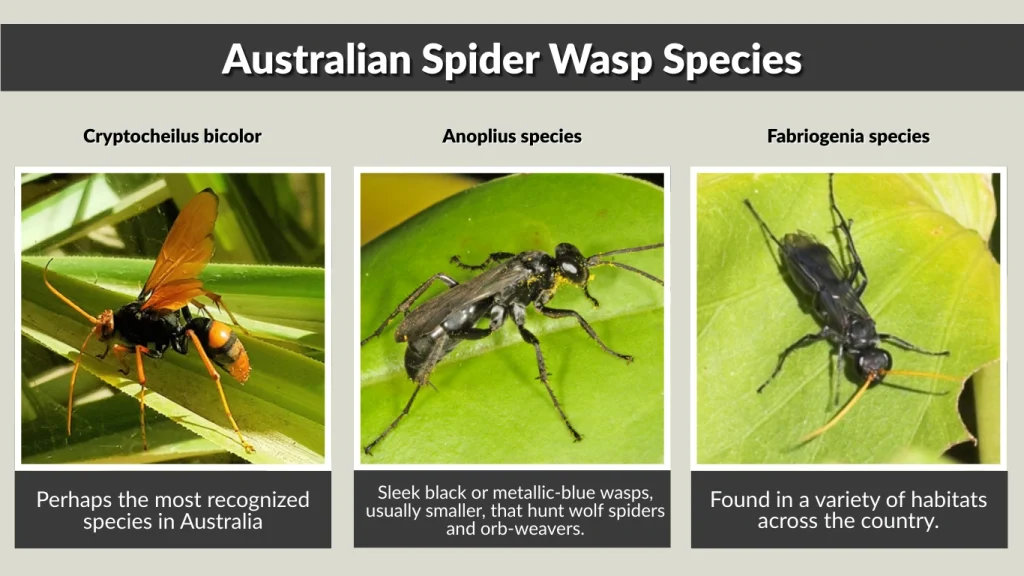
Australia is home to several spider wasp species, but a few are especially well-known:
- Cryptocheilus bicolor – Perhaps the most recognized species in Australia, this large wasp has a striking black body with orange wings. It is known for tackling big huntsman spiders.
- Anoplius species – Sleek black or metallic-blue wasps, usually smaller, that hunt wolf spiders and orb-weavers.
- Fabriogenia species – Found in a variety of habitats across the country, these wasps specialize in capturing medium-sized spiders.
While species vary in size, color, and preferred prey, they all share the same behavior of paralyzing spiders and using them as a living food source for their larvae.
Australian Spider Wasp Identification

Spider wasps are relatively easy to recognize once you know their main features:
- Size: Ranges from 1 to 4 cm, with some of the largest species (like Cryptocheilus bicolor) reaching nearly 5 cm.
- Body color: Typically black or metallic blue-black. Many species have orange or reddish wings, a visual warning of their painful sting.
- Wings: Long, narrow, and often brightly colored.
- Legs: Long and spindly, adapted for grappling with spiders.
- Flight pattern: Fast and erratic, often skimming low over the ground as they search for prey.
Their combination of large size, vivid coloration, and distinctive flying style makes them one of the most conspicuous wasps in Australia.
Australian Spider Wasp Habitat and Distribution
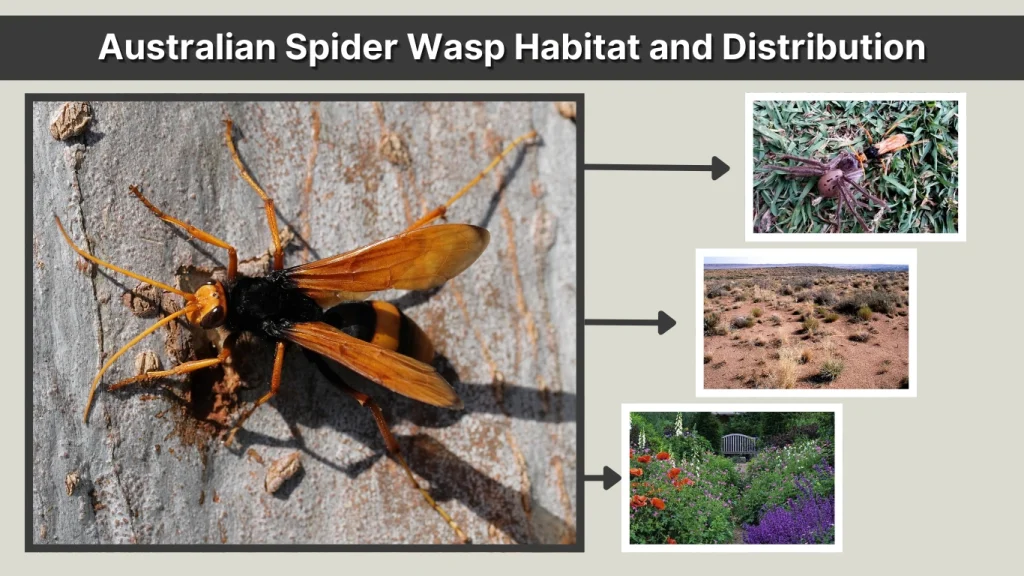
Spider wasps are found across all of Australia, from tropical forests to arid deserts. They are particularly common in:
- Bushland and open forests – Hunting for orb-weavers and huntsman spiders.
- Grasslands and scrubland – Good nesting sites with sandy soil.
- Gardens and suburban areas – Attracted by both spiders and flowering plants for nectar.
They prefer habitats with loose, sandy or soft soil, where females can dig burrows for their nests. They are most active during the warmer months, especially summer, when spider populations are high and flowers provide abundant nectar.
Australian Spider Wasp Sting
Pain and Danger
The sting of an Australian spider wasp is known to be extremely painful, though not usually dangerous. Many people describe the pain as sharp, burning, and intense, but it tends to be short-lived. The venom is designed to paralyze spiders rather than harm large animals, which is why its effects on humans, while unpleasant, are temporary.
Effects on Humans
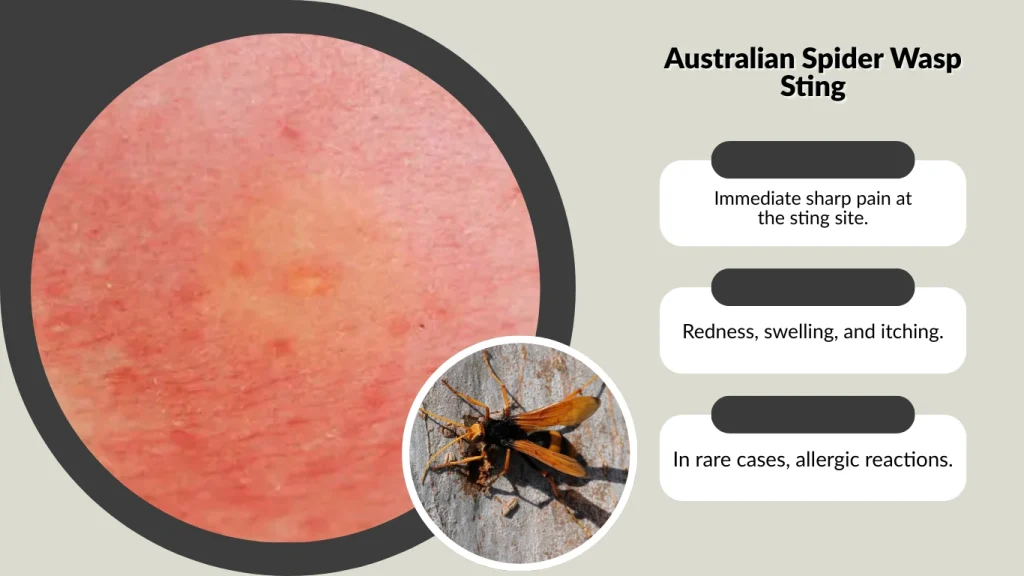
- Immediate sharp pain at the sting site.
- Redness, swelling, and itching.
- In rare cases, allergic reactions.
- Pain typically fades within a few minutes to an hour.
Defensive Behavior
Australian spider wasps are not aggressive toward humans. They do not guard nests in colonies or swarm like other wasps. Stings usually occur only if the wasp is handled, trapped, or feels directly threatened. Their vivid wing coloration acts as a warning to both humans and predators: “Do not touch.”
Australian Spider Wasp vs Spider

The most dramatic part of a spider wasp’s life is its battle with spiders. Female spider wasps are highly skilled hunters, able to subdue spiders much larger than themselves.
The Hunt
- The wasp searches the ground or spider webs for prey.
- When a spider is found, the wasp provokes it, dodging strikes until she gets close enough to deliver her sting.
- The venom instantly paralyzes the spider but does not kill it.
The Struggle
Once immobilized, the wasp uses her long legs to drag the spider — sometimes several times her size — across the ground to a burrow. This can be an extraordinary sight, as a wasp determinedly pulls a heavy spider across sand or rocks.
Egg-Laying
Inside the burrow, the female lays a single egg on the spider’s body. The burrow is sealed, leaving the spider alive but unable to move, ready to serve as food for the developing larva.
This predator-prey relationship, though brutal, is part of nature’s balance. By targeting large spiders like huntsmans and wolf spiders, the wasp helps regulate populations of these predators.
Australian Spider Wasp Life Cycle

Like other wasps, the Australian spider wasp goes through a complete metamorphosis:
- Egg – Laid on the paralyzed spider inside a burrow.
- Larva – After hatching, the larva begins feeding on the spider, starting with non-vital tissues so the host stays alive and fresh.
- Pupa – Once fully grown, the larva spins a cocoon inside the burrow, sometimes within the spider’s hollowed body.
- Adult – Emerges after pupation, digs its way out of the burrow, and begins the cycle anew.
Adults live for several weeks to a few months, with activity peaking in the hot summer when both spiders and flowering plants are abundant.
Australian Spider Wasp Diet
The diet of spider wasps depends on the stage of their life cycle:
- Adults: Feed primarily on nectar and plant juices. They are often seen on flowers such as eucalypts, tea trees, and wattles. This makes them incidental pollinators, though not as effective as bees.
- Larvae: Feed exclusively on the paralyzed spider provided by the mother. Each larva receives only one spider, which it consumes entirely before pupating.
This dual diet makes them both predators (through their larvae) and nectar-feeders, connecting them to multiple levels of the food chain.
Predators of Australian Spider Wasps
Despite their painful sting and warning coloration, spider wasps do have a few predators:
- Birds such as magpies and kookaburras may occasionally eat them if they can avoid the sting.
- Reptiles and amphibians like lizards, skinks, and frogs sometimes take the risk.
- Parasitism – Other insects may lay eggs in their burrows, stealing the food meant for the spider wasp larva.
However, because of their vivid coloration and painful sting, most predators avoid them, leaving them relatively free from natural enemies.
Unique Facts About Australian Spider Wasps
- Some species can paralyze and drag huntsman spiders nearly twice their size.
- Their sting is among the most painful of any Australian insect, though it is short-lived.
- They are relatives of the tarantula hawk wasps of the Americas, which are famous for hunting tarantulas.
- Despite their fearsome hunting methods, they are non-aggressive pollinators when visiting flowers.
- Their presence in gardens often indicates a healthy ecosystem, with both spiders and flowering plants abundant.
FAQs
How big can Australian spider wasps get?
Most species measure between 1 and 4 cm in length, but larger species like Cryptocheilus bicolor can reach up to 5 cm. Their large size, combined with long legs and orange wings, makes them easy to recognize.
Do Australian spider wasps kill spiders?
Yes, but not immediately. They sting and paralyze spiders, keeping them alive as a fresh food source for their larvae. Huntsman spiders, wolf spiders, and orb-weavers are among their common prey.
Are Australian spider wasps dangerous to humans?
No, they are not considered dangerous. Their sting is very painful but short-lived and not medically harmful for most people. They only sting when provoked or handled.
Where are Australian spider wasps commonly found?
They occur throughout Australia, especially in bushland, forests, grasslands, and suburban gardens. They prefer habitats with sandy soil for nesting and are most active in summer.
What is the largest spider wasp in Australia?
The largest is Cryptocheilus bicolor, reaching up to 5 cm long. It is easily identified by its black body and orange wings and is known for hunting large huntsman spiders.
