
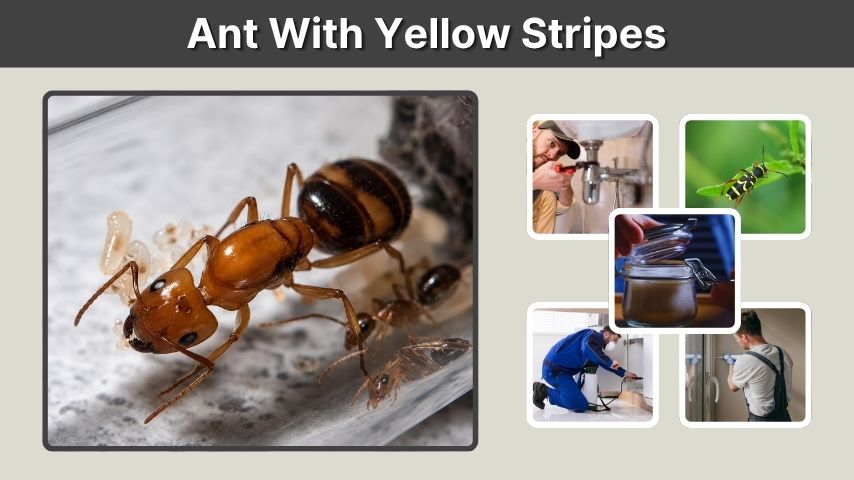
An ant with yellow stripes can be confusing because several insects share this color pattern. Some are true ants, while others are wasps, termites, or ant-like bugs. Yellow stripes may appear on the abdomen, thorax, or back, and the insect may be black, red, brown, or golden. Correct identification depends on body shape, wings, antennae, size, and behavior.
What Is an Ant With Yellow Stripes?
An ant with yellow stripes usually refers to a dark ant that has yellow, golden, or pale bands on the body. These markings are often seen on the abdomen, sometimes called the gaster. In some cases, the “yellow stripe” is not a solid band but a line of golden hairs or light-colored body segments.
Not every black and yellow striped insect is an ant. Velvet ants, yellow jackets, wasps, termite swarmers, and beetles may look ant-like from a distance. True ants usually have elbowed antennae, a narrow waist, and a clearly segmented body. Winged ants also have front wings that are longer than their back wings, unlike termite swarmers, which have equal-length wings.
Quick Identification Signs
Look closely at the insect’s body before deciding what it is.
- Antennae: True ants have bent or elbowed antennae.
- Waist: Ants have a narrow, pinched waist between the thorax and abdomen.
- Wings: Flying ants have two pairs of wings, with the front pair longer than the back pair.
- Body texture: Hairy, fuzzy, bright yellow-and-black insects may be velvet ants, which are actually wasps.
- Movement: Fast, erratic movement may suggest crazy ants, including yellow crazy ants in warm regions.
- Location: Ants near damp wood, wall gaps, or sawdust-like debris may be carpenter ants.
Common Ants and Ant-Like Bugs With Yellow Stripes
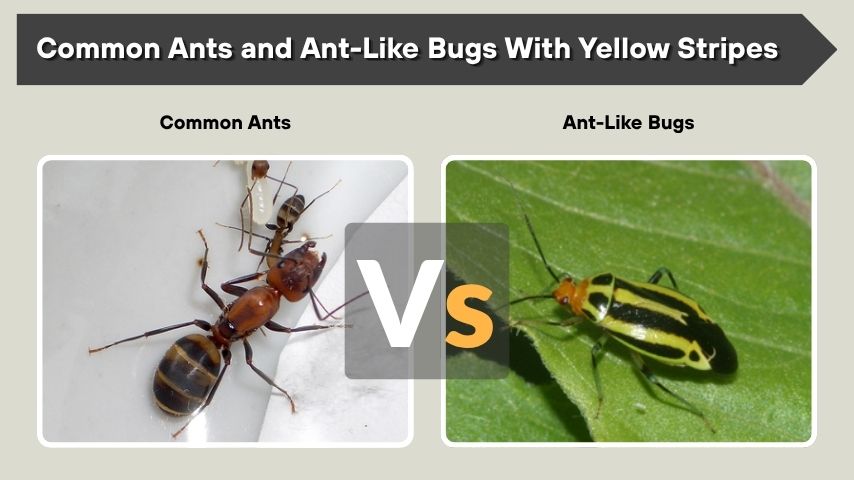
Several insects can match the description “ant with yellow stripes.” Some are harmless outdoor ants, while others may require attention if found indoors. The exact species often depends on your location.
| Possible Insect | Main Color Pattern | Key Clue | Concern Level |
|---|---|---|---|
| Carpenter ant | Black, red, or brown with pale/golden bands or hairs | Large body, rounded thorax, one node | Medium if indoors |
| Yellow crazy ant | Yellow to golden-brown, darker striped abdomen | Long legs, long antennae, erratic movement | High in invasive areas |
| Velvet ant | Black with yellow, orange, red, or white hairy bands | Fuzzy body, wingless female | Sting risk |
| Flying ant | Black, brown, or reddish with wings and pale bands | Elbowed antennae, unequal wings | Depends on species |
| Yellow jacket mimic | Black and yellow striped, wasp-like body | Smooth body, strong flight | Sting risk |
Carpenter Ants With Yellowish Stripes
Carpenter ants are among the most common large ants people mistake for yellow-striped ants. They are often black, reddish-black, or brown, and some may appear to have yellowish or golden bands because of body hairs or reflections. Carpenter ants are identified by a smooth, evenly rounded thorax and one petiole node between the thorax and abdomen.
These ants do not eat wood like termites. Instead, they excavate tunnels and galleries to build nests, especially in moist or decaying wood. If you see large black ants with yellowish stripes inside the house, especially near windows, bathrooms, kitchens, or damp wood, check for sawdust-like frass, rustling sounds in walls, or repeated indoor activity.
Yellow Crazy Ants
Yellow crazy ants are slender, golden-brown ants with long legs and long antennae. Their abdomen can look darker and sometimes striped. They are named for their fast, erratic movement when disturbed. These ants do not sting like fire ants, but they can spray formic acid.
They are mostly a concern in tropical and subtropical regions where they can form large colonies. Around homes, they may trail along walls, garden beds, tree roots, loose leaf litter, or outdoor structures. If you live in an area where yellow crazy ants are invasive, report suspicious colonies to local pest or biosecurity authorities.
Velvet Ants That Look Like Yellow-Striped Ants
Velvet ants are not true ants. They are wasps from the family Mutillidae, and the wingless females often look like large, hairy ants. Some species have black bodies with yellow, orange, red, white, silver, or golden hair patches. Their bright colors are warning colors, and females can deliver a painful sting if handled.
A velvet ant usually walks alone on the ground rather than traveling in long ant trails. It often looks fuzzy or velvety, with a strong, compact body. If the insect looks like a big hairy ant with yellow stripes, do not touch it. It is better to observe it from a safe distance and let it move away naturally.
Black Ant With Yellow Stripes
A black ant with yellow stripes may be a carpenter ant, a field ant, or another dark ant with pale abdominal bands. In many cases, the yellow lines are not bright like a yellow jacket’s stripes. They may look golden, cream, tan, or light brown depending on light and body hair.
The best way to identify a black ant with yellow stripes is to check the body shape. Carpenter ants are usually larger than many household ants and have a smooth, rounded thorax. If the ant has wings, compare it with termites. Ants have bent antennae, a pinched waist, and unequal wing lengths, while termites have straight antennae, a thicker waist, and equal-length wings.
Where You May Find Them
Black ants with yellowish stripes may appear in several places:
- Inside walls or near windows: Possible carpenter ant activity.
- Around damp wood: Rotten logs, stumps, decks, fences, and moisture-damaged boards can attract wood-nesting ants.
- Kitchen or pantry: Some ants forage for sweets, protein, or greasy food.
- Garden soil: Outdoor ants may nest under stones, mulch, or plant roots.
- After rain or warm weather: Winged ants may emerge during mating flights.
Red Ant With Yellow Stripes
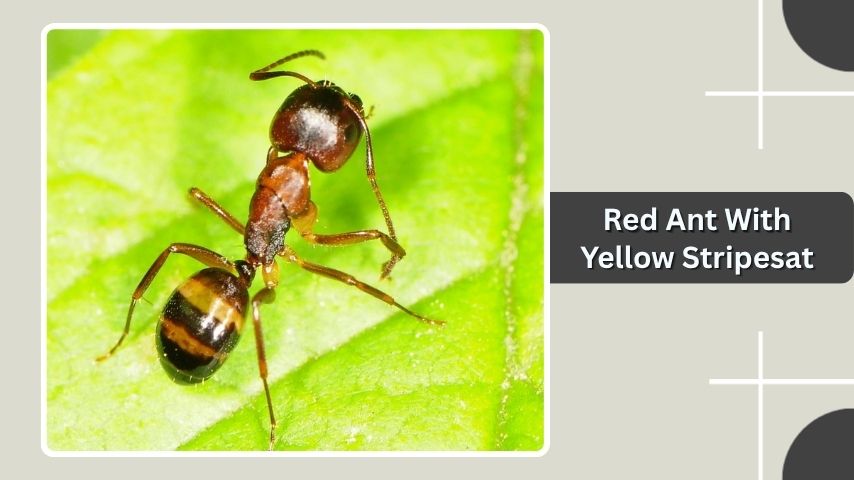
A red ant with yellow stripes can be difficult to identify without a clear view. It may be a reddish carpenter ant, a field ant, a velvet ant, or another ant-like wasp. Some red and black ants have pale bands or golden hairs on the abdomen, making them appear striped.
If the insect is fuzzy, brightly colored, and moving alone, it may be a velvet ant rather than a true ant. If it is moving in a trail with other ants, has elbowed antennae, and a narrow waist, it is more likely a true ant. Red ants should be treated carefully because some species can bite or sting, depending on the type.
Is It Dangerous?
Most yellow-striped ants are not dangerous to healthy adults, but some can bite, sting, or spray defensive chemicals. Carpenter ants can bite if handled and may cause concern when nesting indoors. Yellow crazy ants can spray formic acid. Velvet ants can sting painfully, although they are not aggressive and usually sting only when touched or trapped.
Flying Ant With Yellow Stripes
A flying ant with yellow stripes is often a reproductive ant, also called an alate or swarmer. These ants leave the colony to mate and start new colonies. Winged ants can be confused with termites, especially when they appear indoors or around lights.
Flying ants have a narrow waist, elbowed antennae, and unequal wing pairs. Termite swarmers have straight antennae, a broad waist, and wings of equal length. If you find many winged insects indoors, collect a few in a small container or take clear photos for identification. Indoor swarms can indicate a nearby colony, especially if they appear repeatedly.
Wings and Yellow Stripes
Yellow stripes on a flying ant may appear on the abdomen or thorax. Sometimes the color is caused by body hairs rather than a true stripe. If the insect has a very narrow wasp-like body and flies strongly, it may be a small wasp rather than an ant. If it crawls in groups and has bent antennae, it is more likely an ant.
Ant-Like Bug With Yellow Stripes
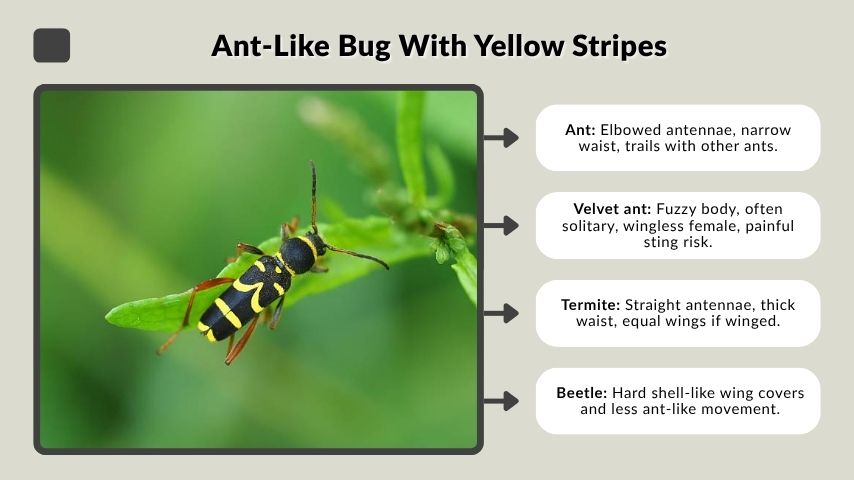
Many people describe an insect as an “ant-like bug with yellow stripes” when it only resembles an ant. This is common because several insects have a narrow body and black-yellow markings.
Possible look-alikes include velvet ants, yellow jackets, parasitic wasps, flower beetles, and termite swarmers. Yellow jackets have smooth black-and-yellow bodies and strong flight. Velvet ants are fuzzy and often wingless. Termites have straight antennae and no pinched waist. Beetles have hard wing covers and do not have the same narrow waist as ants.
How to Separate Ants From Look-Alikes
Use these simple checks:
- Ant: Elbowed antennae, narrow waist, trails with other ants.
- Velvet ant: Fuzzy body, often solitary, wingless female, painful sting risk.
- Wasp: Smooth body, strong flying behavior, often brighter yellow-black pattern.
- Termite: Straight antennae, thick waist, equal wings if winged.
- Beetle: Hard shell-like wing covers and less ant-like movement.
Why Do Some Ants Have Yellow Stripes?
Yellow stripes can come from body color, hair, reflection, age, or species variation. Some ants have pale bands between abdominal segments. Others have golden hairs that create a striped look. Winged queens and males may also look different from worker ants in the same colony.
Color alone is not enough for identification. Size, antennae, waist shape, thorax shape, wings, nesting site, and movement are more reliable. This is especially important when deciding whether you are seeing a harmless outdoor ant, a carpenter ant problem, or a stinging wasp mimic.
What to Do If You Find Yellow-Striped Ants at Home
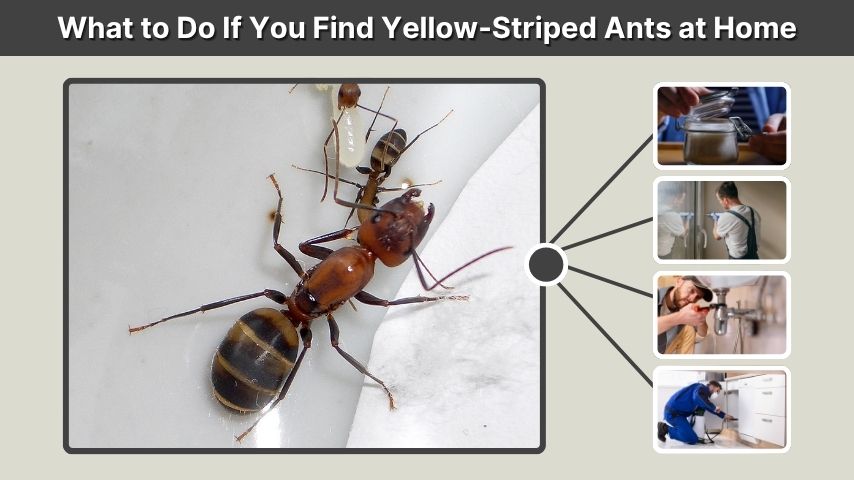
If you find one or two yellow-striped ants outdoors, you usually do not need to worry. If you see repeated indoor activity, winged ants inside, or large ants near damp wood, inspect the area more carefully.
Safe Control Steps
Start with simple prevention before using chemicals.
- Clean food sources: Wipe counters, seal sugar, honey, pet food, and greasy leftovers.
- Remove moisture: Fix leaks, improve ventilation, and dry damp wood areas.
- Seal entry points: Close cracks around windows, doors, pipes, and foundation gaps.
- Check wood damage: Look for frass, hollow-sounding wood, or ants near damp boards.
- Avoid crushing unknown insects: Some ant-like wasps may sting if handled.
- Use bait carefully: Ant baits work better than sprays for many indoor ant trails because workers carry bait back to the colony.
- Call a professional: Get help if you suspect carpenter ants, repeated winged ants indoors, or a large hidden nest.
FAQs
What kind of ant has yellow stripes?
An ant with yellow stripes may be a carpenter ant, yellow crazy ant, field ant, or another dark ant with pale bands or golden hairs. Some ant-like insects, such as velvet ants or wasps, can also look striped. Check antennae, waist shape, wings, and behavior for accurate identification.
Are black ants with yellow stripes dangerous?
Most black ants with yellowish stripes are not highly dangerous, but some can bite or cause home concerns. Carpenter ants may bite and can damage wood by nesting in it. If the insect is fuzzy and solitary, it may be a velvet ant, which can sting painfully if handled.
Why do I see flying ants with yellow stripes?
Flying ants are usually reproductive ants leaving the colony for mating. Yellow stripes may appear on the abdomen, thorax, or body hairs. If they appear indoors in large numbers, check whether they are ants or termites. Ants have elbowed antennae, narrow waists, and unequal wing lengths.
Is a yellow-striped ant the same as a yellow jacket?
No, a yellow-striped ant is not the same as a yellow jacket. Yellow jackets are wasps with smooth black-and-yellow bodies and strong flight. Ants have elbowed antennae and a pinched waist. If the insect flies aggressively around food or nests, it may be a wasp, not an ant.
Should I kill yellow-striped ants?
You do not need to kill every yellow-striped ant, especially if it is outdoors and not causing trouble. First, identify the insect. If ants are entering your home, remove food sources, seal entry points, and use bait if needed. For carpenter ants, winged indoor ants, or painful stinging insects, professional help is safer.
