
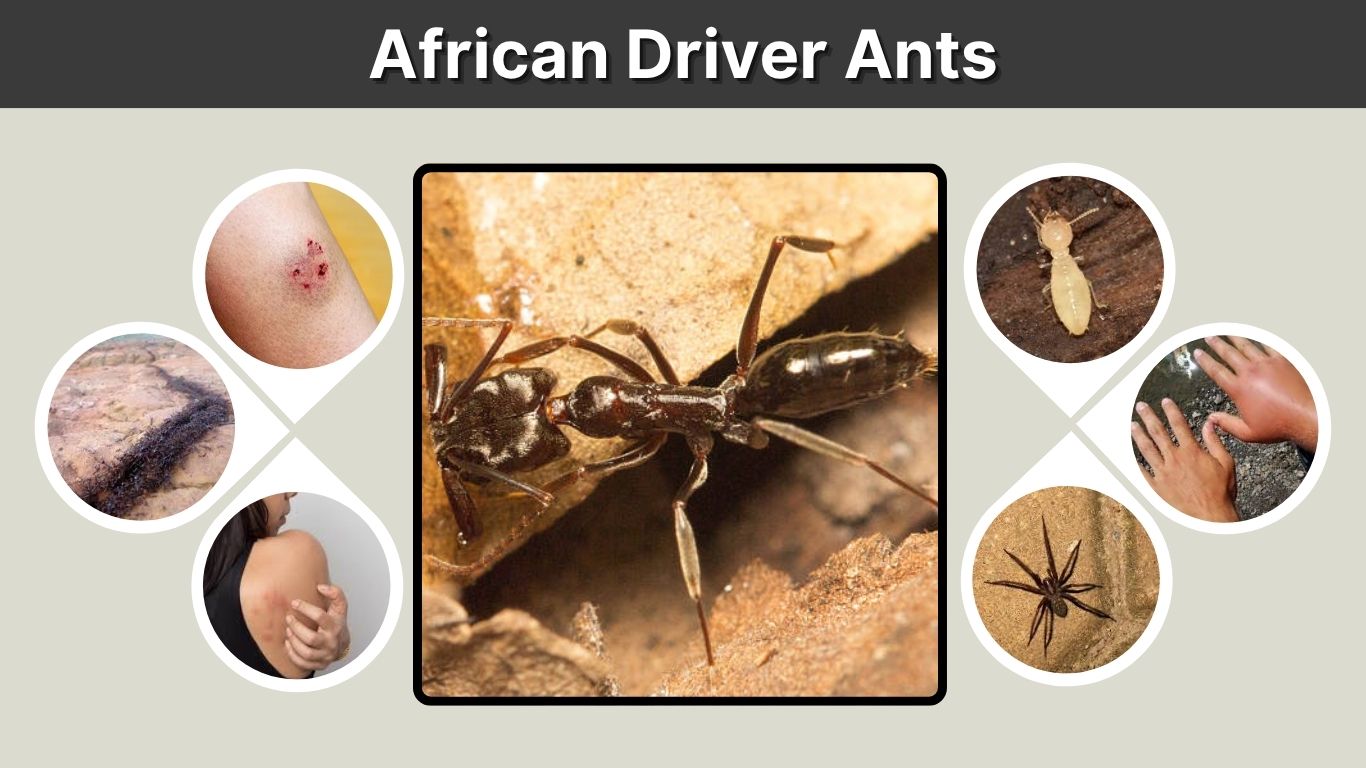
African driver ants are some of the most feared and fascinating ants in the world. Also called siafu, safari ants, or simply driver ants, they are famous for huge marching swarms, powerful bites, and massive colonies. These ants do not hunt humans, but their numbers and aggressive defence can make them dangerous in certain situations. Here is everything to know about African driver ants.
What Are African Driver Ants?
African driver ants are army ants from the genus Dorylus. They live in many parts of Africa and are best known for forming large moving columns that sweep across the ground in search of prey. Unlike ordinary household ants, they often travel in organised raiding groups and may shift nest locations depending on food supply and colony needs.
These ants are social insects with a highly organised colony system. A colony may contain workers, soldiers, males, and one queen. Each type of ant has a specific role, allowing the colony to move, hunt, defend itself, and reproduce efficiently.
African driver ants are not pests in the same way as kitchen ants or pavement ants. In the wild, they are important predators that help control insects and recycle nutrients. However, when they pass through homes, farms, camps, or animal shelters, they can cause serious problems.
Common Names for African Driver Ants
African driver ants are known by several names across different regions and sources. These include:
- Driver ants
- African driver ants
- Siafu ants
- Safari ants
- Dorylus ants
- African army ants
The name “driver ant” comes from their ability to drive insects, small animals, and even people away from their path. When a swarm moves through leaf litter or grass, many creatures flee ahead of it.
Where Do African Driver Ants Live?
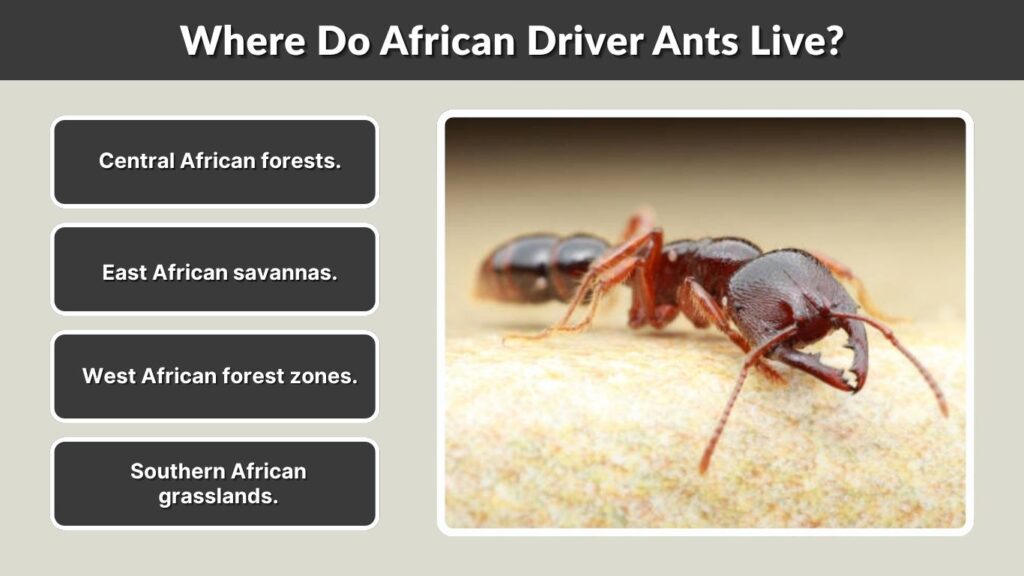
African driver ants are found across many parts of sub-Saharan Africa. They are especially associated with tropical forests, savannas, grasslands, and woodland areas. Some species are more visible above ground, while others spend much of their time underground or beneath leaf litter.
They can live in a wide range of habitats as long as there is enough food, moisture, and cover. Their movement often depends on the availability of prey such as termites, insects, worms, larvae, spiders, and other small invertebrates.
African Driver Ant Locations
African driver ants may be found in:
- Central African forests
- East African savannas
- West African forest zones
- Southern African grasslands
- Rainforest floors
- Rural farms and villages
- Areas with high termite activity
Searches such as “driver ants in Africa,” “driver ants of Africa,” “west Africa driver ants,” and “south African driver ants” usually refer to these Dorylus species. Exact distribution depends on the species, local climate, soil, and habitat.
African Driver Ant Size
African driver ants vary widely in size because their colonies contain different castes. Small workers may be only a few millimetres long, while soldiers are much larger and have powerful jaws. The queen is far larger than any worker or soldier and may become enormous when full of eggs.
| Caste | Approximate Appearance | Main Function |
|---|---|---|
| Small workers | Small, fast-moving ants | Foraging, carrying prey, colony maintenance |
| Soldiers | Larger ants with big heads and strong jaws | Defence and cutting prey |
| Males | Large, winged reproductive ants | Mating |
| Queen | Very large with enlarged abdomen | Egg production |
What Do African Driver Ants Look Like?
African driver ants are usually reddish-brown, dark brown, or blackish. Their appearance depends on species and caste. Workers are smaller and slimmer, while soldiers have large heads and curved mandibles that can grip tightly.
The soldiers are the ants most people notice during a swarm because they protect the colony edges. If disturbed, they may bite and hold on firmly. Their bite is one reason these ants have such a strong reputation.
African Driver Ant Queen
The African driver ant queen is one of the most remarkable ant queens in the insect world. She is much larger than the workers and soldiers, especially when her abdomen becomes swollen with eggs. Her main role is reproduction, and she can produce huge numbers of eggs to support the colony.
A mature colony depends heavily on the queen. Without her, the colony cannot maintain its population over time. Because driver ant colonies can be very large, the queen’s egg-laying ability is essential.
African Driver Ant Eggs
African driver ant eggs are produced by the queen and cared for by workers. The workers move eggs, larvae, and pupae when the colony shifts location. During certain phases, the colony may stay in one place while the queen lays eggs. During other phases, it becomes more nomadic and moves through the environment.
This cycle allows the colony to balance reproduction with hunting. When the colony needs more food, workers launch raids and bring back prey to feed the growing larvae.
African Driver Ant Swarms
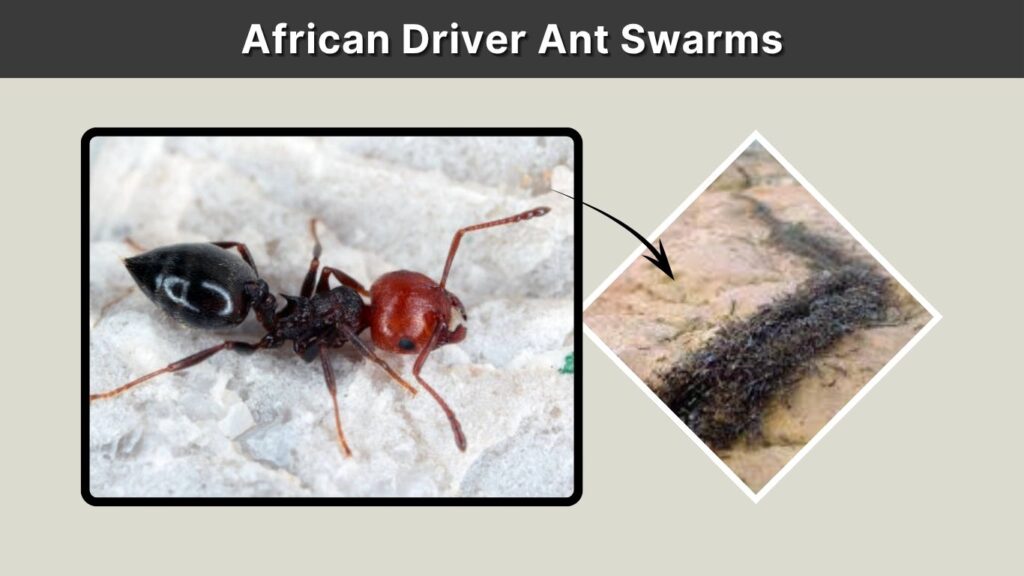
African driver ant swarms are the main reason these ants are famous. A swarm may contain thousands or even millions of ants moving together. The ants form trails, columns, or broad raiding fronts as they search for food.
A swarm may look chaotic, but it is highly organised. Workers search for prey, soldiers protect the edges, and other ants carry captured food back toward the colony.
What Do African Driver Ants Eat?
African driver ants are predators and scavengers. Their diet may include:
- Termites
- Insects
- Spiders
- Worms
- Larvae
- Small invertebrates
- Dead animal matter
- Soft-bodied prey
They are especially effective at raiding termite colonies and flushing small creatures out of hiding. This makes them important in African ecosystems, even though their swarms can be alarming to humans.
Are African Driver Ants Dangerous?
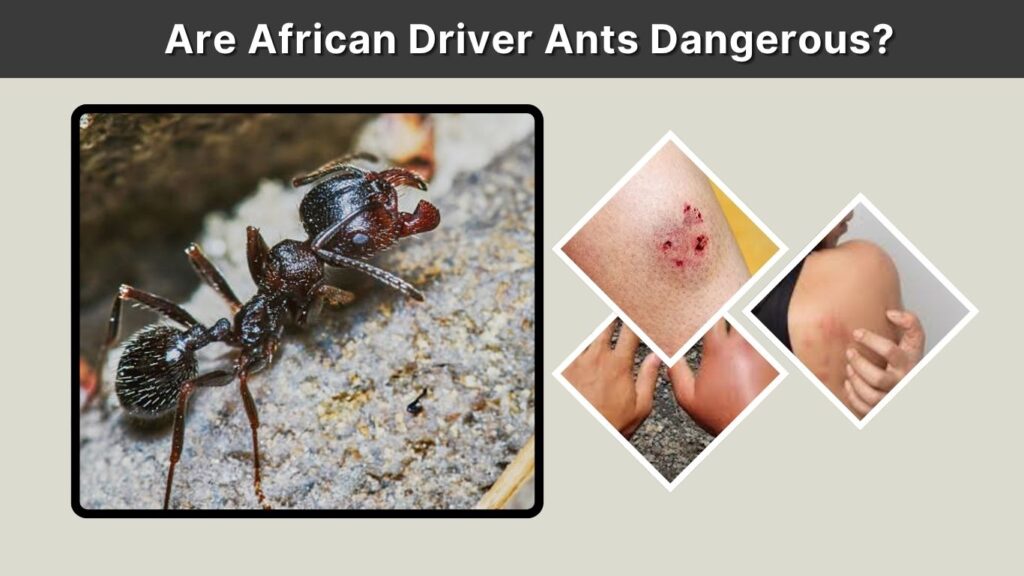
African driver ants can be dangerous, but the danger is often exaggerated. They do not actively hunt people. Most healthy adults can avoid serious harm by moving away from a swarm. However, their bites are painful, and a large number of ants can overwhelm vulnerable people or animals.
They are most dangerous to anyone who cannot quickly escape. This can include babies, sleeping people, elderly individuals, sick people, injured people, small pets, and confined livestock.
African Driver Ant Bite
African driver ants bite with strong mandibles. They do not rely mainly on a sting like fire ants or wasps. Soldier ants can grip the skin so firmly that they may be difficult to remove.
A bite may cause:
- Sharp pain
- Small puncture wounds
- Redness
- Swelling
- Irritation
- Minor bleeding
- Risk of infection if not cleaned
If bitten by many ants, the pain and skin injury can be significant. The first step is always to move away from the swarm before removing ants.
Can African Driver Ants Kill Humans?
African driver ants can kill humans in rare situations, but they do not normally attack people as prey. Fatal incidents are usually linked to people who cannot escape, such as infants, people who are sleeping, unconscious individuals, or people with limited mobility.
Searches like “African driver ants kill human,” “Africa driver ants eat humans,” and “African driver ants kill babies” often come from sensational stories. The realistic answer is more balanced: driver ants are not human hunters, but a large swarm can be dangerous if a person is trapped, asleep, or unable to move away.
Do African Driver Ants Eat Humans?
African driver ants do not normally eat humans. They may bite humans who disturb them or stand in their path, but humans are not their usual food. Their normal prey includes insects, termites, worms, and other small animals.
In extreme cases, if a person or animal dies or is unable to move, ants may feed on tissue like many scavenging insects would. However, the idea that driver ants routinely hunt and consume people is misleading.
Do African Driver Ants Eat Cows or Large Animals?
African driver ants do not normally kill healthy cows, elephants, or large animals. A healthy large animal can usually move away from a swarm. Problems can occur when animals are tied, trapped, weak, very young, or unable to escape.
For example, a confined calf, sick animal, or trapped small livestock could be at risk if a large swarm enters the area. This is why farmers in regions with driver ants may take swarms seriously around animal shelters and pens.
African Driver Ants vs Army Ants
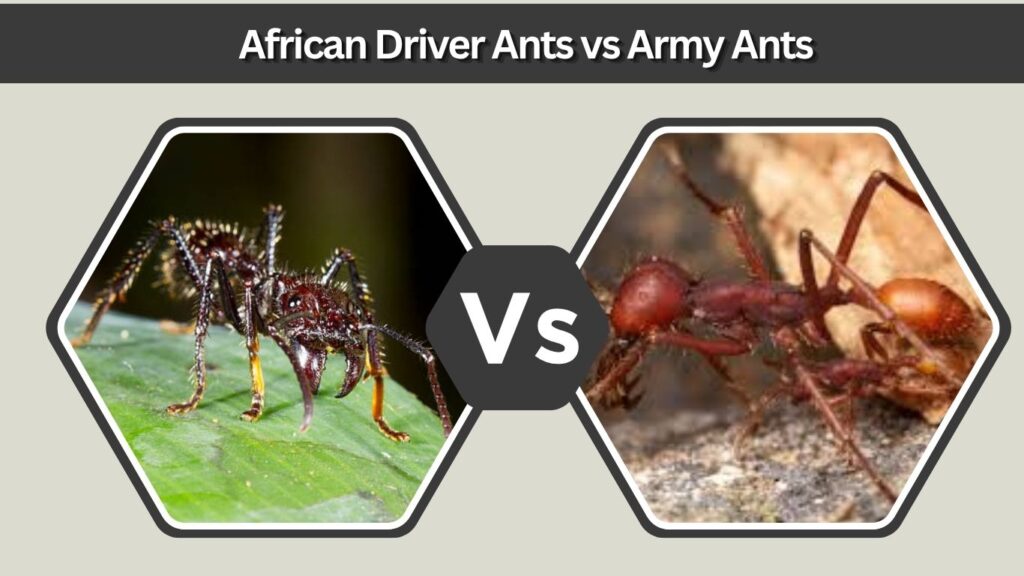
African driver ants are a type of army ant. The term “army ant” describes ants that raid in coordinated groups and often move colonies rather than staying permanently in one nest. Driver ants are the African and Old World examples, while some famous army ants in the Americas belong to different groups.
In simple terms:
- African driver ants are army ants.
- Not all army ants are African driver ants.
- Driver ants belong to the genus Dorylus.
- Many American army ants belong to other genera.
- Both groups are known for swarm hunting.
This comparison is useful because many people use “driver ants” and “army ants” interchangeably. They are related in behaviour, but not always the same biologically.
African Driver Ant Facts
African driver ants are impressive because of their size differences, colony organisation, and swarm behaviour. They are both feared and respected in regions where they live.
Important facts include:
- African driver ants are also called siafu.
- They belong to the genus Dorylus.
- They are a type of army ant.
- Colonies can contain very large numbers of ants.
- Soldiers have strong jaws and painful bites.
- Queens are much larger than workers.
- They feed mainly on insects and small invertebrates.
- They may raid termite colonies.
- They can be dangerous to trapped or vulnerable people.
- They play an important role in natural ecosystems.
African Driver Ants in Rainforests and Savannas
African driver ants can live in both rainforest and savanna environments, depending on the species. In rainforests, they often move through leaf litter and shaded forest floors. In savannas, they may travel through grass, soil, and open woodland.
Their ability to move as a colony helps them survive in changing conditions. If food becomes scarce in one area, the colony can shift and raid somewhere else. This mobility is one reason they are so successful.
African Red Driver Ants
Some people search for “African red driver ants” because many driver ants appear reddish or brownish. Colour varies by species and caste. A red or reddish-brown driver ant may still be part of the Dorylus group, but exact identification usually requires expert knowledge.
Colour alone is not enough for identification. Behaviour, location, size, caste, and colony structure are also important.
Should People Control African Driver Ants?
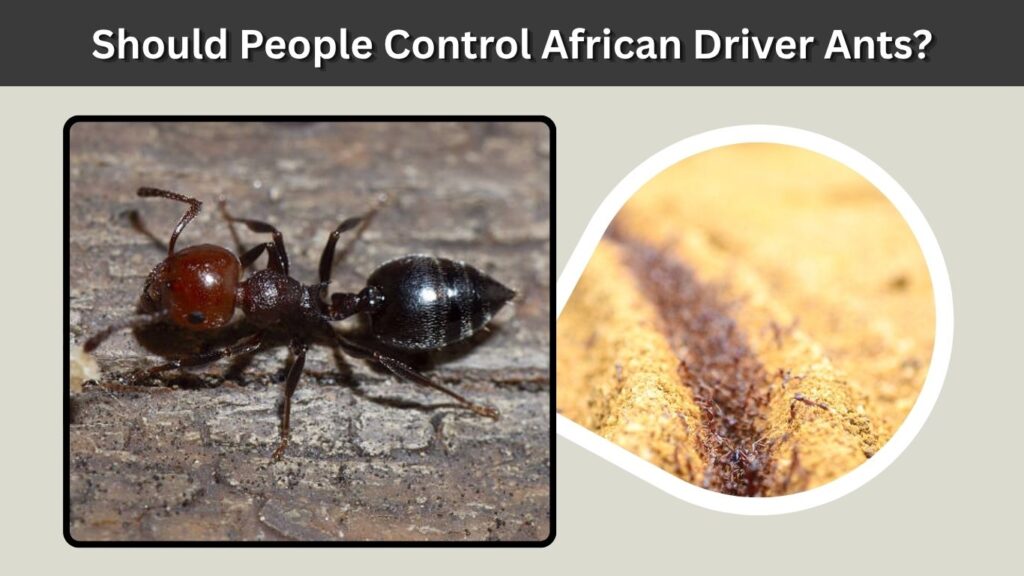
In wild areas, African driver ants should usually be left alone. They are part of the natural ecosystem and help control other insects. If a swarm is simply passing through an outdoor area, the safest response is to avoid it and let it move on.
Control may be needed when swarms enter homes, schools, hospitals, camps, animal pens, or sleeping areas. In those cases, local pest control professionals or community authorities may be needed.
How to Stay Safe Around African Driver Ants
To reduce risk:
- Do not stand in a driver ant trail.
- Keep children and pets away from swarms.
- Avoid sleeping directly on the ground in known driver ant areas.
- Check campsites before resting.
- Move animals away if a swarm approaches.
- Keep sleeping areas sealed where possible.
- Clean bites quickly to reduce infection risk.
The best safety measure is distance. Driver ants are powerful in large numbers, but they are usually easy to avoid if noticed early.
FAQs
Are African driver ants real?
Yes, African driver ants are real ants from the genus Dorylus. They are also known as siafu, safari ants, or African army ants. They are famous for their large colonies, organised swarms, and painful bites.
How big are African driver ants?
African driver ant size depends on caste. Small workers may be only a few millimetres long, while soldiers are larger with powerful jaws. The queen is much larger than all other colony members, especially when her abdomen is enlarged with eggs.
Can African driver ants kill a human?
African driver ants can kill humans in rare cases, usually when someone cannot escape a large swarm. They do not hunt people, but many ants biting at once can be dangerous to babies, sleeping people, sick people, or anyone unable to move away.
Do African driver ants eat humans?
African driver ants do not normally eat humans. They mainly feed on insects, termites, worms, larvae, spiders, and other small prey. Sensational stories about them eating humans are usually exaggerated, although trapped or deceased animals may attract ants.
Where do African driver ants live?
African driver ants live in many parts of sub-Saharan Africa, including forests, savannas, grasslands, and woodland habitats. They are especially associated with warm regions where there is plenty of prey, soil cover, and leaf litter.
