
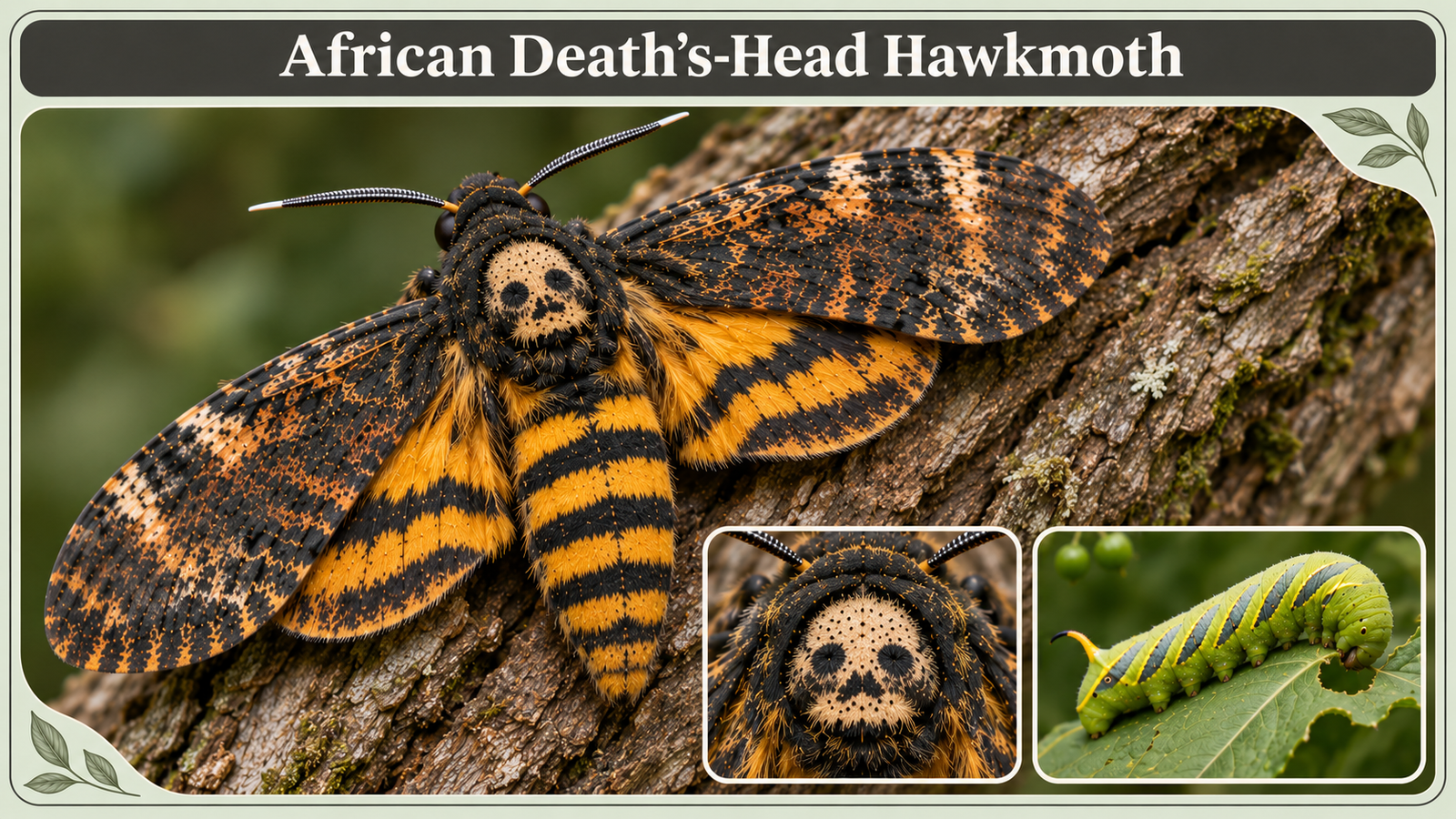
The African death’s-head hawkmoth (Acherontia atropos) is a large, nocturnal moth known for the skull-like marking on its thorax. Its bold yellow-and-black abdomen, powerful flight, and ability to enter honeybee hives make it one of the most recognizable hawkmoths. Despite its ominous name, it is harmless to people. This guide covers how to identify the African species, where it lives, what it eats, how it squeaks, and how it develops from egg to adult.
What Is the African Death’s-Head Hawkmoth?
The African death’s-head hawkmoth is Acherontia atropos, a species in the hawkmoth family Sphingidae. It is the best-known member of the genus Acherontia, whose other species are A. styx and A. lachesis. All three are sometimes called death’s-head hawkmoths because they share a skull-like thorax marking. The word “African” identifies A. atropos, but the species is not limited to Africa.
Range and habitat
Acherontia atropos occurs widely in Africa and in parts of the Mediterranean region, the Middle East, and Europe. It is a strong migrant, and adults can travel into cooler regions during warmer months. In northern areas, a sighting may be seasonal, and local pupae may not survive winter. The moth uses varied habitats where suitable larval food plants grow, including gardens, farmland, and natural vegetation.
The common name can cause confusion in South Asia. In places such as Bangladesh, the related Acherontia styx is recorded, so a moth called a “death’s-head hawkmoth” locally may not be A. atropos. Location is useful when identifying the species, especially if the moth is not from Africa or Europe.
How to Identify an African Death’s-Head Hawkmoth
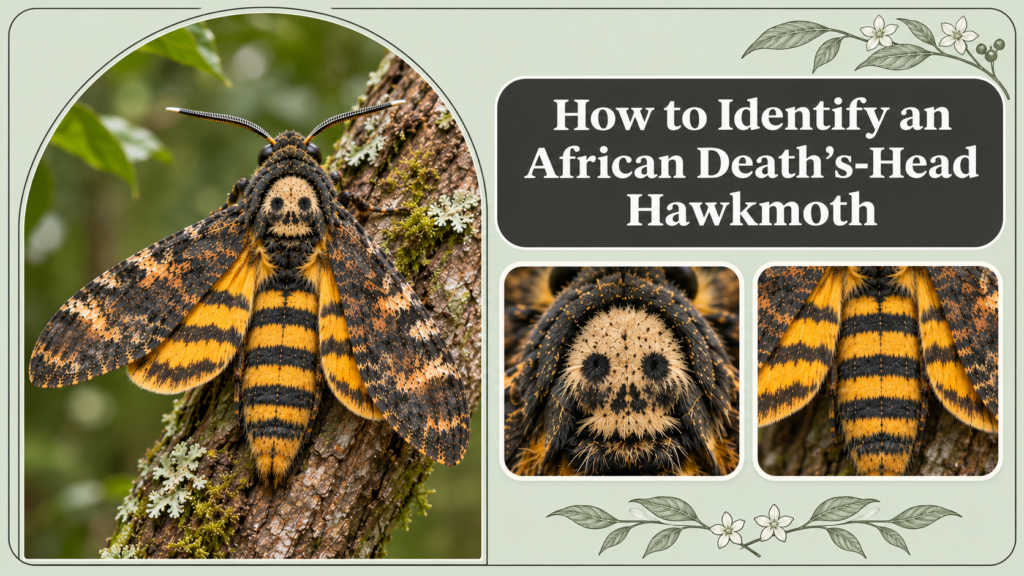
An adult A. atropos is large, thick-bodied, and fast-flying. Its forewings are dark brown with mottled tan markings, while the hindwings are yellow-orange with dark bands. When the wings are folded, the bright hindwing pattern may be hidden. The most famous feature is the pale marking on the thorax, which resembles a skull but may vary in shape and contrast between individuals.
Adult identification features
- Thorax: Dark and marked with a pale, skull-like pattern.
- Forewings: Long, dark brown, and mottled with lighter areas.
- Hindwings: Yellow-orange with dark bands, usually seen when the moth opens its wings.
- Abdomen: Stout, with yellow and dark bands.
- Size: A large hawkmoth, with a wingspan that can reach roughly 12 centimeters.
- Activity: Mostly nocturnal; adults may be attracted to artificial lights.
A worn specimen may have faded scales or damaged wing edges, making the skull pattern less obvious. Check the entire combination of body size, wing colors, and shape rather than relying on the thorax marking alone. The other Acherontia species look similar, so a location record or expert identification may be needed to separate them.
What the caterpillar looks like
The caterpillar is also large and has a curved horn at the rear. Its color varies through growth and among individuals: green or yellow forms may have blue diagonal stripes, while brown forms can show pale or gray stripes. The horn can look like a stinger, but it is not used to sting. Mature larvae leave their food plant and move over the ground to find a place to pupate.
What Does the African Death’s-Head Hawkmoth Eat?
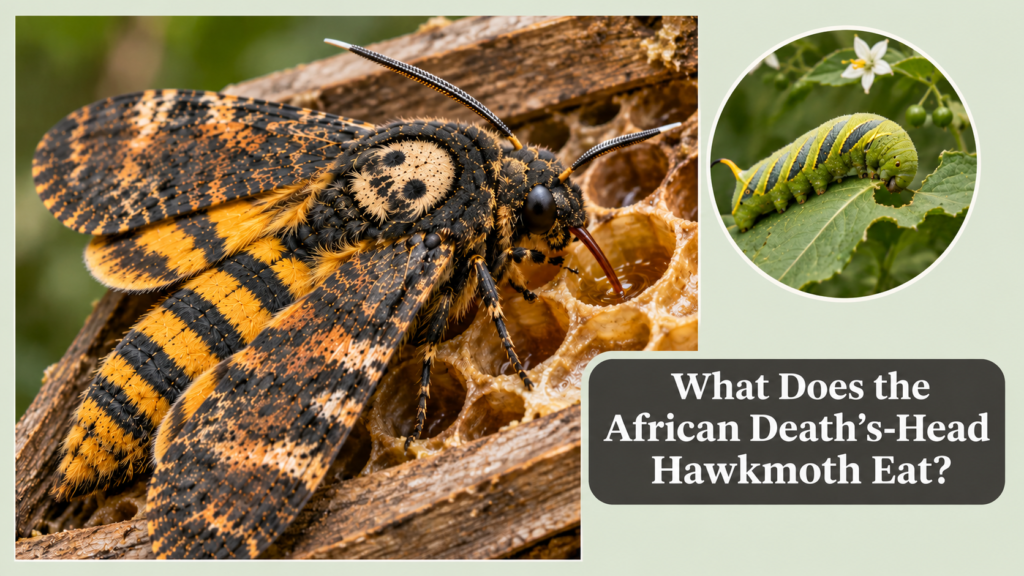
The caterpillar feeds on leaves from a wide range of plants, with nightshades especially important. Potato is a familiar host, and larvae may also use other plants in the nightshade family, including tomato, tobacco, and related species. They can feed on additional plant families as well, so potato is not the only possible host. A caterpillar found on another plant should not be ruled out on that basis alone.
The adult has an unusual diet for a hawkmoth. It is famous for entering honeybee hives and drinking stored honey. Its short, strong proboscis is suited to piercing capped honey cells, and its body is covered with dense scales that offer some protection from bee stings. Chemical similarities to honeybees may help A. atropos avoid being recognized as an intruder once inside the colony.
The moth may also feed on nectar, sap, or other sugary materials. Honey theft is a well-known behavior, but it does not mean every adult enters a hive. Its visits can concern beekeepers, while the moth itself remains a natural part of the ecosystem.
Why Does It Make a Squeaking Sound?
When disturbed, an adult African death’s-head hawkmoth can make a short, high-pitched squeak. It draws air into its throat region and expels it through the mouthparts; a vibrating structure helps produce the sound. The squeak is unusual among moths and may startle a predator or handler, giving the insect a chance to escape.
The sound has inspired the claim that the moth imitates the piping call of a queen honeybee to confuse hive workers. Although the moth can squeak in or near a hive, it is not established that the sound reliably imitates a queen or is the main reason the moth can feed there. Its chemical camouflage and physical traits are also important parts of its relationship with honeybees.
African Death’s-Head Hawkmoth Life Cycle
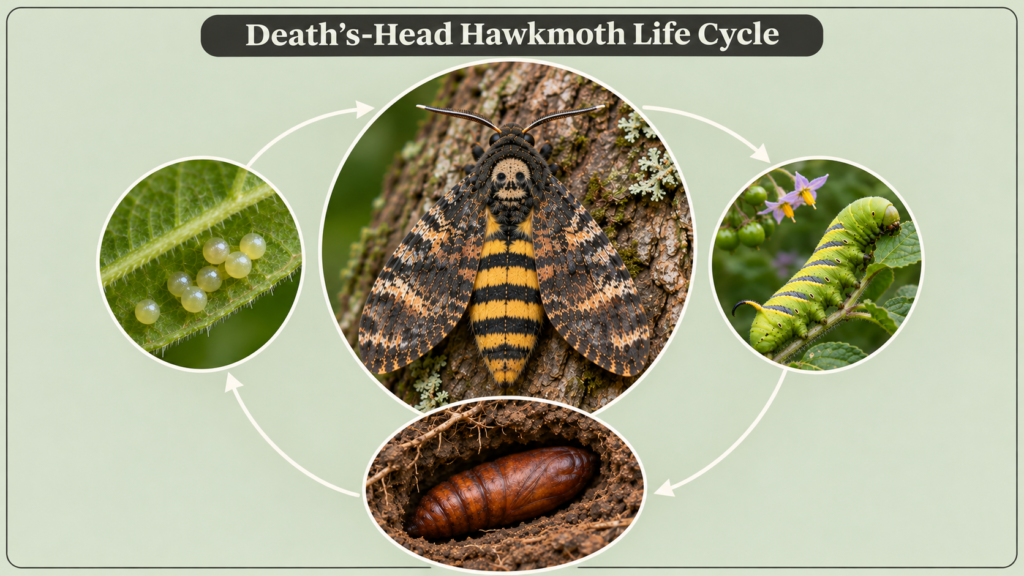
The moth develops through four stages: egg, caterpillar, pupa, and adult. Females lay eggs singly on suitable host plants. After hatching, caterpillars feed and grow through several molts. Their appearance changes as they mature, and they eventually stop feeding before leaving the plant to pupate.
From caterpillar to adult
A mature caterpillar burrows into loose soil and forms a chamber below the surface. It changes into a smooth, brown pupa, where the adult moth develops. The time spent as a pupa varies with conditions and season. When development is complete, the adult emerges underground, climbs to a surface, and allows its wings to expand and dry before flight.
In warm parts of its range, A. atropos may produce more than one generation in a year. In cooler regions, adults can arrive as migrants, and the next generation may not persist through winter. For this reason, the exact timing and number of broods differ by location and climate.
Is the African Death’s-Head Hawkmoth Dangerous?
No. The adult moth is not poisonous, venomous, or capable of stinging people. Its skull-like marking, large body, and squeak can make it seem threatening, but they are not signs of danger. The caterpillar’s rear horn is also harmless. Historical stories about the moth bringing death or causing blindness are folklore, not evidence of a harmful effect.
If you find one resting, observe it without grabbing its wings or squeezing its body. Moths have delicate scales and legs that can be damaged by handling. If it is indoors, opening a window or gently guiding it toward an exit is usually enough. Avoid using insecticide on a harmless moth that can be released outdoors.
Frequently Asked Questions
Is the African death’s-head hawkmoth the same as Acherontia atropos?
Yes. “African death’s-head hawkmoth” is a common name for Acherontia atropos. The genus also contains Acherontia styx and Acherontia lachesis, which are related species and may also be called death’s-head hawkmoths.
Why does the African death’s-head hawkmoth have a skull marking?
The pale pattern on its thorax naturally resembles a skull. It is a color pattern, not a real skull and not a sign that the moth is dangerous. The marking helped inspire the moth’s name and the superstitions associated with it.
Does the African death’s-head hawkmoth really eat honey?
Yes. Adults may enter honeybee hives and feed on stored honey. Their short, sturdy proboscis can pierce capped honey cells. Not every moth visits a hive, and the squeak is not proven to be a dependable way of imitating a queen bee.
What plants do African death’s-head hawkmoth caterpillars eat?
The caterpillars feed on many plants, especially nightshades such as potato, tomato, and tobacco. They can also use plants from other families. Host plants vary by region, so finding a caterpillar on an unfamiliar plant does not automatically rule out this species.
Can the African death’s-head hawkmoth hurt people?
No. It does not sting, bite, or produce venom that harms people. Its appearance can be startling, but it is safe to observe. Avoid handling it roughly, because contact can damage its wings and body.
