

Hoverflies are some of the most beneficial and visually striking insects found in gardens, meadows, and woodlands. Known for their impressive hovering ability and mimicry of bees or wasps, they play a vital role in pollination and pest control. This collection highlights 21 unique types of hoverflies, each with its own appearance, behavior, and ecological value.
1. Drone Fly

A widespread hoverfly known for its close resemblance to the honeybee. Drone flies are common in gardens, fields, and parks, where they play an important role as pollinators.
Identification
- Bee-like body with brown and yellow markings
- Large, dark compound eyes
- Short antennae compared to bees
- Transparent wings held outwards at rest
- Slightly hairy thorax but less hairy than bees
- Distinctive hovering flight behavior
Habitat
Drone flies thrive in gardens, crop fields, wetlands, and urban green areas. Adults are frequently seen visiting flowers for nectar and pollen, whereas larvae (rat-tailed maggots) develop in stagnant or polluted water.
Behavior
They mimic honeybees for protection, hovering in place and darting quickly between flowers. They are harmless and do not sting. Their larvae play an ecological role by helping break down organic matter.
Diet
Adults feed primarily on nectar and pollen, making them important pollinators. Larvae feed on decaying organic material in water, contributing to nutrient recycling in their environment.
2. Marmalade Hoverfly

A brightly patterned and very common hoverfly often seen in gardens and meadows, known for its striking orange-and-black bands and agile hovering behavior.
Identification
- Orange abdomen with two bold black bands
- Distinctive black central line on the thorax
- Clear wings with a slight dark tint near the edges
- Small, slender body shape
- Large reddish-brown eyes
- Rapid, darting flight with precise hovering
Habitat
Found in gardens, hedgerows, open fields, and woodland edges. This species thrives in sunny areas rich in flowering plants and is one of the most frequently observed hoverflies in Europe and many other regions.
Behavior
Active for long seasons, often appearing from early spring to late autumn. Known for migration in some regions. Peaceful, non-stinging, and commonly seen hovering just above flowers.
Diet
Adults feed on nectar and pollen, especially from daisies, marigolds, and umbellifers. Larvae are beneficial predators that feed on aphids, helping naturally control garden pests.
3. Hornet Mimic Hoverfly

A large, striking hoverfly that closely resembles a hornet, using mimicry to deter predators. Despite its intimidating appearance, it is completely harmless and unable to sting.
Identification
- Bold yellow and black hornet-like markings
- Large, robust body
- Brown-tinted wings
- Dark head with large reddish eyes
- Short antennae unlike real hornets
- Slow, purposeful flight pattern
Habitat
Common in wooded areas, parks, gardens, and near decaying trees. Adults are often seen resting on foliage or visiting flowers for nectar. They prefer warm, sunny spots with plenty of vegetation.
Behavior
Relies heavily on Batesian mimicry to appear dangerous. Flies slowly and confidently like a hornet. Non-aggressive and harmless, spending most of its time feeding or basking.
Diet
Adults consume nectar and pollen from a variety of flowering plants. Larvae typically develop in rotting wood or decaying organic matter, contributing to natural decomposition processes.
4. Tiger Hoverfly

A boldly patterned hoverfly recognized by its striking yellow-and-black banding, giving it a tiger-like appearance. It is a strong flier often seen darting around sunny flower-rich habitats.
Identification
- Bright yellow and black striped abdomen
- Clear wings with slight shading near the tips
- Slender body with a wasp-like look
- Large, dark compound eyes
- Short antennae typical of hoverflies
- Quick, agile hovering flight
Habitat
Found in meadows, gardens, woodland edges, and open grassy areas. Prefers warm, sunny environments with abundant flowering plants. Often seen resting on leaves or hovering low over vegetation.
Behavior
Active and fast-moving, frequently shifting between flowers. The wasp-like pattern provides protection from predators. Completely harmless, it relies on mimicry rather than aggression.
Diet
Adults feed on nectar and pollen from various flowering plants. Larvae commonly prey on aphids, playing a helpful role in natural pest control.
5. Dead Head Hoverfly

A large, distinctive hoverfly named for the dark patch on its thorax, which can resemble a skull-like mark. Despite its bold appearance, it is a gentle and important pollinator.
Identification
- Brownish-yellow abdomen with darker bands
- Prominent dark “dead head” marking on the thorax
- Broad, strong body structure
- Clear wings with slight smoky tint
- Large reddish-brown eyes
- Steady, slow hovering flight
Habitat
Common in gardens, woodlands, hedgerows, and fields. Often seen visiting flowers or resting on foliage. Prefers warm, sunny areas with plenty of nectar sources.
Behavior
Calm and slow-moving, often lingering around blossoms. Uses its appearance as a deterrent but is completely harmless. Adults are active for long periods during warm seasons.
Diet
Adults consume nectar and pollen from a wide range of flowers. Larvae typically develop in decaying plant material or organic debris, contributing to decomposition and soil health.
6. Migrant Hoverfly

A highly mobile hoverfly species known for its long-distance migratory behavior. It appears in large numbers during warm seasons and is commonly seen hovering above flowers in open landscapes.
Identification
- Yellow and black striped abdomen
- Slender body with a wasp-like look
- Clear wings with subtle shading
- Reddish-brown eyes
- Distinct dark line running along the thorax
- Fast, agile hovering and darting flight
Habitat
Found in meadows, gardens, farmland, and coastal areas. Because of its migratory nature, it can appear suddenly in large populations, especially during warm weather and flower-rich periods.
Behavior
Known for seasonal migrations across regions. Active, fast-flying, and often seen in swarms during peak migration. Non-aggressive and harmless despite its wasp-like mimicry.
Diet
Adults feed on nectar and pollen from various flowering plants, often favoring daisies and umbellifers. Larvae are beneficial aphid predators, aiding natural pest control.
7. Footballer Hoverfly

A colorful hoverfly named for its striped “jersey-like” pattern, resembling a sports uniform. It is commonly seen basking on leaves or hovering around flowers in sunny spots.
Identification
- Bright orange abdomen with bold black bands
- Distinctive striped thorax resembling a sports jersey
- Clear wings with slight smoky tint
- Large, reddish-brown eyes
- Slim, agile body shape
- Confident hovering flight
Habitat
Found in gardens, parks, woodland edges, and hedgerows. Prefers warm, sunny areas with abundant flowers and leafy resting places. Often seen perched on leaves between feeding flights.
Behavior
Active and alert, frequently hovering in one place before darting to a new flower. Non-stinging and peaceful, relying on vibrant coloration for mimicry and predator deterrence.
Diet
Adults feed on nectar and pollen from various flowering plants. Larvae typically prey on aphids, making this species helpful for natural pest reduction.
8. White-banded Hoverfly

A striking hoverfly distinguished by the pale or white bands across its abdomen. Known for its clean, contrasting coloration and graceful hovering behavior.
Identification
- Dark abdomen with clear white or pale bands
- Smooth, shiny thorax
- Clear wings with minimal tint
- Medium-sized, slender body
- Large, dark compound eyes
- Stable, precise hovering flight
Habitat
Found in meadows, woodland edges, gardens, and open grassy areas. Prefers sunny locations rich in flowering plants and is commonly seen visiting blossoms during warm months.
Behavior
Calm and steady in flight, often hovering low over vegetation or drifting slowly between flowers. Harmless to humans, using its patterned appearance as mild mimicry for protection.
Diet
Adults feed on nectar and pollen from a variety of wildflowers. Larvae typically inhabit decaying plant material or moist organic debris, contributing to natural decomposition.
9. Common Pond Hoverfly

A hoverfly frequently found near water bodies, especially ponds and wetlands. It is known for its association with aquatic habitats and its steady, purposeful flight.
Identification
- Dark abdomen with yellow or pale side markings
- Slender, medium-sized body
- Clear wings with slight shading
- Large, rounded dark eyes
- Smooth, glossy thorax
- Calm hovering behavior near water
Habitat
Typically found around ponds, marshes, streams, and wet meadows. Adults visit nearby flowering plants for nectar, while larvae thrive in shallow water rich in organic material.
Behavior
Often flies low over water or vegetation, moving slowly and deliberately. Harmless and non-stinging, it relies on gentle mimicry and agility for protection.
Diet
Adults feed on nectar and pollen from wetland and meadow flowers. Larvae usually live in water, feeding on decaying organic matter and contributing to the health of aquatic ecosystems.
10. Greater Bulb Fly
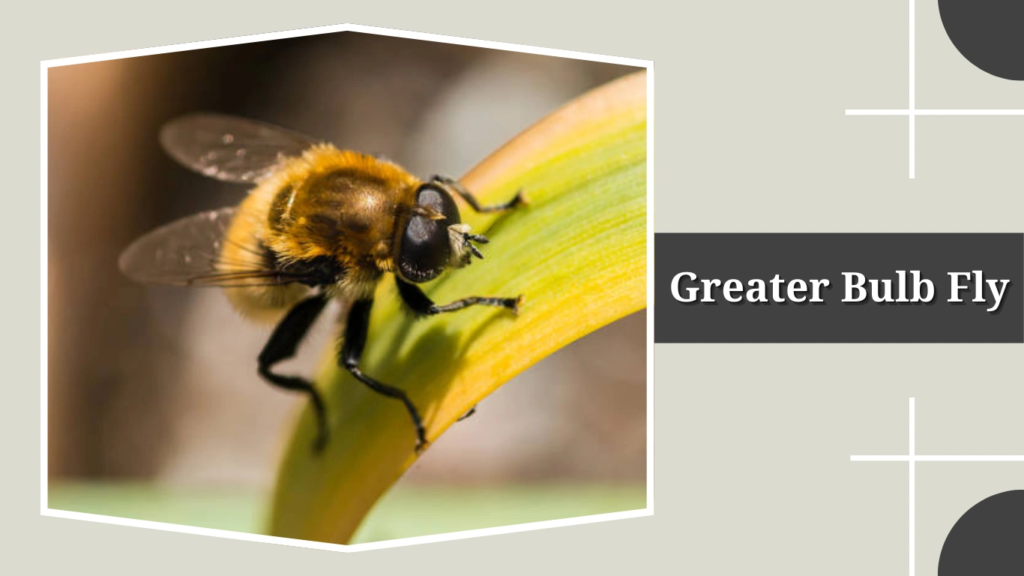
A large hoverfly species often associated with bulb plants. Its larvae are known for developing inside bulbs, giving it a strong connection to garden and agricultural settings.
Identification
- Robust, rounded body shape
- Yellowish to brown abdomen with darker patches
- Clear wings with a slight smoky tint
- Short antennae and large dark eyes
- Bee-like appearance but less hairy
- Slow, steady flight
Habitat
Common in gardens, flower beds, woodland edges, and areas where bulb plants grow. Adults visit flowering plants for nectar, while larvae inhabit bulbs of various ornamental species.
Behavior
Calm and slow-moving, often hovering close to the ground near host plants. Though sometimes considered a pest due to larvae feeding on bulbs, adults are harmless and beneficial pollinators.
Diet
Adults feed on nectar and pollen from common garden flowers. Larvae consume the inner tissues of plant bulbs, which can sometimes damage ornamental or cultivated plants.
11. Lesser Bulb Fly

A smaller relative of the greater bulb fly, this species is also linked to bulb-growing areas. While less destructive, it still develops in decaying or damaged bulbs.
Identification
- Smaller, slimmer body than the greater bulb fly
- Dark abdomen with lighter patches
- Clear wings with mild smoky shading
- Large eyes and short antennae
- Slightly bee-like but less hairy
- Slow, hovering flight close to vegetation
Habitat
Found in gardens, plant beds, and woodland edges, especially where bulb plants grow. Adults visit flowering plants, while larvae develop in decaying or weakened bulbs rather than healthy ones.
Behavior
Moves slowly and often remains close to the ground near host plants. Completely harmless to humans. Its larvae generally focus on soft, decaying plant tissue.
Diet
Adults consume nectar and pollen from various garden flowers. Larvae feed on decomposing bulb material, playing a role in breaking down organic plant matter.
12. Rat-tailed Maggot Hoverfly

A unique hoverfly species best known for its larvae, called rat-tailed maggots, which possess a long breathing tube for living in stagnant water. Adults are agile fliers and frequent flower visitors, contributing significantly to pollination.
Identification
- Slender body with yellow and black markings
- Clear wings held out to the sides
- Large reddish-brown eyes
- Short antennae
- Larvae have long “tail-like” breathing tubes
- Precise hovering behavior
Habitat
Common around ponds, ditches, wetlands, manure pits, and other areas with stagnant or nutrient-rich water. Adults visit nearby flowers, while larvae thrive in polluted or low-oxygen water environments.
Behavior
Adults hover steadily and move quickly between flowers. Larvae use their extended tail to breathe air from the surface while submerged in murky water, giving the species its distinctive name.
Diet
Adults feed on nectar and pollen from a wide range of flowering plants. Larvae feed on organic debris and microorganisms in stagnant water, playing a vital role in nutrient recycling.
13. Common Hoverfly

A widespread and familiar hoverfly frequently seen in gardens, parks, fields, and woodlands. Known for its gentle nature, bright coloration, and steady hovering, it plays a major role in pollination and natural pest control.
Identification
- Yellow and black banded abdomen
- Slender, medium-sized body
- Clear wings with fine venation
- Large reddish-brown eyes
- Short hoverfly antennae
- Agile hovering and quick darting movement
Habitat
Found in a wide variety of environments including gardens, hedgerows, grasslands, and forest edges. Prefers sunny areas with abundant flowering plants and places where aphids are present for larval feeding.
Behavior
Peaceful and non-stinging, often seen hovering around flowers or resting on leaves. Active during warm months and may appear in large numbers. Larvae hunt aphids, providing natural pest regulation.
Diet
Adults feed on nectar and pollen from many types of flowers, especially daisies, marigolds, and umbellifers. Larvae primarily consume aphids, making this species highly beneficial in both natural and cultivated habitats.
14. Tapered Drone Fly
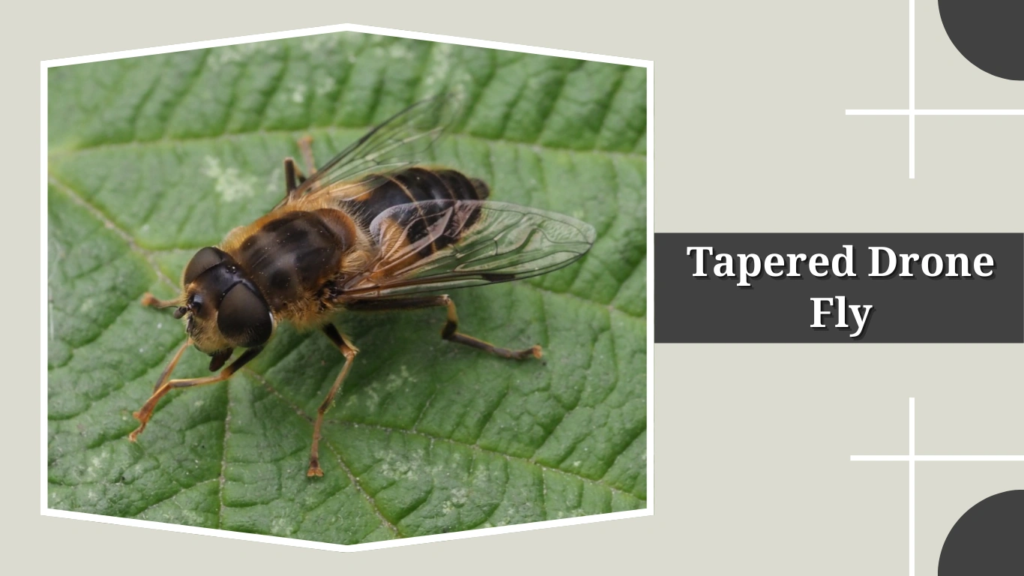
A hoverfly with a distinctive elongated abdomen that narrows toward the tip, giving it a tapered appearance. Common in gardens and open landscapes, it resembles a small bee but is completely harmless and an effective pollinator.
Identification
- Long, tapered abdomen
- Brown and yellow bee-like pattern
- Clear wings with slight tint
- Large dark eyes
- Short antennae typical of hoverflies
- Smooth, hovering flight
Habitat
Found in gardens, meadows, wetlands, and farmland. Adults often visit flowering plants, while larvae typically develop in stagnant or organically rich water, similar to other drone fly species.
Behavior
Calm and steady in flight, often hovering close to flowers before darting away. Uses subtle mimicry to avoid predators but poses no threat. Adults are most active in warm, sunny weather.
Diet
Adults feed on nectar and pollen from various flowering plants. Larvae consume decaying organic material in water, helping break down waste and maintain ecological balance.
15. Thick-legged Hoverfly
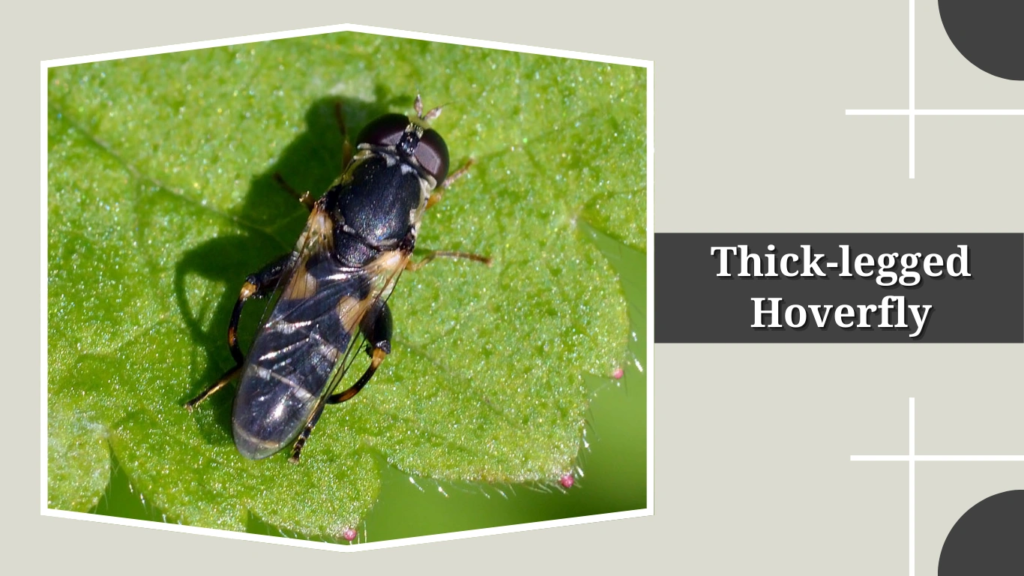
A distinctive hoverfly species recognized by its noticeably swollen hind legs, which give it a unique and somewhat robust appearance. Active around flowers, it contributes greatly to pollination in warm, sunny environments.
Identification
- Enlarged, thick hind legs
- Yellow and black striped abdomen
- Clear wings with faint shading
- Compact, sturdy body shape
- Large compound eyes
- Smooth hovering and quick maneuverability
Habitat
Common in gardens, meadows, woodland edges, and fields. Prefers sunny patches rich in wildflowers where adults can feed easily. Larvae typically inhabit decaying organic matter or plant debris.
Behavior
Often seen resting on leaves or hovering above flowers. Despite its bold appearance, it is harmless and non-stinging. Its exaggerated hind legs may play a role in mating displays and mimicry.
Diet
Adults consume nectar and pollen from a variety of flowering plants. Larvae feed on decomposing plant material, aiding in nutrient recycling within ecosystems.
16. Sun Fly
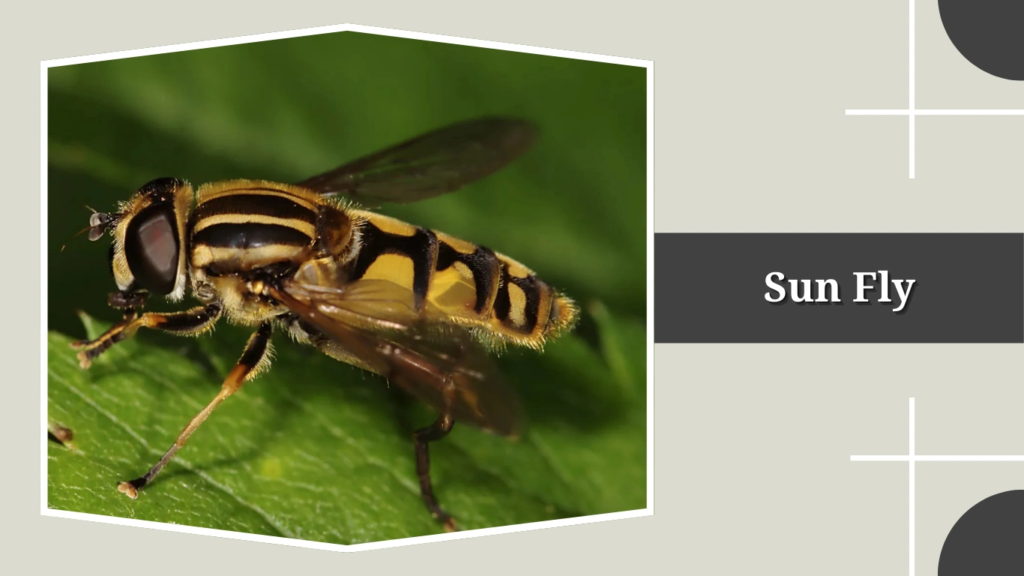
A bright, reflective hoverfly species commonly seen basking in sunlight, which inspires its name. It favors open, warm habitats where it hovers gracefully among flowers, playing an important role in pollination.
Identification
- Shiny, often metallic body surface
- Yellow and black banded abdomen
- Clear wings with subtle shading
- Large, rounded eyes
- Short antennae
- Smooth, gliding hover behavior
Habitat
Found in sunny meadows, gardens, grasslands, and open forest edges. It prefers warm climates and locations with abundant flowering plants. Often observed resting on sunlit leaves.
Behavior
Active during the warmest parts of the day. Frequently hovers above flowers or perches in bright, open spots to absorb heat. Harmless, relying on mimicry and flight agility for protection.
Diet
Adults feed on nectar and pollen from a variety of sun-loving flowers. Larvae often develop in decaying organic matter or moist plant debris, contributing to decomposition and soil health.
17. Bumblebee Hoverfly

A large hoverfly species that closely mimics the appearance of a bumblebee, offering excellent protection from predators. Despite its fuzzy and intimidating look, it is completely harmless and a valuable pollinator.
Identification
- Furry, bumblebee-like body
- Yellow, black, and sometimes white banding
- Clear wings with a smoky tint
- Large dark eyes
- Short, stout antennae
- Strong, steady hovering flight
Habitat
Common in gardens, heaths, meadows, and woodland edges. Prefers flower-rich areas where it can feed frequently. Larvae are usually found in decaying wood, plant debris, or rotting vegetation.
Behavior
Moves slowly and confidently, much like a real bumblebee. Often seen hovering close to flowers or resting on low vegetation. Harmless and non-stinging, it relies on mimicry for defense.
Diet
Adults consume nectar and pollen from a wide range of flowering plants, especially those with open blooms. Larvae feed on decaying organic material, helping to recycle nutrients in their environment.
18. Narcissus Bulb Fly

A hoverfly species often associated with ornamental bulb plants, especially daffodils. Its robust body and bee-like appearance help it blend into garden environments while contributing to pollination.
Identification
- Thick, rounded bee-like body
- Yellowish to brown abdomen with darker patches
- Clear wings with light smoky tint
- Large eyes and short antennae
- Strong, purposeful flight
- Larvae develop inside plant bulbs
Habitat
Typically found in gardens, parks, flower beds, and areas where bulb plants such as narcissus, tulips, and hyacinths grow. Adults visit flowers, while larvae inhabit and feed on bulb tissues.
Behavior
Slow-moving and often seen hovering near flowering plants or low vegetation. Its mimicry provides protection, though it is fully harmless. Larval activity inside bulbs can occasionally harm ornamental plants.
Diet
Adults feed on nectar and pollen from common garden flowers. Larvae consume the inner tissues of bulb plants, which provides nourishment but may damage cultivated bulbs.
19. Long-hovering Hoverfly
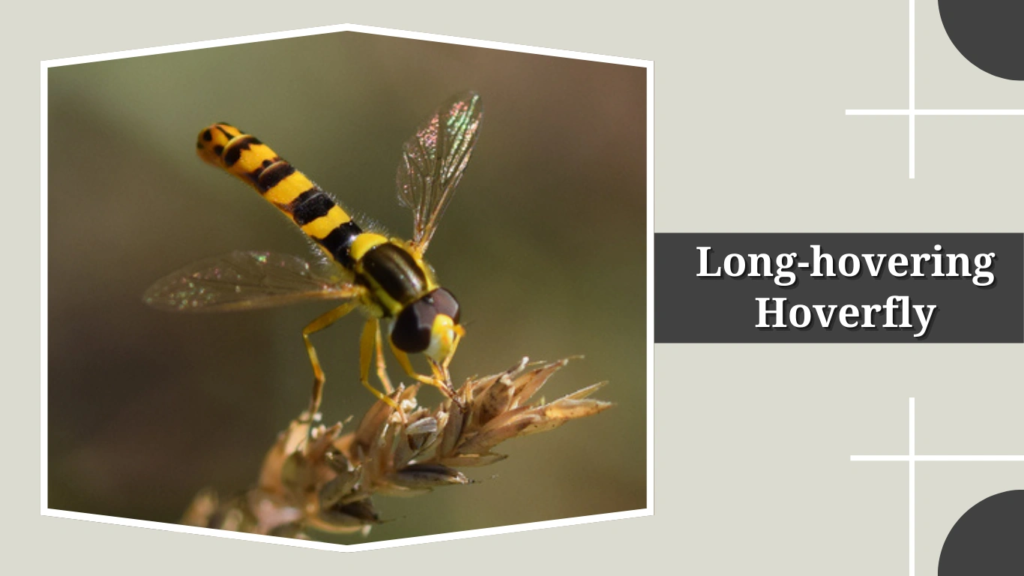
A hoverfly known for its ability to remain suspended in one spot for an extended time, showcasing remarkable hovering stability. It is often seen in open, sunny areas where flowers are abundant.
Identification
- Slender body with yellow and black markings
- Clear, elongated wings
- Large, rounded eyes
- Short, typical hoverfly antennae
- Exceptional hovering ability
- Smooth, controlled flight movements
Habitat
Found in meadows, gardens, hedgerows, and open grassy areas. Prefers sunny environments where it can hover and feed efficiently. Larvae usually develop in decaying plant material or moist organic debris.
Behavior
Displays long, motionless hovering, often remaining in mid-air before quickly darting to another flower. Peaceful and harmless, relying on mimicry and agility for protection.
Diet
Adults feed on nectar and pollen from a variety of flowering plants. Larvae consume decaying organic matter, contributing to natural nutrient recycling in their ecosystems.
20. Leaf-miner Hoverfly

A hoverfly species named for its larvae, which create winding tunnels—or “mines”—inside plant leaves. Adults are graceful fliers and frequent flowers, playing an important role in natural pollination cycles.
Identification
- Small to medium-sized slender body
- Yellow and black banded abdomen
- Clear wings with light venation
- Large dark eyes
- Short antennae
- Larvae create visible leaf mines
Habitat
Common in gardens, forests, farmland, and hedgerows. Adults visit flowering plants, while larvae inhabit the inside of leaves, feeding between upper and lower surfaces and forming characteristic leaf trails.
Behavior
Adults hover lightly around vegetation, often resting on leaves or flowers. They are harmless and rely on mimicry and swift flight for safety. Larvae remain hidden inside leaves during development.
Diet
Adults feed on nectar and pollen from a range of flowering plants. Larvae consume internal leaf tissue, creating mines that may appear as winding patterns but usually cause minimal long-term harm to the plant.
21. Pied Hoverfly
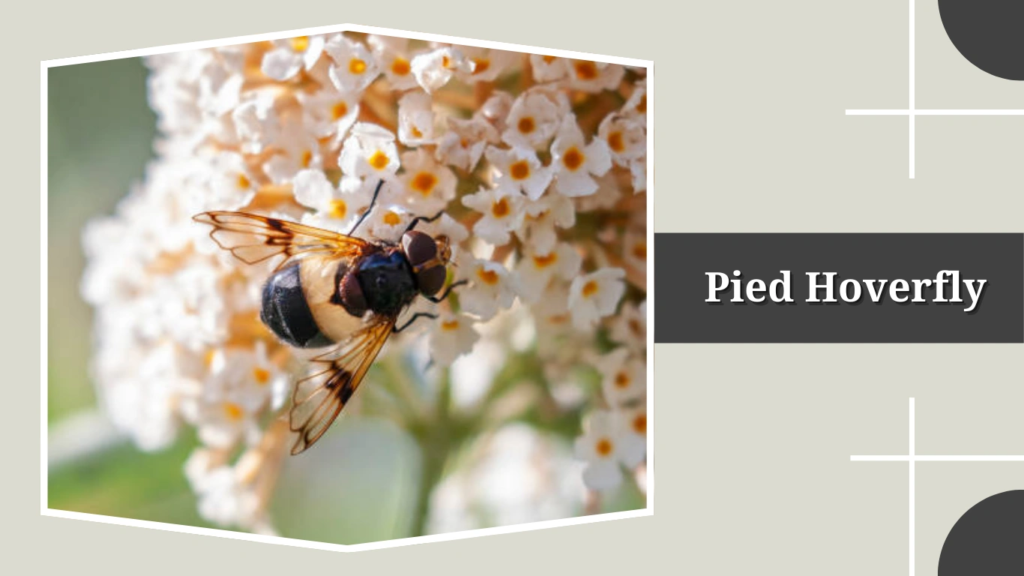
A distinctively patterned hoverfly known for its contrasting black and white markings. Its striking appearance makes it easy to recognize as it hovers confidently around flowers in a variety of habitats.
Identification
- Bold black and white striped abdomen
- Smooth, shiny thorax
- Clear wings with fine venation
- Large, dark compound eyes
- Short hoverfly-style antennae
- Controlled, stable hovering flight
Habitat
Found in gardens, woodland edges, meadows, and hedgerows. Prefers sunny locations with abundant flowers. Larvae often develop in decaying organic material or damp plant debris.
Behavior
Active and agile, frequently hovering near flowers or moving quickly between plants. The contrasting coloration serves as mild mimicry, though the species is entirely harmless and non-stinging.
Diet
Adults consume nectar and pollen from a wide range of flowering plants. Larvae typically feed on decomposing plant matter, helping maintain ecological balance through nutrient recycling.
