
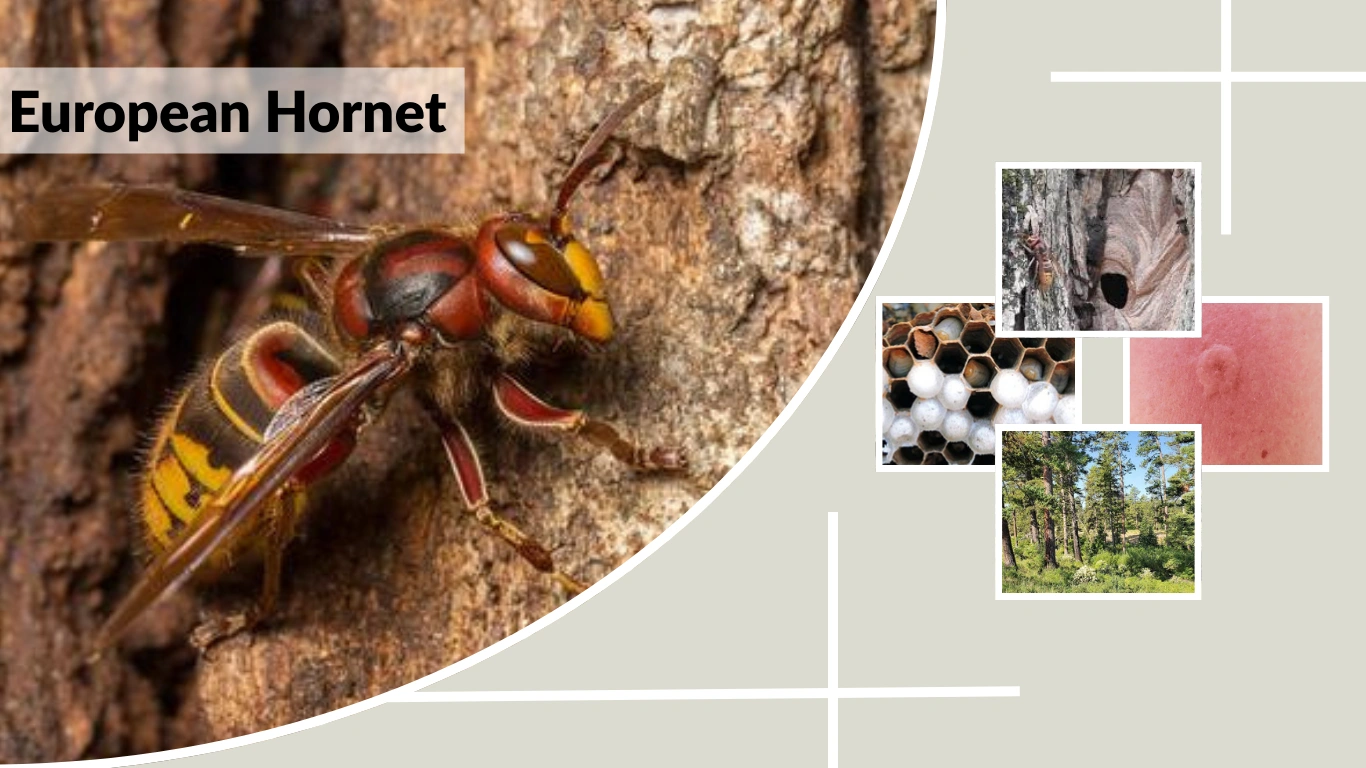
The European Hornet (Vespa crabro) is the largest hornet species native to Europe and one of the few hornets found in North America. Recognized for its reddish-brown body, yellow-striped abdomen, and deep buzzing flight, it has long been a subject of fascination and fear. While its size and sting can intimidate, the European Hornet is not the aggressive “monster” it is sometimes made out to be. In reality, it plays an important role in controlling insect populations and contributes to ecological balance.
What is the European Hornet?
The European Hornet is a member of the wasp family Vespidae and belongs to the genus Vespa, which includes other hornet species such as the Asian Giant Hornet. Unlike its Asian counterpart, which is larger and more notorious, the European Hornet tends to be less aggressive toward humans. It is considered the only true hornet species native to Europe, though it has since spread beyond its original range.
Scientific Classification
- Kingdom: Animalia
- Phylum: Arthropoda
- Class: Insecta
- Order: Hymenoptera
- Family: Vespidae
- Genus: Vespa
- Species: Vespa crabro
Common Names
The insect is most commonly called the European Hornet, but in different regions, it may also be referred to as the brown hornet or simply a giant wasp. These alternate names reflect its intimidating size and appearance.
Physical Characteristics
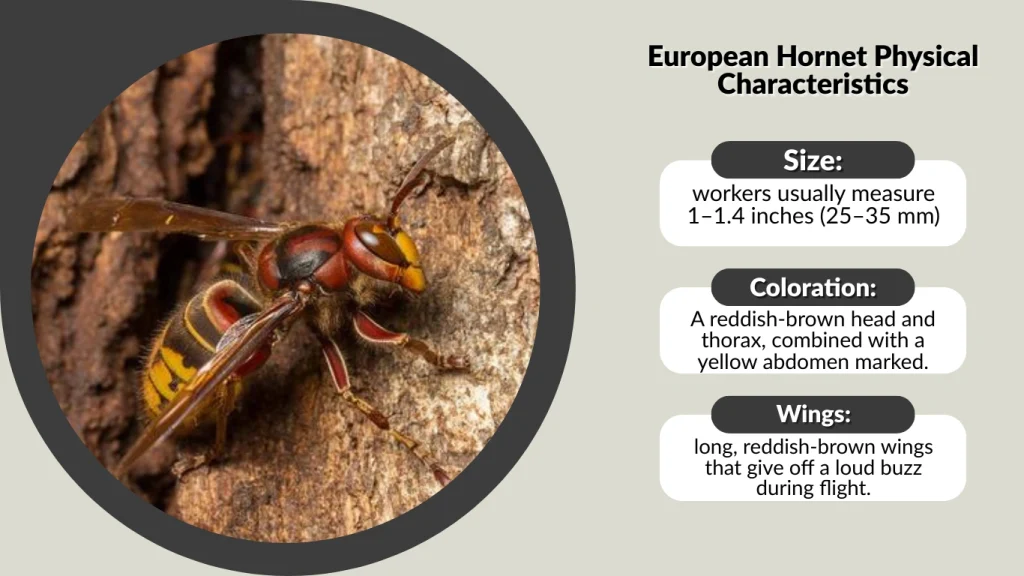
The European Hornet is one of the largest wasps people are likely to encounter in Europe or North America. Its body size, buzzing sound, and flight behavior set it apart from smaller yellowjackets and common wasps.
Identification
Adult European Hornets can be recognized by a few key features:
- Size: workers usually measure 1–1.4 inches (25–35 mm), while queens may grow up to 1.6 inches (40 mm).
- Coloration: a reddish-brown head and thorax, combined with a yellow abdomen marked with brown stripes.
- Wings: long, reddish-brown wings that give off a loud buzz during flight.
Their mandibles are powerful, designed for chewing wood fibers to build nests and for capturing prey. They also possess a stinger capable of delivering venom multiple times, unlike honeybees which die after stinging.
European Hornet vs Other Hornets
Compared to the Asian Giant Hornet (Vespa mandarinia), the European Hornet is smaller and less dangerous to humans. Its sting is painful but not as toxic. Unlike yellowjackets, which are often more aggressive around food, European Hornets are usually more reserved unless provoked near their nest.
Habitat and Distribution
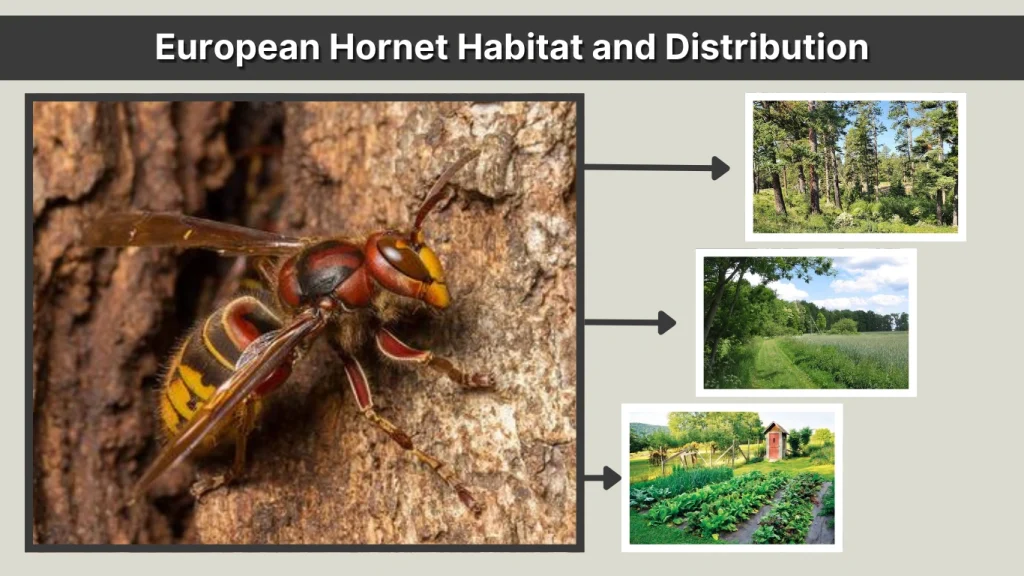
The European Hornet has a wide distribution and has adapted to diverse environments. Its spread beyond Europe has raised questions about its ecological impact in new regions.
Native Range
As the name suggests, the species is native to Europe, where it thrives across much of the continent. It is also present in parts of Asia, including western Russia and northern China.
Preferred Habitat
European Hornets favor wooded areas, forest edges, and rural landscapes. They are often seen near gardens and farmland where prey insects are abundant. Uniquely, they can also adapt to human-dominated areas, building nests in attics, sheds, and wall voids. Their ability to coexist with people contributes to their visibility during summer and autumn.
Global Spread
The hornet was first introduced to North America in the mid-19th century. Since then, it has become established in parts of the United States and Canada, particularly in the eastern regions. Although it is considered non-native in these areas, it has integrated into local ecosystems without causing the same alarm as the Asian Giant Hornet.
Nesting and Life Cycle
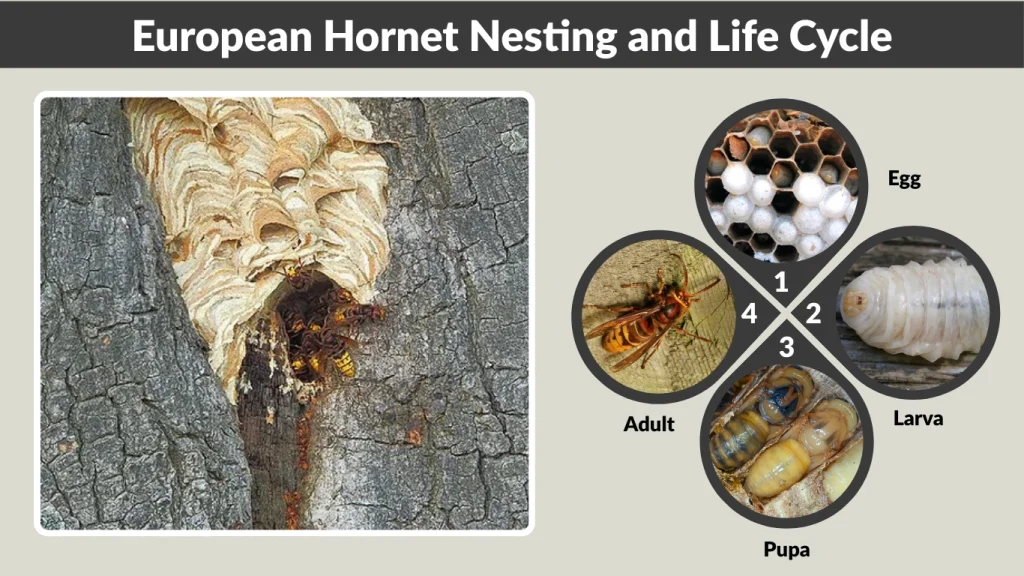
Like other social wasps, European Hornets live in colonies. Their nests are a marvel of insect engineering, created from a papery substance made by chewing wood fibers mixed with saliva.
Nest Characteristics
Nests are typically found in tree hollows, barns, wall cavities, and attics. The structure consists of layered cells arranged in tiers, enclosed by a protective papery shell. A mature nest can contain several hundred individuals at its peak, though it is generally smaller than nests built by yellowjackets.
Life Cycle Stages
The colony’s development follows a seasonal pattern:
- Egg: The queen lays eggs in spring after emerging from hibernation.
- Larva: Eggs hatch into larvae, which are fed by workers with chewed insects.
- Pupa: After several molts, the larvae spin silk caps and pupate inside their cells.
- Adult: Adults emerge as workers, drones, or new queens depending on the season.
Seasonal Cycle
The European Hornet colony is annual. In spring, a queen starts building the nest alone. By summer, the colony expands as workers take over duties of feeding larvae and enlarging the nest. In autumn, the colony reaches peak numbers, often up to 700 individuals. With the onset of winter, the colony dies off, leaving only newly mated queens to survive and restart the cycle the following year.
Behavior and Characteristics

The behavior of European Hornets is shaped by their social structure and survival strategies. They are less aggressive than their reputation suggests, though they will defend their colony if disturbed.
Social Structure
The colony functions in a highly organized system:
- Queen: primary egg-layer and founder of the nest.
- Workers: perform hunting, nest building, and defense.
- Drones (males): emerge late in the season and mate with new queens.
This hierarchy ensures efficiency, with each group carrying out specialized tasks.
Feeding Habits
European Hornets are omnivorous. Adults consume sugary foods such as tree sap, nectar, and fruit juices, while larvae require protein. Workers hunt other insects—including flies, grasshoppers, moths, and even bees—which they chew into a paste to feed the developing larvae. This predatory role makes them valuable in controlling pest populations.
Aggression and Defense
Contrary to common belief, European Hornets are not naturally aggressive toward humans. They generally avoid conflict unless their nest is threatened. If disturbed, however, they release alarm pheromones that can trigger multiple hornets to attack. Their defensive nature means that nest removal should only be attempted by professionals.
European Hornet Sting

The sting of a European Hornet is often the most feared aspect of the species. While painful, it is typically not life-threatening to healthy individuals.
Pain and Venom
The sting produces a sharp burning sensation, stronger than that of a common wasp or bee. The venom contains compounds that break down cell membranes and cause inflammation. Unlike bees, hornets can sting repeatedly without dying, which makes multiple stings possible if a person disturbs a colony.
Symptoms in Humans
Reactions to a sting vary, but most include:
- Immediate sharp pain and swelling at the site.
- Redness and itching lasting for hours.
- In rare cases, severe allergic reactions such as anaphylaxis.
Danger Level
For most people, stings are not fatal. However, multiple stings or allergic responses can be dangerous and require medical treatment. It is recommended to clean the wound, apply ice, and monitor for signs of allergic reaction. Epinephrine is vital for individuals with known allergies.
European Hornet vs Asian Giant Hornet

European Hornets are often confused with their more infamous cousin, the Asian Giant Hornet (Vespa mandarinia). While they share similarities, key differences exist in size, behavior, and danger to humans.
Size and Appearance
The Asian Giant Hornet is the largest hornet in the world, with queens growing over 2 inches long. In contrast, European Hornet queens rarely exceed 1.6 inches. Coloration also differs: Asian hornets have bright orange heads and bold black-yellow bands, while European Hornets display a reddish-brown head and thorax with yellow-brown striped abdomens.
Behavior
European Hornets are less aggressive than Asian Giant Hornets. They generally avoid unnecessary conflict with humans and rarely attack unless their nest is disturbed. Asian hornets, on the other hand, are known for coordinated and devastating attacks on honeybee colonies. While European Hornets also hunt bees, their impact is less catastrophic and more localized.
Interaction with Humans
The European Hornet’s presence near homes and gardens often causes alarm. However, their actual behavior toward humans is usually less threatening than people assume.
Common Sightings
European Hornets are attracted to light at night, making them one of the few wasp species regularly seen buzzing around outdoor lamps and windows. Their loud flight can startle people, but they are typically only investigating light sources, not seeking to attack.
Myths and Misconceptions
Several myths surround European Hornets. They are often believed to attack humans without provocation or to deliberately seek out confrontation. In reality, they are defensive, not aggressive. They prefer to conserve energy for hunting and nest maintenance, only stinging when threatened.
Cultural Perceptions
In parts of Europe, hornets have been linked to folklore and superstition. Some stories portrayed them as omens of bad luck or destruction. However, modern science shows they play a beneficial ecological role. In certain rural regions, locals even tolerate hornet nests, recognizing their pest-control benefits.
European Hornet Sting and Human Safety
Even though European Hornets are less aggressive, encounters can still be dangerous if a person gets too close to the nest.
- Single stings cause pain and swelling but are manageable with basic first aid.
- Multiple stings may be more serious, especially for children or those with allergic sensitivities.
- Allergic reactions require immediate medical treatment, as anaphylaxis can be life-threatening.
It is important for homeowners to respect hornet activity and call professionals if nests are located in high-risk areas such as attics, wall voids, or near doorways.
Control and Prevention
European Hornets generally don’t need removal unless their nests are close to human activity. If a nest is located in an attic, shed, or wall cavity, professional pest control is the safest option. Attempting to destroy a nest without proper protection can provoke mass attacks.
Prevention focuses on sealing entry points around homes, keeping food waste covered, and reducing bright outdoor lighting at night, which attracts hornets. When nests are in remote areas, it is often best to leave them undisturbed since they provide natural pest control.
Interesting Facts about European Hornets
- They are the only true hornet species native to Europe.
- Unlike most wasps, they can fly and hunt at night, attracted to artificial lights.
- Colonies can grow to 600–700 individuals at peak season.
- Despite their size, they are less aggressive than many smaller wasps.
- Their papery nests are made from chewed wood fibers mixed with saliva.
FAQs
How big do European Hornets get?
European Hornets are among the largest wasps in Europe. Workers usually grow between 1 to 1.4 inches (25–35 mm), while queens can reach up to 1.6 inches (40 mm). Their large size, combined with reddish-brown coloration and yellow-striped abdomen, makes them easy to identify compared to smaller wasps or bees.
Are European Hornets dangerous?
European Hornets can sting multiple times, and their venom causes sharp pain, redness, and swelling. For most healthy individuals, stings are not fatal, but people allergic to wasp venom are at greater risk of severe reactions such as anaphylaxis. Caution is advised around nests, but hornets usually avoid confrontation unless disturbed.
Where are European Hornets found?
European Hornets are native to Europe and parts of Asia. They were introduced to North America in the 19th century and have since established populations in the eastern United States. They typically inhabit woodlands, gardens, and rural areas, but they can also nest in wall cavities, attics, or outbuildings near human settlements.
What do European Hornets eat?
Adults feed on tree sap, nectar, and ripe fruit for energy. They are also skilled hunters, preying on insects like flies, grasshoppers, and moths. Workers chew captured insects into a paste to feed larvae, which in turn secrete a nourishing liquid that adults consume. This mutual exchange strengthens the entire colony.
Do European Hornets attack honeybees?
Yes, European Hornets occasionally attack honeybee colonies, but their impact is not as destructive as the Asian Giant Hornet’s. They typically hunt individual bees rather than wiping out entire colonies. Despite this, they can still pose a threat to local hives, especially if food sources are scarce late in the season.
