
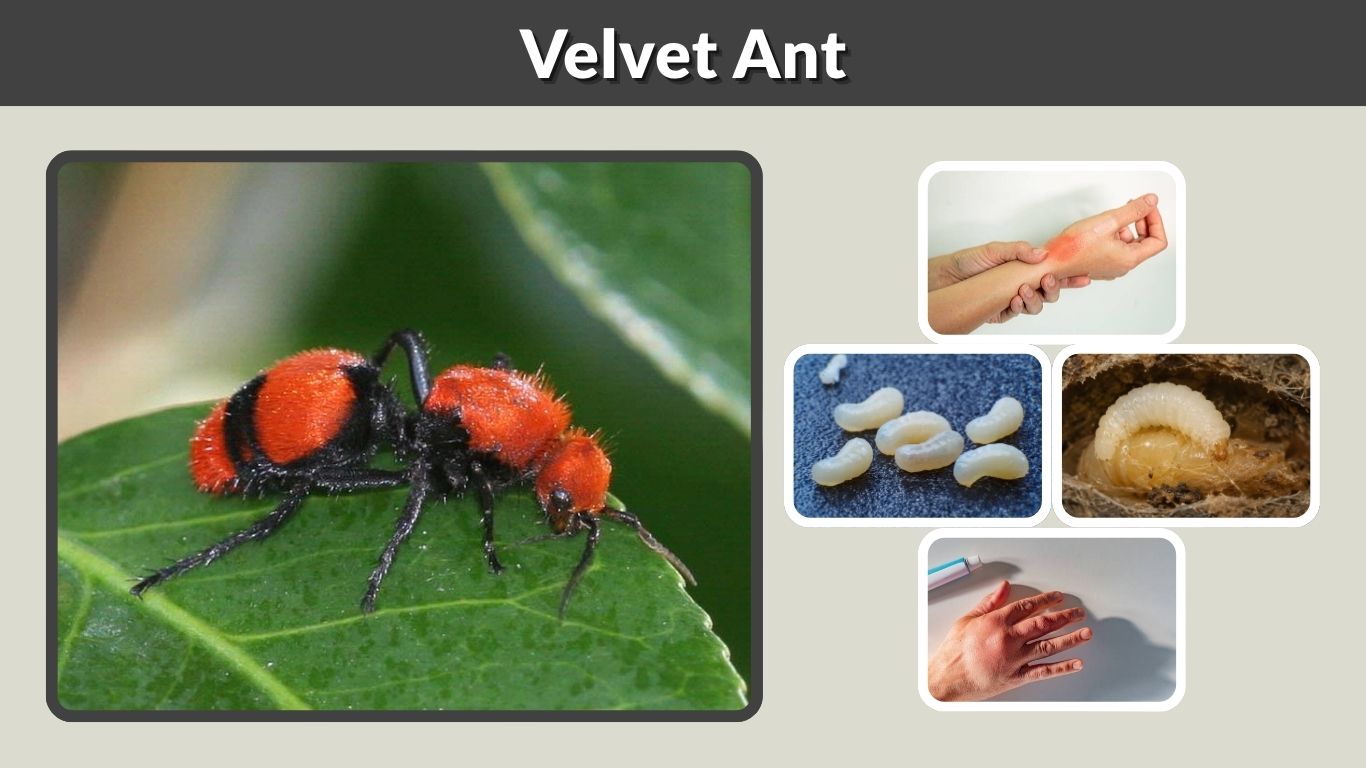
Velvet ants are striking insects known for their fuzzy appearance, vivid colors, and exceptionally painful sting. Despite their common name, they are not true ants. Velvet ants are actually wasps belonging to the family Mutillidae, and the wingless females are responsible for their ant-like appearance. The red velvet ant, sometimes called the cow killer wasp, is one of the most recognizable species in North America. Understanding their appearance, habitat, behavior, and sting risk makes these fascinating insects much easier to identify safely.
What Is a Velvet Ant?
Velvet ants are solitary parasitoid wasps found in many warm and dry environments around the world. Females usually lack wings and travel across the ground, while males have functional wings and look more like conventional wasps. Their dense hairs and bright warning colors make many species easy to notice. Although intimidating, velvet ants generally avoid people and sting primarily when handled or trapped.
Velvet Ant Identification
Common identification features include:
- Dense, velvet-like hairs covering much of the body
- Bright red, orange, yellow, white, or black coloration
- Females without wings
- Males with transparent or darkened wings
- Tough, heavily armored exoskeleton
- Noticeably long legs and antennae
- Fast movement across open ground
- Adult size varying considerably depending on species
Color alone should not be used for identification because velvet ants include thousands of species with different patterns.
Is a Velvet Ant Really an Ant?
No. Velvet ants belong to the wasp family Mutillidae. Their misleading common name developed because wingless females resemble large, hairy ants as they move along the ground.
The difference becomes clearer when males are observed because adult males possess wings. Females also have a powerful defensive stinger, another characteristic associated with wasps rather than ordinary worker ants.
Red Velvet Ant and Eastern Velvet Ant
The eastern velvet ant (Dasymutilla occidentalis) is one of the best-known velvet ants in the United States. Females have conspicuous reddish-orange hair combined with black areas on the body.
Because its sting can be extremely painful, this species is commonly called the cow killer or cow killer velvet ant. The nickname exaggerates its actual danger; the name refers mainly to the intensity of its sting rather than an ability to kill cattle.
Male vs. Female Velvet Ant
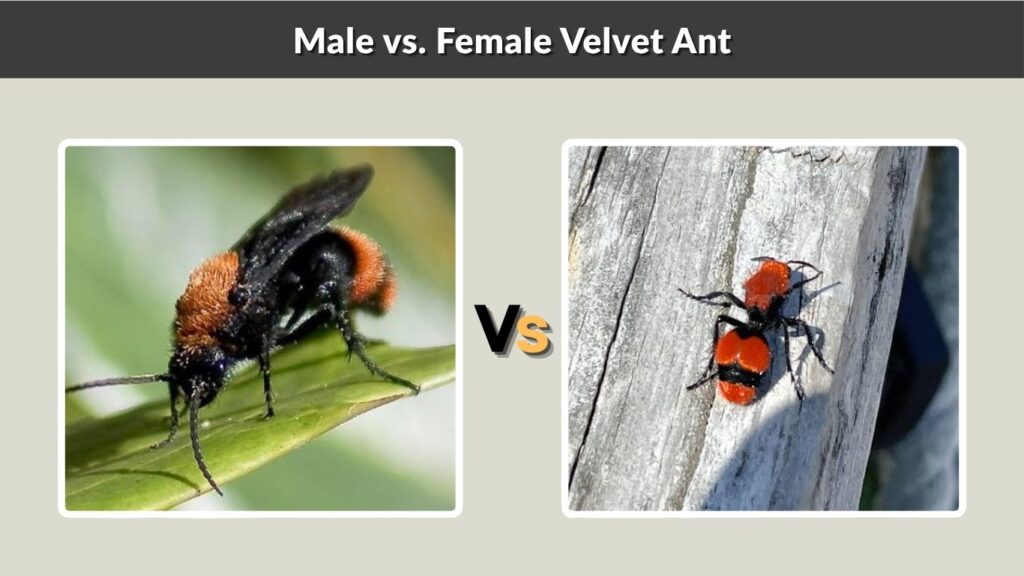
Male and female velvet ants may look surprisingly different, making identification confusing for someone encountering them for the first time. Females are typically seen walking rapidly across soil because they cannot fly. Males possess wings and often spend more time searching for females. Most importantly, only females have the defensive stinger associated with the famous velvet ant sting.
Female Velvet Ant
Female velvet ants typically have:
- No functional wings
- A strongly armored body
- Dense colorful hairs
- A long defensive stinger
- An ant-like appearance
- Ground-dwelling behavior
Females search for nests of suitable host insects. Once they locate one, they enter the nest and lay an egg associated with the developing host.
Male Velvet Ant
Male velvet ants typically have:
- Functional wings
- A more conventional wasp-like appearance
- Long antennae
- No functional stinger
- A generally slimmer body
- Strong flight behavior when searching for females
Depending on the species, males and females may differ enough in size and coloration that they were historically difficult to associate with one another.
Can Male Velvet Ants Sting?
Male velvet ants cannot deliver the painful defensive sting for which these insects are famous. The female’s egg-laying structure has been modified into a powerful stinger.
However, identifying sex from a quick glance is not always easy. For this reason, avoiding unnecessary handling is the safest approach when encountering an unfamiliar velvet ant.
Velvet Ant Sting and Pain
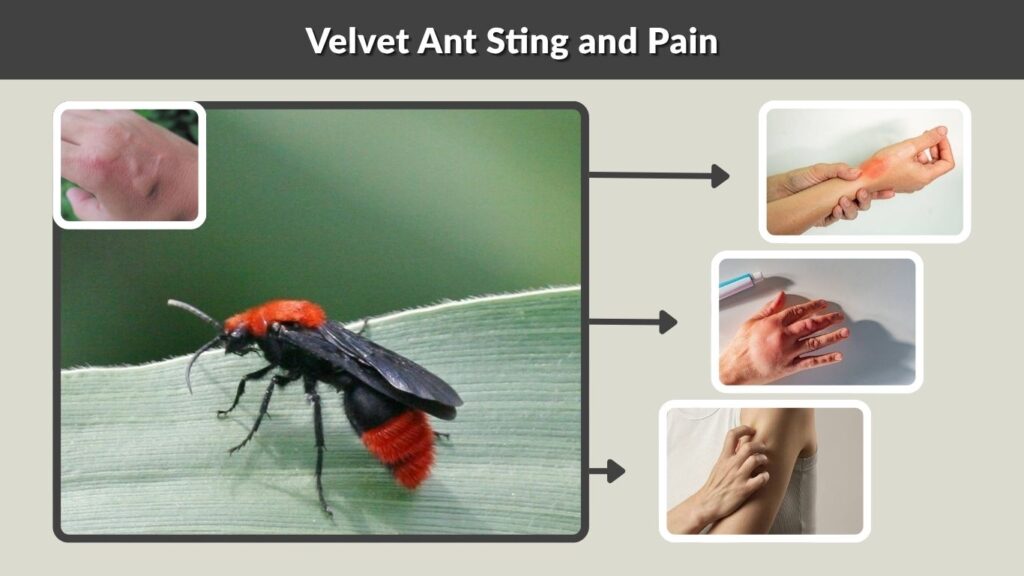
The velvet ant sting has an intimidating reputation, particularly in larger species such as the red velvet ant. The sting is primarily defensive rather than aggressive. A female normally attempts to escape before using her stinger. Most human encounters occur when the insect is stepped on, squeezed, trapped against clothing, or deliberately picked up.
What Does a Velvet Ant Sting Feel Like?
A sting may cause:
- Immediate sharp or burning pain
- Redness around the sting site
- Local swelling
- Tenderness
- Itching or irritation afterward
- Temporary discomfort surrounding the affected area
The amount of pain varies with species, sting location, and individual sensitivity. A painful sting does not automatically mean that severe poisoning has occurred.
What to Do After a Velvet Ant Sting
For an uncomplicated sting:
- Move away from the insect
- Wash the affected area with soap and water
- Apply a wrapped cold pack for short periods
- Avoid scratching the sting site
- Monitor swelling and other symptoms
- Follow directions for an appropriate over-the-counter pain or itch treatment if needed
Seek urgent medical attention if breathing becomes difficult, swelling develops around the face or throat, faintness occurs, or other signs of a serious allergic reaction appear.
Velvet Ant Bite or Sting?
People frequently search for a velvet ant bite, but the defensive injury people worry about is normally a sting.
Female velvet ants have powerful mouthparts, yet their elongated stinger is responsible for their well-known painful encounters with humans. Calling the injury a bite is therefore generally inaccurate.
Where Do Velvet Ants Live?
Velvet ants occur in many regions, but they are especially noticeable in warm, sunny environments with exposed soil. In the United States, different species occur across states such as Texas, Arizona, Florida, California, Oklahoma, Georgia, and other suitable areas. Their presence depends heavily on the availability of host insects because velvet ant larvae develop using other insects’ immature stages.
Common Velvet Ant Habitats
They may be encountered around:
- Sandy or loose soil
- Open grasslands
- Desert and semi-desert environments
- Woodland edges
- Fields and meadows
- Gardens and yards
- Areas containing ground-nesting bees or wasps
- Dry paths and other sunny ground surfaces
Adults are often noticed running quickly over bare soil while searching for mates or potential host nests.
Do Velvet Ants Build Nests?
Velvet ants do not establish organized colonies like typical ants, nor do they build large communal nests with workers and queens.
Females instead search for nests belonging to other insects, especially solitary bees and wasps. They enter suitable nest chambers and place their eggs where the developing velvet ant larva can use the host’s immature stage as a food source.
Are Velvet Ants Social?
Velvet ants are primarily solitary. There is no permanent worker caste performing colony duties comparable with honey bees, yellowjackets, or many true ants.
Adults spend much of their lives independently. Males mainly search for females, while females search for suitable host nests in which reproduction can occur.
Velvet Ant Life Cycle and Behavior
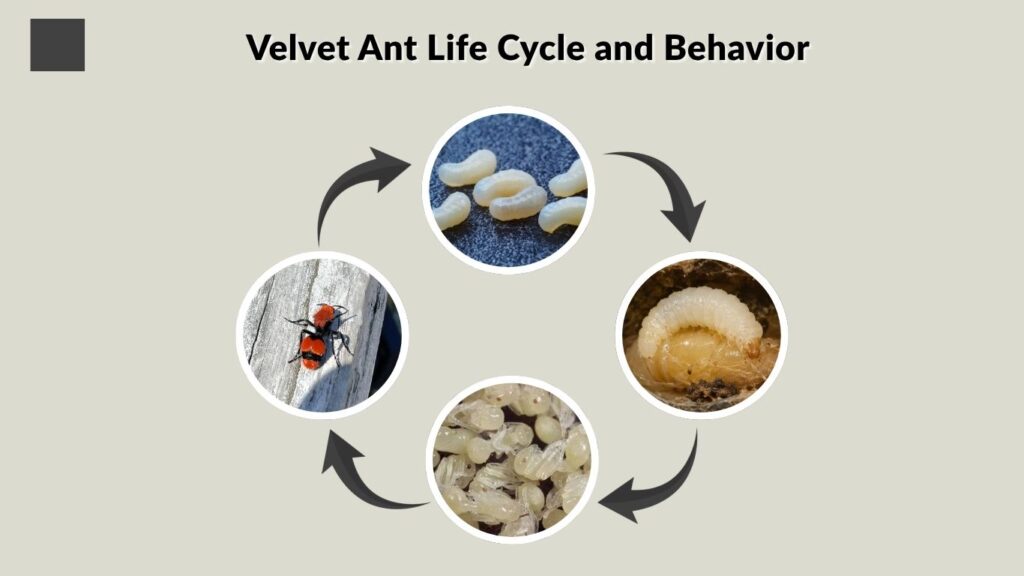
The unusual life cycle of velvet ants explains much of their behavior. Rather than collecting food to raise larvae in their own nest, females use nests constructed by other insects. The velvet ant larva develops as a parasitoid of the host’s immature stage. Adults, in contrast, are free-living insects and may obtain energy from nectar and other available sugary resources.
Velvet Ant Life Cycle
The basic development process includes:
- Egg: A female finds a suitable host nest and lays an egg.
- Larva: The emerging larva develops using the host’s immature stage.
- Pupa: The velvet ant eventually enters a pupal stage.
- Adult: A fully developed male or female emerges and begins an independent adult life.
The exact host species and developmental timing vary among different velvet ant species.
Why Are Velvet Ants So Tough?
Velvet ants have unusually durable bodies. Their strong exoskeleton helps protect females when entering nests belonging to other stinging insects.
Bright coloration also functions as a warning signal. Combined with their defensive sting and other protective adaptations, this makes velvet ants difficult prey for many would-be predators.
Do Velvet Ants Make Noise?
Some velvet ants can produce noticeable squeaking or chirping sounds when disturbed. This sound is created through a process known as stridulation, in which specialized body structures are rubbed together.
The noise functions as another defensive warning. A velvet ant producing these sounds is best left alone rather than handled.
Are Velvet Ants Dangerous?
Velvet ants can deliver a remarkably painful sting, but they are not insects that normally chase or attack humans. Females usually depend first on speed, warning coloration, their durable body, and other defenses. Problems most commonly develop from accidental contact or intentional handling.
For people sharing outdoor spaces with velvet ants, simple avoidance usually provides adequate protection. Wearing footwear outdoors, watching where hands are placed, and teaching children not to pick up colorful unfamiliar insects can significantly reduce the likelihood of a sting.
Should You Kill a Velvet Ant?
Finding a single velvet ant outdoors does not necessarily indicate an infestation. Because these insects are solitary, seeing one female walking through a yard does not mean that a large underground colony exists nearby.
If the insect is outside and not creating an immediate risk, leaving it undisturbed is generally practical. Preventing direct contact is usually more useful than attempting to handle it.
FAQs
1. Why is the velvet ant called a cow killer?
The nickname cow killer comes from the reputation of the female red velvet ant’s extremely painful sting. It is a dramatic common name rather than evidence that these insects normally kill cattle.
2. Can a velvet ant fly?
Male velvet ants have wings and can fly. Adult females of many species are wingless and spend their time walking across the ground while searching for hosts or mates.
3. How big is a velvet ant?
Size varies greatly among species. Some velvet ants are quite small, while conspicuous species such as the eastern velvet ant can become much larger and easier to recognize.
4. Are red velvet ants poisonous?
Female red velvet ants are venomous in the sense that they inject venom through a stinger. Their sting can be intensely painful, although most uncomplicated stings cause localized symptoms rather than severe systemic illness.
5. What should I do if I find a velvet ant in my yard?
Avoid touching or stepping on it and allow it room to move away. A single velvet ant usually represents a solitary insect rather than an ant-style colony infestation. Keep children and pets from handling it, particularly if it appears to be a wingless female.
