
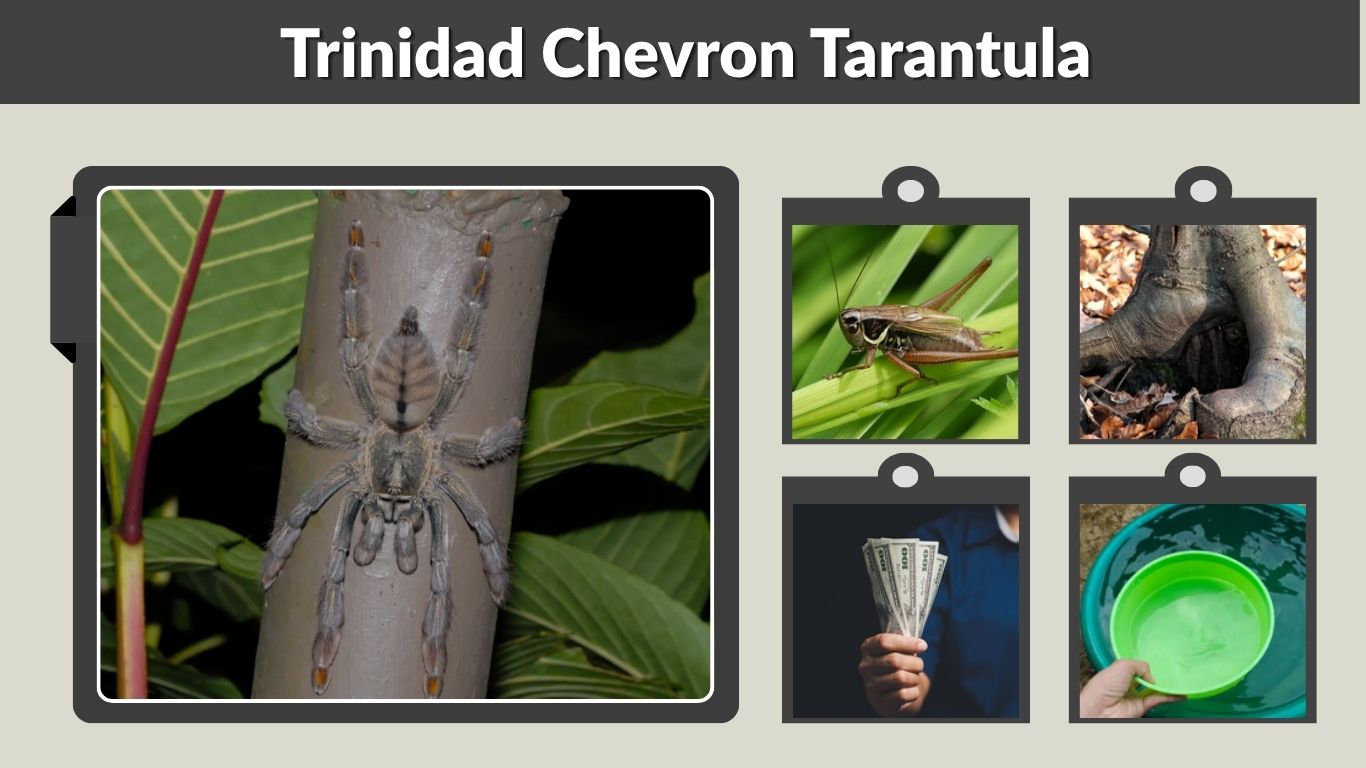
The Trinidad chevron tarantula (Psalmopoeus cambridgei) is a fast-growing arboreal species recognized by its olive-brown coloration and dark abdominal markings. Native to Trinidad and Tobago, it lives in trees, natural cavities, and heavily webbed retreats. Although hardy in captivity, its remarkable speed, defensive temperament, and potentially painful bite make it unsuitable for beginners or handling. This guide explains its identification, natural habitat, adult size, enclosure requirements, feeding habits, lifespan, sex differences, venom, and responsible purchasing considerations.
Trinidad Chevron Tarantula Identification
The Trinidad chevron belongs to the arboreal tarantula genus Psalmopoeus. Its common name comes from the repeating chevron-shaped markings across its abdomen. Colors vary with age, sex, lighting, and molt condition, but adult females usually display earthy green, brown, and gray tones.
Identifying Features
- Scientific name: Psalmopoeus cambridgei
- Family: Theraphosidae
- Native range: Trinidad and Tobago
- Type: Arboreal
- Adult leg span: Approximately 5–6 inches
- Growth rate: Fast
- Primary colors: Olive green, brown, gray, and black
- Abdominal pattern: Dark chevron-shaped markings
- Defensive hairs: Absent
- Experience level: Intermediate to advanced
- Handling: Strongly discouraged
Spiderlings often have darker bodies with pale or orange markings on their legs and abdomen. Their appearance changes as they molt and mature. Adult coloration is generally less contrasting but provides effective camouflage against bark and vegetation.
The World Spider Catalog recognizes Psalmopoeus cambridgei as the type species of its genus and records its distribution in Trinidad and Tobago. World Spider Catalog
Is There a Giant Trinidad Chevron?
“Giant Trinidad chevron” is not the name of a separate recognized species or color form. The term may be used informally for a particularly large female. Feeding condition, sex, posture, and measurement methods can all make one specimen appear larger than another.
Trinidad Chevron Tarantula Habitat and Distribution
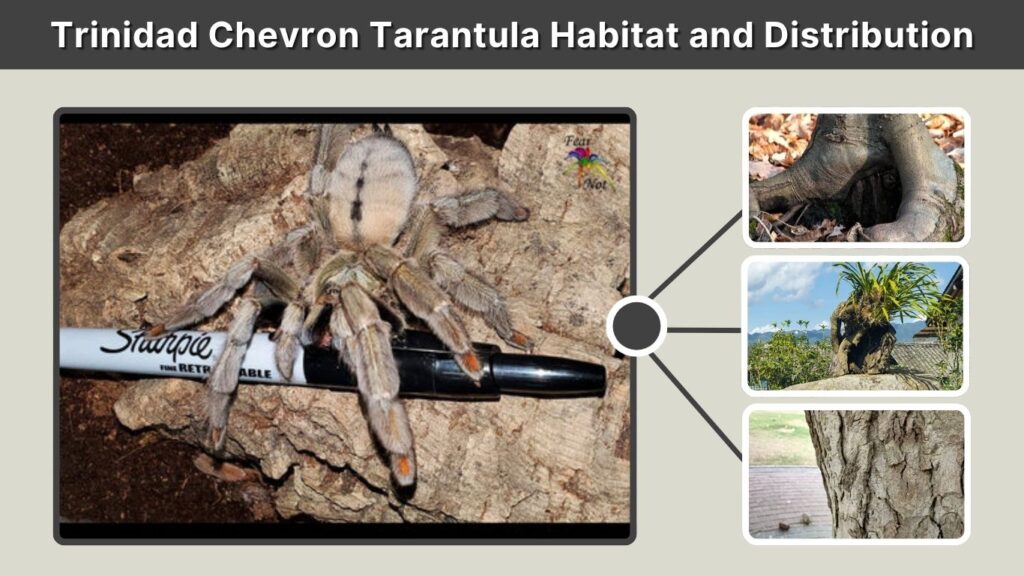
Trinidad chevrons inhabit warm tropical environments containing mature trees and numerous natural hiding places. Although classified as arboreal, individuals may use tree cavities, folded vegetation, hollow structures, bark crevices, or protected spaces closer to ground level.
Natural Habitat
In the wild, the tarantula constructs a silk-lined tubular retreat inside a secure cavity. It usually remains hidden during daylight and waits near the entrance after dark. The surrounding silk transmits vibrations produced by prey, predators, or other approaching animals.
The natural environment is warm and seasonally humid, but the tarantula’s retreat is protected from direct rain and extreme sunlight. Captive enclosures should therefore provide moisture and ventilation without remaining constantly soaked.
Adaptability
Trinidad chevrons have been observed using both natural and artificial shelters. Trees, bamboo, folded leaves, hollow pipes, and protected parts of buildings may provide suitable retreats.
This adaptability does not mean the spider should be kept in a bare enclosure. A secure vertical hiding place remains essential for reducing stress and supporting natural web-building behavior.
Behavior and Temperament
This species is known for speed, agility, and a strong feeding response. Most individuals prefer escaping into their retreat, but a cornered tarantula may turn, raise its front legs, strike, or bite. Its behavior makes careful enclosure design particularly important.
Defensive Behavior
Unlike many New World terrestrial tarantulas, Trinidad chevrons do not possess urticating abdominal hairs. Their primary defenses include:
- Retreating rapidly
- Hiding inside webbed tunnels
- Assuming a threat posture
- Slapping with the front legs
- Stridulating when seriously threatened
- Striking or biting
Their speed can make routine feeding and cleaning challenging. Always know where the spider is before opening the enclosure. Use long tools and keep a catch cup nearby during maintenance.
Handling
A Trinidad chevron should not be handled. It can sprint suddenly, climb smooth surfaces, and move rapidly between the keeper’s hands, clothing, furniture, or nearby walls.
Handling also exposes the spider to potentially fatal falls. Transfers should be completed in a controlled space using a catch cup, long paintbrush, and appropriately sized rehousing container.
Trinidad Chevron Tarantula Care
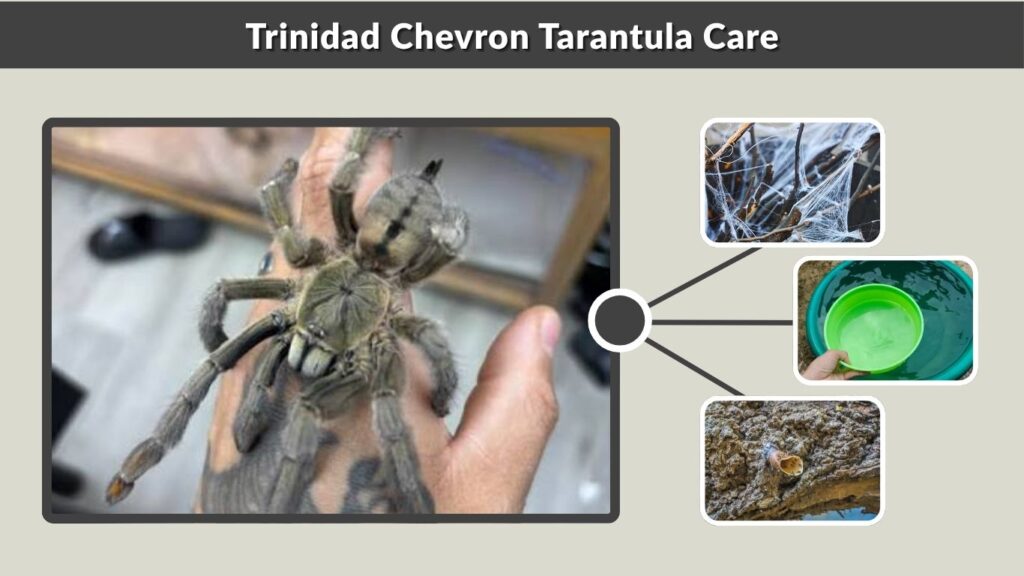
A suitable setup should provide vertical climbing space, a dark retreat, strong web-anchoring points, adequate cross-ventilation, and several inches of substrate. The enclosure must be completely escape-proof because even small juveniles can exploit surprisingly narrow openings.
Adult Housing
An adult enclosure may be approximately 12 inches wide, 12 inches deep, and 18 inches tall. Exact dimensions can be adjusted according to the spider’s size. Important features include:
- A tall arboreal enclosure
- Secure front or top access
- Cross-ventilation on multiple sides
- An upright cork-bark tube or curved slab
- Artificial plants or branches
- Approximately 3–5 inches of substrate
- A shallow water dish
- A tightly secured door and ventilation holes
Place the primary retreat away from the enclosure door. This reduces the chance of the spider rushing through the opening when disturbed.
Young spiderlings may burrow or remain closer to the substrate. Give them enough soil to excavate while also providing a small upright piece of bark.
Temperature and Moisture
Maintain temperatures of approximately 72–80°F (22–27°C). Normal warm-room conditions are often sufficient. Avoid direct sunlight, heat lamps, and uncontrolled heat mats because small enclosures can overheat rapidly.
Keep the lower substrate slightly moist while allowing some of the surface to dry. A full water dish should always be available. Good ventilation is essential for preventing stagnant conditions and excessive mold growth.
Rather than trying to maintain one exact humidity percentage, observe the substrate, ventilation, and water availability. Constantly saturated conditions can be as problematic as severe dryness.
Webbing and Cleaning
Trinidad chevrons can produce extensive sheets and tunnels of silk around their retreat. Their webbing should not be removed unless necessary because it provides security and helps the spider detect movement.
Spot-clean boluses, discarded prey, and visible waste using long tongs. A complete substrate replacement is rarely necessary unless mold, mites, contamination, or another serious enclosure problem develops.
Trinidad Chevron Tarantula Feeding and Growth
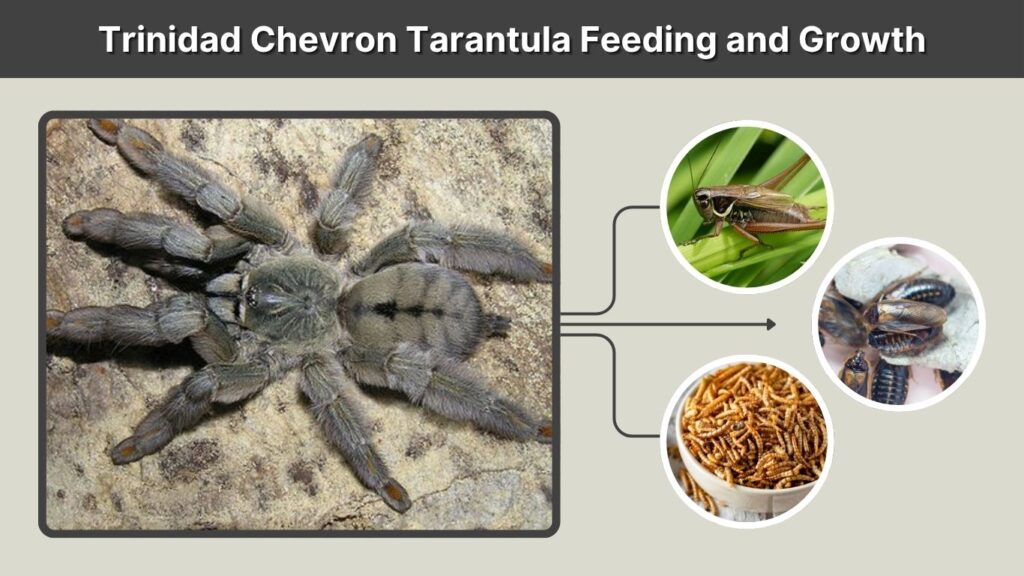
This tarantula is an opportunistic ambush predator with a strong feeding response. It grows considerably faster than many slow-growing terrestrial species. Feeding should support healthy development without causing the abdomen to become excessively large.
Suitable Foods
- Crickets
- Dubia roaches
- Red runner roaches
- Locusts where legally permitted
- Mealworms
- Superworms
- Fruit flies or small pre-killed prey for spiderlings
Spiderlings may eat one or two appropriately sized meals each week. Juveniles can usually be fed weekly, while adults may receive food every 7–14 days. Adjust the schedule according to prey size and the condition of the abdomen.
Remove uneaten prey within 24 hours. Stop feeding when the tarantula begins refusing food or closes its retreat because these behaviors may indicate premolt.
Growth and Molting
Trinidad chevrons can develop rapidly under warm, well-fed captive conditions. Spiderlings may molt several times annually, while mature females molt less frequently.
Signs of premolt include:
- Refusing food
- Reduced activity
- Darker coloration
- Increased webbing
- Sealing the retreat entrance
- Lying on the back or side
Never disturb a molting spider. Wait until the new fangs have hardened before feeding again. Small juveniles may be ready after approximately one week, while large adults may need 10–14 days.
Size, Lifespan, and Sex Differences
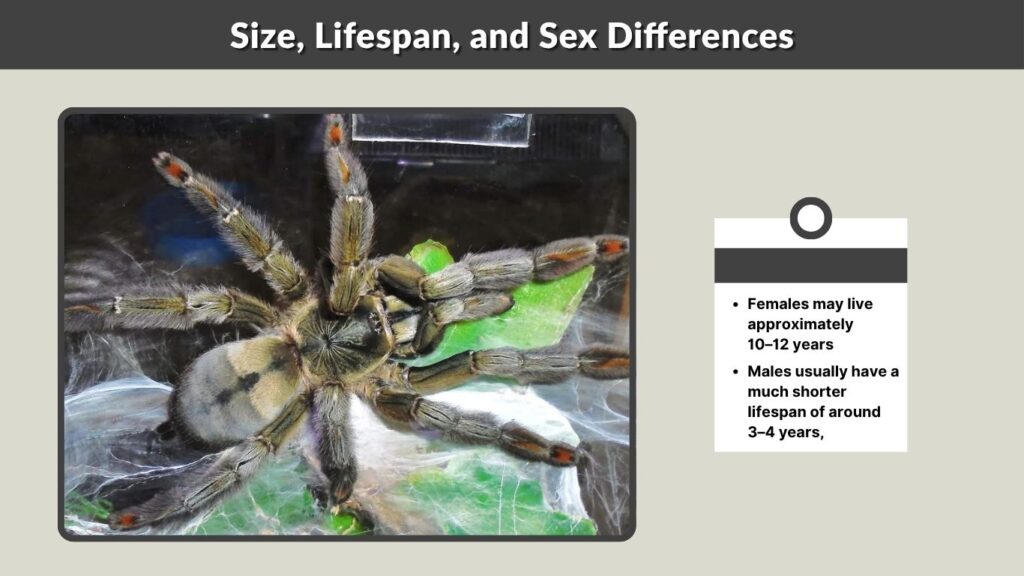
Trinidad chevrons are medium-to-large arboreal tarantulas with long legs and relatively slender bodies. Females become heavier and remain patterned throughout adulthood. Mature males undergo noticeable changes in body proportions and coloration.
Full Adult Size
Adults commonly reach approximately 5–6 inches in diagonal leg span. Exceptional females may appear slightly larger, but reports of enormous or “giant” individuals are frequently exaggerated.
Leg span should be measured diagonally from the tip of one front leg to the opposite rear leg. Body length alone produces a much smaller measurement.
Female vs Male
Adult females usually have:
- A heavier abdomen
- A broader body
- More noticeable chevron markings
- Shorter legs relative to the body
- A substantially longer lifespan
Mature males normally develop a slimmer body, proportionately longer legs, and enlarged emboli on their pedipalps. They may become more uniformly gray or brown after reaching maturity. Reliable sexing of juveniles requires examination of the inside of a suitable molt.
Lifespan
Females may live approximately 10–12 years, with some potentially living longer under excellent captive conditions. Males usually have a much shorter lifespan of around 3–4 years, depending on how quickly they mature. A mature male may survive from several months to more than a year after his final molt.
Trinidad Chevron Tarantula Bite, Fangs, and Venom
The Trinidad chevron is venomous rather than poisonous. Its fangs inject venom into prey, while its lack of urticating hairs means biting is one of its principal close-range defenses. The combination of speed, long fangs, and defensive potential demands careful management.
Possible Bite Effects
A bite may cause:
- Immediate puncture pain
- Burning or throbbing
- Redness
- Local swelling
- Tenderness
- Muscle discomfort
- Nausea or other systemic symptoms
There is limited clinical information specifically describing confirmed Trinidad chevron bites. Therefore, claims that its venom is either harmless or exceptionally dangerous should be treated cautiously.
Wash the wound with soap and water and contact a medical professional or poison-control service. Seek urgent help for breathing difficulty, facial swelling, faintness, severe pain, vomiting, muscle cramps, or rapidly worsening symptoms.
Trinidad Chevron Tarantulas for Sale
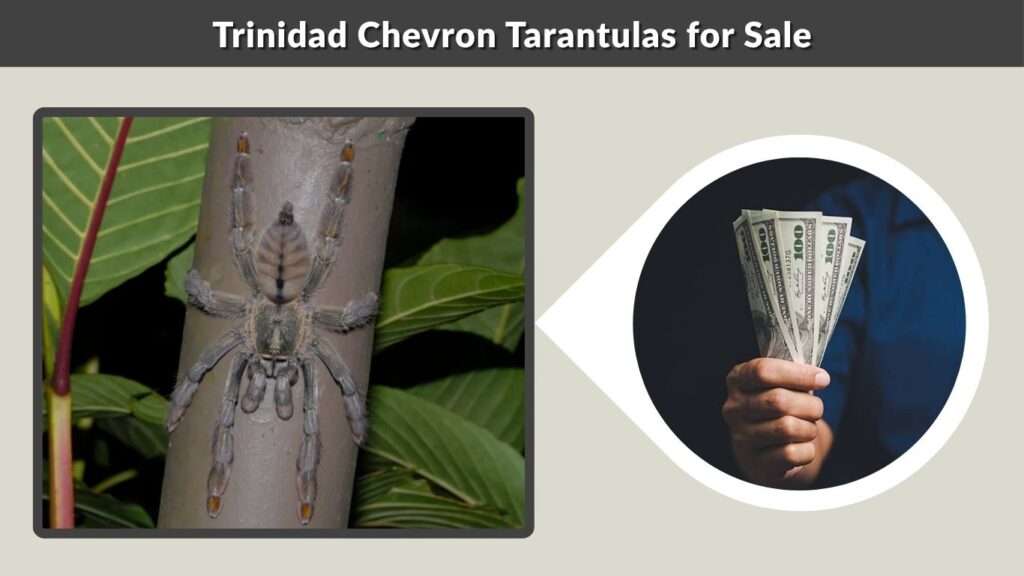
Price varies according to country, size, sex, availability, and shipping costs. Confirmed adult females generally cost more because of their larger body and longer expected lifespan. Spiderlings are usually cheaper and grow relatively quickly.
Purchase a captive-bred spider from a reputable breeder. Ask for its scientific name, sexing method, approximate size, feeding record, last molt, and photographs of the actual animal. Check local exotic-animal and import regulations before purchasing.
“Trinidad chevron hot sauce” refers to products made with Trinidad peppers and has no connection to the Trinidad chevron tarantula.
FAQs
Is a Trinidad chevron suitable for beginners?
No. Its speed, defensive behavior, arboreal movement, and bite potential make it more appropriate for intermediate or experienced keepers.
How large does a Trinidad chevron get?
Adults commonly reach approximately 5–6 inches in diagonal leg span. Females are generally heavier than mature males.
Do Trinidad chevrons make a lot of webbing?
Yes. They frequently build dense sheets and tubular web retreats around cork bark, foliage, and enclosure walls.
Can you handle a Trinidad chevron tarantula?
Handling is strongly discouraged. The spider is extremely fast and may bite, escape, or suffer a fatal fall.
How long does a Trinidad chevron live?
Females may live approximately 10–12 years or longer. Males typically live around 3–4 years and have a much shorter adult life.
