
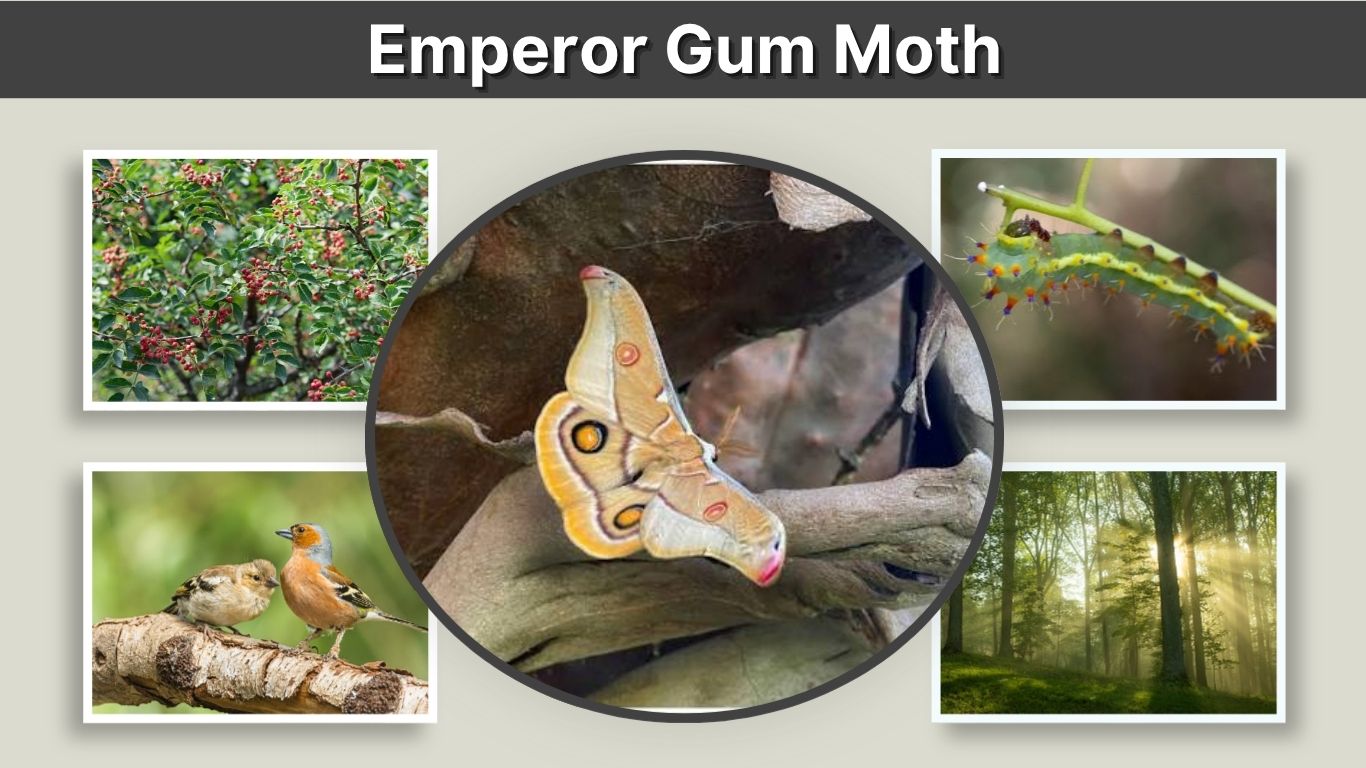
The emperor gum moth (Opodiphthera eucalypti) is one of Australia’s most recognizable giant silk moths. Its large patterned wings, prominent eyespots, and impressive green caterpillar make it easy to notice in gardens, forests, and areas with eucalyptus trees. The species is also established in New Zealand, where its larvae commonly feed on introduced gum trees. This guide covers emperor gum moth identification, caterpillars, diet, size, habitat, eggs, cocoons, life cycle, and whether the caterpillar is poisonous.
What Is an Emperor Gum Moth?
The emperor gum moth belongs to the family Saturniidae, which includes many of the world’s large silk moths. Native to Australia, it is strongly associated with eucalyptus trees, although the caterpillars can use several other plants. Adults are large, heavily patterned moths with noticeable eyespots that may help discourage predators.
Emperor Gum Moth Identification
Important features include:
- Scientific name: Opodiphthera eucalypti
- Family: Saturniidae
- Body: Thick and hairy
- Wing color: Brown, reddish, pinkish, gray, and cream
- Eyespots: Large circular markings on all four wings
- Antennae: Feather-like, especially in males
- Activity: Primarily nocturnal
- Host association: Often found around eucalyptus and other gum trees
Individual moths vary considerably in coloration. Some appear predominantly brown, whereas others show strong pink, reddish, or purplish tones.
Pink Emperor Gum Moth
A pink emperor gum moth is generally not a separate species. Adults naturally vary in color, and some individuals have particularly strong pink or reddish areas on their wings.
Lighting can also make these colors look brighter in photographs. Despite the variation, the characteristic wing eyespots and overall structure remain useful identification features.
Emperor Gum Moth Size and Wingspan
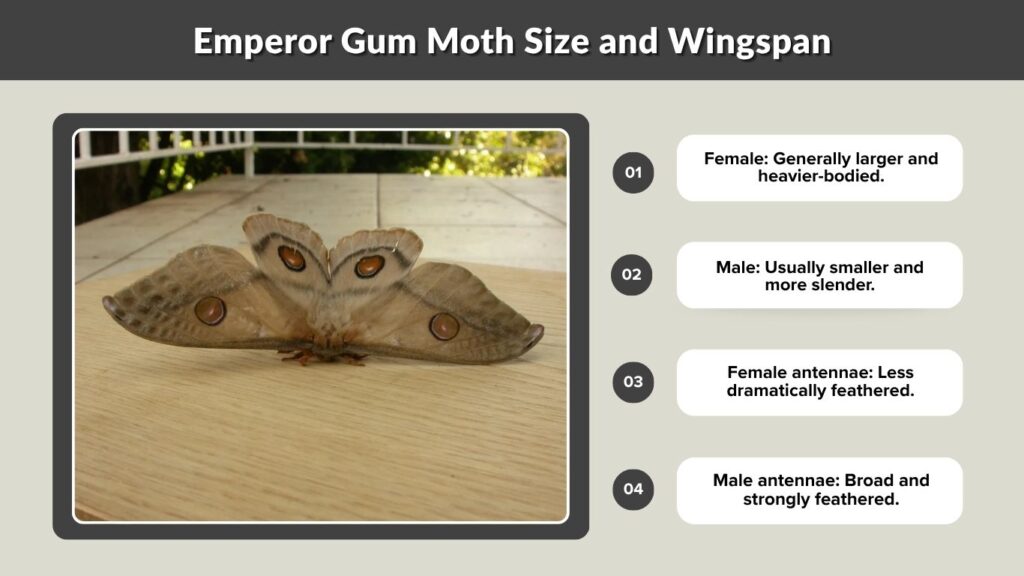
The emperor gum moth is a large insect compared with most everyday garden moths. Females are generally larger and heavier than males, while males have more strongly developed feathered antennae. The difference between the sexes is related largely to reproduction, with females carrying eggs and males specialized for locating mates.
Emperor Gum Moth Wingspan
Adult wingspan varies according to sex and individual development, but large specimens can reach approximately 12–15 cm across. Females commonly appear broader and more robust.
Males are often somewhat smaller but compensate with particularly prominent antennae designed to detect pheromones released by females.
Male vs. Female Emperor Gum Moth
The sexes can often be distinguished by several characteristics:
- Female: Generally larger and heavier-bodied.
- Male: Usually smaller and more slender.
- Female antennae: Less dramatically feathered.
- Male antennae: Broad and strongly feathered.
- Female abdomen: Fuller because it contains developing eggs.
- Male behavior: More likely to fly actively while searching for females.
These differences are easiest to recognize when male and female moths can be compared directly.
Emperor Gum Moth Caterpillar
The emperor gum moth caterpillar, also called the gum emperor moth caterpillar, is nearly as impressive as the adult. Mature larvae become large and bright green, with raised structures arranged along their bodies. Their unusual appearance sometimes leads people to assume that they are dangerous.
The caterpillar spends most of its time eating and storing energy for pupation and adulthood.
What Does the Caterpillar Look Like?
A mature emperor gum moth larva typically has:
- A thick green body
- Rows of raised blue, yellowish, or reddish tubercles
- Small hairs extending from the raised structures
- Clearly visible body segments
- Strong prolegs for gripping branches
- A chunky appearance when fully grown
Young larvae may look quite different and often have darker coloration before becoming increasingly green during later growth stages.
Emperor Gum Moth Caterpillar Size
A fully grown emperor gum moth caterpillar can reach roughly 7–8 cm long, although individual size varies.
Its large body enables it to consume substantial quantities of foliage before pupating. Caterpillars molt repeatedly while growing, becoming noticeably larger after each developmental stage.
Is the Emperor Gum Moth Caterpillar Poisonous?
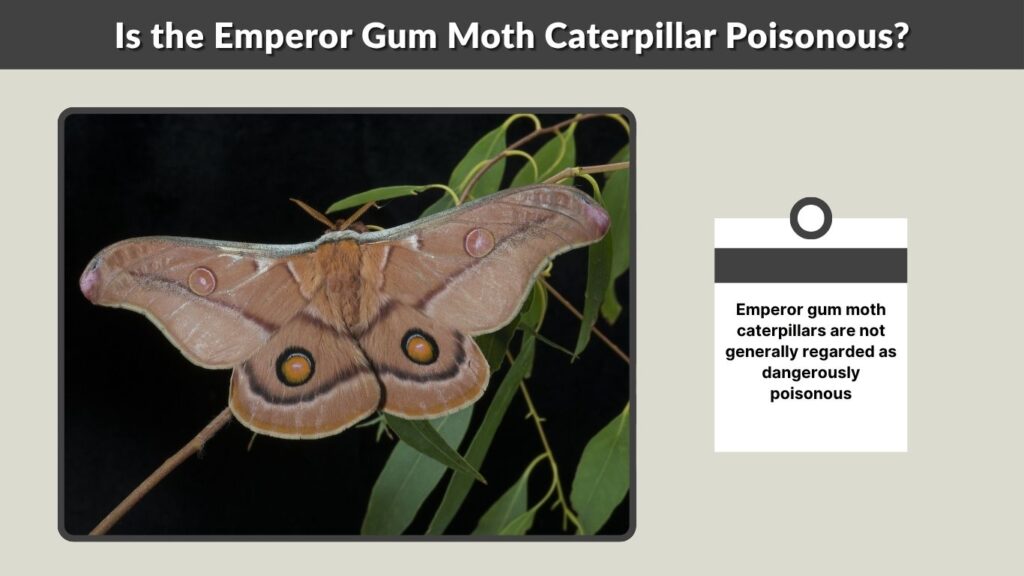
The question “Is an emperor gum moth caterpillar poisonous?” is common because the larva has numerous bumps and short hairs. Its unusual appearance can resemble that of genuinely stinging caterpillars.
Emperor gum moth caterpillars are not generally regarded as dangerously poisonous or venomous to humans. However, direct handling is still unnecessary and may occasionally cause skin irritation.
Can the Caterpillar Sting?
The emperor gum moth caterpillar does not have the powerful venomous sting associated with some hazardous caterpillar species.
Contact with its hairs or body structures may nevertheless irritate particularly sensitive skin. If you find one, it is better to observe it without repeatedly touching or disturbing it.
Children and pets should also be discouraged from handling unfamiliar caterpillars because many species can look surprisingly similar.
What Do Emperor Gum Moths Eat?
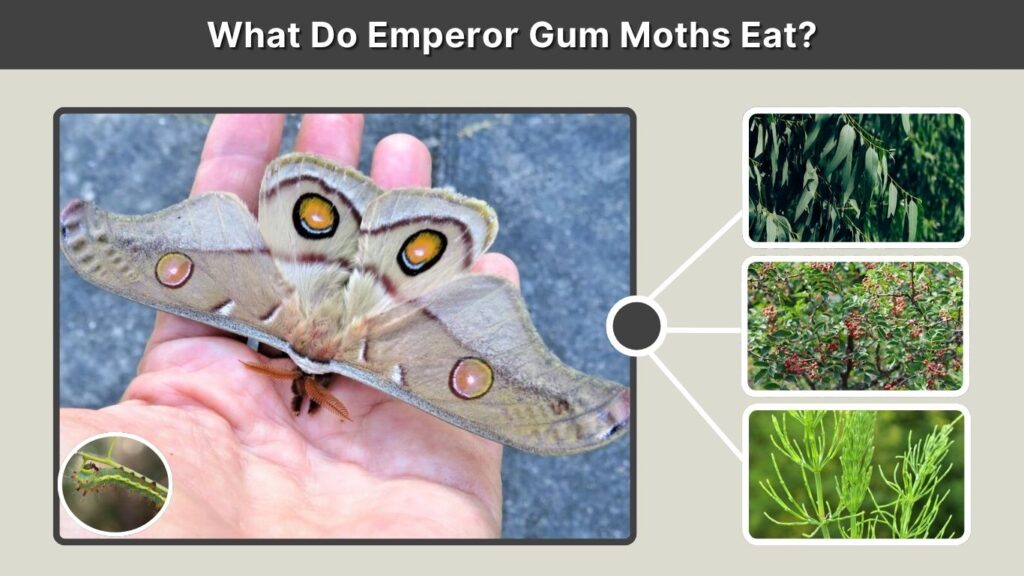
The emperor gum moth diet differs dramatically between caterpillars and adults. Caterpillars are active leaf eaters and must consume enough food to support growth, cocoon formation, metamorphosis, and later adult activity. Adult emperor gum moths, by contrast, have greatly reduced feeding ability and depend primarily on stored energy.
Emperor Gum Moth Caterpillar Food
Larvae commonly feed on leaves from:
- Eucalyptus or gum trees
- Pepper trees
- Bottlebrush
- Brush box
- Various related native trees and shrubs
- Some introduced ornamental plants
Eucalyptus is particularly important and explains the insect’s common name.
What Do Adult Emperor Gum Moths Eat?
Adult emperor gum moths generally do not feed. Like many giant silk moths, adults have reduced mouthparts and rely on fat and energy reserves accumulated during the caterpillar stage.
Consequently, their adult lives are comparatively short. Their main purpose after emerging is to locate a mate, reproduce, and lay eggs for the next generation.
Emperor Gum Moth Life Cycle
The emperor gum moth life cycle has four main stages: egg, larva, pupa, and adult. This is known as complete metamorphosis. Development may take many months because the moth can spend a substantial period protected inside its cocoon before emerging as an adult.
Emperor Gum Moth Eggs
After mating, females lay eggs on suitable host plants. Eggs may be deposited in groups on leaves, branches, fences, tree trunks, or other nearby surfaces.
After development is complete, small larvae hatch and begin feeding. Young caterpillars may initially remain relatively close together before spreading farther through the host plant.
Larval Development
During the larval stage, caterpillars:
- Feed heavily on foliage
- Grow rapidly
- Molt several times
- Change coloration as they mature
- Store energy for later development
- Search for an appropriate pupation site when fully grown
This is the only life stage during which the insect consumes substantial amounts of food.
Emperor Gum Moth Cocoon
When mature, the caterpillar produces a strong emperor gum moth cocoon from silk. The cocoon is commonly attached to branches, leaves, tree trunks, or nearby structures.
Inside, the caterpillar transforms into a pupa. The tough silken covering helps protect the developing moth from weather and some predators.
The insect may remain inside the cocoon for an extended period before conditions are suitable for adult emergence.
Adult Stage
After completing metamorphosis, the adult breaks free from its cocoon. Its wings initially appear soft and folded.
The moth pumps fluid into the wings until they expand fully and then allows them to harden. Adults become active primarily at night. Because they do not normally feed, their remaining energy is devoted largely to reproduction.
Emperor Gum Moth Habitat and Distribution
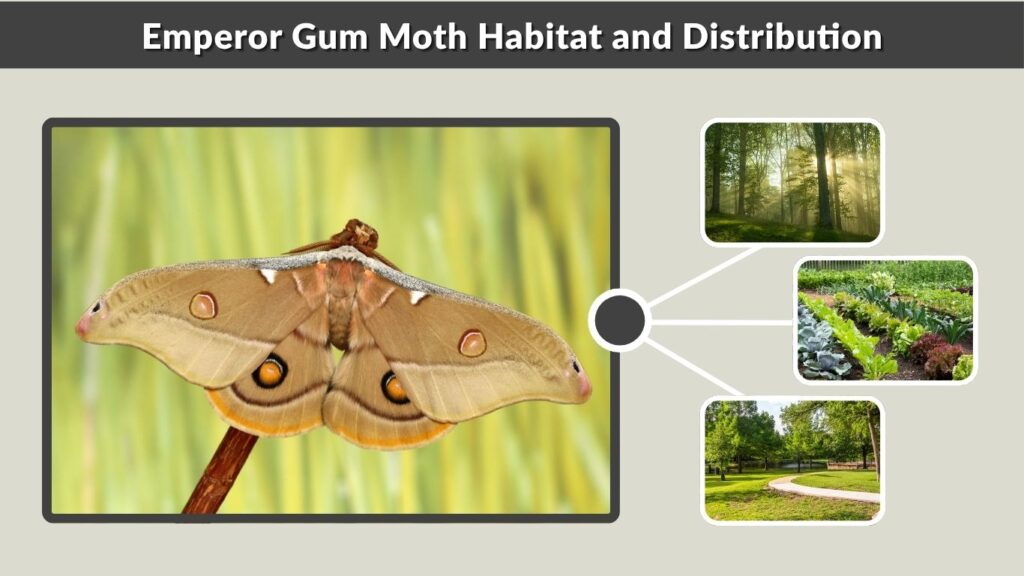
The Australian emperor gum moth naturally occurs across substantial parts of Australia wherever appropriate host plants and environmental conditions are available. It can occur in forests, woodland, suburban gardens, parks, plantations, and other areas containing eucalyptus trees.
Humans have also helped the species establish outside its original Australian range.
Emperor Gum Moth in Australia
Within Australia, the species occurs in several regions, including parts of:
- New South Wales
- Victoria
- Queensland
- South Australia
- Tasmania
Its exact abundance varies according to climate, vegetation, host-tree availability, and season.
Emperor Gum Moth in New Zealand
The emperor gum moth in New Zealand is an introduced species rather than a native one. It became established because eucalyptus and other suitable host plants were widely planted.
Today, emperor gum moth larvae may be found on gum trees in parts of New Zealand. The insect is sometimes known there simply as the gum emperor moth.
Emperor Gum Moth Predators
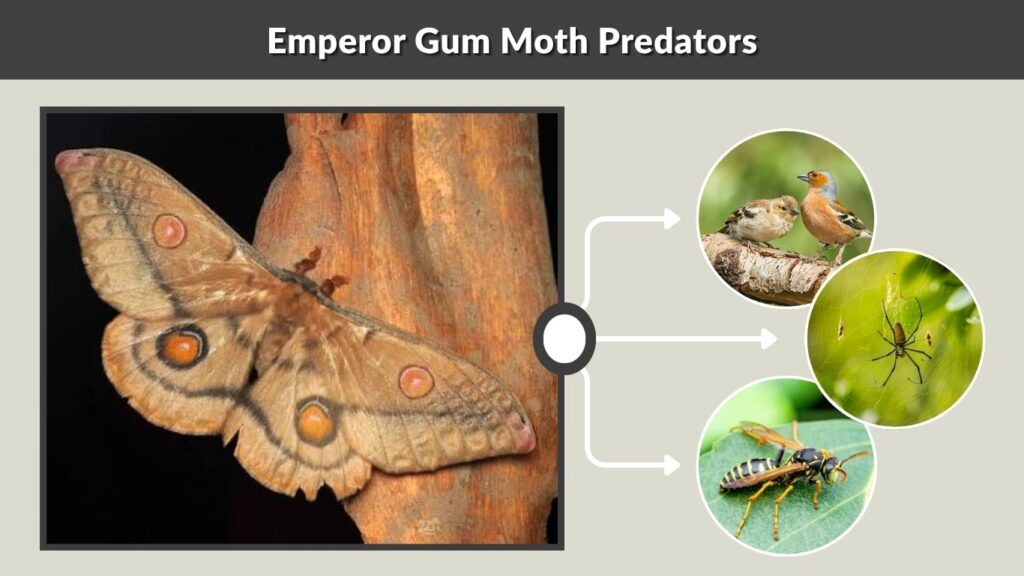
Despite its impressive size, the emperor gum moth faces many natural predators throughout its life. Eggs, caterpillars, pupae, and adults are all vulnerable, although each stage has different defenses.
Natural Predators
Potential predators include:
- Birds
- Spiders
- Predatory insects
- Small mammals
- Parasitoid wasps and flies
The caterpillar’s hairs and unusual appearance may discourage some predators. Adult eyespots can also create the impression of a much larger animal when the wings are suddenly revealed.
Cocoons provide additional physical protection, but they do not make the pupa completely safe.
Emperor Gum Moth Meaning and Symbolism
The emperor gum moth’s spiritual meaning is cultural rather than scientific. Like many moths and butterflies, it is sometimes associated with transformation because of the dramatic changes it undergoes between caterpillar, cocoon, and adult.
Its short adult life can also inspire interpretations involving change, renewal, and impermanence.
Common Symbolic Meanings
People may associate emperor gum moth symbolism with:
- Transformation — because of complete metamorphosis
- Renewal — emerging from the cocoon in a new form
- Growth — changing dramatically throughout development
- Patience — spending an extended period inside the cocoon
- Change — moving through completely different life stages
These meanings come from personal and cultural interpretations and are not biological characteristics of the moth.
FAQs
1. Are emperor gum moth caterpillars poisonous?
No. Emperor gum moth caterpillars are not generally considered dangerously poisonous or venomous. Their hairs may occasionally irritate sensitive skin, so unnecessary handling is best avoided.
2. How big does an emperor gum moth get?
Large adult emperor gum moths may reach approximately 12–15 cm in wingspan. Females are generally larger and heavier than males.
3. What do emperor gum moth caterpillars eat?
They primarily eat foliage from eucalyptus and other suitable trees and shrubs. Gum trees are among their most important host plants.
4. How long do emperor gum moths live?
Most of their life is spent developing larvae and pupae. The adult stage is relatively short because the moth does not normally feed and survives on stored energy while mating and reproducing.
5. Where are emperor gum moths found?
They are native to Australia and occur in areas with suitable host trees, including forests, gardens, and parks. The species has also become established in New Zealand.
