
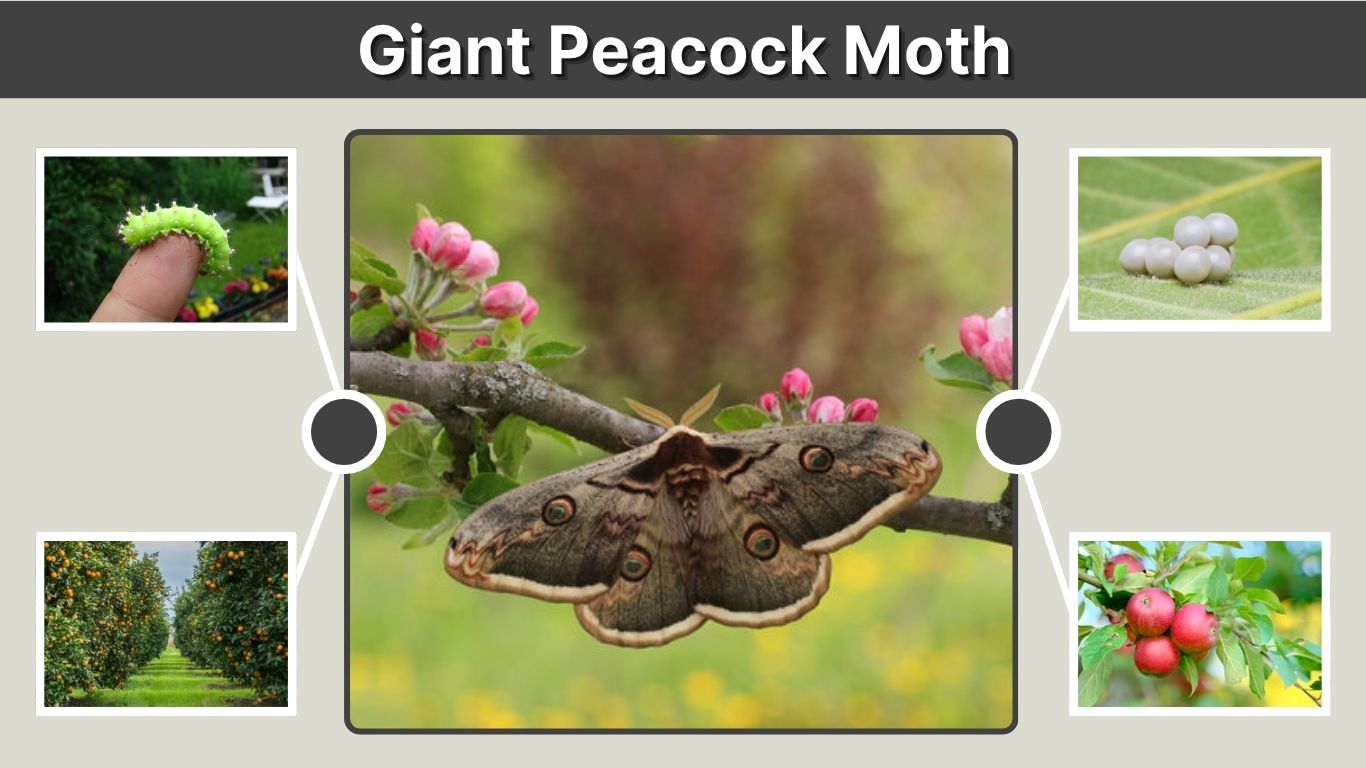
The giant peacock moth (Saturnia pyri) is one of Europe’s largest and most impressive moths. Known for its broad wings, dramatic eyespots, and brown-gray patterns, this nocturnal species is closely associated with warm woodland, orchards, and Mediterranean landscapes. Its large green caterpillar is equally striking and often raises questions about whether it is poisonous. From its unusual life cycle and diet to its connection with Vincent van Gogh, the giant peacock moth has a fascinating natural and cultural story.
What Is a Giant Peacock Moth?
The giant peacock moth belongs to the Saturniidae family, a group commonly known as giant silk moths or emperor moths. Its scientific name is Saturnia pyri. The species occurs mainly across southern and central Europe and neighboring regions. Its enormous size and prominent wing eyespots make adults relatively easy to distinguish from most other European moths.
Identification
A giant peacock moth can be recognized by several characteristics:
- Scientific name: Saturnia pyri
- Family: Saturniidae
- Wing color: Grayish-brown with darker wavy markings
- Eyespots: One large, colorful eyespot on each wing
- Body: Thick, hairy, and brownish-gray
- Antennae: Broad and strongly feathered in males
- Activity: Mainly nocturnal
- Overall appearance: Large-bodied moth with broad, patterned wings
The eyespots are particularly noticeable. Their circular markings resemble large animal eyes and may help discourage predators when the moth suddenly exposes its wings.
Giant Peacock Moth Wingspan
The giant peacock moth wingspan is one of its most remarkable characteristics. Large adults commonly span roughly 10–15 centimeters, while exceptionally large individuals may be even broader.
Females are generally heavier-bodied than males because they carry eggs. Males usually have much more strongly feathered antennae, which allow them to detect chemical signals released by females.
Giant Peacock Moth Caterpillar
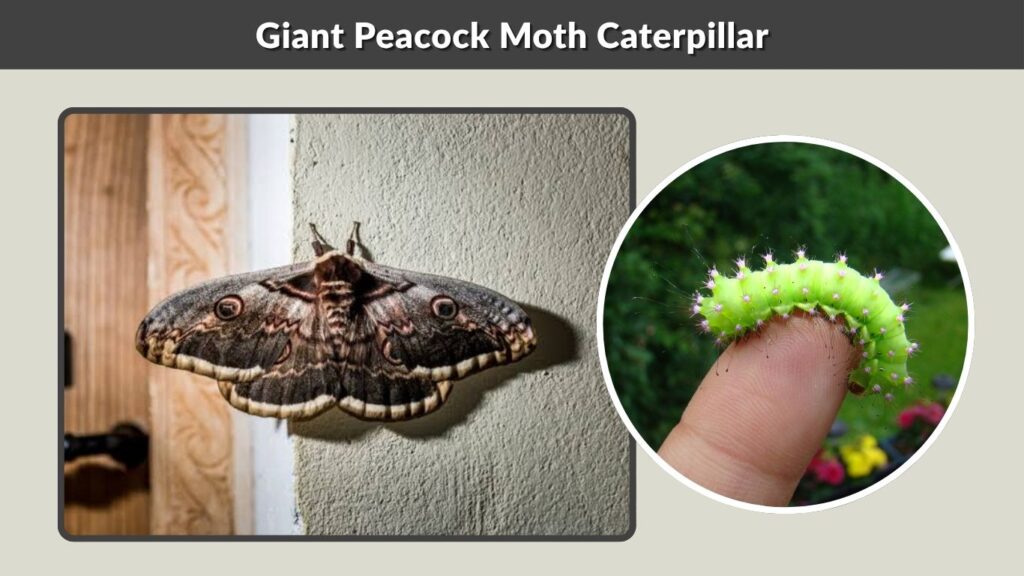
The giant peacock moth caterpillar looks almost nothing like the dark, patterned adult. Mature larvae are large, bright green caterpillars decorated with distinctive tubercles. Their impressive appearance sometimes causes people to mistake them for dangerous or stinging caterpillars.
As they develop, the caterpillars change noticeably in size and coloration before eventually producing a strong silken cocoon.
How to Identify the Caterpillar
Important characteristics of a mature caterpillar include:
- A large, thick green body
- Rows of blue or turquoise-colored tubercles
- Small hairs projecting from the raised tubercles
- Clearly separated body segments
- Strong gripping prolegs
- Considerable size when fully developed
Younger caterpillars may differ in coloration from mature larvae, becoming increasingly green and conspicuous as they grow.
Is the Giant Peacock Moth Caterpillar Poisonous?
The giant peacock moth caterpillar is not generally considered poisonous or dangerously venomous to humans. Its hairs and raised body structures make it look threatening, but they are primarily defensive features.
Handling wild caterpillars unnecessarily is still best avoided. Sensitive skin may become irritated after contact with hairs or body structures, and other caterpillar species can be difficult to distinguish without experience.
If you find one outdoors, observing it without touching it is usually the safest approach for both the caterpillar and the observer.
Giant Peacock Moth Life Cycle
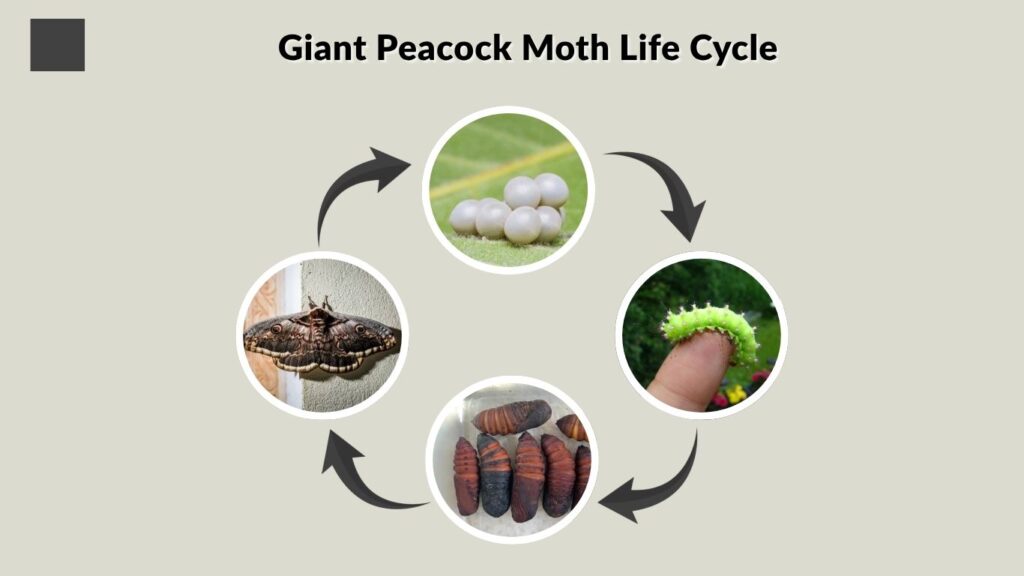
The giant peacock moth life cycle involves complete metamorphosis. Like other moths, it passes through four major stages: egg, caterpillar, pupa, and adult. Most of its active feeding and physical growth occur during the caterpillar stage, while adult moths devote their short lives primarily to locating mates and reproducing.
Egg Stage
After mating, a female lays numerous eggs on or close to suitable host plants. The selected plants provide food for the young caterpillars immediately after they hatch.
Development time depends on environmental conditions, particularly temperature.
Caterpillar Stage
Once hatched, the larvae begin eating leaves and grow rapidly. During this period they:
- Feed extensively on host plants
- Molt several times
- Increase dramatically in size
- Develop their characteristic green coloration
- Build energy reserves for metamorphosis
The caterpillar stage is especially important because the adult moth feeds little or not at all.
Pupal Stage
When fully grown, the caterpillar stops feeding and produces a strong silken cocoon. Inside, it becomes a pupa and undergoes major anatomical changes.
The pupal stage can last for a considerable period, and the insect may overwinter in this protected form before emerging during the appropriate season.
Adult Stage
The adult giant peacock moth emerges with fully developed wings. After expanding and drying its wings, it becomes active mainly during the night.
Adults have a relatively short lifespan compared with the lengthy immature stages. Their primary objectives are finding a mate, reproducing, and completing another generation.
What Does the Giant Peacock Moth Eat?
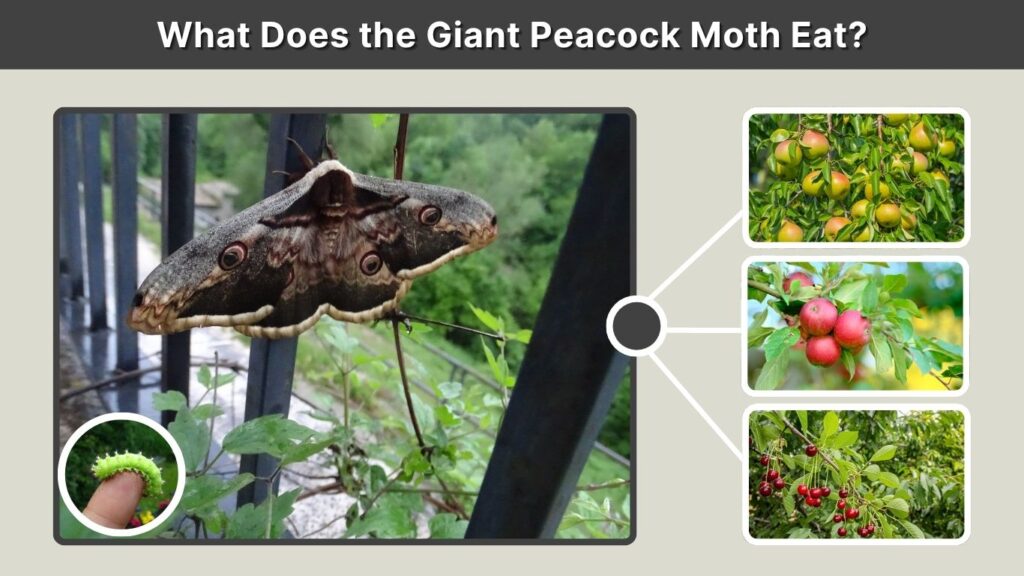
The answer to giant peacock moth diet depends on its life stage. Caterpillars require considerable amounts of plant material, whereas adults rely primarily on energy stored during larval development. This feeding strategy is common among several members of the giant silk moth family.
Caterpillar Diet
Larvae may feed on the foliage of various trees and shrubs, including:
- Pear trees
- Apple trees
- Plum trees
- Cherry and other fruit trees
- Hawthorn
- Ash
- Other suitable deciduous trees and shrubs
Because fruit trees can serve as hosts, caterpillars may occasionally appear in traditional orchards as well as natural woodland habitats.
Do Adult Giant Peacock Moths Eat?
Adult giant peacock moths have reduced feeding structures and generally do not depend on regular feeding. Instead, they survive primarily using energy accumulated during the caterpillar stage.
This explains why caterpillars consume so much foliage. They must store enough energy not only for pupation but also for much of the adult moth’s short reproductive life.
Where Do Giant Peacock Moths Live?
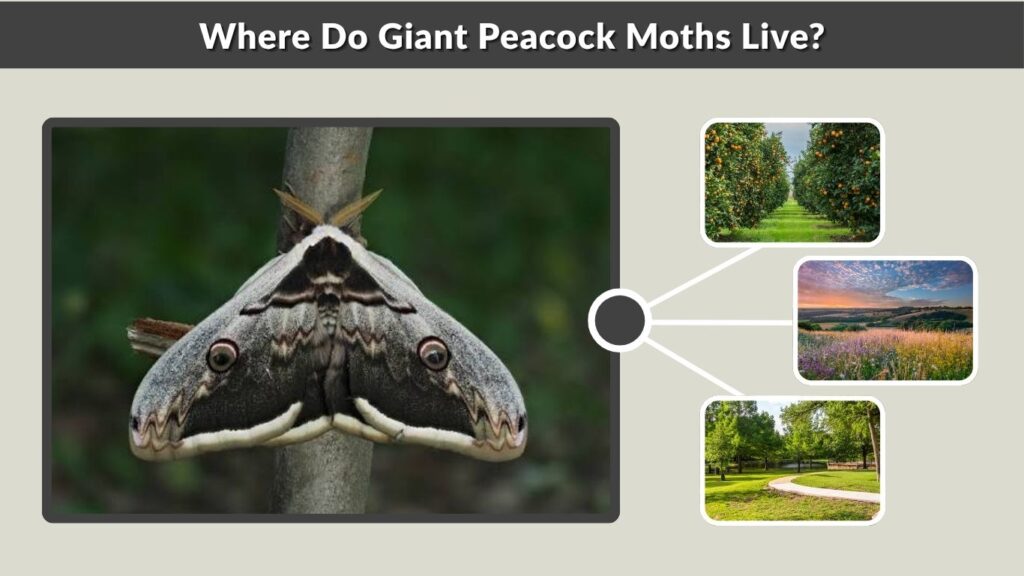
Saturnia pyri has a primarily European and Mediterranean distribution. It favors relatively warm regions containing abundant trees and shrubs suitable for larval feeding. The species may occupy woodland edges, orchards, countryside, scrubby landscapes, parks, and other semi-natural areas.
Its abundance varies considerably between countries and regions.
Giant Peacock Moth in France and Europe
The giant peacock moth in France is particularly associated with warmer parts of the country, especially southern regions where climate and vegetation provide favorable conditions.
Its broader range includes:
- Southern Europe
- Parts of central Europe
- Mediterranean regions
- Portions of southeastern Europe
- Nearby western Asian regions
Its presence becomes more localized toward cooler parts of its range.
Giant Peacock Moth in the UK
The giant peacock moth is not considered a typical widespread native moth of the UK. Reports there should therefore be interpreted carefully, as unusually large moths can be misidentified and captive individuals may occasionally occur.
The European peacock moth should also not be confused with large North American moth species. Searches for a giant eastern US peacock moth may refer to unrelated giant silk moths rather than Saturnia pyri.
Giant Peacock Moth and Vincent van Gogh
The giant peacock moth has an unusual connection with art history. Vincent van Gogh created a painting featuring the species in 1889 during his time in southern France. The artwork helped make the moth recognizable beyond entomology and is frequently searched under terms such as Van Gogh giant peacock moth and Giant Peacock Moth on Arum.
Van Gogh’s Giant Peacock Moth
Van Gogh was deeply interested in the natural environment around him. Plants, flowers, insects, fields, and seasonal changes frequently entered his work.
In his 1889 giant peacock moth painting, the moth is shown alongside vegetation, emphasizing its patterned wings and connection with the surrounding natural world. The subject reflects Van Gogh’s close observation of small details in the landscape during this period.
The artwork is sometimes described using titles referring to a giant peacock moth on arum.
Giant Peacock Moth Symbolism
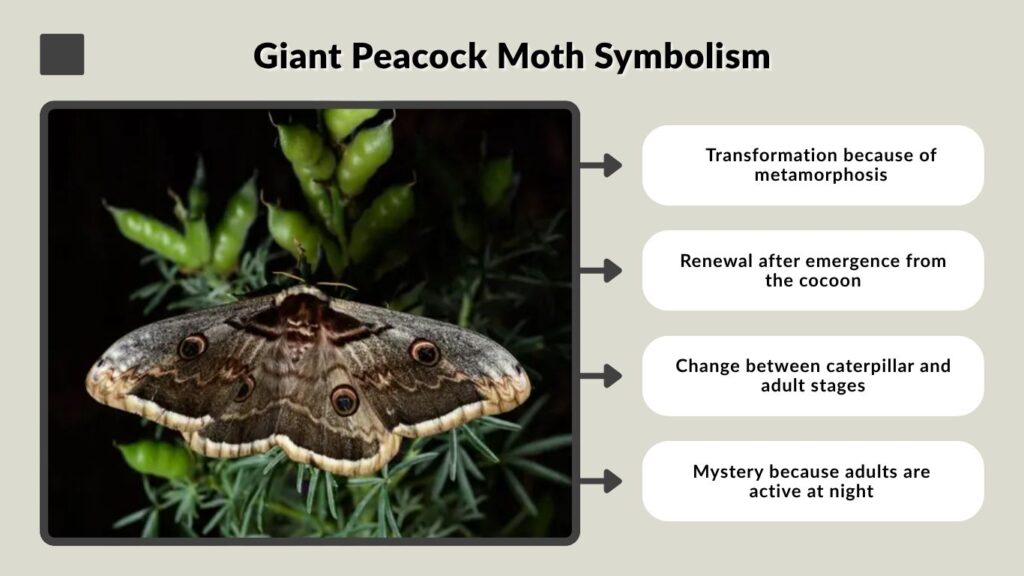
Because moths undergo dramatic transformation, people have given them many symbolic meanings. The giant peacock moth symbolism is therefore often connected to broader cultural interpretations of moths rather than one scientifically defined meaning.
Common symbolic associations include:
- Transformation because of metamorphosis
- Renewal after emergence from the cocoon
- Change between caterpillar and adult stages
- Mystery because adults are active at night
- Attraction to the unseen through their nocturnal behavior
- Impermanence because adult life is relatively short
These are cultural interpretations rather than biological characteristics. Their meanings may differ among individuals, artistic traditions, and cultures.
Interesting Facts About the Giant Peacock Moth
The remarkable size of this species is only one reason it attracts attention. Its sensory abilities, unusual adult feeding behavior, dramatic caterpillar, and artistic history make Saturnia pyri one of Europe’s most distinctive moths.
Quick Giant Peacock Moth Facts
- It is among the largest moth species found in Europe.
- Its scientific name is Saturnia pyri.
- Each wing carries a conspicuous eyespot.
- Male antennae are highly feathered.
- Caterpillars are large and bright green when mature.
- Larvae feed on several deciduous trees and fruit trees.
- Adults survive largely on energy stored during larval development.
- Vincent van Gogh featured a giant peacock moth in an 1889 artwork.
- Adults are mainly active at night.
- Despite its intimidating appearance, the caterpillar is not regarded as dangerously poisonous.
FAQs
1. How big is a giant peacock moth?
Adults commonly have a wingspan of approximately 10–15 centimeters, making Saturnia pyri one of Europe’s largest moths.
2. Is a giant peacock moth caterpillar poisonous?
No. Giant peacock moth caterpillars are not generally considered dangerously poisonous or venomous to humans, although unnecessary handling should be avoided.
3. What do giant peacock moth caterpillars eat?
The caterpillars eat leaves from various trees and shrubs, particularly fruit trees such as pear, apple, plum, and related deciduous plants.
4. How long does a giant peacock moth live?
Most of the moth’s life is spent developing as a larva and pupa. The adult stage is comparatively short because adults mainly concentrate on mating and reproduction.
5. Why did Van Gogh paint a giant peacock moth?
Van Gogh frequently observed and painted nature while living in southern France. His 1889 giant peacock moth artwork reflects his interest in local plants, animals, colors, and natural forms.
