
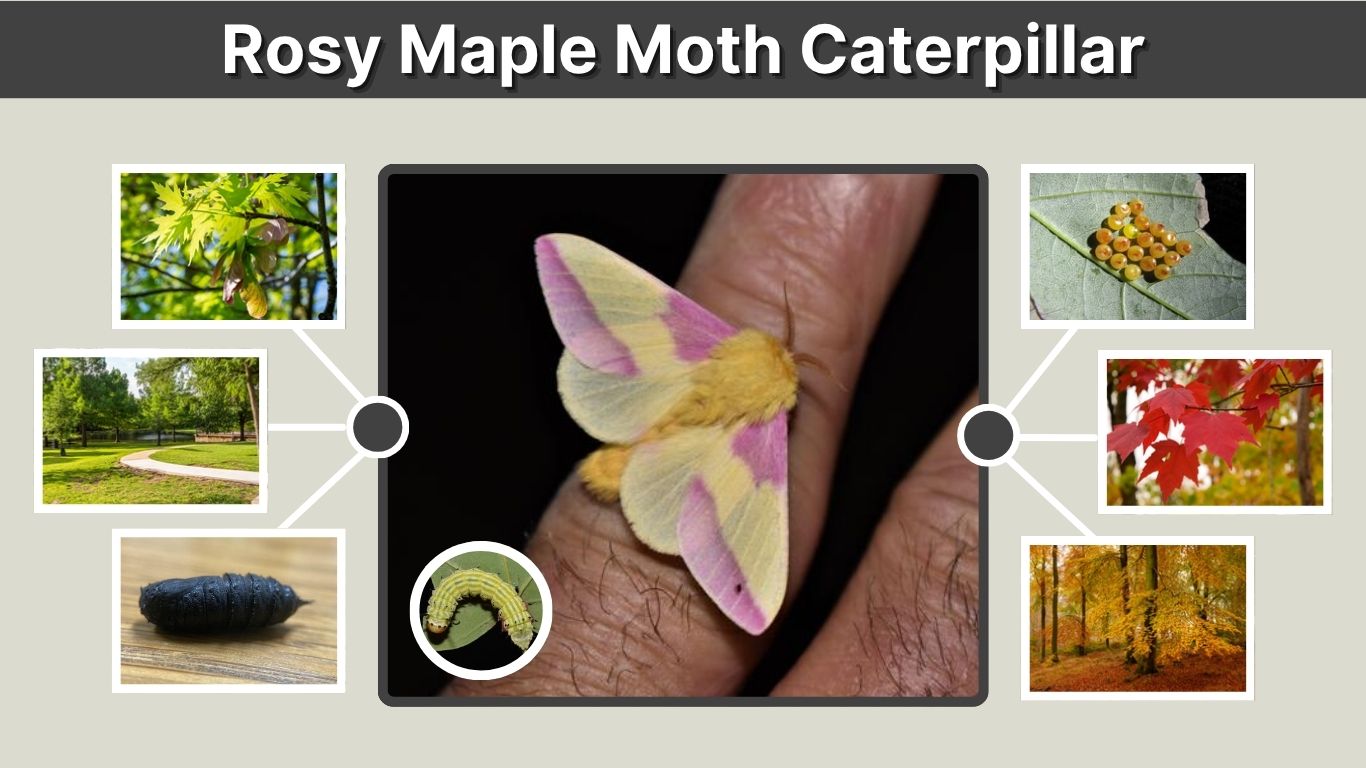
The rosy maple moth caterpillar is the larval stage of one of North America’s most colorful moths. Before becoming the pink-and-yellow rosy maple moth, the caterpillar is green, striped, and covered with small spines that give it a distinctive appearance. Often called a green-striped mapleworm, it mainly feeds on maple trees and occasionally gathers in large numbers. This guide explains how to identify a rosy maple moth caterpillar, what it eats, whether its spines sting, where it lives, and how it develops into an adult moth.
What Does a Rosy Maple Moth Caterpillar Look Like?
A rosy maple moth looks dramatically different during its caterpillar stage than it does as an adult. The larva begins relatively small and dark but becomes a large green caterpillar as it matures. Its striped body and noticeable spines make identification easier, especially when it is feeding on maple leaves with other caterpillars.
Identification
Key features of a mature rosy maple moth caterpillar include:
- Body color: Usually light to yellowish green.
- Length: Mature larvae can reach roughly 1.5 to 2 inches.
- Stripes: Several thin pale or greenish-white lines run lengthwise along the body.
- Head: Typically reddish-brown to dark brown.
- Spines: Two prominent dark spines appear behind the head, with shorter spines along the body.
- Body shape: Long, cylindrical, and slightly thicker toward the middle.
- Legs: Several pairs of abdominal prolegs help the caterpillar hold tightly to leaves and branches.
Young larvae may look darker and are more likely to remain together in groups, while older caterpillars become greener and often spread out.
Why Is It Called a Green-Striped Mapleworm?
The caterpillar is commonly called the green-striped mapleworm because of its green body, narrow stripes, and preference for maple leaves. Its scientific name is Dryocampa rubicunda. Once it completes the caterpillar stage, it transforms into the familiar rosy maple moth with pink and yellow coloration.
Rosy Maple Moth Caterpillar Life Cycle
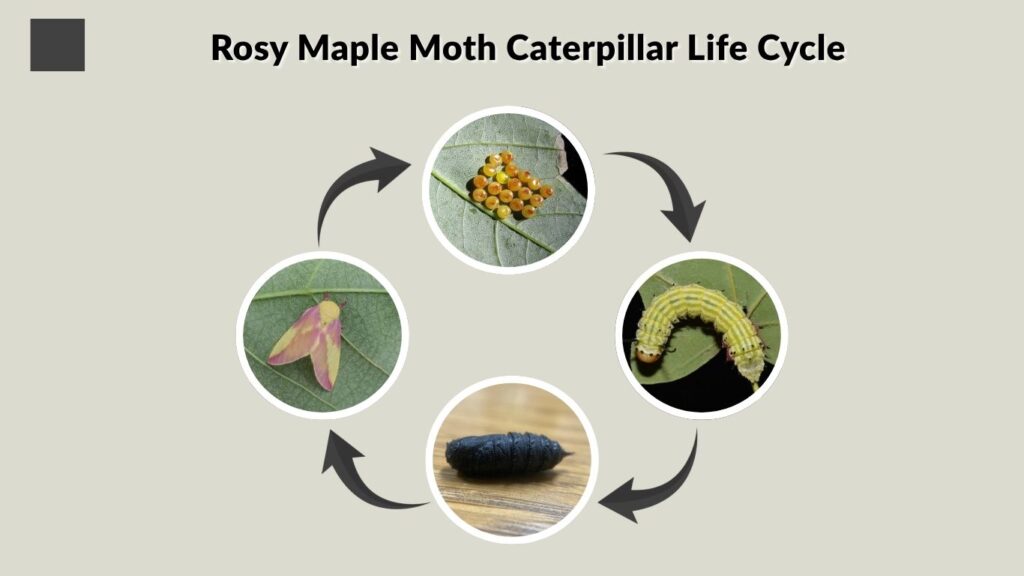
The transformation from a rosy maple moth caterpillar to an adult moth involves complete metamorphosis. Like other moths, the species develops through egg, larva, pupa, and adult stages. The caterpillar stage is primarily devoted to feeding and growth, while the adult stage focuses mainly on reproduction.
Egg Stage
Adult female rosy maple moths deposit eggs on the underside of suitable host-tree leaves. Maple trees are particularly important. Eggs are generally laid in groups, providing newly hatched larvae with immediate access to food.
After hatching, the tiny caterpillars begin eating leaf tissue and may remain together during their earliest developmental stages.
Caterpillar Stage
The rosy maple moth caterpillar grows through several molts. Young caterpillars often feed communally, sometimes appearing in noticeable clusters on individual branches.
During development, they:
- Eat large quantities of maple leaves.
- Shed their skin repeatedly as they grow.
- Change in coloration and appearance.
- Develop increasingly obvious body stripes and spines.
- Become more solitary as they approach maturity.
Heavy populations can remove considerable foliage from a tree, although healthy mature maples generally recover from occasional feeding.
Pupa and Adult Stage
When fully developed, the caterpillar leaves its feeding location and searches for a protected place near or within the soil. It pupates and undergoes its final transformation.
The emerging adult is unmistakable. Rosy maple moths commonly have bright yellow bodies, pink legs, and wings covered with varying combinations of pink, yellow, cream, or white. Adults do not resemble the green caterpillar they developed from.
What Do Rosy Maple Moth Caterpillars Eat?
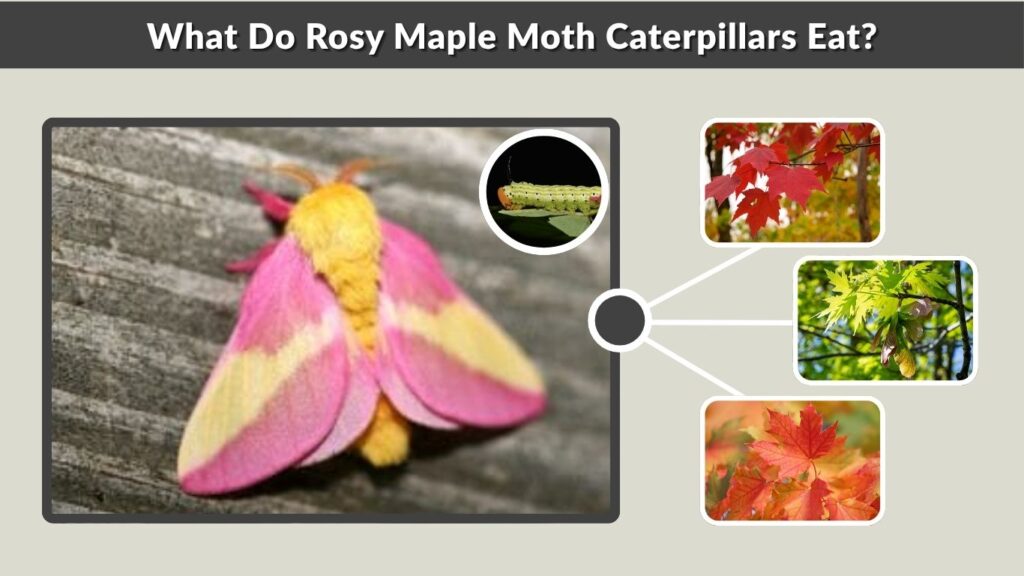
The rosy maple moth caterpillar is primarily a leaf-eating insect associated with hardwood trees. Maple species are its most important hosts, which explains why homeowners sometimes discover these caterpillars while examining damaged maple foliage.
Common Host Trees
Rosy maple moth caterpillars may feed on:
- Red maple
- Silver maple
- Sugar maple
- Boxelder
- Other maple species
- Occasionally selected oak or related hardwood trees
Maple foliage normally provides all the food the caterpillar requires during its larval development.
How They Feed
Young caterpillars may feed together and remove leaf tissue from the same area. As they grow larger, they can consume much more foliage and gradually spread across different parts of the tree.
They do not feed on people, clothing, stored foods, or household materials. Finding one near a house usually means a suitable host tree is growing nearby.
Does a Rosy Maple Moth Caterpillar Sting?
The appearance of the rosy maple moth caterpillar often causes concern because it has visible spines. Some caterpillars with similar structures can deliver painful stings, making it reasonable to wonder about a rosy maple moth caterpillar sting.
Rosy maple moth caterpillars are not considered among the dangerous stinging caterpillars. However, direct handling should still be avoided because their spines may cause mild mechanical irritation in sensitive individuals.
What Happens If You Touch One?
Contact may produce no noticeable reaction at all, but possible effects can include:
- Minor skin irritation
- Slight redness
- An itching sensation
- Mild discomfort from the spines
Severe reactions are not typical. Washing the contact area with soap and water is usually a sensible precaution if irritation occurs.
Are They Dangerous?
Rosy maple moth caterpillars are not aggressive and do not chase, bite, or intentionally attack people. Their spines primarily function as a physical defense against predators.
Children and pets should still be discouraged from handling unfamiliar caterpillars because many species look similar, and some genuinely possess irritating or venomous spines.
Where Are Rosy Maple Moth Caterpillars Found?
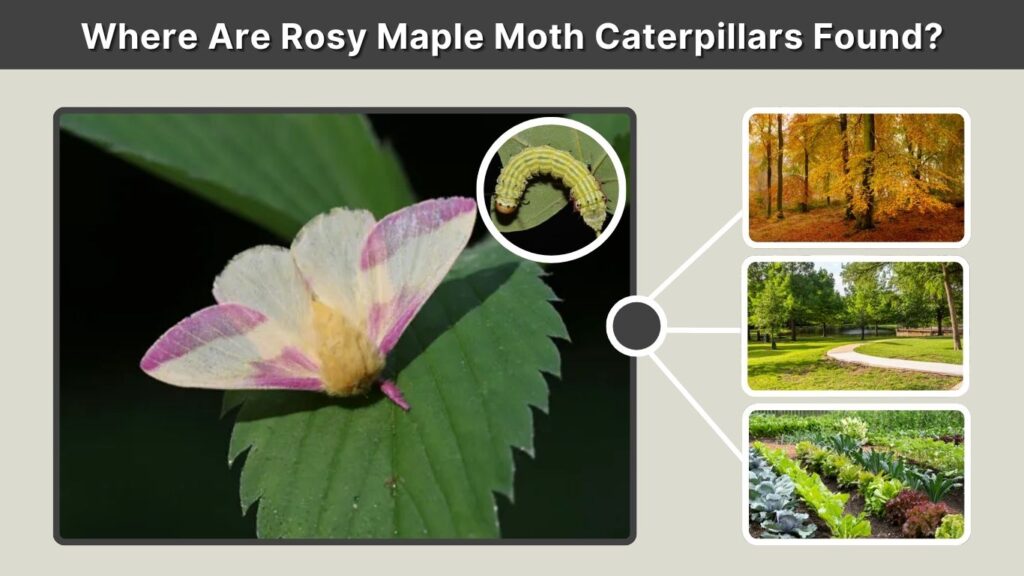
Rosy maple moths occur across a large part of eastern North America. Their distribution closely follows areas where suitable maple and other host trees grow.
The caterpillars are usually easiest to notice during warmer months when leaves are available and larvae are actively feeding. Their exact seasonal timing varies with latitude and local climate.
Habitat and Distribution
Suitable habitats include:
- Deciduous forests
- Woodland edges
- Suburban neighborhoods
- Parks
- Gardens
- Areas containing mature maple trees
A rosy maple moth caterpillar in Pennsylvania, for example, is not unusual because the state provides abundant hardwood forests and host trees. The species also occurs through many other parts of the eastern United States and into portions of Canada.
Where to Look for Caterpillars
Check the undersides and edges of maple leaves if you are trying to find green-striped mapleworms. Young larvae may cluster together, making them easier to spot.
Signs that caterpillars have been feeding include partially eaten leaves, missing leaf sections, and groups of larvae resting on branches or foliage.
Rosy Maple Moth Caterpillar vs. Luna Moth Caterpillar
People occasionally confuse a luna moth rosy maple moth caterpillar because both can be large and green. However, they belong to different moth families and develop into very different adults.
Major Differences
The two caterpillars can be distinguished by several characteristics:
- Rosy maple moth caterpillar: Usually has obvious longitudinal stripes and prominent dark spines behind the head.
- Luna moth caterpillar: Has a thicker green body with small colored bumps rather than long, conspicuous thoracic spines.
- Host plants: Rosy maple moth larvae strongly favor maples, while luna moth caterpillars feed on trees such as walnut, hickory, sweetgum, and birch.
- Adult appearance: Rosy maple moths are pink and yellow, while luna moths are pale green with large wings and long hindwing tails.
Examining both body markings and the tree on which the caterpillar is feeding can make identification much easier.
Can You Keep a Rosy Maple Moth Caterpillar?
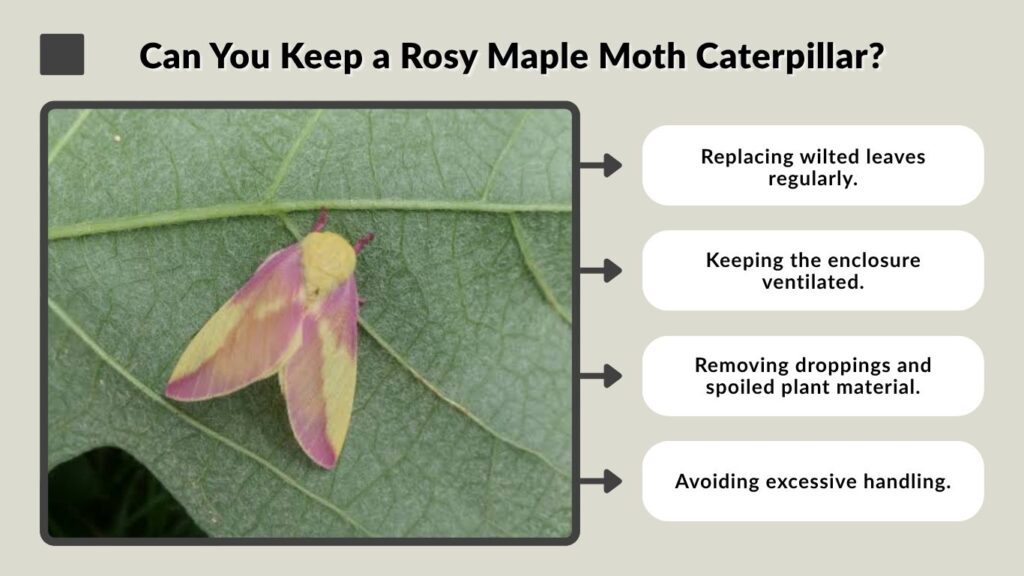
People interested in observing moth development sometimes keep caterpillars temporarily. However, successful rearing requires fresh host leaves, good ventilation, cleanliness, and suitable conditions for pupation.
Basic Care
If legally collected in your area, basic care involves:
- Providing fresh leaves from the same type of tree where the caterpillar was found.
- Replacing wilted leaves regularly.
- Keeping the enclosure ventilated.
- Removing droppings and spoiled plant material.
- Avoiding excessive handling.
- Providing appropriate material or substrate when the caterpillar is ready to pupate.
Wild caterpillars are generally best left outdoors unless you understand their care requirements.
Rosy Maple Moth Caterpillar for Sale
Searches for a rosy maple moth caterpillar for sale sometimes lead to insect breeders or specialty suppliers. Availability may vary by season and location.
Before purchasing or transporting live caterpillars, check local regulations because moving insects between regions can be restricted. Responsible captive-rearing practices also reduce the risk of accidentally introducing insects or diseases into new environments.
FAQs
1. Is a rosy maple moth caterpillar poisonous?
No. The rosy maple moth caterpillar is not generally considered poisonous to humans. Its spines may cause minor irritation if handled, but serious reactions are uncommon.
2. What does a rosy maple moth caterpillar turn into?
It turns into the rosy maple moth, Dryocampa rubicunda. The adult is famous for its bright pink-and-yellow wings and fuzzy yellow body.
3. What trees do rosy maple moth caterpillars eat?
They primarily eat maple leaves, including red maple, silver maple, and sugar maple. Boxelder may also serve as a host.
4. Can rosy maple moth caterpillars damage maple trees?
Large groups can remove noticeable amounts of foliage. However, occasional feeding usually does not permanently damage a healthy established maple tree.
5. How can I identify a rosy maple moth as a caterpillar?
Look for a green caterpillar with narrow lengthwise stripes, a brownish head, short body spines, and two longer dark spines directly behind the head. Finding it feeding on maple leaves provides another strong identification clue.
