
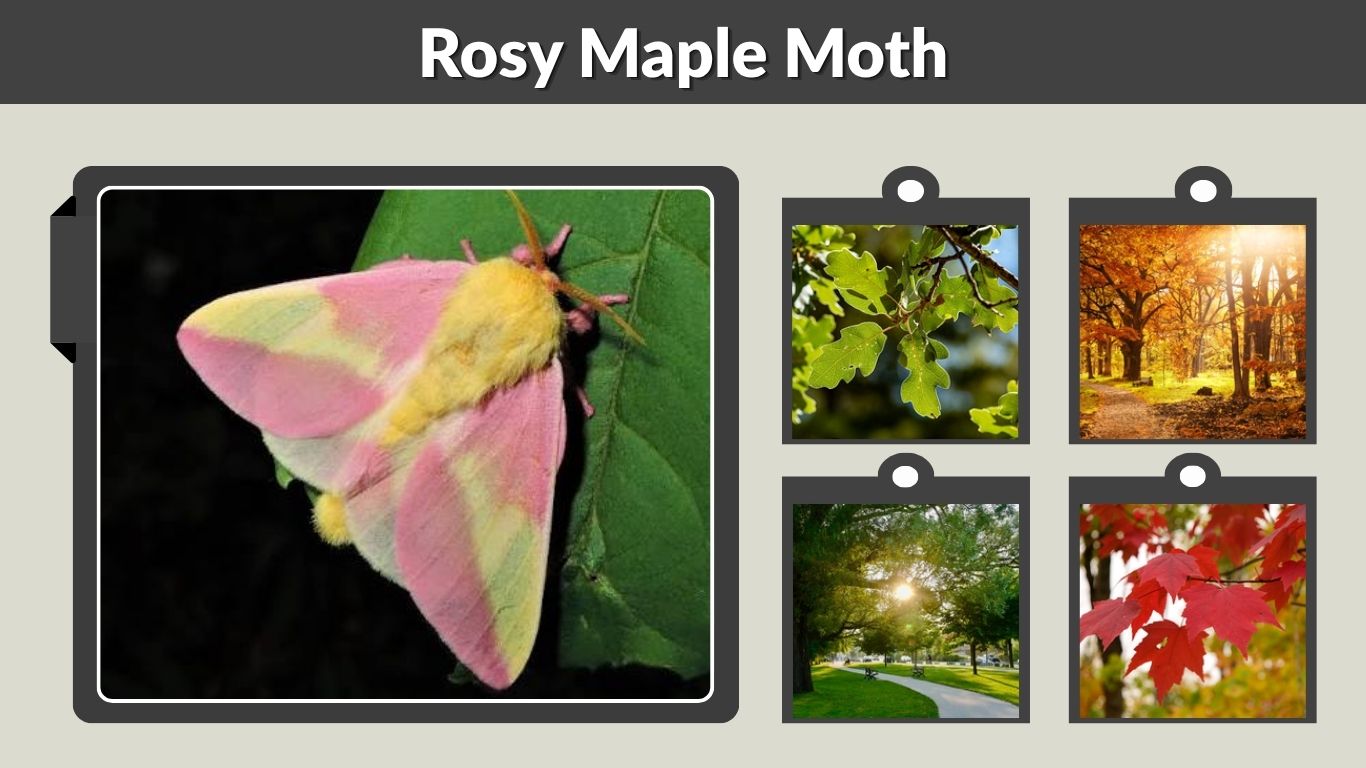
The rosy maple moth (Dryocampa rubicunda) is a small North American silk moth famous for its fluffy body and remarkable pink-and-yellow wings. Adults can vary from strongly pink to pale cream or nearly white, while their larvae are known as green-striped mapleworms. These caterpillars primarily feed on maple and oak leaves before pupating underground. Adult moths do not eat and live mainly to reproduce. This guide covers identification, caterpillars, diet, habitat, lifespan, life cycle, size, and male-versus-female differences.
What Does a Rosy Maple Moth Look Like?
Rosy maple moths are among the easiest North American moths to recognize when they display their classic colors. Their thick, woolly bodies are usually yellow, cream, or white, while the legs and undersides commonly show rosy pink. Wing coloration is highly variable, however, and some individuals have much less pink than others.
Rosy Maple Moth Identification
Typical identification features include:
- Pink, yellow, cream, or white wings
- Pink concentrated around wing margins and bases
- Thick and fuzzy-looking body
- Rose-pink legs and antennae
- Broad, rounded wings
- Wingspan of about 1.3 to 2.2 inches
- More feathery antennae in males
- Considerable variation between individuals
The rosy maple moth belongs to the Saturniidae family and the royal moth subfamily Ceratocampinae.
Why Are Rosy Maple Moths Pink?
The amount of pink varies naturally among rosy maple moths. Some individuals have broad areas of vivid pink and yellow, while others may be predominantly cream or white with only limited pink markings.
A particularly pale form occurs in parts of the species’ range. Because of this variation, an unusually pale individual can still be a genuine rosy maple moth.
Rosy Maple Moth Caterpillar
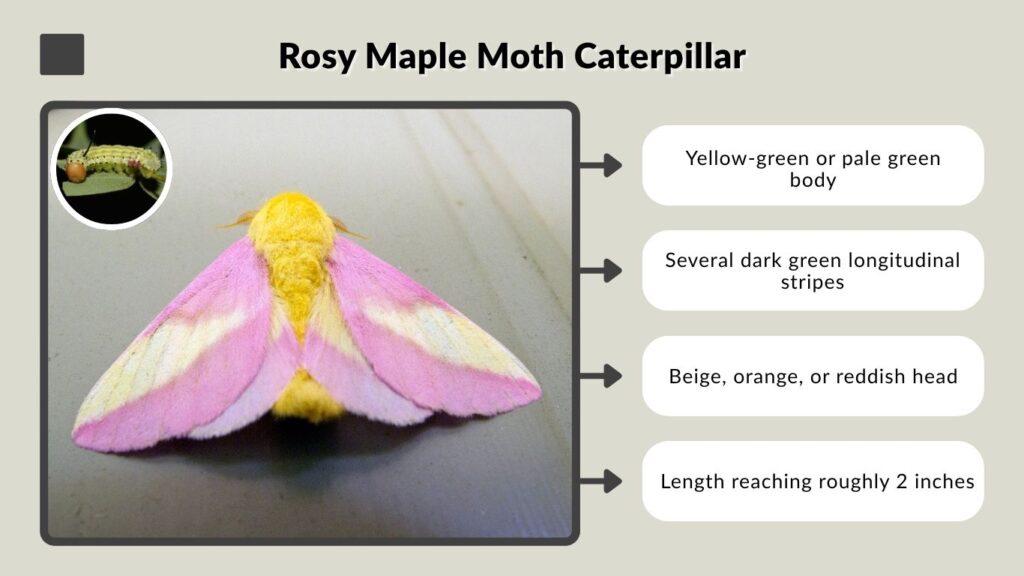
The caterpillar of the rosy maple moth is commonly called the green-striped mapleworm. Its appearance changes considerably while passing through its larval stages. Younger caterpillars have darker heads and paler bodies, while mature larvae become green with longitudinal stripes and prominent dark horns. Fully developed caterpillars can reach approximately two inches in length.
Caterpillar Identification
A mature rosy maple moth caterpillar may have:
- Yellow-green or pale green body
- Several dark green longitudinal stripes
- Beige, orange, or reddish head
- Two prominent black horns near the front
- Small dark spines along the body
- A thick, segmented appearance
- Length reaching roughly 2 inches
- Green coloration that blends with leaves
Young larvae initially feed together but become more solitary as they mature.
Are Rosy Maple Moth Caterpillars Poisonous?
Rosy maple moth caterpillars have conspicuous horns and small spines, but they are not generally treated as dangerous stinging caterpillars like Io moth or puss caterpillar larvae.
Their appearance can seem intimidating, but avoiding unnecessary handling is still sensible. Unknown caterpillars should not be squeezed or rubbed against bare skin because correct identification is not always easy.
What Do Rosy Maple Moths Eat?
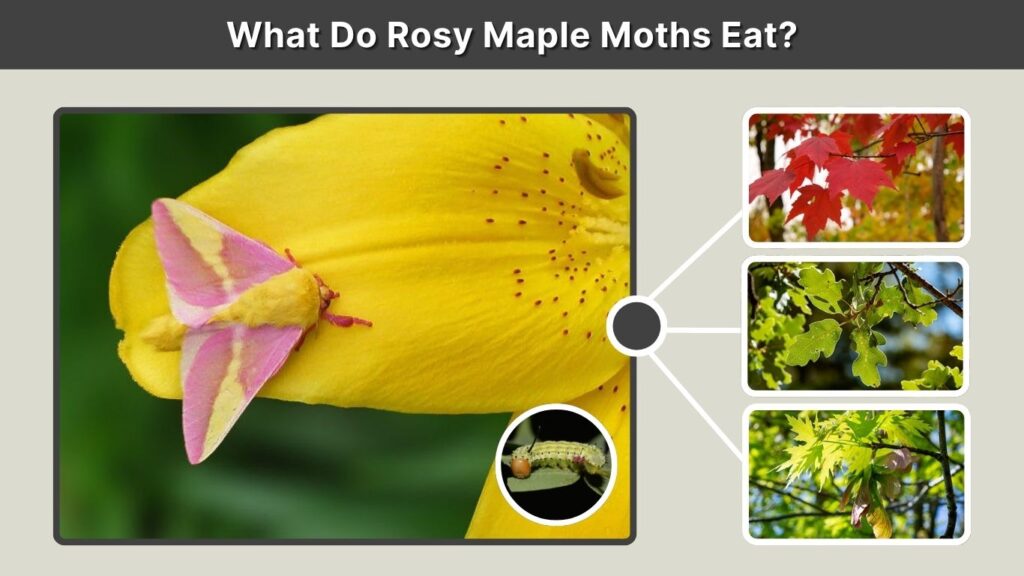
Diet changes completely between the larval and adult stages. Green-striped mapleworms are leaf-eating caterpillars that grow by consuming foliage from suitable host trees. Adult rosy maple moths, in contrast, do not feed. They rely on energy accumulated during larval development to support flight, mating, and egg production during their brief adult stage.
Rosy Maple Moth Host Plants
Caterpillars may feed on:
- Red maple
- Sugar maple
- Silver maple
- Box elder
- Oak
- Turkey oak
- Sycamore
- Beech
Maples are particularly important host plants, which explains the moth’s common name. Large populations of caterpillars can occasionally remove substantial amounts of foliage, although affected trees generally recover.
Do Adult Rosy Maple Moths Eat?
Adult rosy maple moths do not feed. Once they emerge from their pupae, their main biological purpose is reproduction.
They therefore do not visit flowers for nectar in the way many butterflies and some other moths do. The energy needed during adulthood comes from reserves accumulated when they were leaf-eating caterpillars.
Rosy Maple Moth Life Cycle
Rosy maple moths undergo complete metamorphosis, progressing through egg, caterpillar, pupa, and adult stages. Females place clusters of eggs on host-plant foliage. After hatching, the larvae feed together during their earliest stages before becoming increasingly independent. Mature caterpillars eventually leave the foliage and pupate beneath the soil, where some populations spend the winter.
Life Cycle Stages
The major stages are:
- Egg: Females lay clusters of about 10–30 eggs on host leaves.
- Young larva: Caterpillars hatch and initially feed together.
- Later larva: Green-striped mapleworms grow through several instars.
- Mature caterpillar: Older larvae become solitary feeders.
- Pupa: Mature caterpillars enter shallow underground chambers.
- Adult moth: Adults emerge, mate, and begin another generation.
Rosy maple moth larvae pass through five instars before pupation.
Rosy Maple Moth Cocoon and Pupa
Unlike silk moths that produce large cocoons hanging prominently from branches, rosy maple moth caterpillars pupate underground.
A mature caterpillar descends from its host plant and enters a shallow soil chamber. In colder portions of the range, the moth may overwinter in this pupal stage and emerge as an adult during the following warm season.
Rosy Maple Moth Habitat and Range
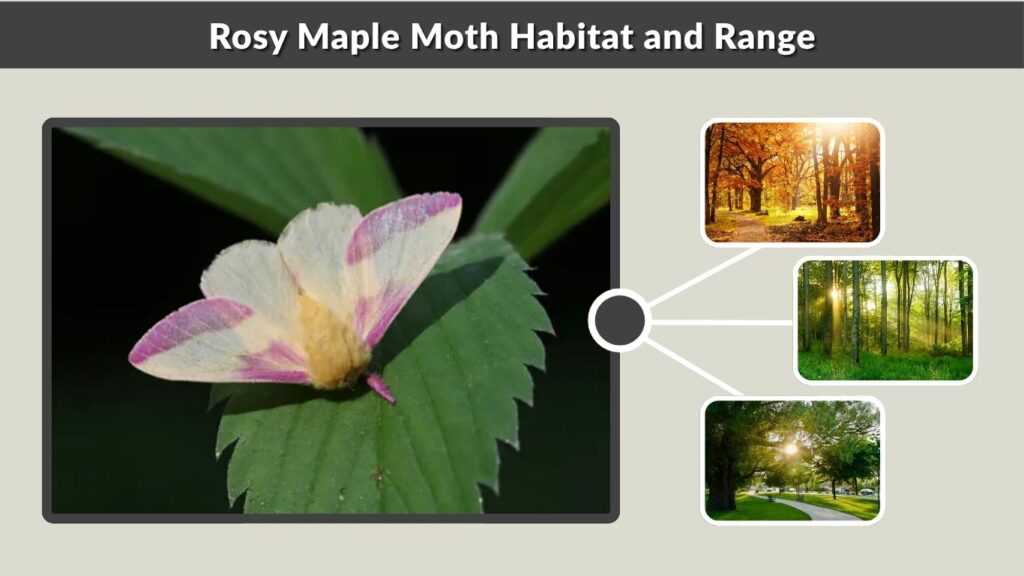
Rosy maple moths are native to North America and are primarily associated with deciduous forests containing suitable host trees. Their range extends through much of eastern North America, from parts of southern Canada south through the eastern United States and into Florida and Texas. They can also appear in suburban areas where maple trees are abundant.
Where Do Rosy Maple Moths Live?
Typical locations include:
- Deciduous forests
- Maple woodlands
- Forest edges
- Parks
- Suburban yards
- Gardens containing host trees
- Areas with mature maple and oak trees
Records extend through southern Canada, the eastern United States, Florida, the Gulf Coast, and parts of the central United States.
Are Rosy Maple Moths Rare?
Rosy maple moths are not generally considered threatened or endangered, although abundance varies locally. People may still consider them unusual because adults are nocturnal, seasonal, and short-lived.
They are frequently attracted to artificial lights, which can provide one of the easiest opportunities to see an adult during its local flight season.
Male vs Female Rosy Maple Moth
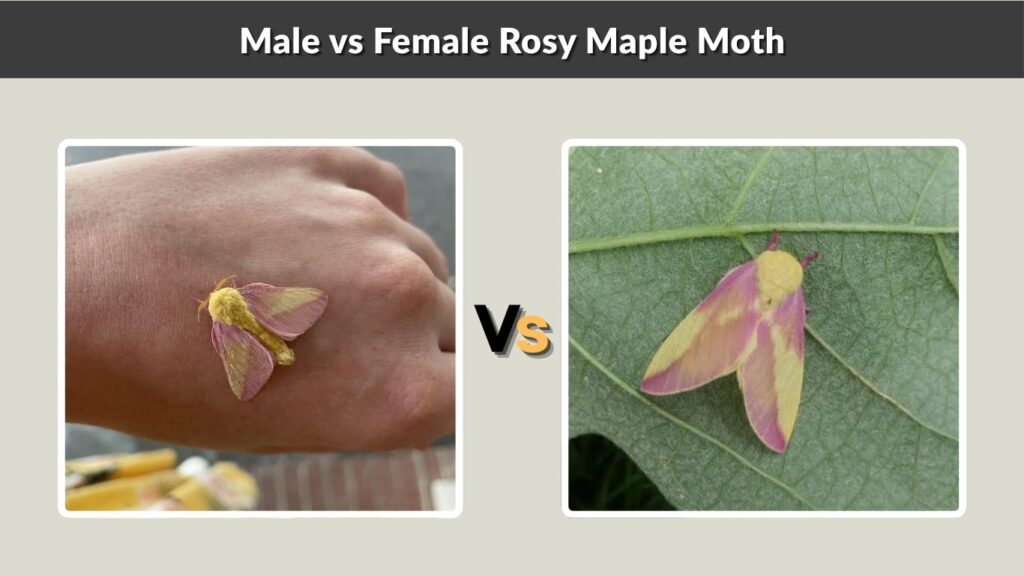
Male and female rosy maple moths share the characteristic pink-and-yellow coloration, but differences in antennae, wing shape, and overall size can help separate them. Females generally have broader, more rounded wings, while males possess more strongly feathered antennae that help detect female pheromones during mating.
Male Rosy Maple Moth
Males generally have bushier, bipectinate antennae and somewhat narrower wings. Their antennae increase the surface area available for detecting pheromones released by receptive females.
The body can still display the same yellow, cream, white, and pink coloration seen in females, so color alone is not a dependable way to determine sex.
Female Rosy Maple Moth
Females tend to have broader, more rounded wings and simpler antennae. After mating, a female deposits her eggs on the undersides of suitable host leaves.
Eggs are usually placed in groups, allowing newly hatched caterpillars to begin feeding together before they eventually separate during later developmental stages.
FAQs
1. How long do rosy maple moths live?
The complete lifespan can extend for several months because much of the life cycle is spent as a caterpillar or pupa, especially when overwintering occurs. The adult stage itself is comparatively brief and is devoted primarily to mating and reproduction.
2. Are rosy maple moths poisonous?
Adult rosy maple moths are not considered poisonous or dangerous to humans. They do not bite or sting and do not feed as adults. Their caterpillars possess noticeable spines, so unnecessary handling of larvae is still best avoided.
3. What do rosy maple moths eat?
Adult rosy maple moths do not eat. Their caterpillars feed primarily on foliage from maple trees such as red, sugar, and silver maple, along with several oak species and some other deciduous trees.
4. How big is a rosy maple moth?
Adults generally have a wingspan of about 32–55 mm, or approximately 1.3–2.2 inches. Mature green-striped mapleworm caterpillars can reach roughly 50–55 mm long. Females generally have broader and more rounded wings than males.
5. Can you keep a rosy maple moth as a pet?
Rosy maple moths can sometimes be observed through their life cycle in captivity, but adults are short-lived and do not eat. Anyone raising caterpillars needs the correct fresh host foliage and suitable conditions for underground pupation. Keeping wild insects should also follow applicable local wildlife regulations.
