
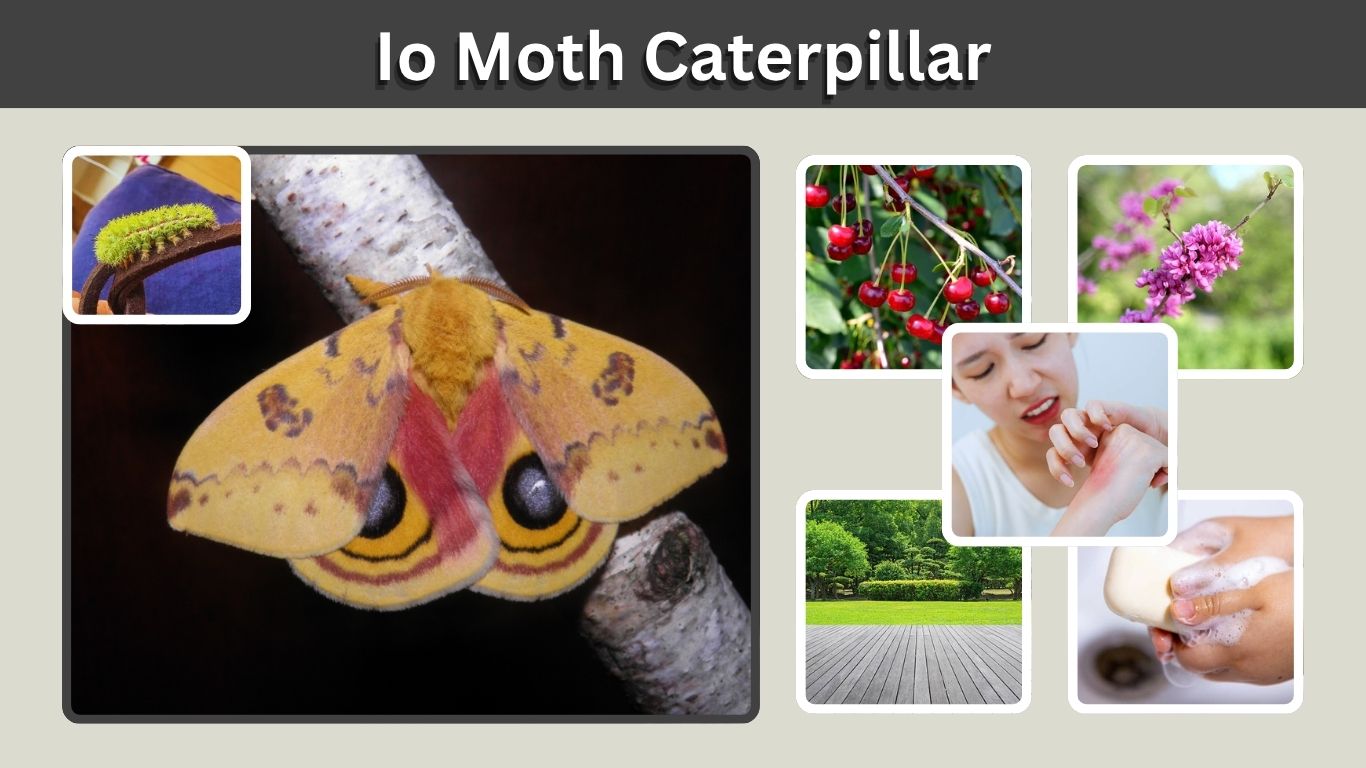
The Io moth caterpillar (Automeris io) is a striking green caterpillar known for its branched, venomous spines and painful sting. Mature larvae develop bright green bodies with red-and-white side stripes, while younger stages can look brown or orange. They feed on many trees and shrubs before forming cocoons and becoming colorful Io moths. Because even accidental contact can cause burning, redness, itching, and swelling, recognizing this caterpillar is important. This guide covers identification, sting treatment, food, host plants, development, habitat, and safe control.
What Does an Io Moth Caterpillar Look Like?
Io moth caterpillars change considerably as they grow. Early larvae are dark reddish-brown and gradually become lighter through successive molts. Mature caterpillars are typically pale to bright green and can reach about 6.5 cm, or roughly 2.5 inches, long. Their conspicuous branched spines are their most important identification and defensive feature.
Io Moth Caterpillar Identification
A mature Io caterpillar typically has:
- Bright or pale green coloration
- A thick, cylindrical body
- Red and whitish stripes running along each side
- Numerous branched green or yellow spines
- Dark or black tips on some spines
- Several spine-covered fleshy projections
- Body length reaching about 2.5 inches
- Strong gripping legs and abdominal prolegs
The spines are not decorative hairs. They are defensive structures associated with venom and should not be touched.
Green Io Moth Caterpillar
The familiar green appearance develops later in the larval stage. This coloration helps the caterpillar blend into leaves while feeding.
A green Io caterpillar may look attractive enough to handle, particularly to children, but its bright coloration should instead be treated as a warning. Even light contact with the spine-covered body can cause a painful reaction.
Io Moth Caterpillar Sting
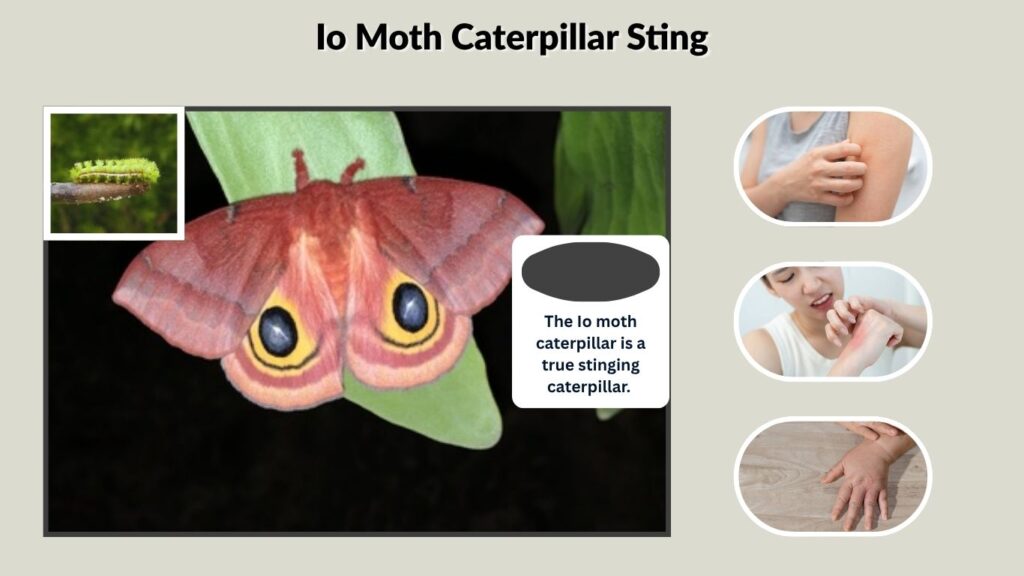
The Io moth caterpillar is a true stinging caterpillar. Much of its body is protected by venomous spines. When these penetrate skin, their tips can break and release venom, and fragments may remain embedded and contribute to continued irritation. Individual sensitivity varies, but the reaction usually begins rapidly after contact.
Io Moth Caterpillar Sting Symptoms
Common effects can include:
- Immediate stinging or burning pain
- Redness around the contact area
- Intense itching
- Local swelling
- Raised welts
- Tender or irritated skin
- Small areas of inflammation
- Occasionally more extensive reactions
University of Florida guidance reports that pain generally decreases within a couple of hours and localized swelling commonly improves within roughly 6–8 hours, although reactions vary. Systemic symptoms are considered uncommon.
Is the Io Moth Caterpillar Poisonous?
The more accurate description is venomous rather than poisonous. Its defensive substance is delivered when specialized spines penetrate the skin.
The adult Io moth does not sting. The risk comes from the caterpillar stage and its spine-covered body. Simply observing one without touching it is safe.
Io Moth Caterpillar Sting Treatment
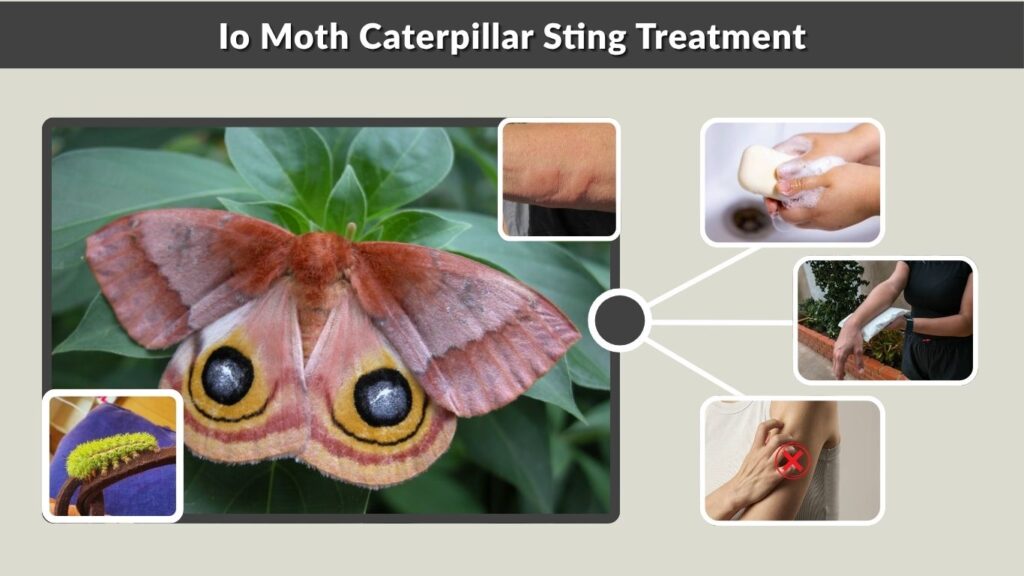
First aid should focus on removing embedded spines and reducing irritation. Rubbing the area can push spine fragments farther into the skin, so it should be avoided. Poison Control and University of Florida guidance recommend using adhesive tape to lift embedded hairs or spines before gently cleaning the affected skin.
What to Do After a Sting
- Do not rub or scratch the affected skin.
- Remove the caterpillar without touching it directly.
- Press adhesive tape gently onto the affected area.
- Pull the tape away to help remove embedded spines.
- Repeat with fresh tape if necessary.
- Wash the skin gently with soap and water.
- Apply a wrapped cold pack to reduce discomfort and inflammation.
- Monitor symptoms for worsening swelling or other reactions.
Seek medical attention for severe blistering or significant worsening symptoms. Difficulty breathing, difficulty swallowing, facial or throat swelling, or other signs of a severe allergic reaction require urgent medical care.
What Do Io Moth Caterpillars Eat?
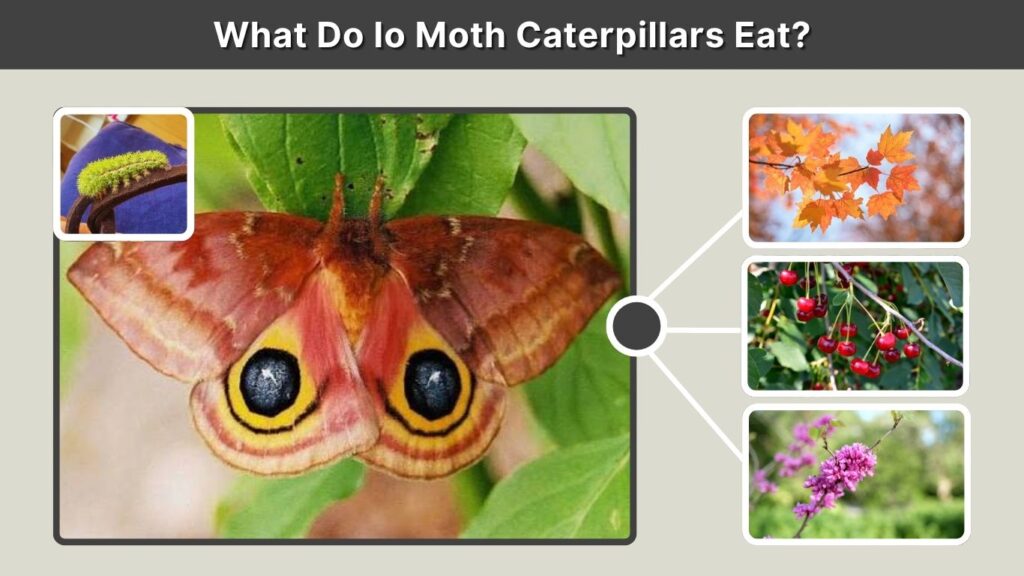
Io caterpillars are generalist plant feeders and can develop on many species of trees and shrubs. This broad diet contributes to their wide distribution. Caterpillars may feed together when young before becoming more dispersed as they mature. Host plants vary according to region and what vegetation is locally available.
Io Moth Caterpillar Host Plants
Common host plants include:
- Hibiscus
- Elm
- Maple
- Willow
- Wisteria
- Wild cherry
- Redbud
- Other trees and shrubs
University of Florida specifically lists hibiscus, elm, maple, wisteria, and willow among known host plants, while wild cherry has also been cited as a preferred food plant in rearing.
What Should You Feed an Io Caterpillar?
If an Io caterpillar must temporarily be cared for, fresh leaves from the plant on which it was originally found are generally the safest choice. Changing host plants suddenly may result in poor feeding.
Because the caterpillar stings, avoid direct handling. Use leaves, tools, or a container when moving it, and make sure children and pets cannot reach the enclosure.
Io Moth Caterpillar Stages and Life Cycle
Io moths undergo complete metamorphosis through egg, larval, pupal, and adult stages. The caterpillar passes through multiple instars separated by molts. Five larval instars are typical for Saturniidae, although additional molts can occur under some rearing conditions. The caterpillar’s appearance changes significantly during this development.
Io Caterpillar Development Stages
The development process includes:
- Eggs: Females deposit groups of small eggs on host vegetation.
- Young larvae: Newly hatched caterpillars are reddish-brown.
- Middle instars: Larvae become increasingly yellow-brown and larger.
- Mature caterpillar: The body becomes green with conspicuous stripes and spines.
- Prepupal stage: Feeding stops as the caterpillar searches for shelter.
- Pupa: The larva transforms inside a protective cocoon.
- Adult moth: A winged Io moth eventually emerges.
Environmental conditions and host quality can influence how quickly development progresses.
Io Moth Caterpillar Cocoon
When mature, the caterpillar stops feeding and prepares to pupate. It forms a cocoon among leaves or similar protective material.
In captivity, prepupal larvae can be provided with leaf litter or suitable material in which to construct their cocoons. Pupae may enter diapause, particularly where seasonal conditions require them to remain dormant before adult emergence.
Where Are Io Moth Caterpillars Found?
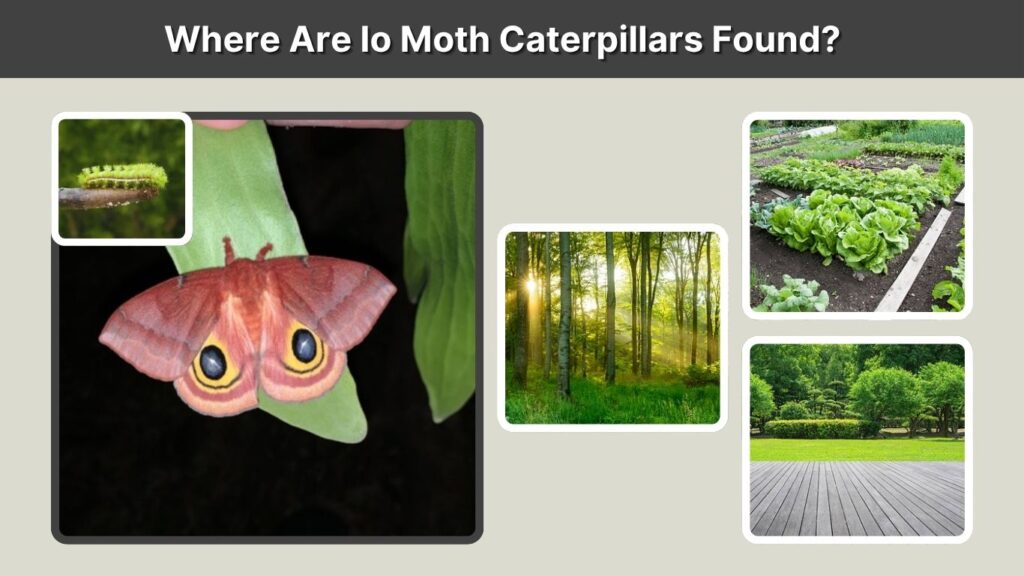
Io moths range from southern Canada through much of the eastern United States and into eastern Mexico. Caterpillars occur wherever appropriate host vegetation is available, including forests, woodland edges, gardens, landscaped areas, and suburban yards.
Io Moth Caterpillars in Florida and the South
Io caterpillars are particularly notable in Florida and other southeastern states because their preferred vegetation can occur in gardens and landscapes. They may feed on hibiscus, palms, wax myrtle, and several other ornamental or native plants.
People pruning or gardening can accidentally brush against them, so gloves and visual inspection of foliage can help prevent contact.
How to Control Io Moth Caterpillars
Io caterpillars usually do not require aggressive control simply because they are present. They are native moth larvae and contribute to local food webs. However, removal may be reasonable when large numbers occur on frequently handled plants or in locations where children and pets could easily contact them.
Safe Control Methods
For small numbers, avoid touching caterpillars directly. Use long-handled tools or remove affected leaves while wearing protective gloves and clothing. Keeping children and pets away from infested plants is especially important.
Before using an insecticide, identify the caterpillar correctly and determine whether treatment is actually necessary. Avoid unnecessary broad-spectrum pesticide applications that could also kill harmless moths, butterflies, and other beneficial insects.
FAQs
1. Can an Io moth caterpillar sting you?
Yes. Io moth caterpillars have numerous venomous spines capable of penetrating skin. Contact commonly causes immediate burning or stinging followed by redness, itching, swelling, or welts. Avoid touching the caterpillar even if it appears harmless.
2. Is an Io moth caterpillar poisonous?
It is more accurately described as venomous. Its spines deliver irritating venom when they penetrate the skin. The adult Io moth does not have these stinging spines and poses no comparable contact hazard.
3. How painful is an Io moth caterpillar sting?
The sting can cause an immediate painful or burning sensation. University of Florida sources indicate that pain often begins declining within a couple of hours, while localized swelling may improve within approximately 6–8 hours.
4. What do Io moth caterpillars eat?
Io caterpillars eat foliage from many plants, including hibiscus, elm, maple, willow, wisteria, wild cherry, and redbud. Their broad range of host plants allows them to survive in forests, gardens, parks, and landscaped areas.
5. How big does an Io moth caterpillar get?
A mature Io moth caterpillar can reach approximately 6.5 cm, or about 2.5 inches, in length. Full-grown larvae are usually green with red-and-white side stripes and numerous branched stinging spines covering much of the body.
