
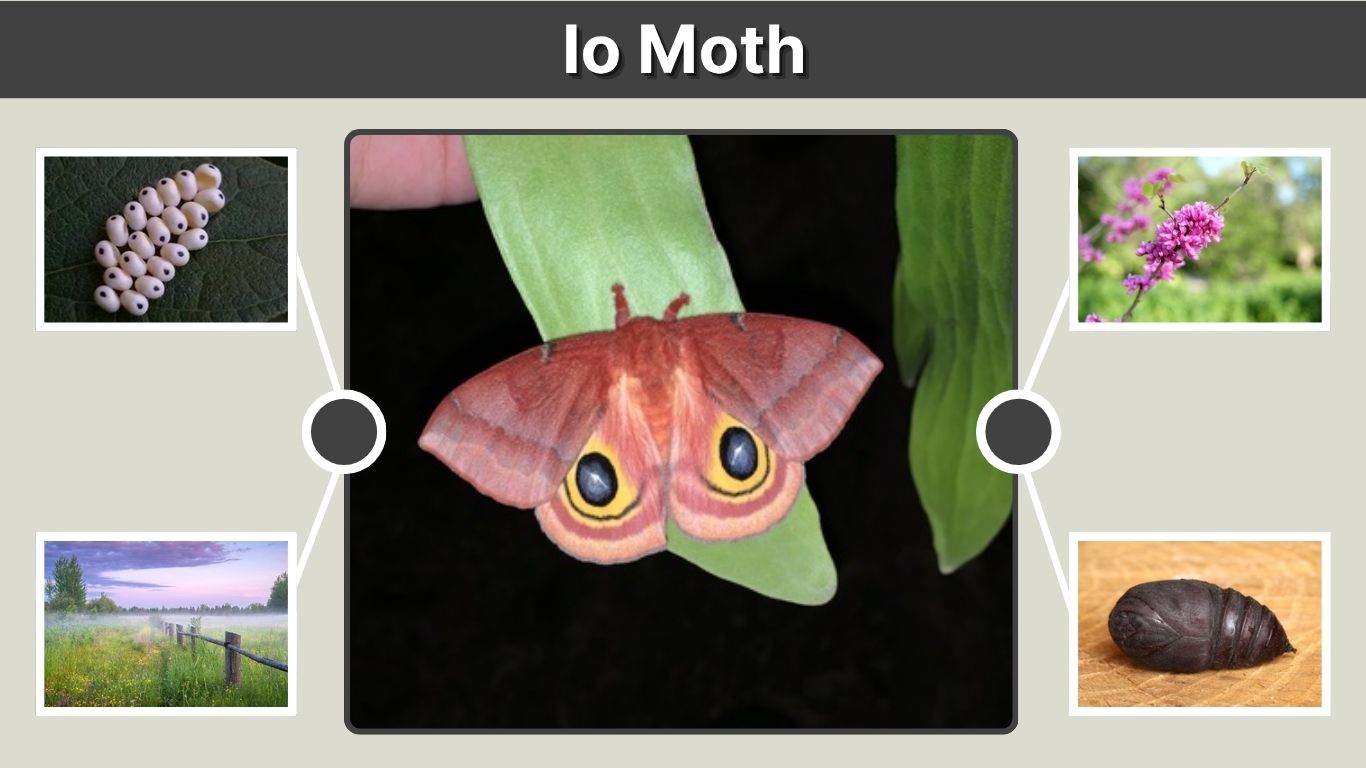
The Io moth (Automeris io) is a colorful North American silk moth best known for the large eyespots hidden on its hindwings. Adult males are usually yellow, while females are larger and reddish brown. The caterpillar is equally distinctive but requires caution because its branched green spines can deliver a painful sting. Io moths pass through egg, caterpillar, cocoon, and adult stages while using many trees and shrubs as larval food plants. Here is how to identify them safely.
What Is an Io Moth?
The Io moth belongs to the giant silk moth family Saturniidae. It is a medium-to-large moth with striking hindwing eyespots that are exposed when the insect feels threatened. These markings may startle predators. Adults are short-lived and concentrate mainly on mating and reproduction because, like many saturniid moths, they have reduced mouthparts and do not feed.
Io Moth Identification
An adult Io moth can be recognized by several features:
- Large black-and-blue eyespots on the hindwings
- Broad, rounded wings
- Yellow males and reddish-brown females
- Hairy, stout body
- Feathery antennae, especially in males
- Wingspan generally around 2.5 to 3.5 inches
- Dark forewing markings that vary between individuals
When resting with its forewings closed over the hindwings, the dramatic eyespots may be completely hidden.
Io Moth Scientific Name
The scientific name is Automeris io. The species belongs to the family Saturniidae, which also contains familiar giant silk moths such as luna, cecropia, polyphemus, and imperial moths.
The name “Io” is pronounced in different ways, but it is often said like “EYE-oh.” The moth’s striking coloration and defensive eyespots make it one of the more recognizable Saturniids.
Male vs Female Io Moth
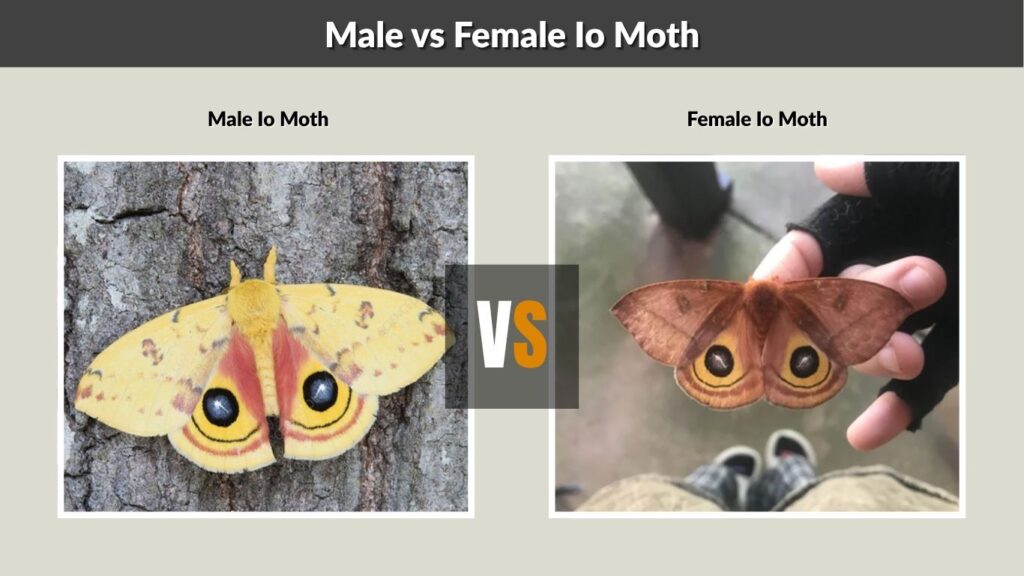
Male and female Io moths show strong sexual dimorphism, meaning they look noticeably different despite belonging to the same species. Males are generally bright yellow, while females are darker and larger-bodied. Both sexes have dramatic hindwing eyespots, although the surrounding wing coloration differs considerably.
Male Io Moth
Male Io moths usually have:
- Bright yellow forewings
- Smaller, more slender bodies
- Large feathery antennae
- Dark markings on the forewings
- Prominent hindwing eyespots
- More active flight while searching for females
The broad antennae help males detect pheromones released by females.
Female Io Moth
Females are commonly reddish brown, purplish brown, or rusty in appearance. Their bodies are heavier because they carry eggs.
Female Io moths tend to have narrower antennae than males. After mating, they lay clusters of eggs on suitable host plants, beginning the next generation of caterpillars.
Io Moth Caterpillar Identification
The Io moth caterpillar is bright green and covered with numerous branched spines. Although beautiful, it should not be handled. These hollow or venom-associated defensive spines can produce a painful skin reaction when they penetrate the skin. Young caterpillars often feed together in groups, while older larvae become more independent as they increase in size.
What Does an Io Moth Caterpillar Look Like?
Mature caterpillars commonly show:
- Bright green body coloration
- Numerous branched, stinging spines
- Red-and-white stripe along each side
- Thick cylindrical body
- Several pairs of abdominal prolegs
- Length approaching about 2 to 3 inches
- More solitary behavior near maturity
Young larvae may initially look orange or brownish before becoming increasingly green as they molt.
Io Moth Caterpillar Stages
Io moth caterpillars pass through several instars. During these stages, they:
- Hatch from eggs in groups.
- Feed together on host leaves.
- Molt repeatedly as they grow.
- Develop stronger green coloration and prominent spines.
- Become more solitary as mature larvae.
- Stop feeding when ready to pupate.
Their appearance changes enough during development that early larvae may not immediately resemble full-grown specimens.
Does an Io Moth Caterpillar Sting?
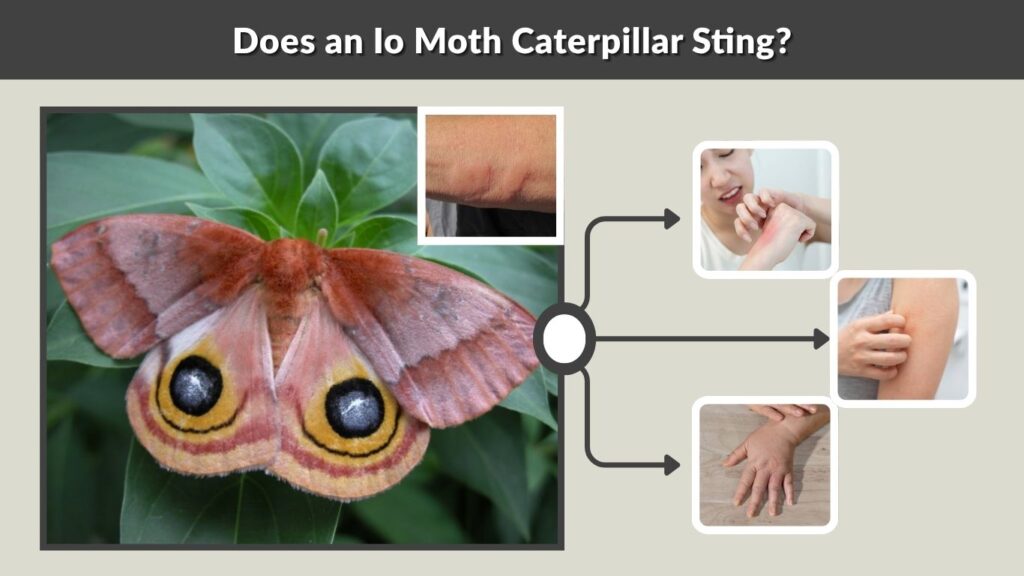
Yes. The Io moth caterpillar is a genuine stinging caterpillar. Its body is covered with defensive spines capable of producing immediate pain and skin irritation. Touching the caterpillar directly is unnecessary and should be avoided, particularly by children or anyone sensitive to insect stings.
Io Moth Caterpillar Sting Symptoms
Possible reactions include:
- Immediate burning or stinging pain
- Redness
- Itching
- Local swelling
- Raised bumps or welts
- Tenderness
- Irritation lasting for several hours
The severity varies depending on how many spines contact the skin and individual sensitivity.
Io Moth Caterpillar Sting Treatment
After accidental contact:
- Move away from the caterpillar without touching it again.
- Avoid rubbing the affected skin.
- Remove visible embedded spines carefully.
- Wash the area with soap and water.
- Apply a cold compress to reduce pain and swelling.
- Monitor for worsening symptoms.
Seek medical care promptly if there is difficulty breathing, facial or throat swelling, severe dizziness, widespread hives, or another serious reaction.
What Do Io Moth Caterpillars Eat?
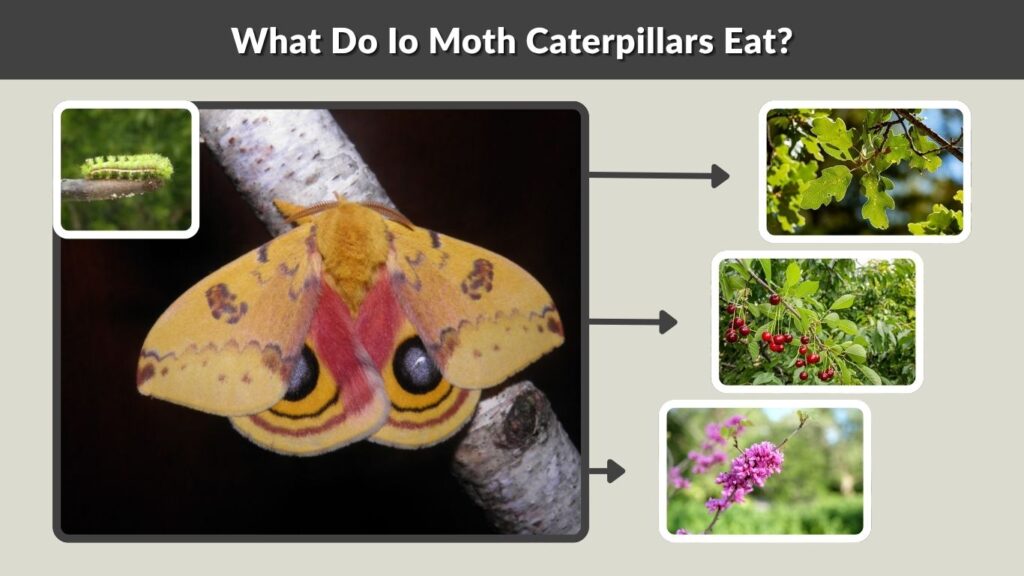
Io moth caterpillars can feed on a broad selection of trees, shrubs, and other plants. This flexible diet helps the species survive in many habitats. Females select suitable vegetation for egg laying, and newly hatched larvae begin eating leaves soon afterward.
Io Moth Host Plants
Common host plants include:
- Oak
- Willow
- Maple
- Elm
- Hackberry
- Sassafras
- Redbud
- Cherry
- Birch
- Cottonwood
- Various ornamental shrubs
Host use varies across the moth’s range, so caterpillars may be found on many additional plant species.
What Do Adult Io Moths Eat?
Adult Io moths do not normally eat. Their mouthparts are reduced, and they rely on energy accumulated during their caterpillar stage.
The adult’s primary activities are finding a mate, reproducing, and laying eggs. This explains why their adult life is relatively brief compared with the much longer caterpillar and pupal portions of the life cycle.
Io Moth Life Cycle and Cocoon
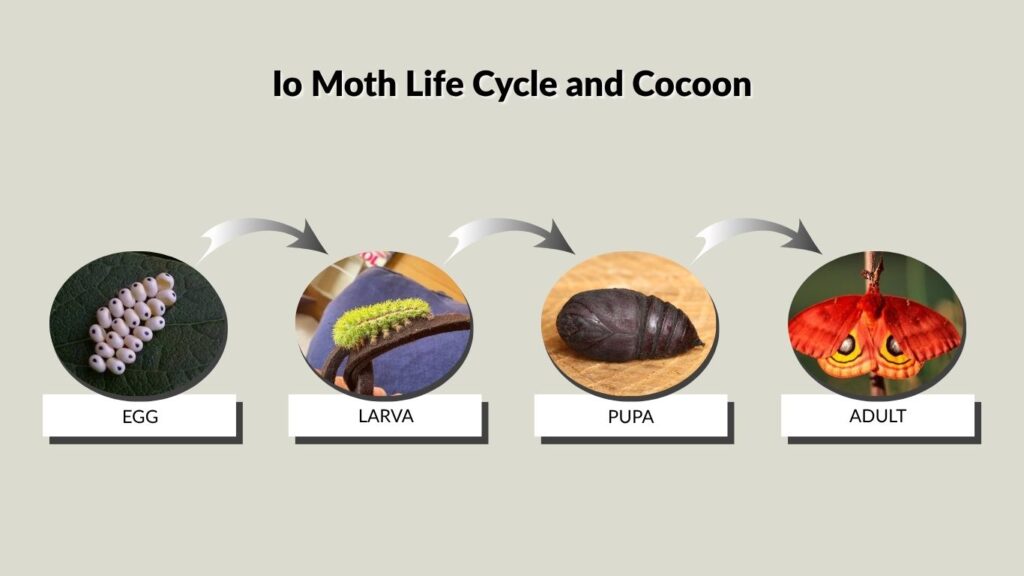
Io moths undergo complete metamorphosis. Their development begins with clusters of eggs, followed by several caterpillar stages. Mature larvae eventually create a protective pupal structure among leaves or debris. After the pupal period is complete, an adult moth emerges and begins the reproductive stage.
Io Moth Life Cycle
The life cycle consists of:
- Egg: Eggs are laid in clusters on host vegetation.
- Larva: Caterpillars hatch and begin eating leaves.
- Instars: Larvae molt repeatedly while growing.
- Pupa: Mature caterpillars form a protected pupal stage.
- Adult: Moths emerge, mate, and reproduce.
The number of generations per year can differ depending on climate and geographic location.
Io Moth Cocoon
A mature Io caterpillar eventually stops eating and searches for a sheltered location. It forms a thin, somewhat irregular cocoon, often incorporating leaves or plant debris around the pupa.
In cooler areas, the pupal stage may last through winter. Adults then emerge when seasonal conditions become favorable.
Io Moth Habitat and Range
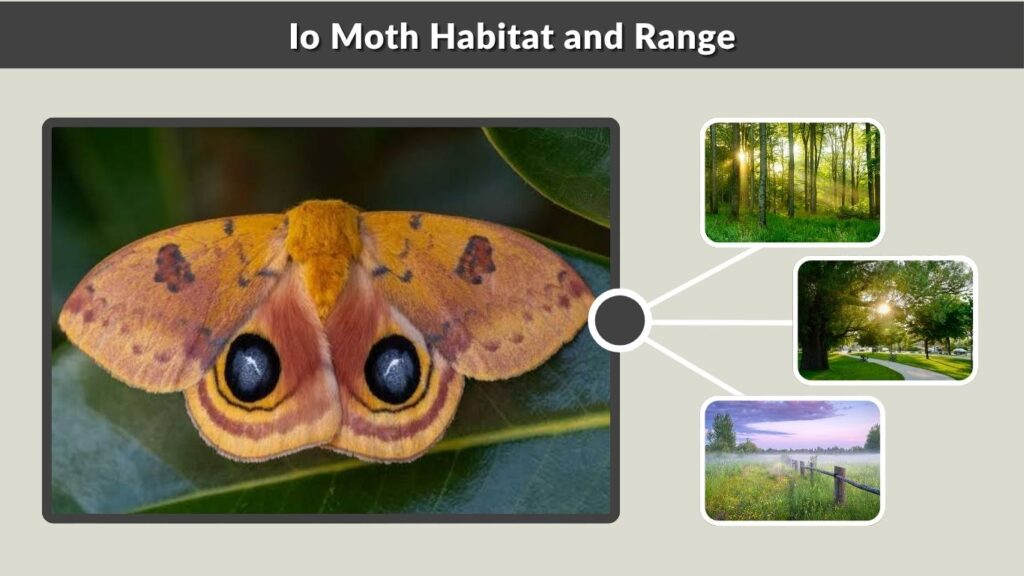
Io moths are widely distributed across eastern and central portions of North America. They inhabit forests, woodland edges, gardens, meadows, and suburban landscapes where suitable host plants are available. Their broad larval diet allows them to occupy many environments, including areas close to homes.
Where Are Io Moths Found?
Io moths may occur in:
- Deciduous forests
- Woodland edges
- Meadows
- Gardens
- Parks
- Suburban yards
- Areas with abundant shrubs and trees
- Parts of the eastern and central United States
They are particularly associated with warm regions but also occur considerably farther north.
Io Moth in Florida
Florida provides favorable conditions for Io moths because host plants and warm temperatures are widely available. Caterpillars may be encountered on trees or ornamental vegetation.
Because their spines sting, gardeners should avoid picking up green caterpillars unless they are certain of the species. Moving them with a tool or leaving them undisturbed is safer.
FAQs
1. Are Io moths poisonous?
Adult Io moths are not poisonous and do not sting. However, their caterpillars possess venomous or urticating defensive spines that can cause painful skin irritation. Avoid touching Io caterpillars directly even though the adult moth itself is harmless.
2. What happens if an Io moth caterpillar stings you?
Contact can cause immediate burning pain, redness, itching, swelling, and raised bumps. Wash the area, remove any remaining spines carefully, and use a cold compress. Seek urgent medical help if breathing difficulty, severe swelling, or other serious allergic symptoms occur.
3. What do Io moth caterpillars eat?
Io caterpillars eat leaves from many plants, including oak, willow, maple, elm, hackberry, sassafras, redbud, cherry, and other trees and shrubs. Their wide host range allows them to live in forests, gardens, parks, and suburban areas.
4. How can you tell a male from a female Io moth?
Male Io moths are usually bright yellow and have especially broad, feathery antennae. Females are generally larger and reddish brown or rusty colored. Both sexes possess large, dramatic eyespots on their hindwings.
5. How long do adult Io moths live?
Adult Io moths generally survive only for a short period because they do not feed. They rely entirely on stored energy accumulated as caterpillars. During adulthood, their main purpose is to locate mates, reproduce, and lay eggs before their energy reserves are exhausted.
