
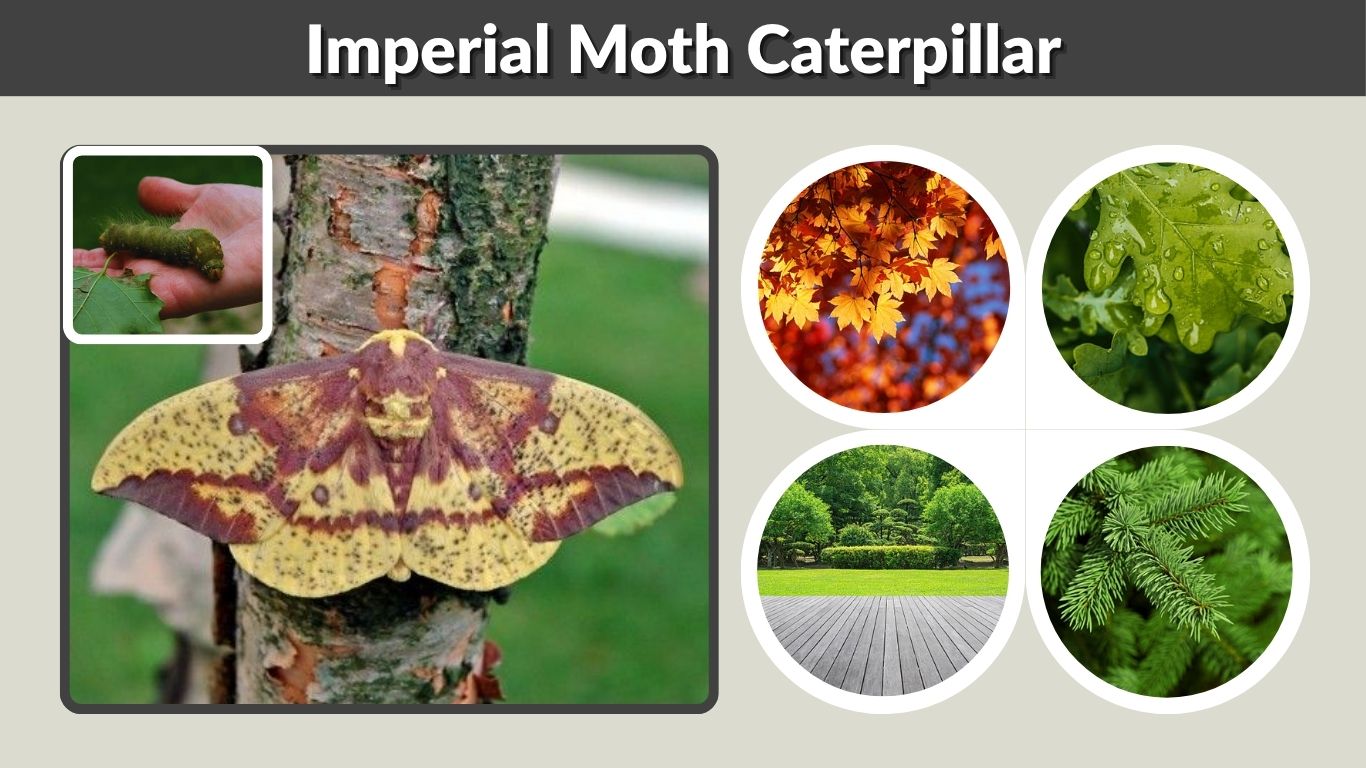
The imperial moth caterpillar is the large, colorful larval stage of the imperial moth (Eacles imperialis), a striking North American silk moth. These caterpillars may appear green, brown, reddish, or orange as they develop, and mature individuals can reach several inches long. Their large size, prominent spines, and dramatic colors sometimes make them look dangerous, but they are not considered venomous or dangerously poisonous. This guide covers identification, size, diet, host plants, safety, life cycle, pupation, and basic caterpillar care.
What Does an Imperial Moth Caterpillar Look Like?
Imperial moth caterpillars change noticeably as they pass through several larval stages. Young caterpillars may look very different from mature ones, which explains the variety of green, orange, reddish, and brown individuals people encounter. Fully grown larvae have thick bodies, conspicuous hairs or spines, and prominent projections near the front of the body.
Imperial Moth Caterpillar Identification
Common identification characteristics include:
- Large, thick caterpillar body
- Green, brown, reddish, or orange coloration
- Several long horn-like projections near the front
- Smaller spines and hairs across the body
- Pale or yellowish markings along the sides
- Dark breathing openings called spiracles
- Strong legs for gripping leaves and branches
- Body becoming especially bulky before pupation
Color alone should not be used for identification because imperial moth caterpillars can change considerably as they mature.
Green Imperial Moth Caterpillar
Green is one of the most recognizable colors of a mature imperial moth caterpillar. Green individuals often have yellowish markings and noticeable reddish or dark spines.
The coloration provides excellent camouflage among foliage. A caterpillar feeding high in a tree may remain unnoticed until it descends toward the ground when ready to pupate.
Brown, Red, and Orange Caterpillars
Some mature imperial moth caterpillars become brown, reddish brown, or orange instead of remaining bright green. This variation is normal.
Colors may become darker as the caterpillar approaches pupation. Individuals wandering away from a host tree are sometimes mistaken for entirely different species because their appearance can differ dramatically from younger green larvae.
How Big Is an Imperial Moth Caterpillar?
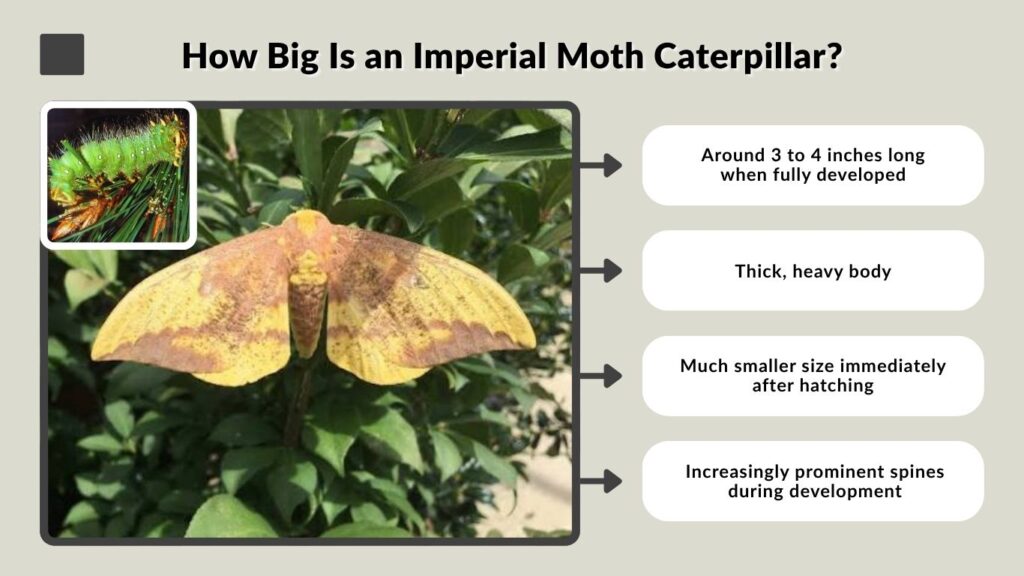
Imperial moth larvae rank among the larger caterpillars found in their range. Their impressive size is understandable because the adult imperial moth is itself a large member of the giant silk moth family. Growth occurs through repeated molts, with each larval stage becoming larger until the caterpillar reaches its final instar and prepares to pupate.
Imperial Moth Caterpillar Size
A mature caterpillar may have these characteristics:
- Around 3 to 4 inches long when fully developed
- Thick, heavy body
- Much smaller size immediately after hatching
- Increasingly prominent spines during development
- Noticeably swollen appearance before pupation
Individual size depends on development, food availability, and environmental conditions.
Giant Imperial Moth Caterpillar
People sometimes use the term “giant imperial moth caterpillar” when encountering an especially large larva. It generally refers to a mature imperial moth caterpillar rather than a separate species.
A full-grown larva can look surprisingly massive compared with common garden caterpillars. Its large body, horns, and heavy appearance may make it resemble a small branch or unusual tropical insect.
Is an Imperial Moth Caterpillar Poisonous?
The prominent spines of an imperial moth caterpillar can make it appear threatening. However, it is not considered a medically significant venomous caterpillar. Unlike true stinging caterpillars that possess specialized venom-delivering spines, imperial moth larvae mainly rely on their intimidating appearance and body structures for protection.
Does an Imperial Moth Caterpillar Sting?
Imperial moth caterpillars do not have the type of powerful venomous sting associated with caterpillars such as saddlebacks or puss caterpillars.
Their stiff hairs and spines may nevertheless feel uncomfortable against sensitive skin. For this reason:
- Avoid squeezing the caterpillar.
- Do not rub it across bare skin.
- Wash your hands after handling.
- Keep it away from the face and eyes.
- Use a leaf or container when moving one.
- Teach children not to handle unknown caterpillars.
Leaving the caterpillar undisturbed is usually the simplest option.
Is It Dangerous to Touch?
For most people, brief contact is unlikely to cause serious problems. However, skin sensitivity varies, and mechanical irritation from hairs or spines is possible.
If contact causes irritation, wash the area gently with soap and water. Persistent or severe reactions should receive appropriate medical attention, especially when the exact caterpillar species is uncertain.
What Do Imperial Moth Caterpillars Eat?
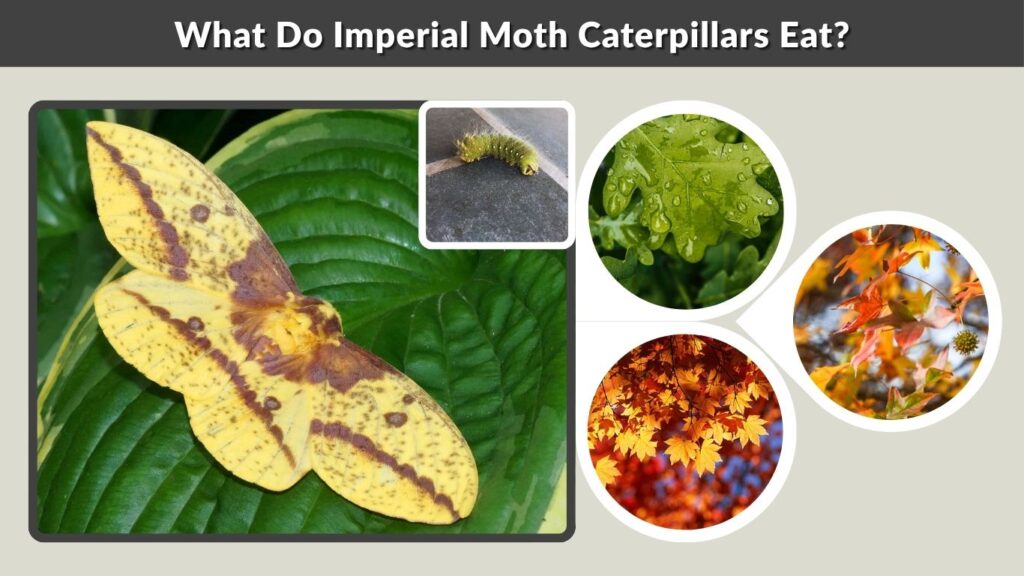
Imperial moth caterpillars are plant eaters that feed primarily on the leaves of trees. They can use a relatively broad range of host plants compared with some more specialized moth species. The exact plants used vary geographically, and a caterpillar found on a particular tree has often developed while eating that tree’s leaves.
Imperial Moth Caterpillar Host Plants
Commonly reported host plants include:
- Pine
- Oak
- Maple
- Sweetgum
- Sassafras
- Cedar
- Hickory
- Sycamore
- Other suitable native trees
Some populations show strong preferences for particular host plants. Pine-feeding imperial moth caterpillars, for example, may consume needles rather than broad leaves.
Do Imperial Moth Caterpillars Eat Pine Needles?
Yes, some imperial moth caterpillars feed readily on pine. Caterpillars associated with pine trees may consume fresh needles throughout their larval development.
This flexibility helps explain why imperial moths can occupy different forest habitats. However, a caterpillar being raised in captivity should preferably receive foliage from the same type of plant on which it was originally found.
Imperial Moth Caterpillar Life Cycle
The caterpillar represents only one stage of the imperial moth’s complete metamorphosis. The life cycle progresses from egg to larva, then pupa, and finally adult moth. Much of the animal’s feeding and growth occurs during the caterpillar stage because adult imperial moths have reduced mouthparts and do not feed.
Caterpillar Development
The main developmental stages include:
- Eggs laid on suitable host plants
- Tiny larvae emerging from the eggs
- Several caterpillar instars separated by molts
- A large final-stage caterpillar
- Prepupal wandering stage
- Underground pupation
- Adult imperial moth emerging later
As the caterpillar grows, its coloration and body structure can change considerably.
Imperial Moth Caterpillar Cocoon and Pupa
Imperial moths differ from many familiar silk moths because they generally do not make a large above-ground silk cocoon attached to a branch.
A mature caterpillar usually leaves its host plant and searches for suitable soil or leaf litter. It burrows into the ground and transforms into a dark brown pupa. The moth later emerges from this underground pupal chamber.
How to Care for an Imperial Moth Caterpillar
Occasionally, people find an imperial moth caterpillar and decide to observe it until pupation. Successful care depends mainly on providing fresh food, adequate ventilation, cleanliness, and appropriate conditions for the caterpillar to enter the soil when development is complete.
Basic Caterpillar Care
For temporary care:
- Provide leaves from the host plant where it was found.
- Replace old foliage with fresh leaves regularly.
- Use a well-ventilated enclosure.
- Remove droppings and decaying leaves daily.
- Avoid exposing the container to direct overheating sunlight.
- Provide suitable soil when the caterpillar stops feeding.
- Minimize unnecessary handling.
A caterpillar that suddenly stops eating and begins wandering may be preparing to pupate rather than becoming ill.
Preparing for Pupation
When fully mature, an imperial moth caterpillar usually becomes restless and begins searching for soil. An appropriate layer of loose, slightly moist—not waterlogged—soil allows it to burrow naturally.
Once underground, it should not be repeatedly disturbed. Depending on season and climate, the pupa may remain dormant for an extended period before the adult emerges.
Where Are Imperial Moth Caterpillars Found?
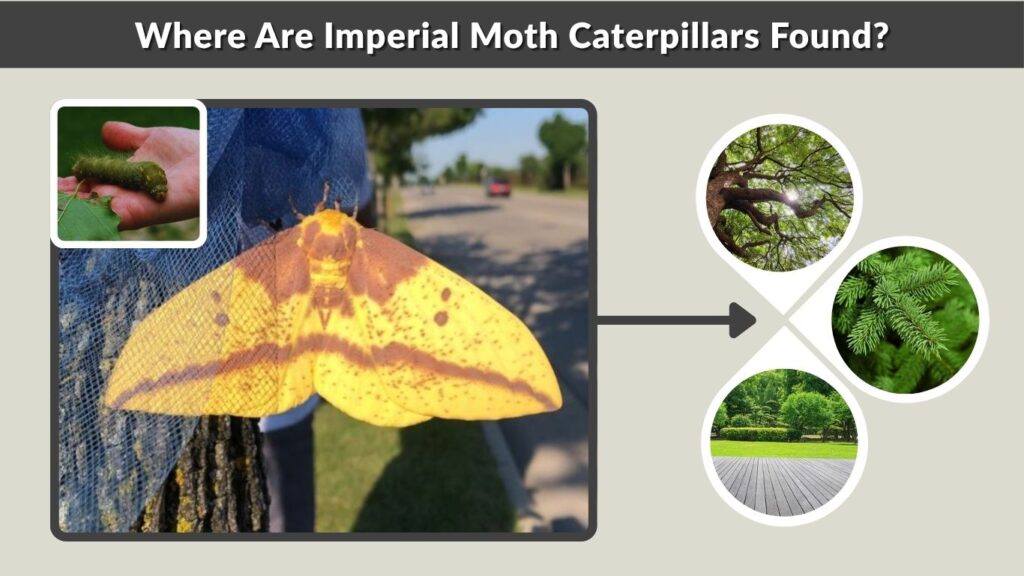
Imperial moths occur across a broad portion of eastern and central North America, with populations extending into parts of the southern United States and neighboring regions. Caterpillars are usually associated with trees and woodland habitats but can also appear in suburban yards containing suitable host plants.
Common Places to Find Them
Imperial moth caterpillars may be encountered:
- On tree branches
- Among pine needles
- In deciduous forests
- In wooded yards
- Beneath host trees
- Crossing paths or driveways
- Crawling across lawns before pupation
Large caterpillars seen on the ground late in their development may simply be searching for a suitable place to burrow.
Imperial Moth Caterpillars in Florida, Texas, and Ohio
Imperial moths occur across several U.S. regions, although abundance and seasonal timing differ with climate.
In warmer southern states such as Florida and Texas, activity can occur over a longer portion of the year. Farther north, including Ohio, development is more strongly tied to the warmer months, and pupae may overwinter before adults emerge.
FAQs
1. Are imperial moth caterpillars poisonous?
Imperial moth caterpillars are not considered dangerously poisonous or venomous. Their large spines may look threatening and can potentially cause minor mechanical irritation, but they lack the medically significant venomous spines associated with some genuinely stinging caterpillar species.
2. What does an imperial moth caterpillar eat?
Imperial moth caterpillars feed on tree foliage. Host plants can include pine, oak, maple, sweetgum, sassafras, cedar, hickory, and several other trees. Diet varies by region, and caterpillars may show preferences for the particular host species on which they developed.
3. How big does an imperial moth caterpillar get?
A mature imperial moth caterpillar can reach roughly 3 to 4 inches in length. Its thick body and prominent spines make it appear particularly large. Newly hatched larvae are tiny and progressively increase in size through several molts.
4. Does an imperial moth caterpillar make a cocoon?
Not typically in the familiar above-ground sense. Mature imperial moth caterpillars usually enter the soil and transform into pupae underground rather than constructing a conspicuous silk cocoon attached to a tree or other surface.
5. Why did my imperial moth caterpillar turn brown?
Color changes can be a normal part of development. Imperial moth caterpillars occur in green, reddish, orange, and brown forms, and individuals may darken as they mature. A large caterpillar that changes color, stops eating, and begins wandering may be approaching the prepupal stage.
