
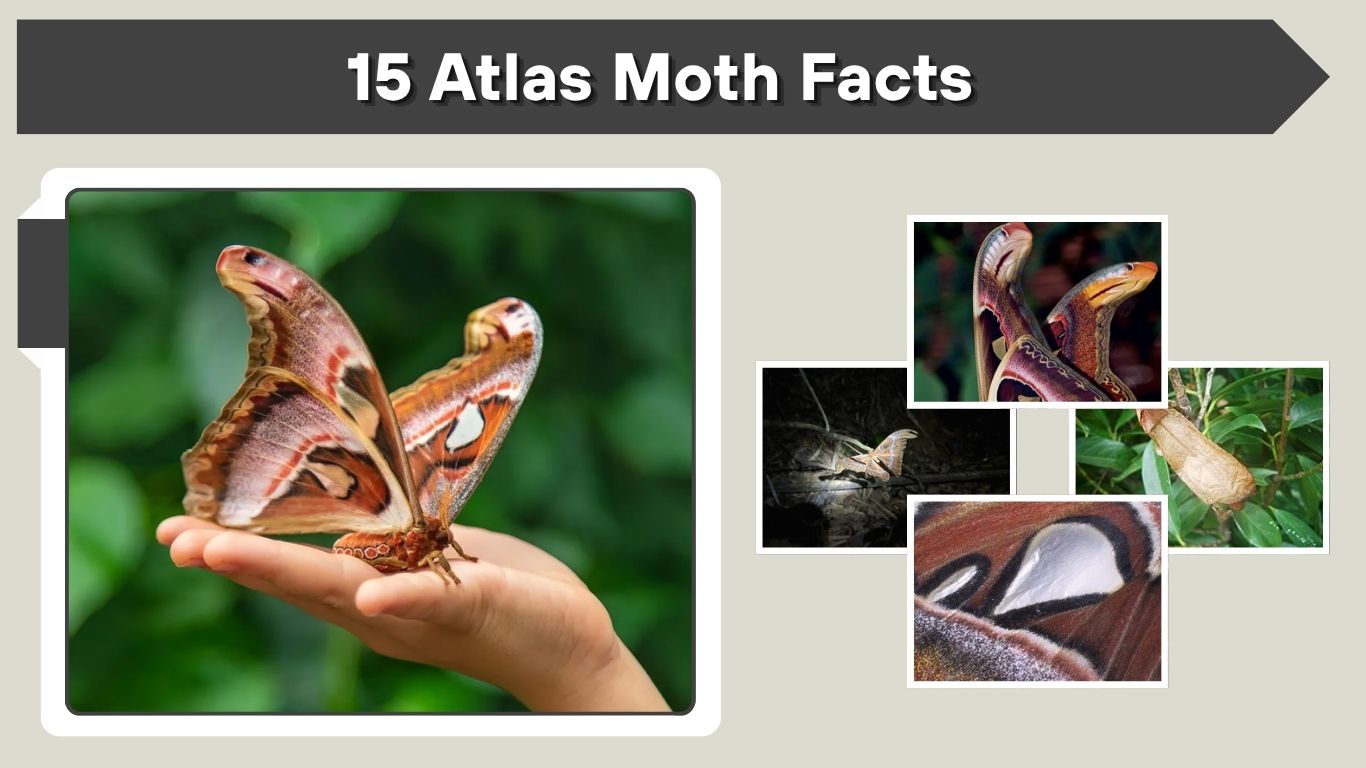
The Atlas moth (Attacus atlas) is one of the largest and most spectacular moths on Earth. Famous for its enormous wings, snake-like wing tips, and rich reddish-brown patterns, this tropical insect looks almost unreal when fully grown. Atlas moths also have an unusual life strategy: adults live only briefly and rely heavily on energy stored during the caterpillar stage. From their impressive wingspan to their behavior, diet, cocoons, and reproduction, these 15 Atlas moth facts reveal what makes this giant moth so extraordinary.
1. Atlas Moths Are Among the World’s Largest Moths
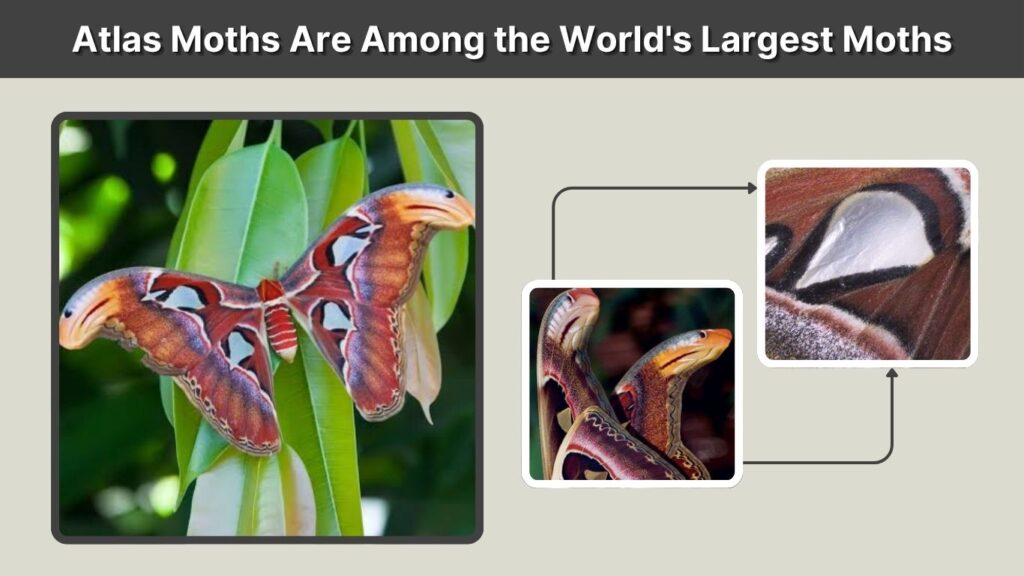
Atlas moths are famous primarily because of their enormous size. They belong to the family Saturniidae, a group that contains many of the world’s giant silk moths.
A large adult Atlas moth can have a wingspan of roughly 9 to 12 inches (23–30 cm). Rather than simply having long wings, it also has an exceptionally large total wing surface area.
Females are generally noticeably larger and heavier than males. Their broad wings make them appear even more impressive when resting completely open.
Although other moths may rival or exceed them in particular measurements, the Atlas moth remains one of the world’s most impressive insects by overall wing size.
2. Their Wing Tips Look Like Snake Heads
One of the most interesting Atlas moth facts about its wings is the unusual shape of its forewing tips.
Each elongated wing tip has markings that can resemble the head of a snake. The resemblance becomes particularly noticeable when the moth moves or rests with its wings positioned in certain ways.
Scientists believe these markings may help discourage predators. A bird or other predator approaching the moth could potentially mistake the threatening-looking pattern for a dangerous animal.
The Atlas moth has few ways to physically defend itself, making camouflage and visual deception particularly valuable.
3. Atlas Moths Have an Impressive Wingspan
The Atlas moth wingspan is commonly around 8 to 10 inches, while especially large individuals may approach approximately 12 inches.
Several features make the wings particularly impressive:
- Broad, triangular overall shape
- Reddish-brown background coloration
- Cream, black, orange, and purple markings
- Transparent patches on all four wings
- Elongated forewing tips
- Strong contrasting bands along the edges
When the wings are fully opened, an Atlas moth can appear wider than a person’s hand.
Its remarkable wing area is one of the reasons photographs of Atlas moths frequently attract so much attention.
4. Atlas Moth Wings Have Transparent Windows
Look closely at an Atlas moth and you may notice clear triangular areas in its wings. These are thin, translucent patches that resemble small windows.
Unlike the surrounding sections, these areas contain fewer of the dense colored scales responsible for normal moth wing patterns.
The transparent sections contrast beautifully with the rich brown and orange coloration surrounding them. They are found on both the forewings and hindwings and are one of the easiest features to use when identifying Attacus atlas.
Combined with the wing-tip patterns, these transparent windows give the species an appearance unlike most ordinary moths.
5. Adult Atlas Moths Hardly Eat
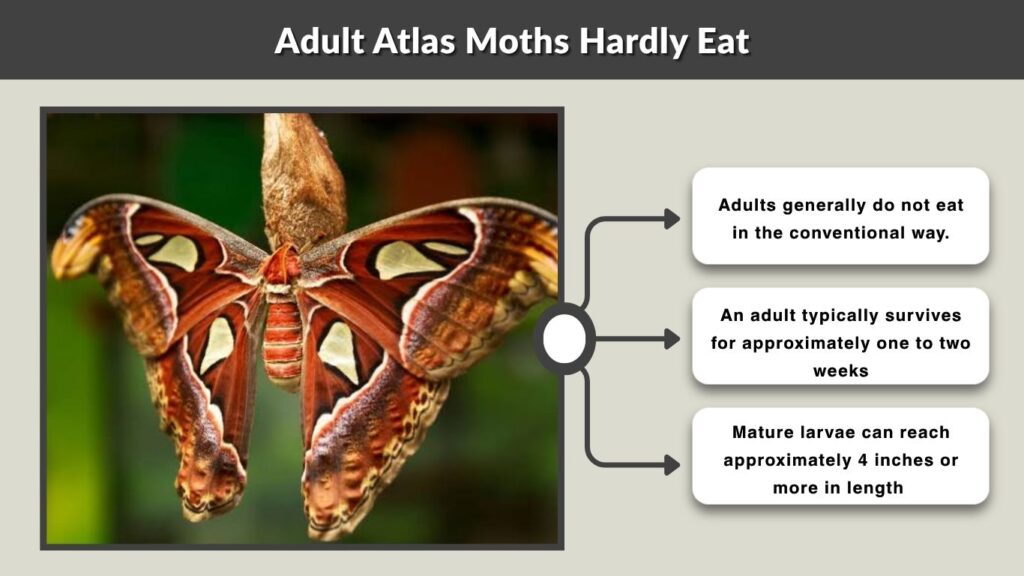
One of the most surprising facts about Atlas moths is that adults generally do not eat in the conventional way.
Adult Atlas moths have greatly reduced mouthparts. Consequently, they cannot depend on regular feeding to fuel their adult lives like many other insects.
Instead, they survive primarily on energy reserves accumulated during their caterpillar stage.
This helps explain why Atlas moth caterpillars spend so much time eating. Before pupating, they must store enough nutrients to support metamorphosis, flying, mating, and reproduction.
Once the adult moth emerges, its biological priorities change dramatically from growth to reproduction.
6. Their Adult Lifespan Is Very Short
Despite their tremendous size, adult Atlas moths live only briefly.
An adult typically survives for approximately one to two weeks, although temperature, activity levels, and other environmental conditions can affect its exact lifespan.
Because adults cannot replenish their energy effectively through feeding, every activity consumes stored reserves.
Their short adult lives are primarily devoted to:
- Finding a mate
- Reproducing
- Laying eggs
- Continuing the next generation
Males may expend significant amounts of energy flying in search of females, while females often remain closer to their emergence area while producing and laying eggs.
7. Atlas Moth Caterpillars Are Giant Larvae
The caterpillar of the Atlas moth is almost as fascinating as the adult.
Mature larvae can reach approximately 4 inches or more in length and develop thick, heavy bodies. Their coloration is generally pale green, bluish-green, or whitish-green.
The body is covered with unusual fleshy projections and often has a powdery or waxy appearance.
Atlas caterpillars pass through several developmental stages called instars. Each time the caterpillar becomes too large for its existing outer skin, it molts and continues growing.
Most of the insect’s physical growth occurs during this larval stage.
8. Caterpillars Have an Enormous Appetite
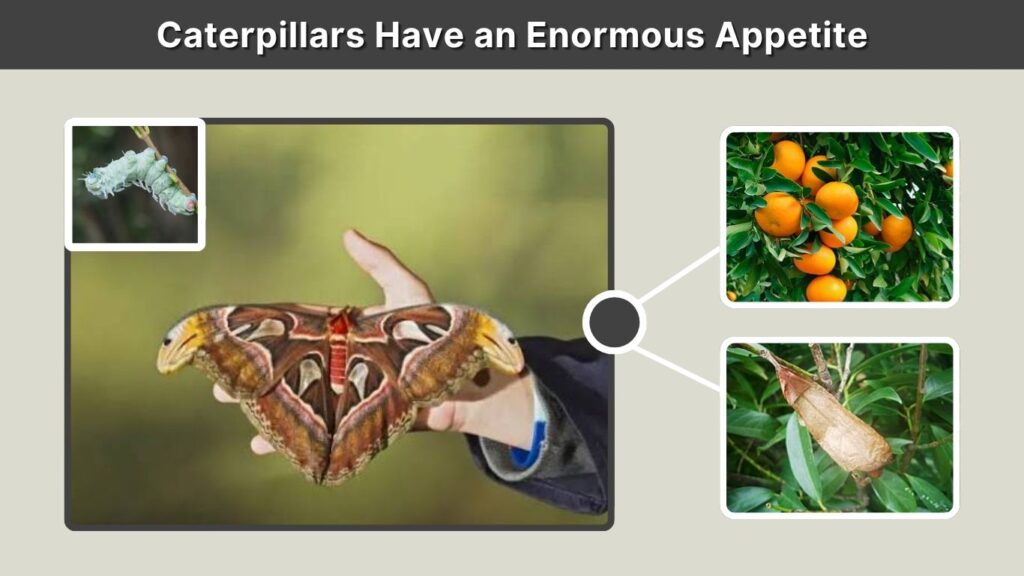
Atlas moth caterpillars spend much of their time feeding because they must accumulate enough energy for both metamorphosis and adulthood.
Their diet consists primarily of leaves from suitable host plants.
Depending on location, host plants may include:
- Citrus
- Guava
- Mango
- Avocado
- Privet
- Indian almond
- Cinnamon-related plants
- Other broadleaf trees and shrubs
Young caterpillars consume relatively small quantities of foliage, but their appetite increases substantially as they grow.
Large final-stage caterpillars can consume impressive amounts of leaves before suddenly reducing their feeding as pupation approaches.
9. They Spin Large Silk Cocoons
When an Atlas moth caterpillar becomes fully grown, it stops spending its time continuously feeding and begins preparing for metamorphosis.
The larva produces silk and creates a strong cocoon, usually attached to leaves or branches. Leaves may sometimes become incorporated directly into the cocoon structure.
Inside this protective covering, the caterpillar transforms into a pupa.
Its internal anatomy is then reorganized as the insect develops adult wings, antennae, legs, and reproductive structures.
The result is one of nature’s most dramatic transformations—from a thick green caterpillar into an enormous winged moth.
10. Females Are Usually Larger Than Males
Male and female Atlas moths can often be distinguished by differences in size and body structure.
Females are generally larger, with broader bodies capable of carrying numerous eggs. Males tend to have smaller bodies and may appear lighter and more streamlined.
However, males possess a particularly noticeable feature: their antennae.
Male Atlas moths have extremely broad, feathery antennae designed to detect chemical signals released by females.
These differences reflect the roles each sex performs during the brief adult stage.
11. Males Can Detect Female Pheromones
The large, feather-like antennae of male Atlas moths are not simply decorative.
They contain highly sensitive sensory structures capable of detecting pheromones released by females. These chemical signals help males locate potential mates, even when visibility is poor at night.
The ability is essential because Atlas moths have very limited adult time.
A male that quickly detects a female has a better opportunity to reproduce before its stored energy reserves become depleted.
This remarkable chemical communication system is common among many moths but is particularly noticeable in giant silk moths because of their impressive antennae.
12. Atlas Moths Are Mainly Active at Night
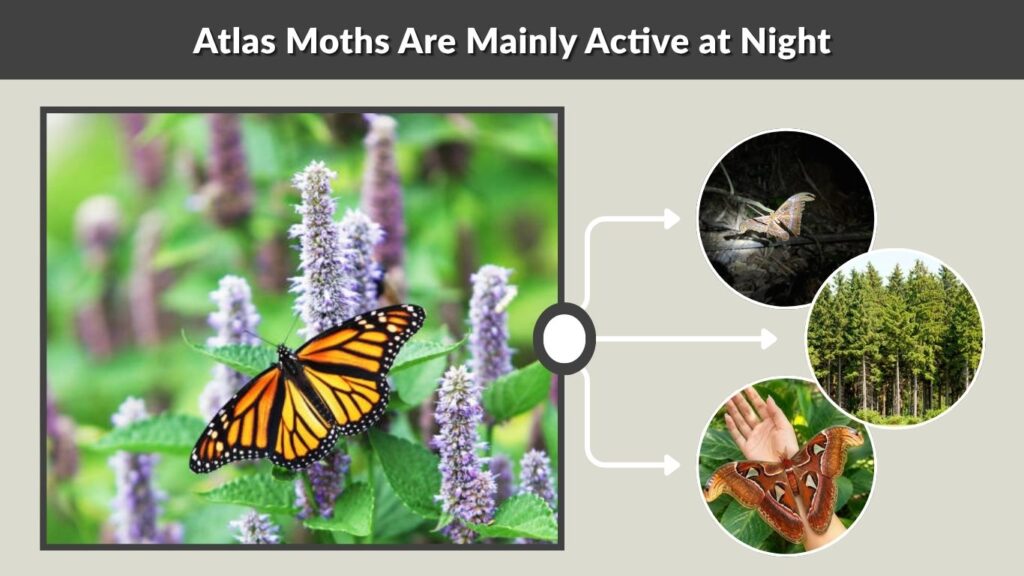
Atlas moths are primarily nocturnal insects.
Adults usually become more active during the evening and nighttime hours. Darkness provides some protection from visually hunting daytime predators and creates appropriate conditions for locating mates.
During daylight hours, an Atlas moth may remain relatively motionless on vegetation or another sheltered surface.
Its complex reddish-brown coloration helps it blend with dry leaves, tree bark, and surrounding vegetation.
Night activity combined with camouflage makes these enormous insects surprisingly difficult to notice despite their size.
13. Atlas Moths Live Naturally in Asia
The Atlas moth is native to tropical and subtropical parts of Asia.
Its natural range includes areas of:
- India
- Bangladesh
- China
- Thailand
- Malaysia
- Indonesia
- Singapore
- The Philippines
- Other parts of South and Southeast Asia
Warm temperatures, suitable humidity, and plentiful host plants provide ideal conditions for its development.
Atlas moths may occur in forests, woodland edges, gardens, plantations, and other areas where their caterpillars can find appropriate vegetation.
Outside their natural range, Atlas moths may sometimes be seen in butterfly houses or specialized insect collections.
14. Their Wings Can Provide Excellent Camouflage
Although their huge wings seem conspicuous in photographs, Atlas moths can blend remarkably well into natural surroundings.
Their reddish-brown and tan coloration resembles:
- Dry leaves
- Tree bark
- Dead vegetation
- Woodland debris
When the moth remains motionless during daylight hours, this coloration can make it surprisingly difficult for predators to distinguish from the background.
The combination of camouflage, large wing patterns, transparent patches, and possible snake mimicry provides the adult moth with several visual defenses despite lacking a sting or powerful bite.
15. Atlas Moths Are Harmless to Humans
Their huge wingspan and snake-like markings can make Atlas moths appear intimidating, but they pose little danger to people.
Adult Atlas moths:
- Do not have a venomous sting.
- Are not aggressive toward humans.
- Do not feed on people.
- Are not known for dangerous bites.
- Usually attempt to escape rather than defend themselves physically.
Their caterpillars also are not considered among the dangerously venomous caterpillar species.
Atlas moths are therefore best appreciated as impressive examples of insect adaptation rather than animals to fear.
Atlas Moth Wingspan and Behavior Facts
The combination of enormous wings and unusual adult behavior makes the Atlas moth particularly distinctive. Its wings are built not only for flight but also provide camouflage and potential predator deterrence. Meanwhile, its short adult life requires extremely efficient mating behavior.
How Atlas Moths Behave
During daylight hours, adults commonly remain relatively inactive. At night, particularly males become more active and may fly while searching for females.
Male antennae detect pheromones, helping them locate mates without relying primarily on sight.
Females generally invest large amounts of energy in egg production. After mating, they deposit eggs near suitable plants that future caterpillars can eat.
Because adult life is so short, reproduction occurs quickly compared with the much longer period spent developing as a caterpillar and pupa.
Fun Facts About Atlas Moths
Beyond their size, several characteristics make Attacus atlas one of the most memorable moth species in the world.
Quick Atlas Moth Facts
- Scientific name: Attacus atlas
- Family: Saturniidae
- Adults are primarily nocturnal.
- Females are usually larger than males.
- Males have highly feathered antennae.
- Adults generally rely on stored energy rather than regular feeding.
- Caterpillars can grow several inches long.
- The species produces large silk cocoons.
- Forewing tips resemble snake heads.
- Wings contain distinctive transparent patches.
FAQs
Are Atlas moths dangerous?
No. Atlas moths are generally harmless to humans. Adults do not possess a venomous sting and are not aggressive. Their huge wings and snake-like markings mainly function as protective adaptations rather than weapons.
What is the wingspan of an Atlas moth?
An adult Atlas moth commonly has a wingspan of roughly 9 to 12 inches, depending on the individual. Females generally grow larger than males. Their exceptionally broad wings also give them one of the largest wing surface areas among moths.
Why do Atlas moth wings look like snakes?
The elongated tips of the forewings contain shapes and markings that resemble snake heads. This appearance may help frighten or confuse predators, providing the relatively defenseless moth with an additional form of protection.
How long do Atlas moths live?
Adult Atlas moths generally live for only around one to two weeks. Their reduced mouthparts prevent substantial feeding, so adults depend largely on energy accumulated while they were caterpillars. Most adult activity therefore focuses on reproduction.
What is the most interesting fact about the Atlas moth?
One of the most remarkable facts is that such an enormous moth spends its adult life largely without eating. The caterpillar stores the energy required for adulthood, allowing the mature moth to focus its brief life almost entirely on finding a mate and reproducing.
