
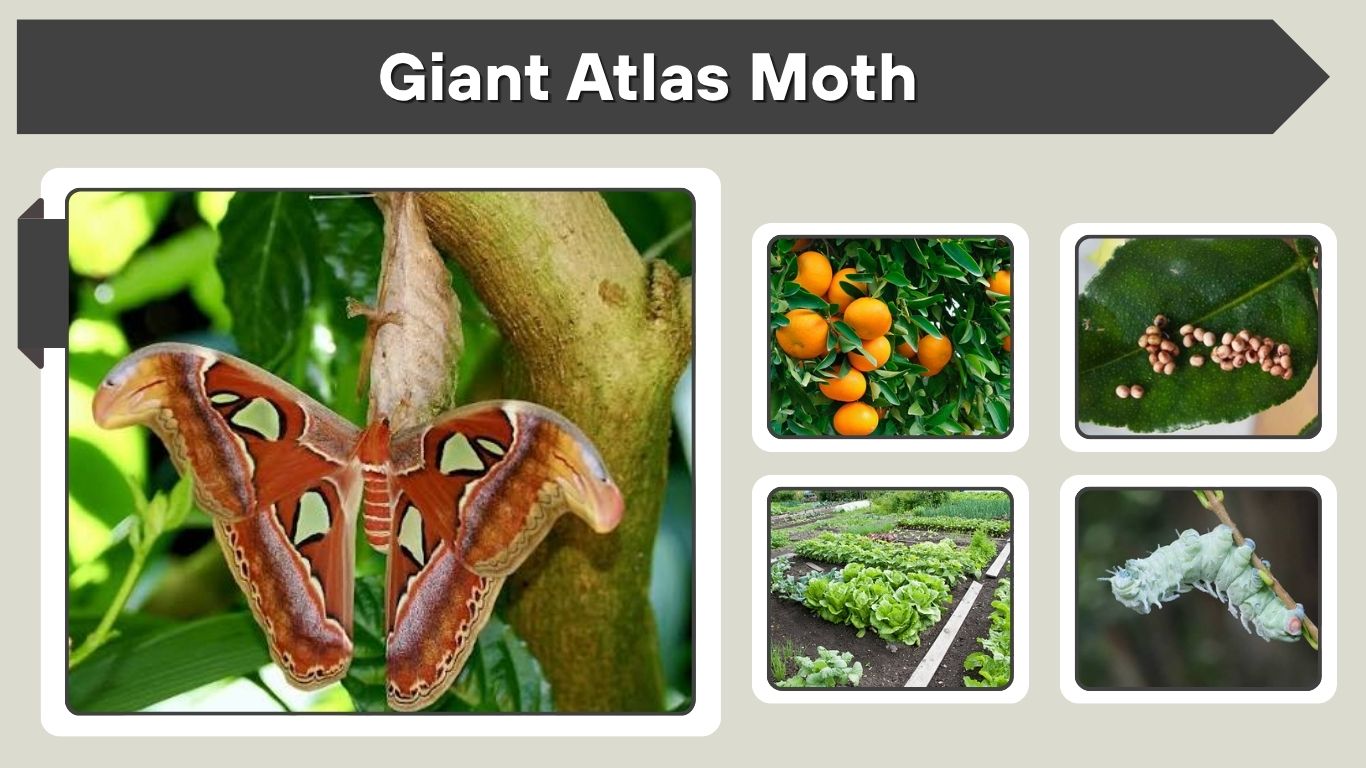
The giant Atlas moth (Attacus atlas) is one of the world’s largest and most recognizable moths. Native to tropical and subtropical regions of Asia, this spectacular insect is famous for its enormous reddish-brown wings, transparent wing patches, and unusual snake-like wing tips. Despite its intimidating size, the Atlas moth is harmless to humans. Its adult life is surprisingly brief because it relies mainly on energy stored during its caterpillar stage. Understanding its size, lifespan, diet, habitat, and life cycle reveals an extraordinary insect.
What Does a Giant Atlas Moth Look Like?
The giant Atlas moth has an appearance unlike most other moth species. Its broad wings contain complex patterns of reddish-brown, orange, cream, black, and purple tones. Transparent triangular areas occur on each wing, while the tips of the forewings have elongated markings that may resemble the head of a snake when viewed from certain angles.
Giant Atlas Moth Identification
Important identifying characteristics include:
- Scientific name: Attacus atlas
- Color: Primarily reddish-brown with orange, cream, black, and purple markings
- Wings: Extremely broad with distinct patterned margins
- Transparent patches: Triangular, window-like areas appear on the wings
- Forewing tips: Curved tips have patterns that resemble snake heads
- Body: Thick, furry, and relatively small compared with the wings
- Antennae: Large and feathery, particularly in males
- Activity: Adults are primarily active during the evening and night
Why Does the Atlas Moth Look Like a Snake?
The ends of the Atlas moth’s forewings have elongated shapes and patterns that resemble snake heads. This unusual feature may help discourage predators.
When the moth rests with its wings spread, the shape can make it appear considerably more threatening than an ordinary insect. This visual defense is particularly useful because adult Atlas moths have few physical defenses.
Giant Atlas Moth Size
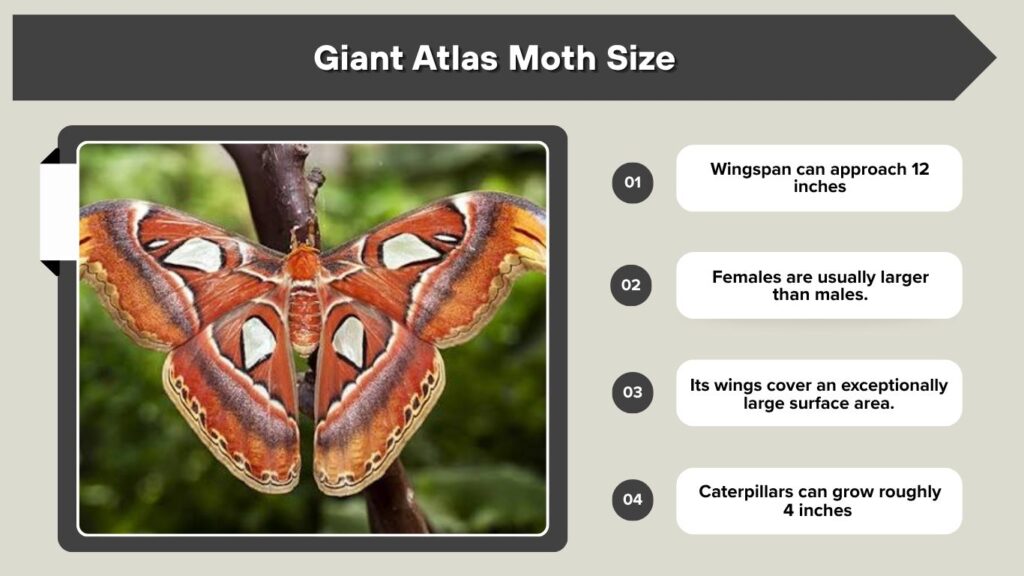
Size is the characteristic that makes the giant Atlas moth especially famous. Although some moth species have greater wingspans, the Atlas moth is among the world’s largest moths when overall wing surface area is considered. Females are generally larger and heavier than males, while males usually have more prominent antennae for locating females.
How Big Is a Giant Atlas Moth?
An adult Atlas moth may have a wingspan of approximately 9 to 12 inches (23–30 cm), depending on the individual.
Notable size characteristics include:
- Wingspan can approach 12 inches in exceptionally large individuals.
- Females are usually larger than males.
- Its wings cover an exceptionally large surface area.
- Caterpillars can grow roughly 4 inches or more before pupating.
- The body appears surprisingly small compared with the enormous wings.
Its impressive dimensions can make a resting moth look almost bird-like when first encountered.
Giant Wood Moth vs. Atlas Moth Size
The giant wood moth and Atlas moth are both extremely large insects, but they are impressive in different ways. Giant wood moths are known for their exceptionally heavy bodies, while Atlas moths are particularly famous for their expansive wings.
The Atlas moth generally appears wider because of its enormous wing area, whereas a giant wood moth may look bulkier because of its thick body.
Giant Atlas Moth Habitat and Distribution
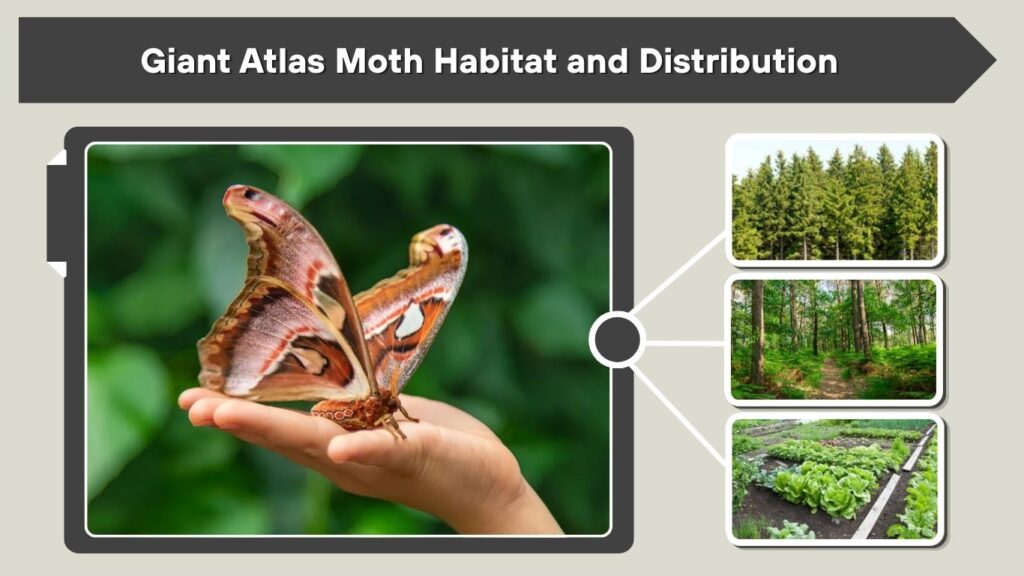
Giant Atlas moths thrive in warm environments where their caterpillars can find abundant host plants. They are associated with tropical and subtropical forests, wooded areas, gardens, plantations, and other vegetation-rich habitats. Their distribution covers a broad portion of Asia, although local populations and host plants vary considerably between different regions.
Where Do Giant Atlas Moths Live?
Atlas moths occur naturally across parts of:
- India
- Bangladesh
- Southern China
- Thailand
- Malaysia
- Indonesia
- Singapore
- The Philippines and nearby regions
- Other areas of South and Southeast Asia
They generally favor warm, humid environments with abundant vegetation.
Giant Atlas Moth in the UK
The Atlas moth is not naturally native to the UK. However, it may sometimes be kept in controlled collections, butterfly houses, or breeding facilities.
Because this species originates from warmer climates, outdoor conditions in the UK are generally unsuitable for establishing normal wild populations. Anyone considering keeping live insects should also check current local regulations regarding exotic species.
What Do Giant Atlas Moths Eat?
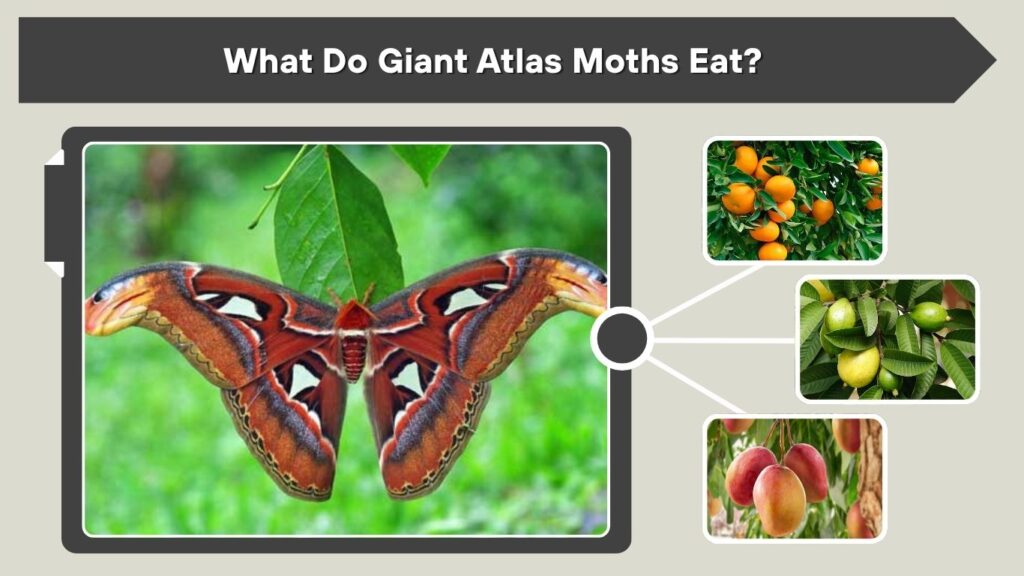
The feeding habits of the Atlas moth change dramatically between its larval and adult stages. Caterpillars consume large quantities of leaves because they must accumulate enough energy to complete metamorphosis and support their short adult lives. Once adults emerge, their bodies are primarily devoted to reproduction rather than prolonged feeding.
Giant Atlas Moth Caterpillar Diet
Atlas moth caterpillars feed on leaves from various plants. Reported host plants include:
- Citrus
- Guava
- Mango
- Avocado
- Privet
- Cinnamon-related plants
- Indian almond
- Other suitable broadleaf trees and shrubs
The exact plants eaten can differ according to location and availability.
What Do Adult Giant Atlas Moths Eat?
Adult Atlas moths generally do not eat in the usual sense. Their mouthparts are greatly reduced, so they depend mainly on fat and energy reserves accumulated while they were caterpillars.
This is one reason the caterpillar stage involves such intensive feeding. Once adulthood begins, the moth’s main purpose is to locate a mate and reproduce before its stored energy is exhausted.
Giant Atlas Moth Lifespan
The giant Atlas moth’s adult lifespan is surprisingly short compared with its spectacular appearance. Much more time is spent developing as an egg, caterpillar, and pupa than flying as an adult. Since adults generally cannot replenish their energy through substantial feeding, their lives revolve around finding mates, reproducing, and laying the next generation of eggs.
How Long Does a Giant Atlas Moth Live?
An adult Atlas moth commonly lives for approximately one to two weeks, although conditions can influence the exact duration.
During this brief period, adults:
- Expand and harden their wings after emerging.
- Search for suitable mates.
- Reproduce.
- Females locate appropriate areas for laying eggs.
- Gradually use the energy stored during the larval stage.
Adult males may spend considerable energy flying in search of females, guided by their sensitive feathery antennae.
Giant Atlas Moth Life Cycle
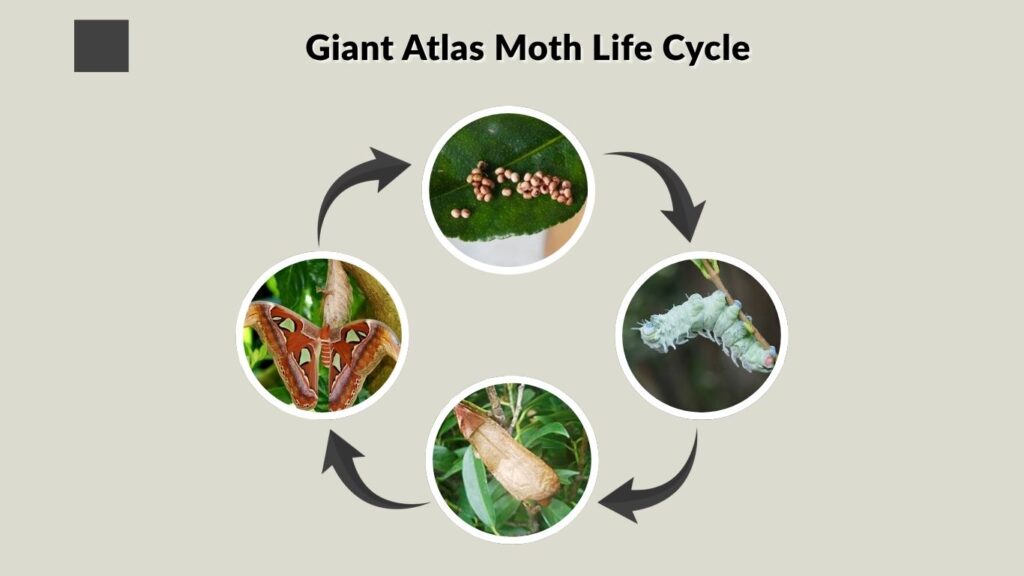
Like other moths, Attacus atlas undergoes complete metamorphosis. Its development contains four main stages: egg, larva, pupa, and adult. Each stage looks completely different from the one before it. Most growth occurs during the caterpillar stage, while dramatic physical transformation happens inside the protective cocoon before the enormous adult moth finally emerges.
Egg Stage
After mating, the female lays numerous eggs on or near suitable host plants. The eggs remain in place while the developing larvae grow inside.
When development is complete, tiny caterpillars emerge and begin feeding almost immediately.
Giant Atlas Moth Caterpillar
The caterpillar is large, pale green or bluish-green, and covered with distinctive fleshy projections. It feeds heavily on leaves and passes through several molts as it grows.
During this period, the larva stores the nutrients that will eventually power its adult life.
Cocoon and Pupal Stage
When the caterpillar reaches maturity, it stops feeding and searches for a suitable place to pupate.
It spins a strong silk cocoon, frequently incorporating or attaching it to leaves. Inside, the caterpillar transforms into a pupa. Major anatomical changes then occur as the adult body develops.
Adult Moth
The adult eventually emerges from its cocoon with folded, soft wings. It pumps fluid through the wings until they expand and harden.
Once ready to fly, the moth begins searching for a mate. Because adults have only limited stored energy, reproduction occurs within a relatively short period.
Giant Atlas Moth Facts
The enormous size of the Atlas moth is only one of its remarkable features. Its specialized adult lifestyle, defensive wing patterns, unusual caterpillar, and short reproductive period make it an excellent example of how dramatically insects can change during metamorphosis.
Interesting Giant Atlas Moth Facts
- The scientific name is Attacus atlas.
- It belongs to the giant silkworm moth family Saturniidae.
- Females are generally larger than males.
- Males have especially large, feathery antennae.
- Its forewing tips resemble snake heads.
- Adults generally survive on energy stored during the caterpillar stage.
- Caterpillars grow several inches long.
- Mature larvae spin large silk cocoons.
- Adult lifespan is usually only around one to two weeks.
- It is among the largest moths in the world by wing surface area.
FAQs
The giant Atlas moth attracts attention because its enormous wings and unusual appearance seem almost unlike those of an ordinary insect. Questions often focus on whether it is dangerous, exactly how large it becomes, how long adults survive, and whether these spectacular moths can be kept or purchased.
Is the giant Atlas moth dangerous?
No. Giant Atlas moths are not considered dangerous to humans. They do not possess a venomous sting, and adults are not aggressive. Their large size and snake-like wing markings can appear intimidating, but these features are primarily associated with appearance and defense against predators.
How large can a giant Atlas moth become?
Atlas moths can reach approximately 9 to 12 inches in wingspan, with females generally growing larger than males. They are especially notable for having an enormous wing surface area, placing them among the world’s largest moth species.
How long does a giant Atlas moth live?
The adult giant Atlas moth typically survives for only about one to two weeks. Because its adult mouthparts are greatly reduced, it depends primarily on energy reserves accumulated during the caterpillar stage. Its brief adult life is focused mainly on mating and reproduction.
Can you keep a giant Atlas moth as a pet?
Atlas moths can be raised by experienced insect keepers where local regulations allow it. Their caterpillars require abundant fresh host-plant leaves, appropriate temperature and humidity, good ventilation, and enough space for pupation and adult wing expansion.
Why doesn’t the giant Atlas moth eat?
Adult Atlas moths have greatly reduced mouthparts and generally do not feed significantly after emerging. Instead, they survive using nutrients and fat accumulated while they were caterpillars. This unusual adaptation means their adult stage is relatively short and strongly focused on reproduction.
