
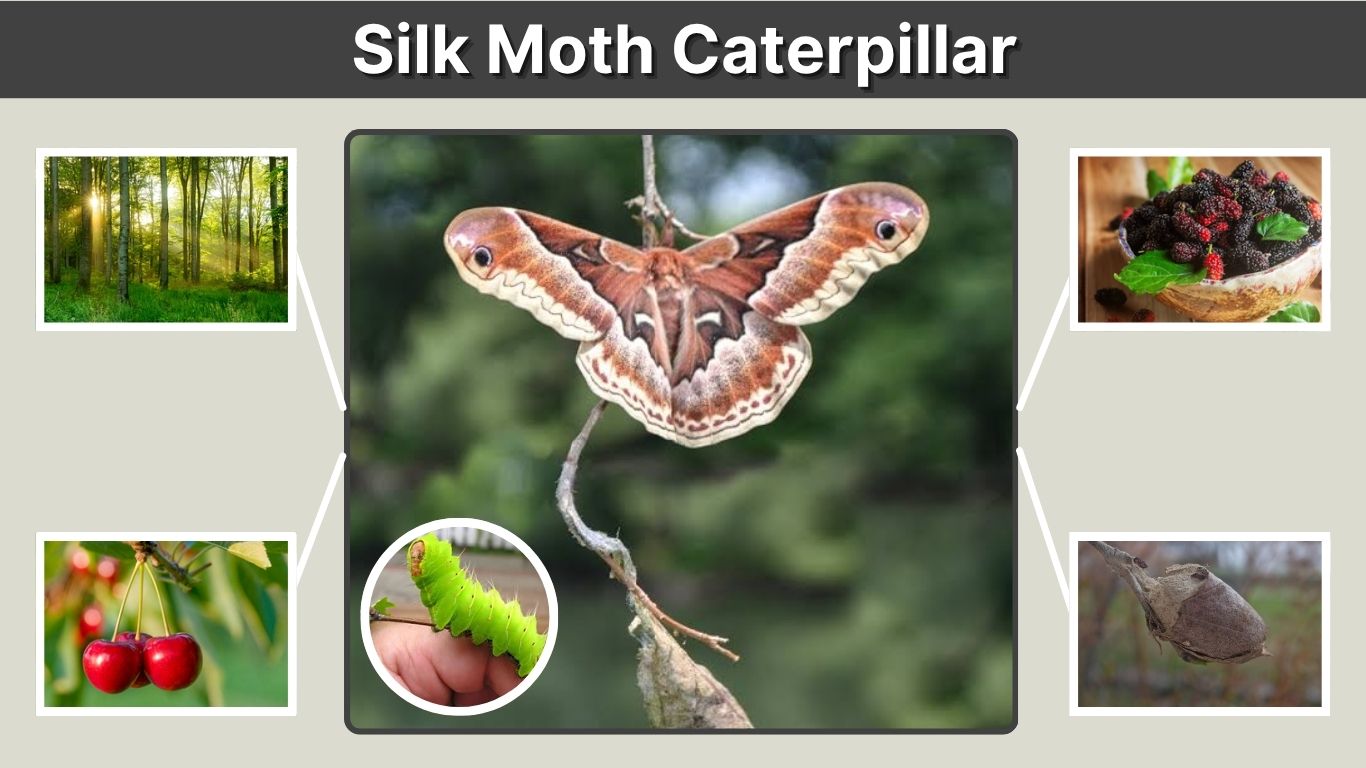
The silk moth caterpillar is the larval stage of several moth species known for producing silk before pupation. Some are smooth and harmless, while others have spines that can irritate or sting the skin. Domestic silkworms mainly feed on mulberry leaves, while giant silk moth caterpillars may eat oak, willow, maple, sassafras, and other host plants. Their appearance varies greatly by species, ranging from plain white larvae to large green caterpillars covered with colorful knobs or spines. This guide covers identification, diet, habitat, cocoons, toxicity, and life cycle.
What Is a Silk Moth Caterpillar?
A silk moth caterpillar is the feeding stage of a moth that later produces silk as it prepares to become a pupa. The term can refer to the domesticated silkworm, Bombyx mori, as well as many wild silk moths. Giant silk moth caterpillars belong mainly to the Saturniidae family and include Cecropia, Polyphemus, Ceanothus, Columbia, and other large species.
Silk Moth Caterpillar Identification
Silk moth caterpillars vary considerably, but common features may include:
- Thick, soft-looking bodies
- Green, white, yellow, or brown coloration
- Knobs, tubercles, or spines
- Large body size in giant species
- Several pairs of fleshy abdominal prolegs
- Strong chewing mouthparts
- A tendency to remain on specific host plants
- Silk production before pupation
Some species are easy to recognize because of their bright colors or unusual projections, while others can resemble unrelated caterpillars.
Domestic Silk Moth Caterpillar
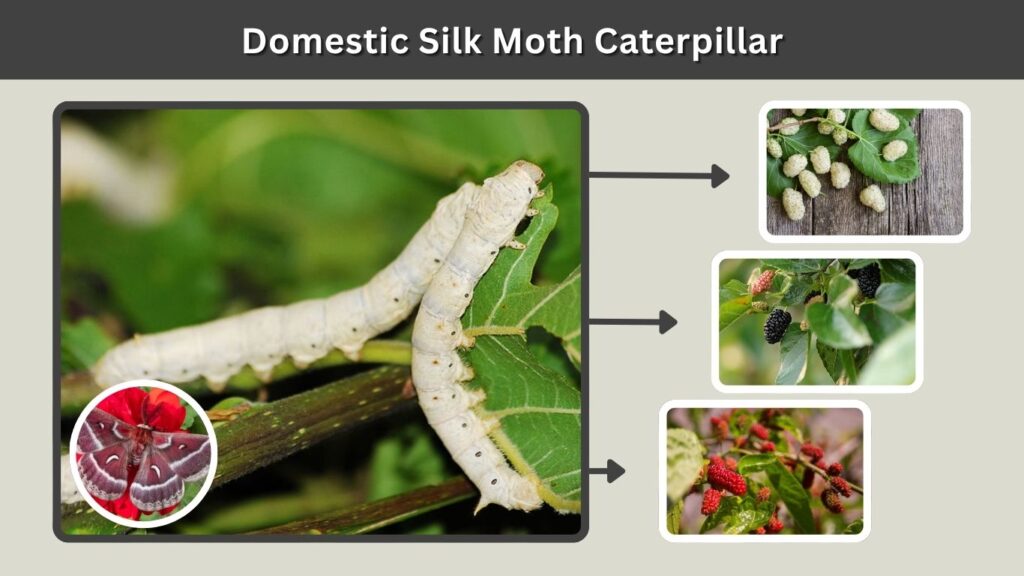
The domestic silk moth caterpillar is commonly called a silkworm. It is one of the best-known silk-producing insects in the world and has been bred by humans for thousands of years.
Unlike many wild caterpillars, domestic silkworms are highly dependent on human care and have a very specialized diet.
What Does a Domestic Silk Moth Caterpillar Look Like?
Domestic silkworm caterpillars are usually pale white or cream-colored with relatively smooth bodies.
They begin life extremely small but increase rapidly in size after repeated feeding and molting. Fully grown larvae are much thicker and longer than newly hatched individuals.
They lack the dramatic spines and brightly colored tubercles seen on some giant silk moth caterpillars.
What Do Domestic Silk Moth Caterpillars Eat?
Domestic silkworms primarily eat mulberry leaves.
Their diet includes:
- White mulberry leaves
- Black mulberry leaves
- Red mulberry leaves
- Specially prepared silkworm diets containing mulberry ingredients
Fresh leaves provide moisture as well as nutrition. Silkworms generally should not be given random tree leaves because they are strongly adapted to mulberry.
Giant Silk Moth Caterpillar
Giant silk moth caterpillars are often among the largest and most impressive caterpillars found on trees and shrubs. Many belong to the family Saturniidae.
Species differ significantly in coloration, body structure, host plants, and defensive features.
Common Giant Silk Moth Caterpillars
Some recognizable examples include:
- Cecropia silk moth caterpillar – Large, green, and covered with colorful tubercles.
- Polyphemus silk moth caterpillar – Thick green body with small reddish or orange markings.
- Ceanothus silk moth caterpillar – Large green larva associated with several woody plants.
- Columbia silk moth caterpillar – Green with prominent body projections.
- Glover’s silk moth caterpillar – Large green caterpillar related to Cecropia moths.
- Hubbard’s silk moth caterpillar – A desert-associated silk moth larva.
- Tussar silk moth caterpillar – A silk-producing caterpillar associated with several Asian host trees.
Not all giant silk moth caterpillars look alike, so location and host plant can help with identification.
What Do Silk Moth Caterpillars Eat?
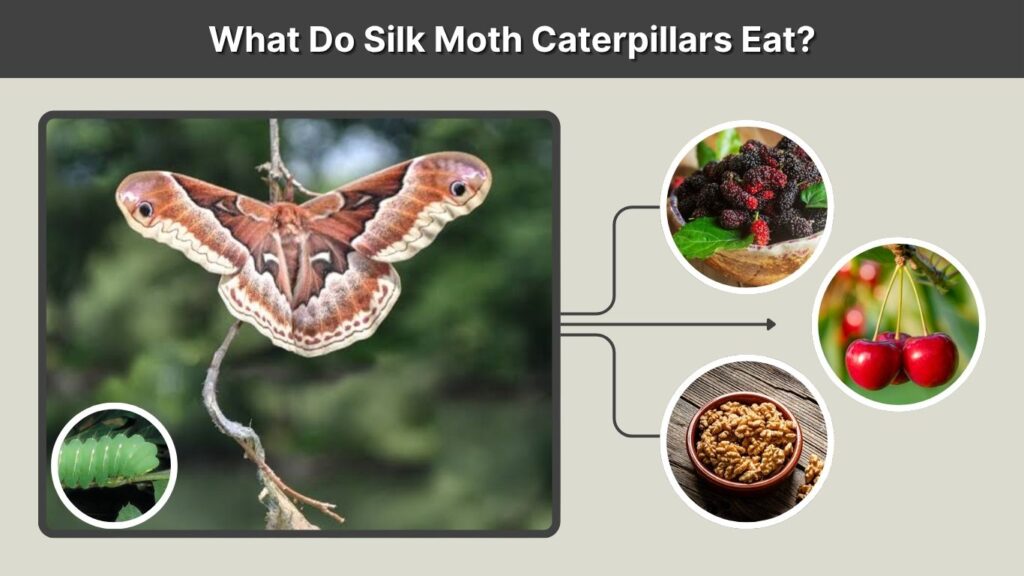
Food depends heavily on species. Domestic silkworms specialize on mulberry, while wild silk moth caterpillars may feed on a wide variety of trees and shrubs.
Many larvae stay on one type of plant once feeding begins.
Common Silk Moth Caterpillar Foods
Depending on the species, host plants may include:
- Mulberry
- Oak
- Willow
- Maple
- Cherry
- Birch
- Walnut
- Poplar
- Sassafras
- Sweetgum
Wild caterpillars should generally be kept on the same host plant on which they were found.
Do Glover’s Silk Moth Caterpillars Eat Willow?
Glover’s silk moth caterpillars may use several woody host plants depending on location and local populations.
Willow, belonging to the genus Salix, may be accepted by some related silk moth caterpillars, but host preferences can vary. A caterpillar already feeding successfully should not be switched unnecessarily to another plant.
Silk Moth Caterpillar Habitat
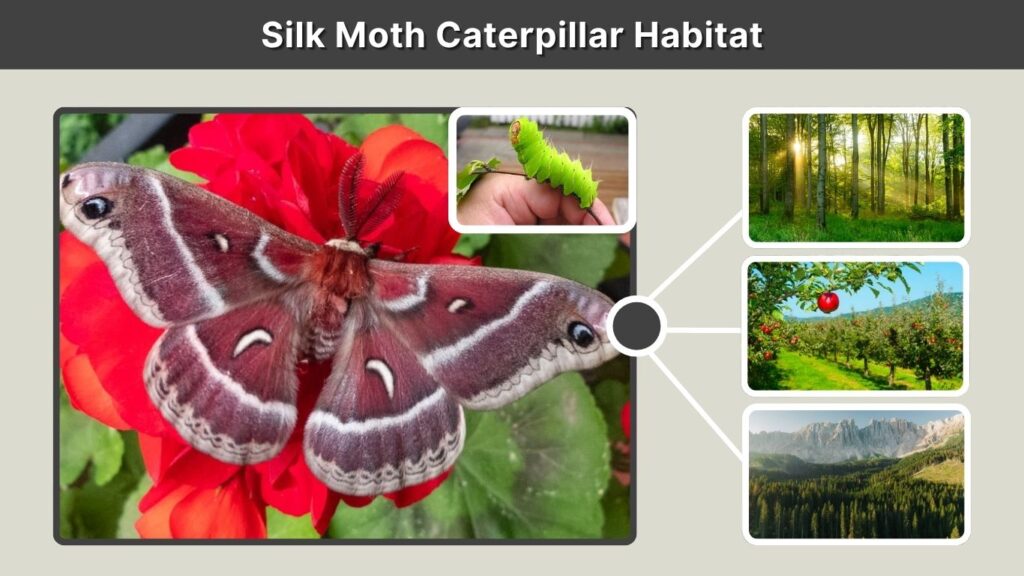
Silk moth caterpillars live wherever suitable host plants are available. Wild species are commonly found in forests, woodland edges, gardens, parks, shrublands, and other vegetated environments.
Their distribution depends strongly on species.
Where Are Silk Moth Caterpillars Found?
Wild silk moth caterpillars may occur in:
- Deciduous forests
- Mixed woodlands
- Gardens
- Orchards
- Shrublands
- River valleys
- Mountain forests
- Suburban landscapes with host trees
Different species occur in North America, South America, Asia, Australia, and other regions.
In North America, giant silk moth caterpillars may be encountered in areas such as Texas, Minnesota, Ontario, and many eastern and central states and provinces.
Are Silk Moth Caterpillars Poisonous?
Some silk moth caterpillars are harmless, while others possess defensive spines capable of causing painful skin reactions.
The word “poisonous” is often used casually, but venomous or stinging is more accurate for caterpillars that inject irritating substances through spines.
Can a Silk Moth Caterpillar Sting?
Yes, certain silk moth caterpillars can sting.
Possible symptoms after touching a stinging species include:
- Burning sensation
- Redness
- Itching
- Localized swelling
- Tenderness
- Small raised bumps
However, many common species, including domestic silkworms and Cecropia caterpillars, are not considered dangerous to handle gently.
Are Giant Silk Moth Caterpillars Poisonous?
Not all giant silk moth caterpillars are poisonous or venomous.
Some Saturniid caterpillars have harmless-looking projections, while others possess true urticating or venomous spines. Because identification can be difficult, brightly colored or heavily spined caterpillars are best observed without touching.
Silk Moth Caterpillar Spikes and Knobs
Many people identify silk moth caterpillars by the bumps, knobs, or spikes on their bodies.
These structures have different purposes depending on the species.
Why Do Silk Moth Caterpillars Have Spikes?
Body projections may:
- Discourage predators
- Help with camouflage
- Make the caterpillar appear larger
- Carry irritating or venomous structures
- Help distinguish one species from another
For example, Cecropia caterpillars have prominent blue, yellow, and reddish tubercles, while other Saturniid caterpillars may have sharper defensive spines.
Silk Moth Caterpillar Cocoon
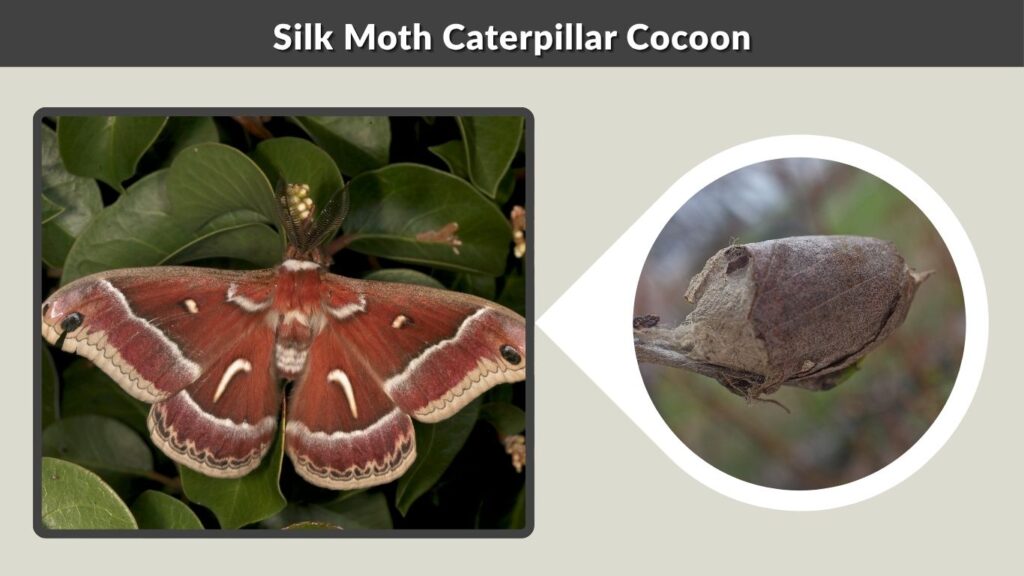
The cocoon is one of the most important stages in the silk moth’s development.
When the caterpillar reaches full size, it stops eating and begins producing silk from specialized glands.
How Does a Silk Moth Caterpillar Make Silk?
Silk is released as a liquid through an organ called a spinneret near the mouth.
The caterpillar moves its head repeatedly and wraps the silk around itself. The silk hardens after exposure to air, eventually forming a protective cocoon.
Domestic silkworm cocoons are especially valued because they can contain long continuous silk fibers.
What Happens Inside the Cocoon?
Inside the cocoon, the caterpillar becomes a pupa.
During this stage, dramatic changes occur as larval structures are reorganized into adult moth structures.
Eventually, the adult silk moth emerges from the cocoon.
Silk Moth Caterpillar Life Cycle
Silk moths undergo complete metamorphosis. Their life cycle includes four separate stages, each with a different purpose.
The caterpillar stage is mainly focused on feeding and growth.
Four Life Cycle Stages
- Egg – A female moth lays eggs on or near suitable host plants.
- Caterpillar – The larva hatches and begins eating.
- Pupa – The mature caterpillar spins a cocoon and transforms.
- Adult moth – The moth emerges, mates, and reproduces.
Depending on species and climate, the entire process may take several weeks or many months.
Green Silk Moth Caterpillar Identification
Many wild silk moth larvae are green, which helps them blend into foliage.
Color alone is not enough for accurate identification because several unrelated species can look similar.
Features to Check
When identifying a green silk moth caterpillar, look at:
- Body size
- Number and arrangement of knobs
- Spine shape
- Side markings
- Color patterns
- Host plant
- Geographic location
Taking note of the plant the caterpillar is feeding on can often narrow down the possibilities considerably.
Silk Moth Caterpillar vs. Luna Moth Caterpillar
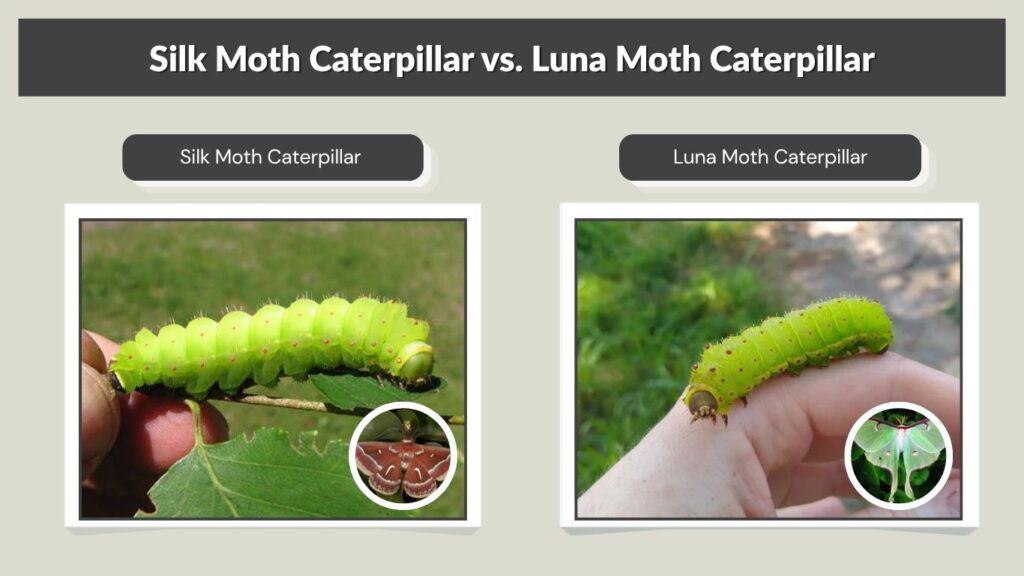
Luna moth caterpillars are themselves a type of giant silk moth caterpillar.
They are green, thick-bodied, and usually have small reddish or orange spots along their sides.
Main Difference
“Silk moth caterpillar” is a broad term covering many species, while a Luna moth caterpillar refers specifically to Actias luna.
Other silk moth caterpillars, such as Cecropia and Polyphemus larvae, may have different markings, host plants, and body structures.
Interesting Silk Moth Caterpillar Facts
Silk moth caterpillars have several unusual characteristics that make them fascinating insects.
Quick Facts
- They produce silk before pupation.
- Domestic silkworms mainly eat mulberry leaves.
- Giant species can grow several inches long.
- Many wild species feed on trees.
- Some caterpillars can sting.
- Others are completely harmless.
- They molt several times while growing.
- Most of their feeding occurs during the larval stage.
- Some species overwinter inside cocoons.
- Adult giant silk moths often do not eat.
FAQs
Are Silk Moth Caterpillars Dangerous?
Most silk moth caterpillars are not dangerous, but some species have venomous or irritating spines. Domestic silkworms are harmless, while certain wild Saturniid caterpillars can cause painful skin reactions. Avoid touching an unidentified spiny caterpillar.
What Does a Silk Moth Caterpillar Eat?
Domestic silkworm caterpillars primarily eat mulberry leaves. Wild silk moth caterpillars may feed on oak, willow, maple, walnut, cherry, sassafras, and other host plants. The correct food depends on the particular moth species.
How Big Do Giant Silk Moth Caterpillars Get?
Large giant silk moth caterpillars can grow several inches long before pupating. Cecropia and Polyphemus caterpillars are particularly large and thick-bodied. Final size depends on species, nutrition, environmental conditions, and developmental stage.
Do Silk Moth Caterpillars Bite?
Silk moth caterpillars are not known for biting humans defensively. Their mouthparts are designed mainly for chewing leaves. The greater concern is contact with species that possess irritating or venomous spines, which can cause a sting-like reaction.
When Does a Silk Moth Caterpillar Make Its Cocoon?
A silk moth caterpillar begins making its cocoon after reaching its final larval stage. It stops feeding, finds a protected location, and produces silk around its body. Inside the completed cocoon, it pupates and eventually transforms into an adult moth.
