
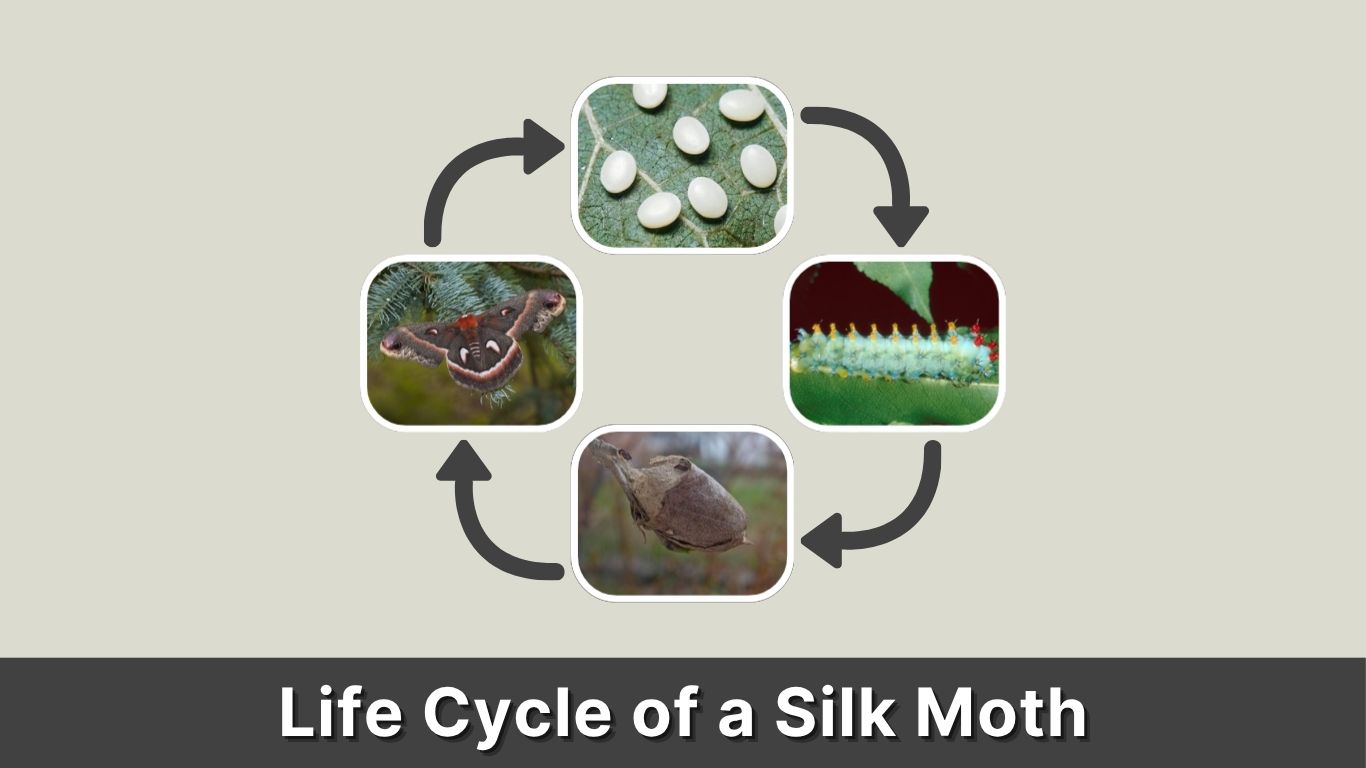
The life cycle of a silk moth is a fascinating example of complete metamorphosis. A silk moth begins life as a tiny egg, develops into a hungry caterpillar, forms a protective cocoon, and finally emerges as an adult moth. Each stage has a specific role in growth and reproduction. The entire silk moth life cycle may last several weeks or months depending on the species, temperature, and environmental conditions. Understanding these stages also explains how silk is naturally produced during the caterpillar-to-pupa transformation.
What Is the Life Cycle of a Silk Moth?
The silk moth life cycle consists of four major stages: egg, larva, pupa, and adult moth. This process is known as complete metamorphosis because the insect changes dramatically between stages. The caterpillar stage is especially important because this is when feeding, growth, and silk production take place before the insect enters its cocoon.
Four Stages of the Silk Moth Life Cycle
The main stages are:
- Egg – The female moth lays eggs.
- Larva or caterpillar – The young silkworm hatches and feeds heavily.
- Pupa inside the cocoon – The caterpillar spins silk and transforms.
- Adult silk moth – The moth emerges, mates, and lays eggs.
These four stages repeat from one generation to the next.
Stage 1: Silk Moth Egg
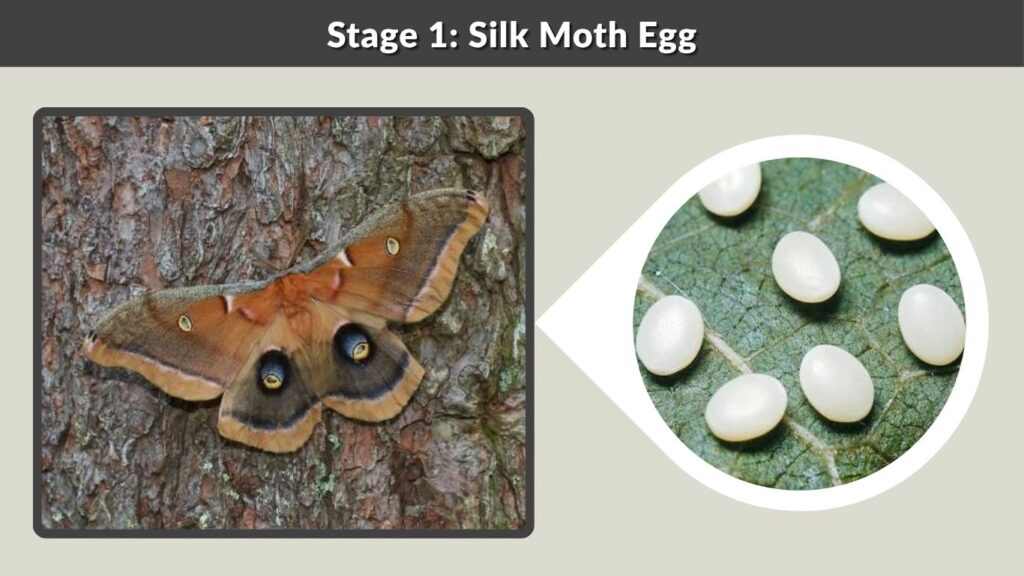
The life of a silk moth begins when an adult female lays eggs. A female domestic silk moth may lay several hundred tiny eggs after mating. The eggs are usually round or oval and initially pale before becoming darker as the developing embryo grows.
How Long Do Silk Moth Eggs Take to Hatch?
Under warm and suitable conditions, silk moth eggs often hatch within about 7 to 14 days. However, development can take longer depending on temperature and species.
Some wild silk moth species produce eggs that remain dormant during unfavorable weather. This period of delayed development allows the next generation to hatch when food plants and temperatures are suitable.
What Happens Inside the Egg?
Inside each egg, a tiny caterpillar develops. Once development is complete, the young larva breaks through the eggshell and emerges.
The newly hatched caterpillar is extremely small but soon begins searching for suitable leaves.
Stage 2: Silk Moth Caterpillar
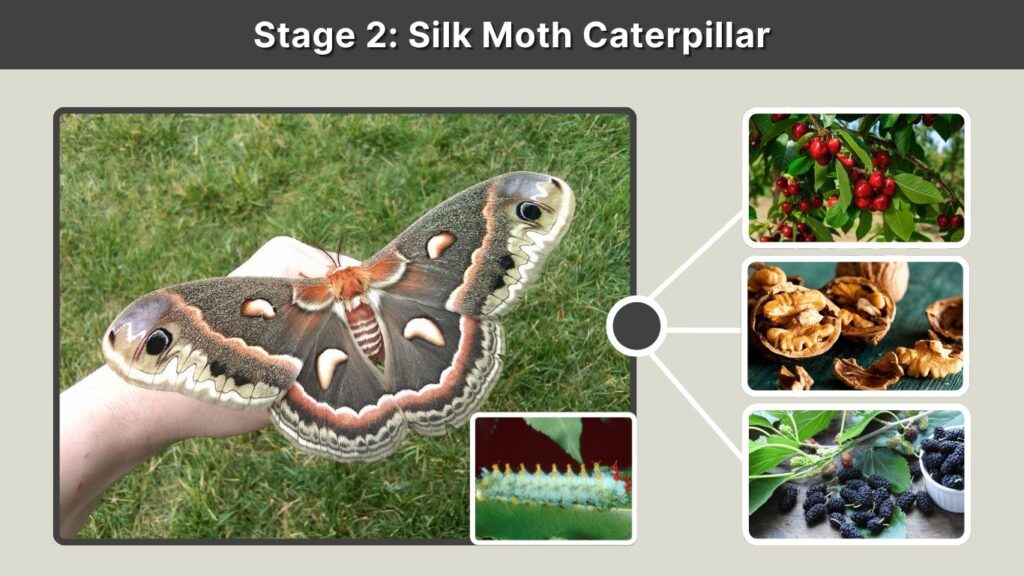
The caterpillar, also called the silkworm, is the main feeding and growing stage of the silk moth life cycle. During this period, the larva spends most of its time eating leaves and increasing rapidly in size.
Domestic silkworms are especially associated with mulberry leaves, while wild silk moth caterpillars may feed on many different trees and shrubs.
What Does a Silk Moth Caterpillar Eat?
Common food plants include:
- Mulberry
- Oak
- Willow
- Maple
- Birch
- Sweetgum
- Cherry
- Sassafras
- Walnut
- Various native shrubs
The exact diet depends on the silk moth species.
How Does the Caterpillar Grow?
A silk moth caterpillar cannot continuously stretch its outer skin. As it gets larger, it must shed its old skin through a process known as molting.
The periods between molts are called instars. Domestic silkworms generally pass through several instars before becoming fully grown.
Throughout this stage, the caterpillar stores nutrients and energy that will later support pupal development and adulthood.
How Long Is the Caterpillar Stage?
The larval stage commonly lasts around 3 to 6 weeks, depending on species, food quality, temperature, and growing conditions.
Near the end of this stage, the caterpillar stops feeding and begins searching for a suitable location to create its cocoon.
Stage 3: Cocoon and Pupa
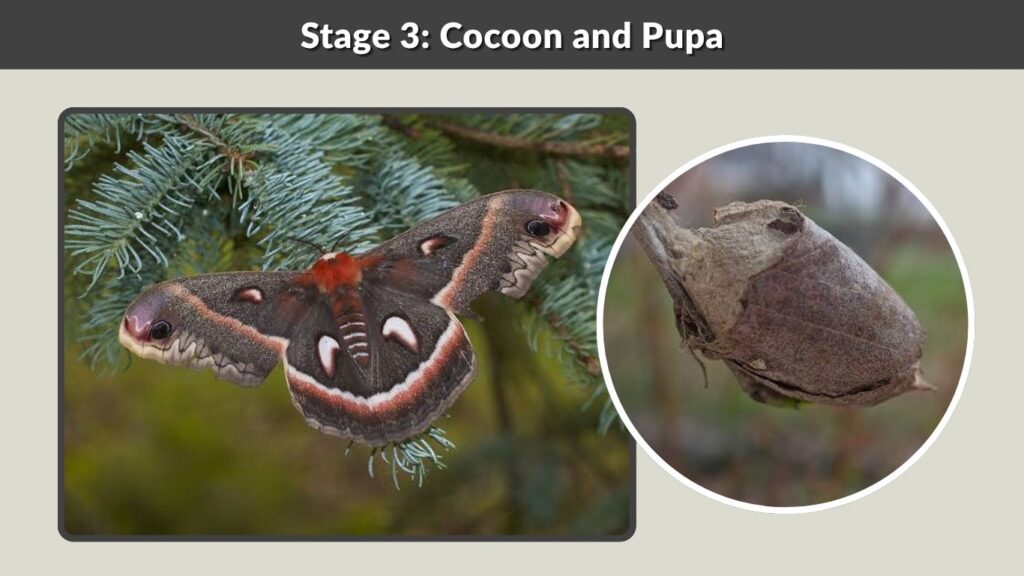
The cocoon stage is one of the most recognizable parts of the life cycle of a silk moth. A mature caterpillar produces silk from specialized glands in its body and gradually wraps itself in a protective covering.
This silk structure protects the insect while it undergoes an extraordinary transformation.
How Does a Silk Moth Make a Cocoon?
The caterpillar releases liquid silk through structures near its mouth called spinnerets. The silk hardens when exposed to air.
The caterpillar repeatedly moves its head while producing a continuous strand of silk around its body. Over time, thousands of movements create a complete cocoon.
Depending on the species, the cocoon may be attached to branches, leaves, vegetation, or other surfaces.
What Happens Inside the Cocoon?
Inside the cocoon, the caterpillar changes into a pupa.
During pupation, the insect’s internal and external structures are reorganized. Caterpillar features gradually disappear while adult structures such as wings, antennae, legs, and reproductive organs develop.
Although the insect appears inactive from outside, major biological changes are taking place inside the cocoon.
How Long Does the Pupal Stage Last?
The pupal stage may last approximately 1 to 3 weeks in domestic silk moths under controlled conditions.
Wild silk moths may remain inside their cocoons for several months, especially when they overwinter as pupae.
Stage 4: Adult Silk Moth
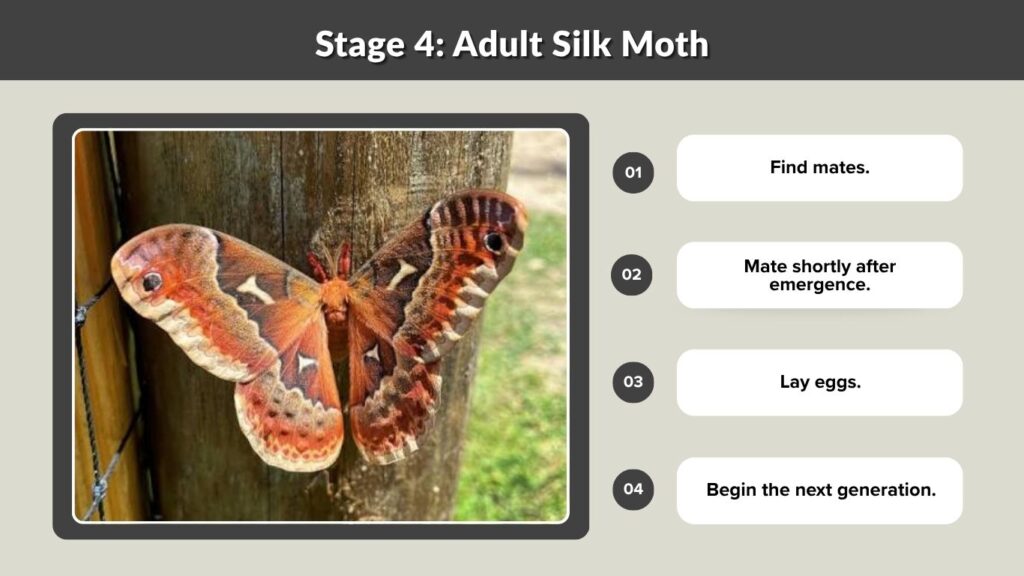
The final stage begins when the fully developed adult moth emerges from the cocoon. At first, its wings are soft and folded. The moth pumps body fluid into the wings, allowing them to expand before they harden.
Adult silk moths are very different from their caterpillar stage.
What Does an Adult Silk Moth Do?
The primary purpose of the adult stage is reproduction.
Adult silk moths generally:
- Find mates.
- Mate shortly after emergence.
- Lay eggs.
- Begin the next generation.
- Live for only a short period.
Domestic silk moths are poor flyers because thousands of years of domestication have greatly changed their natural behavior.
Do Adult Silk Moths Eat?
The domesticated silk moth, Bombyx mori, has reduced mouthparts and does not normally feed during adulthood.
Many giant wild silk moths also have nonfunctional adult mouthparts. They survive using energy stored while they were caterpillars.
This is one reason the adult stage is relatively short.
Silk Moth Life Cycle Diagram
A simple silk moth life cycle diagram can be represented as:
Egg → Caterpillar → Cocoon/Pupa → Adult Moth → Egg
This circular pattern represents the continuous life history of the silk moth.
Easy Life Cycle of Silk Moth Drawing
For a simple school drawing or model, divide a circle into four sections.
Draw:
- Small eggs on a leaf.
- A caterpillar eating leaves.
- A cocoon hanging from a branch.
- An adult moth.
Add arrows between each drawing to demonstrate how one stage develops into the next.
This makes the life cycle easy to understand for students and classroom projects.
How Long Is the Silk Moth Life Cycle?
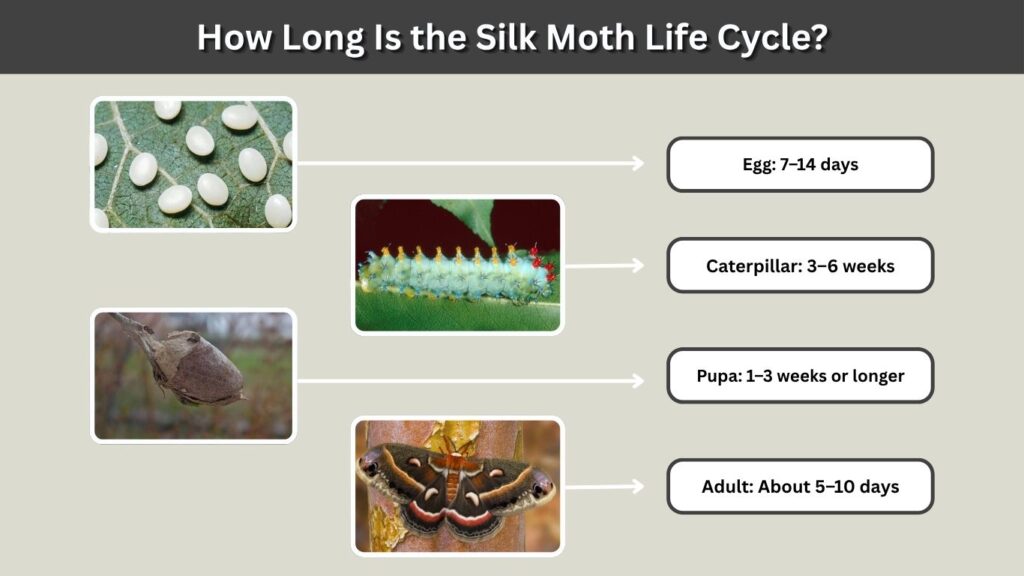
The total length of the silk moth life cycle varies considerably. Domestic silk moths raised under controlled conditions may complete development within roughly 6 to 8 weeks, while wild species may take much longer.
Climate, temperature, food availability, dormancy, and species all influence development.
Approximate Duration of Each Stage
Typical development may look like this:
- Egg: 7–14 days
- Caterpillar: 3–6 weeks
- Pupa: 1–3 weeks or longer
- Adult: About 5–10 days
Wild species that overwinter as pupae can have life cycles lasting many months.
Silk Moth Lifespan
The lifespan of a silk moth should not be confused with its adult lifespan. The adult moth survives for only a small portion of its entire life.
Most of its development occurs as an egg, caterpillar, and pupa.
How Long Do Adult Silk Moths Live?
Adult domestic silk moths commonly live for approximately 5 to 10 days.
During this short period, their main activities are mating and reproduction. Once females lay their eggs, they eventually die, completing the reproductive cycle.
Wild silk moth adults may survive for several days to around two weeks depending on species and environmental conditions.
Domestic vs. Wild Silk Moth Life Cycle
Domestic and wild silk moths share the same basic four-stage life cycle, but their development and behavior can differ significantly.
Domestic Silk Moth
The domestic silk moth, Bombyx mori, has been raised by humans for thousands of years for silk production.
Its caterpillars mainly eat mulberry leaves and are usually kept under carefully controlled conditions. Domestic adults have limited flying ability.
Wild Silk Moths
Wild silk moths include many species from the Saturniidae family.
Their caterpillars may feed on oak, maple, walnut, willow, and numerous other plants. Some species create thick cocoons that remain outdoors throughout winter before adults emerge in spring or summer.
Why Is the Cocoon Important for Silk Production?
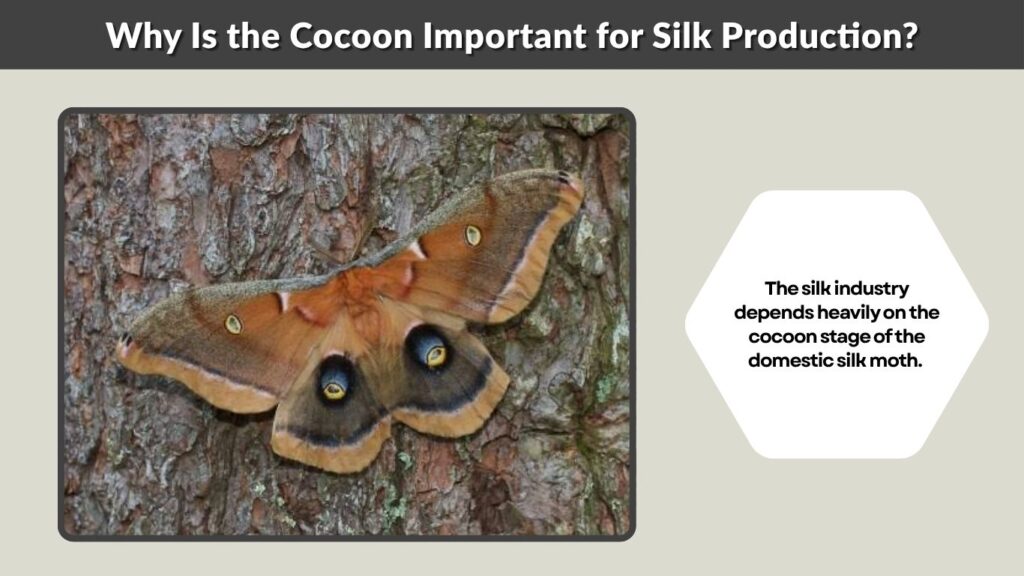
The silk industry depends heavily on the cocoon stage of the domestic silk moth. The caterpillar produces a long continuous silk fiber while constructing its cocoon.
This natural fiber can be carefully processed to produce commercial silk.
How Silk Is Formed
Silk comes primarily from proteins produced inside the caterpillar’s silk glands. The liquid material hardens into strong fibers after leaving the spinnerets.
A single cocoon can contain a remarkably long silk filament. This is one reason domesticated silkworms have been economically important for thousands of years.
Interesting Facts About the Silk Moth Life Cycle
The transformation from egg to moth includes many unusual biological adaptations.
Some interesting facts include:
- Silk moths undergo complete metamorphosis.
- Caterpillars do nearly all of the feeding.
- Domestic silkworms primarily eat mulberry leaves.
- Caterpillars molt several times while growing.
- Silk is produced before the pupal stage.
- Major transformation happens inside the cocoon.
- Adult domestic silk moths usually cannot feed.
- Adult life is mainly devoted to reproduction.
- Some wild silk moth pupae survive through winter.
- A female moth can lay hundreds of eggs.
FAQs
What Are the Four Stages of a Silk Moth?
The four stages of a silk moth are egg, larva or caterpillar, pupa, and adult moth. The caterpillar feeds and grows before producing a silk cocoon. Inside the cocoon it becomes a pupa and eventually transforms into an adult moth that reproduces.
How Long Does a Silk Moth Take to Complete Its Life Cycle?
Domestic silk moths may complete their life cycle in approximately 6 to 8 weeks under suitable conditions. Wild silk moth development may take considerably longer because some species remain in the pupal stage through winter before emerging as adults.
Why Does a Silk Moth Make a Cocoon?
A mature silk moth caterpillar creates a cocoon to protect itself during pupation. Inside the cocoon, the caterpillar undergoes metamorphosis and develops into an adult moth. The cocoon also provides protection from environmental conditions and some predators.
What Is the Lifespan of an Adult Silk Moth?
An adult domestic silk moth usually lives for about 5 to 10 days. Many adults cannot feed because their mouthparts are reduced. They rely on energy stored during the caterpillar stage and spend most of their adult life mating and laying eggs.
What Is the Most Important Stage for Silk Production?
The late caterpillar and cocoon-building stages are the most important for silk production. A mature silkworm produces silk from specialized glands and spins the fiber around itself. These silk fibers form the cocoon that can later be processed for commercial silk.
