
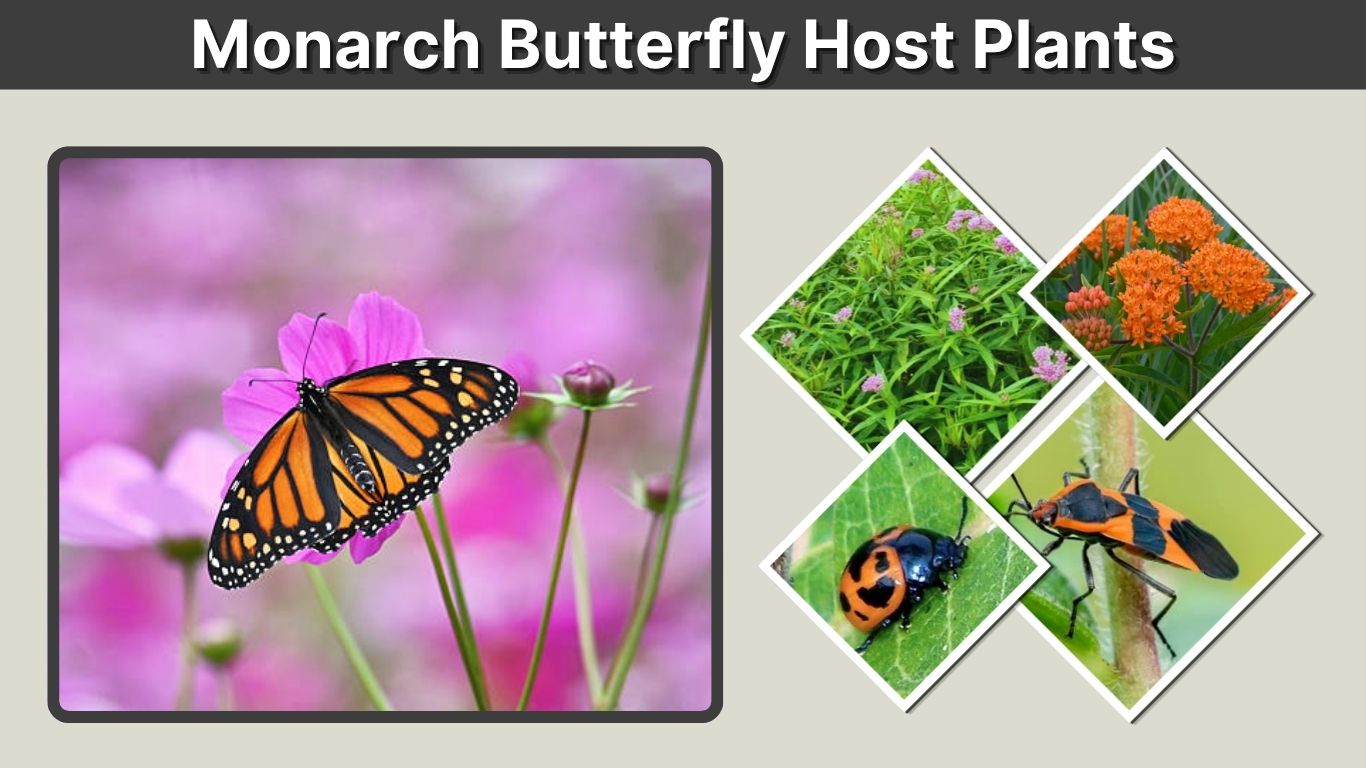
Monarch butterflies depend on milkweed for reproduction and survival. Adult monarchs visit many flowers for nectar, but females lay their eggs only on milkweed and closely related plants that their caterpillars can eat. Without suitable milkweed, monarch caterpillars cannot complete their development. Gardeners can support monarch populations by planting locally native milkweed species, providing nectar flowers throughout the growing season, and avoiding pesticides that may harm eggs, caterpillars, or adult butterflies.
What Is the Host Plant for Monarch Butterflies?
Milkweed is the primary host plant for the monarch butterfly, Danaus plexippus. A host plant is a plant on which a butterfly lays eggs and its caterpillars feed.
Female monarchs inspect milkweed leaves with their antennae and feet before placing small, pale eggs—usually one at a time—on the underside of a leaf. After hatching, the caterpillar consumes its eggshell and begins feeding on the milkweed.
Monarch caterpillars cannot switch to ordinary garden flowers when milkweed is unavailable. Nectar flowers feed adult butterflies, but they do not replace the caterpillar host plant.
Why Do Monarch Caterpillars Need Milkweed?

Milkweed provides both nutrition and protection. Its leaves contain defensive chemicals called cardenolides. Monarch caterpillars can tolerate and store some of these compounds in their bodies.
The stored chemicals make many monarch caterpillars and adults unpleasant or toxic to certain predators. Their bold yellow, black, and white caterpillar stripes and the adult’s orange-and-black wings act as warning colors.
However, milkweed toxicity varies by species. Monarchs use many milkweed types rather than depending on one particular species throughout North America.
Best Host Plants for Monarch Butterflies
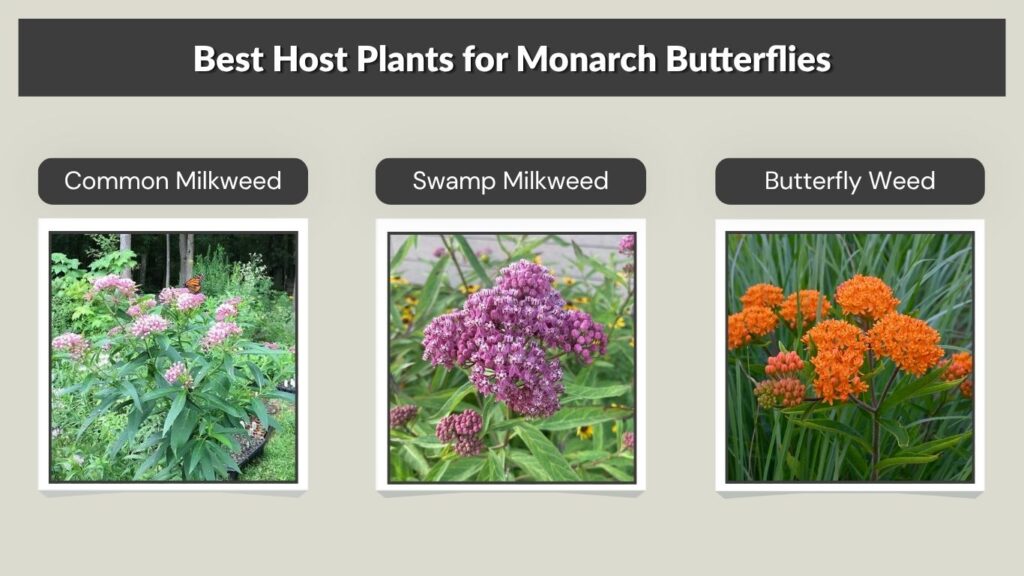
The best milkweed depends on your climate, soil, moisture levels, and location. Native species are usually preferable because they are adapted to local weather and support regional insect communities.
| Milkweed species | Scientific name | Preferred conditions |
| Common milkweed | Asclepias syriaca | Sun and average to moderately dry soil |
| Butterfly weed | Asclepias tuberosa | Full sun and dry, well-drained soil |
| Swamp milkweed | Asclepias incarnata | Sun and moist soil |
| Showy milkweed | Asclepias speciosa | Sun and dry to average soil |
| Whorled milkweed | Asclepias verticillata | Dry, sunny sites |
| Purple milkweed | Asclepias purpurascens | Open woodland and partly shaded edges |
| Antelope-horns milkweed | Asclepias asperula | Dry grasslands and rocky soil |
| Green antelopehorn | Asclepias viridis | Prairies, fields, and roadsides |
Common Milkweed
Common milkweed is an important monarch host across much of eastern and central North America. It produces broad leaves and clusters of fragrant pinkish-purple flowers.
This species spreads through underground rhizomes and may form large colonies. It is best suited to naturalized gardens, meadows, and larger spaces where its spreading habit can be managed.
Swamp Milkweed
Swamp milkweed grows in moist soils near wetlands, pond edges, rain gardens, and drainage areas. It produces narrow leaves and clusters of pink or rose-colored flowers.
Despite its common name, it can grow in ordinary garden soil if it receives consistent moisture. It has a more controlled growth habit than common milkweed, making it suitable for smaller flower beds.
Butterfly Weed
Butterfly weed is a genuine monarch host plant. It belongs to the milkweed genus and has the scientific name Asclepias tuberosa.
Its bright orange flowers provide nectar for adult butterflies, while its leaves support monarch caterpillars. Butterfly weed prefers full sun and dry, well-drained soil. It does not spread as aggressively as common milkweed and is often a good choice for organized garden beds.
Showy Milkweed
Showy milkweed is native to much of western North America. It has broad gray-green leaves and large clusters of pink, star-shaped flowers.
The plant tolerates dry conditions once established and can spread through underground roots. It is a valuable option for western gardens located within its native range.
Antelope-Horns Milkweed
Antelope-horns milkweed includes several dry-climate species with distinctive seedpods that resemble curved horns. These milkweeds are important host plants across parts of the southern and southwestern United States.
They grow best in sunny, open areas with well-drained soil and may struggle in heavily watered garden beds.
Is Tropical Milkweed a Good Host Plant?
Tropical milkweed, Asclepias curassavica, can support monarch eggs and caterpillars. However, it remains green throughout the year in warm climates, unlike native milkweeds that naturally die back during colder seasons.
Year-round tropical milkweed may encourage monarchs to remain and breed instead of continuing their seasonal movements. Persistent foliage may also allow parasites and pathogens to accumulate on plant surfaces.
In regions where tropical milkweed does not naturally die back, gardeners should follow local conservation guidance. Planting native milkweed species adapted to the area is generally the better long-term choice.
Monarch Host Plants vs. Nectar Plants
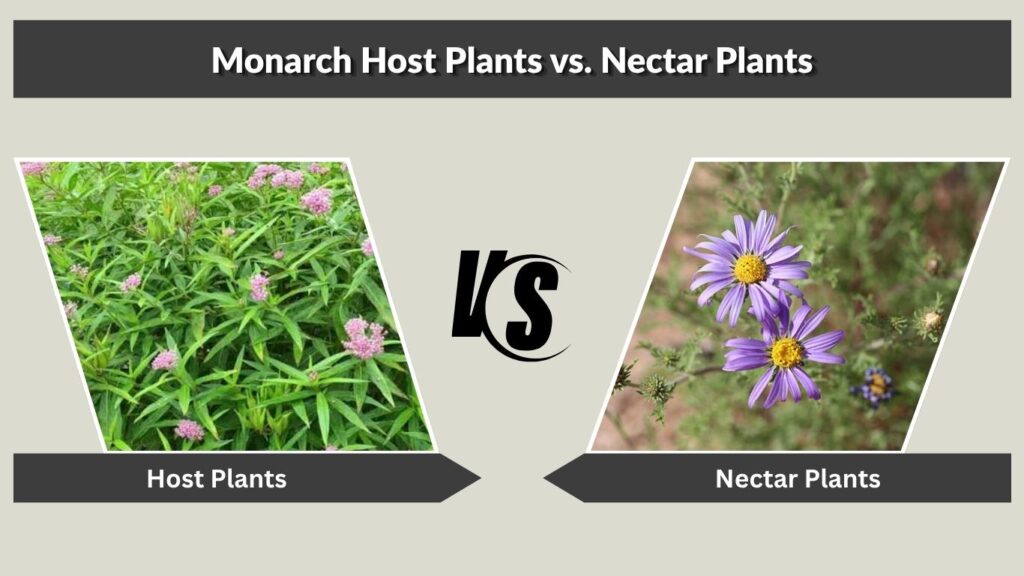
Host plants and nectar plants serve different purposes in a monarch garden.
Host Plants
Host plants support monarch reproduction. Females lay eggs on milkweed, and the caterpillars eat its leaves.
A host planting may become partially defoliated when several caterpillars are present. This is normal. Healthy milkweed can often produce new leaves after being eaten.
Nectar Plants
Nectar plants provide sugary liquid for adult monarchs. Adults need nectar to fly, mate, reproduce, and complete migration.
Useful nectar plants include:
- Native asters
- Goldenrod
- Blazing star
- Purple coneflower
- Joe-Pye weed
- Ironweed
- Bee balm
- Zinnia
- Verbena
- Sunflower
A complete garden should offer milkweed for caterpillars and nectar flowers for adults.
How to Choose Milkweed for Your Region
Avoid choosing milkweed based only on flower color or online availability. A species that performs well in Florida may not survive winters in Minnesota, while a western dryland milkweed may fail in a wet eastern garden.
Consider:
- Native range
- Winter temperature
- Summer heat
- Soil drainage
- Available sunlight
- Natural rainfall
- Mature plant size
- Spreading behavior
Local native-plant nurseries, extension services, botanical gardens, and conservation groups can help identify milkweeds suited to your area.
How to Plant Monarch Butterfly Host Plants
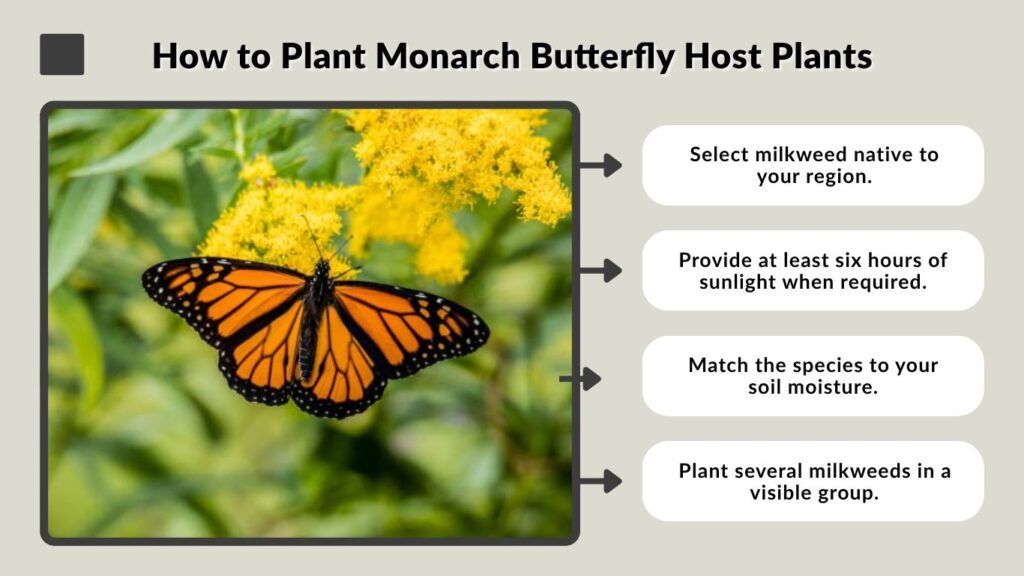
Most milkweeds perform best in sunny locations. Plant several together rather than placing one isolated plant in the garden. A group is easier for female monarchs to locate and provides more leaves for growing caterpillars.
Planting Tips
- Select milkweed native to your region.
- Provide at least six hours of sunlight when required.
- Match the species to your soil moisture.
- Plant several milkweeds in a visible group.
- Include early-, middle-, and late-season nectar flowers.
- Avoid systemic insecticides.
- Expect some leaves to be eaten.
- Leave healthy stems standing until seasonal dieback.
Milkweed seeds from temperate species may need a period of cold, moist conditions before germinating. This process, called cold stratification, imitates winter exposure.
Caring for Milkweed With Monarch Caterpillars
Do not spray a milkweed plant because aphids or other insects appear on it. Broad-spectrum insecticides can kill monarch eggs and caterpillars along with the intended pests.
Small aphid populations usually do not require treatment. When intervention is necessary, remove pests manually or rinse selected areas carefully while checking for monarch eggs and caterpillars first.
Avoid using insecticidal products on flowers visited by adult monarchs. Even products promoted as natural can harm caterpillars or pollinators when used incorrectly.
Other Insects Found on Milkweed
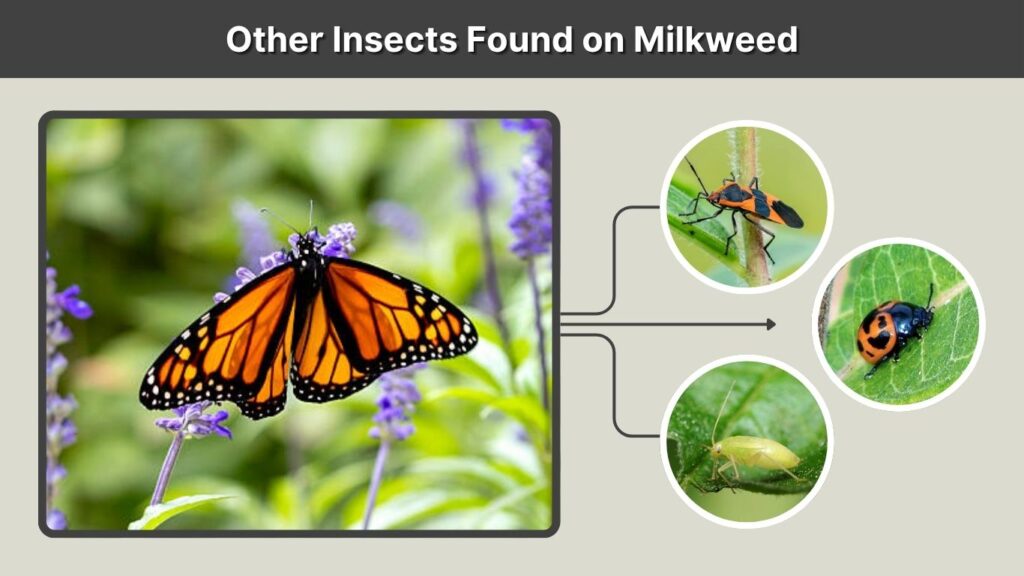
Monarch caterpillars are not the only insects that use milkweed. You may also see:
- Milkweed bugs
- Milkweed beetles
- Aphids
- Bees
- Wasps
- Other butterflies
- Predatory insects
These organisms are part of the milkweed community. Some consume the plant, while others provide pollination or natural pest control. Avoid assuming every insect on milkweed must be removed.
FAQs
What is the main host plant for monarch butterflies?
Milkweed is the essential monarch host plant. Female monarchs lay their eggs on milkweed, and the caterpillars feed on its leaves. Adult monarchs visit many nectar flowers, but those flowers cannot replace milkweed during the caterpillar stage.
Is butterfly weed a monarch host plant?
Yes. Butterfly weed, Asclepias tuberosa, is a milkweed species and an appropriate monarch host plant. Its leaves feed caterpillars, and its orange flowers provide nectar for adult monarchs and other pollinators.
How many milkweed plants should I grow?
A small garden can begin with at least three to six plants, while a larger habitat can include considerably more. Planting several milkweeds together gives females a more visible egg-laying site and provides additional foliage for hungry caterpillars.
Do monarch caterpillars kill milkweed plants?
Caterpillars may remove many leaves, especially when several feed on a small plant. Established milkweed often recovers and produces new growth. Avoid relocating caterpillars simply because the plant looks bare unless they have completely run out of suitable food.
Can adult monarchs survive without milkweed?
Adult monarchs can drink nectar from many flowers and do not eat milkweed leaves. However, monarch populations cannot reproduce without milkweed because it is required by the caterpillars. Both milkweed and nectar plants are necessary for a complete monarch habitat.
